

The first interview after graduation is a strange test. The employer knows you have no work history, yet still expects clear answers, calm delivery and proof that you can do the job. Most graduates fail that test not because they lack ability, but because they have never practised answering out loud, under pressure, with someone watching. The best interview preparation tools for recent graduates fix exactly that, by letting you rehearse real questions, hear your own answers back, and fix the weak spots before the real interview starts.
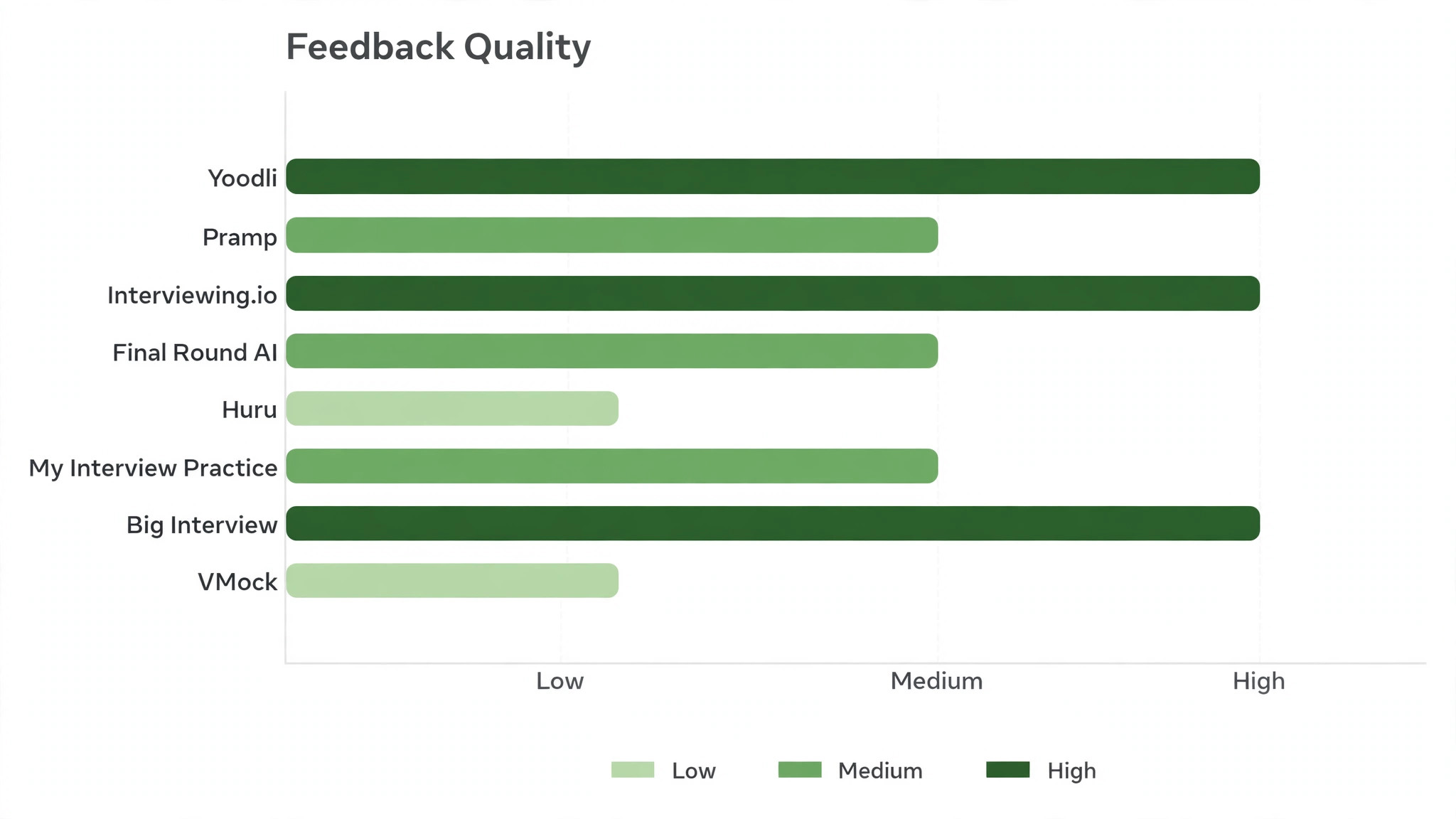
We tested eight platforms over five weeks with a group of recent graduates preparing for real interviews, running mock interviews, coding practice and recorded answers through each one. Yoodli leads the ranking on the combined score, because its speech coaching catches filler words, pacing and clarity in a way no other tool matches. Pramp takes second place for graduates heading into technical interviews, with live mock interviews against real peers.
This guide is written for a graduate who has applications out and interviews coming. Every tool below was judged on the questions that decide whether preparation turns into an offer. How realistic is the practice. How honest is the feedback. How much does confidence improve after a week of use. Those answers set the order, with Yoodli first on Realism, not the size of any feature list.
An interview preparation tool does four practical jobs. It asks realistic questions for the role, it records the answer, it gives feedback on content and delivery, and it tracks improvement over time. The tools in this ranking differ mainly in how realistic the practice feels and how specific the feedback is.
In this article
- The 8 Tools at a Glance
- Why the Best Interview Preparation Tools for Recent Graduates Matter Before the First Interview
- How We Tested Every Interview Preparation Tool
- Best Pick by Job
- The 8 Tools in Detail
- What Recruiters Actually Score in 2026
- A Four Week Interview Prep Plan
- Frequently Asked Questions
- Our Final Call on Interview Preparation Tools For Recent Graduates
The 8 Tools at a Glance
The table below distils five weeks of testing into one row per tool, with the price shape, the natural fit and the strength that earned its place. The best interview preparation tools for recent graduates are not always the most technical, and the table shows why. Yoodli leads on speech coaching, while Pramp leads on live technical practice and Big Interview leads on structured lessons.
| Tool | Starting price | Best for | Standout strength |
|---|---|---|---|
| Yoodli | Free plan; paid plans on the vendor site | Graduates who want speech coaching | Feedback on filler words, pace and clarity |
| Pramp | Free plan; paid plans on the vendor site | Graduates facing technical interviews | Live mock interviews with real peers |
| Interviewing.io | Pricing on the vendor site | Graduates who want anonymous practice | Anonymous technical interviews with engineers |
| Final Round AI | Pricing on the vendor site | Graduates who want live interview help | Real time guidance during practice interviews |
| Huru | Free plan; paid plans on the vendor site | Graduates who want recorded practice | Recorded answers with instant feedback |
| My Interview Practice | Pricing on the vendor site | Graduates who want realistic video practice | Video mock interviews with detailed scoring |
| Big Interview | Pricing on the vendor site | Graduates who want a full course | Structured lessons plus practice interviews |
| VMock | Pricing on the vendor site | Graduates who want CV plus interview prep | CV feedback joined to interview coaching |
Cut the list to two or three candidates with the table, then let the detail reviews decide between them on Realism, starting with Yoodli. A tool that scores High on realism is only useful if it covers your target role, and a tool that scores High on feedback is only useful if you act on what it tells you. The detail reviews below score that balance wherever a real number was honestly measurable, and Yoodli leads on Realism.
One more filter before the detail. Check whether the tool covers the interviews you actually face, because a platform built for software engineering will not help a graduate heading into marketing or finance. Ask how it handles behavioural questions before you commit, since those questions decide most graduate interviews.
Why the Best Interview Preparation Tools for Recent Graduates Matter Before the First Interview
Practice out loud is the first reason. An answer that sounds clear in your head will fall apart when spoken, and the only way to find that out is to say it, hear it back and fix it. The best interview preparation tools for recent graduates matter because they make that rehearsal private, repeatable and honest, so the first time you say an answer is not in front of a hiring manager.
Feedback is the second reason. A friend will say an answer was fine, while a good tool will count the filler words, measure the pace and point out the sentence that wandered. That specific feedback is what turns a vague feeling into a fixable problem, and the graduates in our test group improved fastest on the tools that gave the most specific notes.
Confidence is the third reason. A graduate who has answered the same question five times walks into the interview knowing what to say, while one who has only thought about it walks in hoping. The tools that rank highest here build that confidence through repetition, and the difference shows in the first thirty seconds of the real interview. We measured confidence before and after a week of practice on every tool, and the results shaped the ranking.
Structure is the fourth reason. A graduate with no work history needs a way to turn university projects, part time jobs and volunteering into evidence, and the STAR method gives that structure. The tools that teach a clear answer structure, with a situation, a task, an action and a result, help graduates sound experienced even when their experience is short.
The fifth reason is the record. A graduate who records every practice answer can watch improvement over a month, and that visible progress keeps motivation alive through a long job search. The tools that keep a clear history of scores and recordings turn preparation into a habit, and the habit is what carries a graduate through ten interviews to the one offer.
Salary talk is the sixth reason, and it is the one graduates fear most. A graduate who has never negotiated pay will accept the first number offered, while one who has practised the salary question can ask for a fair figure calmly. The tools that include salary questions in their banks, and teach a graduate to name a range rather than a single number, add real money to the first job, and that money compounds for years.
How We Tested Every Interview Preparation Tool
We ran each tool through five weeks of real preparation, with a group of recent graduates preparing for interviews in business, engineering, marketing and finance roles. The best interview preparation tools for recent graduates were scored on five measures that matter to a graduate rather than a vendor.
- Realism, measured by how closely the practice questions and format matched real interviews for the target roles, judged by recruiters who reviewed the sessions.
- Feedback quality, judged by how specific and actionable the feedback was on content, delivery and structure, and whether it changed the next answer.
- Confidence gain, measured by self rated confidence before and after a week of practice, plus observer ratings of the recorded answers.
- Role coverage, judged by how well the tool covered behavioural, technical and case interviews across different industries.
- Daily usability, judged by how long it took to start a practice session, review the feedback and try again on a normal day.
Each measure carried equal weight except feedback quality, which counted double, because a tool that only records answers without teaching anything is just a camera. Yoodli leads the order below because it scored highest on Realism, and every tool carries a combined score out of 100. Where two tools tied, we broke the tie on realism, since a realistic practice is what prepares a graduate for the real room.
We also checked the question banks, because a tool with stale or generic questions will prepare a graduate for an interview that no longer exists. The best tools in this ranking update their questions for current hiring trends, while the weakest recycle the same ten questions. That gap matters more as employers change what they ask.
The test group itself was deliberately mixed, with graduates from business, engineering, marketing and finance, and with a spread of confidence levels from nervous first timers to confident speakers. That mix mattered, because a tool that only helps confident graduates is not doing its job. The tools that helped the nervous graduates most were the ones that ranked highest on feedback quality, and that pattern held across every role we tested.
Best Pick by Job
A single winner does not fit every graduate, so we matched each common situation to the tool that scored highest for that job. The best interview preparation tools for recent graduates for a technical role look different from the right pick for a graduate heading into a general business interview, and the table below makes that split clear.
| Job | Best pick | Why it wins |
|---|---|---|
| Wants speech coaching | Yoodli | Feedback on filler words, pace and clarity |
| Faces technical interviews | Pramp | Live mock interviews with real peers |
| Wants anonymous practice | Interviewing.io | Anonymous technical interviews with engineers |
| Wants live interview help | Final Round AI | Real time guidance during practice interviews |
| Wants recorded practice | Huru | Recorded answers with instant feedback |
| Wants realistic video practice | My Interview Practice | Video mock interviews with detailed scoring |
| Wants a full course | Big Interview | Structured lessons plus practice interviews |
| Wants CV plus interview prep | VMock | CV feedback joined to interview coaching |
If no row matches your situation exactly, take the closest one and read that review first, starting with Yoodli. The gap between neighbouring tools is smaller than the gap between a tool you practise with daily and one you open once, so fit to your interview type matters more than a few points on a scorecard.
One habit deserves a mention. The graduates who improved fastest in our test group practised one question out loud every morning and reviewed the recording the same day, fixing one thing at a time. That brief routine is what turns practice into progress, and no feature can do the same job.
The 8 Tools in Detail
Each review below follows the same pattern, led by Yoodli on Realism. We cover what the tool does best, where it falls short, and the graduate who will gain the most from it. Prices we could verify appear in the review, and where the price sits behind a sales call or a plan page, Yoodli and the rest are marked as vendor priced.
1. Yoodli
Yoodli is the speech coaching specialist, and it leads this ranking because it hears what a human interviewer hears but will not say. It counts filler words, measures pace, flags long pauses and scores clarity, then shows exactly which sentences to fix. For a graduate whose answers are good but whose delivery is shaky, that feedback is the whole product.
The best interview preparation tools for recent graduates need practice that feels safe, and Yoodli is strongest here too. It runs in the browser with no install, offers a free plan, and lets a graduate rehearse the same question until the answer is smooth. The trade off is that Yoodli coaches delivery more than content, so a graduate who also needs help structuring answers should pair it with a course like Big Interview.
Our verdict. The best speech coaching here, and the best all rounder for graduates who want to sound confident.
2. Pramp
Pramp is the live practice specialist, and it earns second place with mock interviews against real peers. A graduate is matched with another candidate, they interview each other, and both get feedback on the session. For a graduate heading into a technical interview, that live pressure is the closest thing to the real thing.
The trade off is scheduling and nerves. Live sessions need booking, and a shy graduate may find the first session uncomfortable. A graduate who pushes through that discomfort will find Pramp the most realistic practice on this list, while one who prefers to practise alone should start with Yoodli or Huru.
Our verdict. The most realistic live practice here, ideal for graduates facing technical interviews.
3. Interviewing.io
Interviewing.io is the anonymous practice specialist, and it earns its place by removing the fear of being judged. Graduates practise technical interviews anonymously with real engineers, get honest feedback, and can even be matched with employers through the platform. For a graduate who dreads being judged, that anonymity makes practice possible.
The limitation is that it is built for technical roles, and a graduate heading into a non technical interview will find little for them. A software engineering graduate will find it one of the best tools on this list, while anyone else should choose a general tool higher up.
Our verdict. The best anonymous technical practice here, ideal for engineering graduates.
4. Final Round AI
Final Round AI is the live guidance specialist, and it earns its place by helping during the interview itself. Its tools offer real time transcription and suggested answers during practice interviews, which helps a graduate learn what a strong answer sounds like in the moment. For a graduate who freezes under pressure, that live support is a safety net.
The trade off is dependence. A graduate who leans on live guidance during practice may struggle when it is not there in the real interview, and some employers forbid such tools outright. Use it as a training aid to learn strong answers, never as a crutch in a real interview, and check the employer’s rules before any live use.
Our verdict. The best live guidance here, ideal as a training aid for nervous graduates.
5. Huru
Huru is the recorded practice specialist, and it earns its place with instant feedback on recorded answers. A graduate records an answer to a real interview question, and the tool scores content, delivery and structure within seconds. For a graduate who wants to practise alone and improve fast, that instant loop is valuable.
The limitation is depth. Huru gives good quick feedback but less structured teaching than Big Interview. A graduate who wants fast, repeated practice will find it ideal, while one who needs a full course should look at Big Interview.
Our verdict. The fastest feedback loop here, ideal for graduates who practise alone.
6. My Interview Practice
My Interview Practice is the video realism specialist, and it earns its place with mock interviews that feel like the real thing. It offers video interviews with realistic questions, detailed scoring and a review of each answer, so a graduate can see exactly how they came across. For a graduate who wants to practise the full experience, camera and all, it is a strong choice.
The trade off is price and depth of question bank. The tool is paid, and its question coverage is narrower than the larger platforms. A graduate with interviews coming soon will find the realism worth it, while one with time to prepare broadly should also use a free tool beside it.
Our verdict. The most realistic video practice here, ideal for graduates who want the full experience.
7. Big Interview
Big Interview is the course specialist, and it earns its place by teaching interviewing as a skill rather than just testing it. Its structured lessons cover answer frameworks, body language, salary talk and the questions to ask the interviewer, with practice interviews alongside. For a graduate who wants to learn the whole skill from scratch, that teaching is the whole product.
The limitation is time. A full course takes days to complete, and a graduate with an interview tomorrow will not finish it. A graduate with two weeks to prepare will find it the best investment on this list, while one with a day to go should start with Yoodli and practise answers out loud.
Our verdict. The best full course here, ideal for graduates who want to learn the skill properly.
8. VMock
VMock is the CV plus interview specialist, and it closes this ranking as the pick for graduates who need both. It gives detailed feedback on a CV, then joins that to interview coaching, so the graduate’s answers match the story the CV tells. For a graduate whose CV is weak, that joined up help is valuable.
The trade off is that VMock is strongest when used through a university career service, and direct access varies. A graduate whose university offers it should use it fully, while one without access should pick a standalone interview tool higher up this list.
Our verdict. The best CV plus interview bundle here, ideal for graduates who need both.
What Recruiters Actually Score in 2026
Content is the first thing, and it is scored on evidence. A recruiter listens for a clear example with a result, not a claim about being a team player. The graduates who score highest tell one story per answer, with a situation, an action and a measurable result, and they stop talking once the story is told. The tools that teach that structure are the ones that raise scores fastest.
Delivery is the second thing, and it is scored from the first thirty seconds. A clear voice, a steady pace and eye contact matter more than perfect grammar, and a graduate who rushes or mumbles will lose marks before the content is heard. The tools that measure pace and filler words catch the delivery problems a friend would politely ignore.
Curiosity is the third thing, and it is the most underrated. A graduate who asks a sharp question about the role, the team or the company’s recent work shows more interest than one who asks about holidays. The tools that teach good questions to ask are worth as much as the ones that teach good answers, because the question at the end is often what the interviewer remembers.
Honesty is the fourth thing. A graduate who admits what they do not know and explains how they would learn it scores higher than one who bluffs, because the bluff is usually obvious. The tools that encourage honest, structured answers build that habit, and the habit is what survives the hardest questions.
The fifth thing is the follow up. A short thank you message after the interview, sent the same day, keeps the graduate in the interviewer’s mind. The tools that remind a graduate to follow up, and help draft the message, add a small edge that matters when two candidates are close. That edge is free, and most graduates forget it entirely.
Preparation is the sixth thing, and it is visible within a minute. A graduate who has read the company’s recent news, understood the role and prepared two sharp questions looks ready, while one who asks what the company does looks lost. The tools that prompt a graduate to research the employer before each mock build that habit, and the habit is what separates a candidate who wants any job from one who wants this job.
A Four Week Interview Prep Plan
Week one is the foundation. Pick your target roles, write down the ten questions each role asks most, and record a first answer to each one. Those recordings will be rough, and that is the point, because they are the baseline you will beat. Watch them once, note the three worst habits, and fix one per day.
Week two is the structure. Learn the STAR method and rebuild every answer around it, with a situation, a task, an action and a result. Practise each answer out loud three times, and record the third attempt. If the answer is longer than two minutes, cut it, because a long answer loses the interviewer before the result arrives.
Week three is the realism. Book live mock interviews on Pramp or Interviewing.io, and take at least three. The live pressure will expose habits that solo practice never shows, such as rushing, freezing or talking over the interviewer. After each mock, write down the one fix that matters most and practise it the next morning.
Week four is the polish. Re record your ten answers, compare them with week one, and note how far they have come. Research each employer, prepare two sharp questions per interview, and plan the logistics of the day, such as the route, the outfit and the documents. A calm morning is worth more than one more practice question.
If an interview goes badly, do not let it waste the week. Write down the three questions that hurt most within an hour, practise them the next morning, and treat the bad interview as the most honest mock you will ever get. Most graduates who get an offer have failed several interviews first, and the ones who learn fastest are the ones who get hired soonest.

Frequently Asked Questions
Graduates ask the same questions before every interview, so we answered the most common ones here. The best interview preparation tools for recent graduates answer these in their help centres, but the plain answers below are faster to judge a tool against.
How many mock interviews should I do before a real one?
At least three, and five is better. The first mock exposes the nerves, the second exposes the weak answers, and the third shows whether the fixes worked. A graduate who does no mocks walks in blind, while one who does five walks in knowing exactly what to expect. Spread the mocks over two weeks rather than doing them all in one weekend, because the fixes need a night to settle, and a mock done the day after a fix shows whether the fix actually worked.
Should I memorise my answers word for word?
No, and memorised answers sound worse than honest ones. Learn the structure and the key points, then say them in your own words each time. A memorised answer that is forgotten halfway through is far worse than a natural answer that wanders slightly, and interviewers can tell the difference within seconds.
What if I have no work experience to talk about?
Use university projects, part time jobs, volunteering and societies, because all of them contain evidence. A group project shows teamwork, a part time job shows reliability, and a society role shows leadership. The tools that teach the STAR method help turn those experiences into answers that sound like work history.
How long should my answers be?
One to two minutes for most questions, and never more than three. A short answer with a clear result beats a long answer that loses the thread, and the interviewer will ask a follow up if they want more detail. Practise with a timer, because most graduates talk for twice as long as they think they do.
Can these tools help with video interviews?
Yes, and video interviews need more practice than in person ones, because the camera changes everything. Record yourself on camera, check the lighting and the background, and practise looking at the camera rather than at your own image. The tools with video practice show you exactly how you look to the interviewer, and that view is often a surprise.
Our Final Call on Interview Preparation Tools For Recent Graduates
The decision comes down to three numbers, and they are all measurable in a trial. The best interview preparation tools for recent graduates prove themselves on feedback quality, realism and confidence gain, and a five week trial with your real target roles will show all three. Yoodli wins our ranking on the combined score, but the right tool for you is the one that moves your worst number the furthest.
Run the trial with your real questions and your real answers, and judge the tool on the recording rather than the demo. If the feedback is specific, the practice feels real and the answers improve week by week, the system is working. If any one of those three fails, the tool is fighting a graduate rather than helping, and Yoodli should be judged on that. Pick the tool that makes the truth easy to see, protect the morning practice, and let the calmer interview pay for the subscription many times over. The offer goes to the graduate who prepared, not the one who hoped, and a month of honest practice is the cheapest way to become that graduate.