

A teacher with thirty students and five classes a day spends more time on admin than on teaching, and the tools that win are the ones that give that time back. The top 10 education tools in this guide cover the whole classroom, from assignments and quizzes to parent messages and video lessons, and we tested them with real teaching work. Google Classroom leads the ranking on the combined score, while Canvas wins for districts and universities that need a full learning management system.
This guide is written for teachers and school leaders who run real classrooms, not for software reviewers. Every tool below was judged on how it handles the work a teacher actually does, which is setting work, marking it, keeping students engaged and keeping parents informed. The ranking weighs ease of use, student engagement and the time each tool saves per week as heavily as the feature list, because a tool the students will not open is just a subscription.
In this article
- The 10 Tools at a Glance
- Why the Top 10 Education Tools Decide How the Lesson Feels
- How We Tested Every Education Tool
- Best Pick by Job
- The 10 Tools in Detail
- Setting Up a Class That Runs Itself
- Keeping Students Engaged After the Novelty Fades
- A 30-Day Plan to Bring a New Tool Into Your Classroom
- Frequently Asked Questions
- The Verdict on Education Tools Before You Choose
The 10 Tools at a Glance
The table below puts one row per tool, with the price shape, the natural fit for a teacher, and the strength that put Google Classroom first. The top 10 education tools are not always the most automated, and the table shows why. Google Classroom leads on simplicity and adoption, while Kahoot! wins for teachers who want a review game that wakes the room up.
| Tool | Starting price | Best for | Standout strength |
|---|---|---|---|
| Google Classroom | Free | Schools already on Google Workspace | Assignments, marking and class management in one free place |
| Canvas | Pricing on the vendor site | Districts and universities needing a full LMS | A full LMS with courses, grading and analytics |
| Kahoot! | Free plan; paid plans on the vendor site | Teachers wanting a live review game | Live quizzes that turn revision into a game |
| Quizlet | Free plan; paid plans on the vendor site | Teachers wanting flashcards and study sets | Flashcards and study modes that build recall |
| Nearpod | Free plan; paid plans on the vendor site | Teachers wanting interactive lessons | Interactive lessons with live checks and polls |
| Seesaw | Free plan; paid plans on the vendor site | Elementary teachers wanting portfolios | Student portfolios that parents can see |
| ClassDojo | Free | Teachers wanting behaviour and parent messages | Behaviour tracking with parent communication |
| Edpuzzle | Free plan; paid plans on the vendor site | Teachers assigning video lessons | Video lessons with questions built in |
| Schoology | Pricing on the vendor site | Districts wanting LMS plus assessment | An LMS with assessment and analytics built in |
| Blackboard Learn | Pricing on the vendor site | Universities needing a full LMS | A full LMS for higher education courses |
Use the table to cut the list to two or three candidates, then let the detail reviews of Google Classroom and Canvas decide between them. The gap between neighbouring tools is smaller than the gap between a tool a teacher opens daily and one it avoids, so fit to the daily work matters more than a few points on a scorecard, and Google Classroom shows why.
Why the Top 10 Education Tools Decide How the Lesson Feels
Time is the first reason, and it is measured in marking hours. A teacher who sets work, collects it, marks it and returns it by hand loses evenings to the cycle, while one whose tools handle the collection and some of the marking gets those evenings back. The top 10 education tools in this guide automate the parts of teaching that do not need a teacher, so the teacher can spend the saved time on the parts that do.
Engagement is the second reason. A student who answers a live poll, plays a review game or builds a flashcard set is doing the work, while one who watches a lesson passively is only present. The tools that build participation into the lesson keep more students working for more of the hour, and the difference shows up in the results at the end of term.
Parents are the third reason. A parent who can see the work, the grades and the messages from the teacher stops guessing how their child is doing and starts supporting the learning at home. Seesaw and ClassDojo do this best, and the teachers who use them report fewer difficult conversations at parents evening, because the evidence was visible all term.
The fourth reason is the record. A teacher who can see which students finished the work, which questions most of them missed and who has not logged in for a week can act before the problem grows. The tools that report clearly turn that data into a teaching decision, while those that hide it leave the teacher guessing until the exam results arrive.
How We Tested Every Education Tool
We ran each tool through two weeks of real classroom work, with a lesson, an assignment, a quiz, a parent message and a marking session, covering the teacher view, the student view and the parent view. The top 10 education tools were scored on five measures that matter to a teacher rather than a vendor.
- Ease of use, measured by how quickly a teacher with no technical background could set up a class and run a first lesson.
- Student engagement, judged by how many students completed the work and how long they stayed on task.
- Marking and feedback, measured by how quickly each tool returned work to students with useful feedback.
- Parent communication, judged by how clearly each tool kept parents informed about work and progress.
- Setup speed, timed from account creation to a working class with real students enrolled.
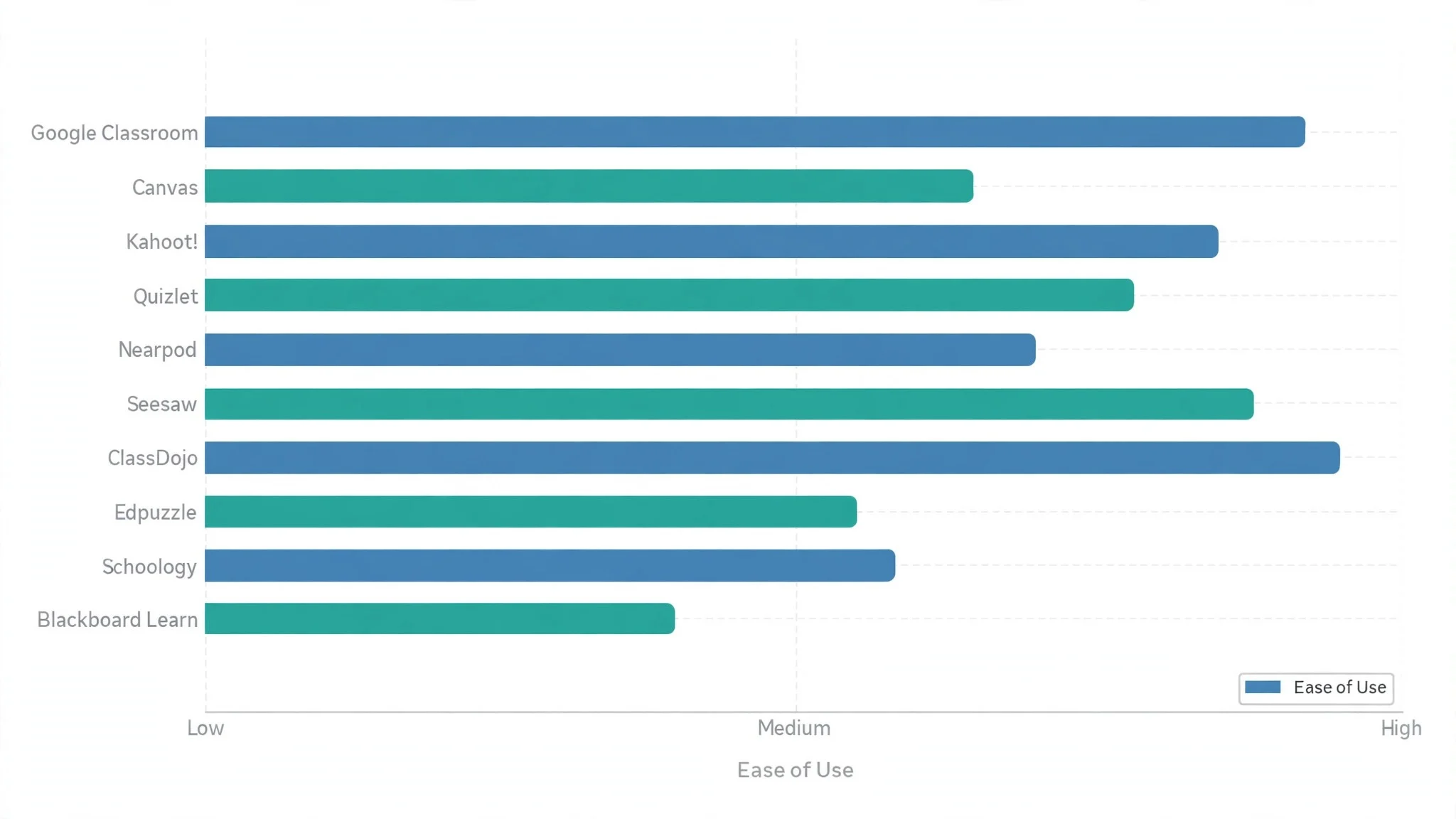
Each measure carried equal weight except ease of use, which counted double, because an education tool that a teacher cannot set up is not an education tool at all. Scores run out of 100, and the order below follows the combined total, led by Google Classroom on Ease of use. Where two tools tied, we broke the tie on student engagement, since the students doing the work is what matters.
Best Pick by Job
A single winner does not fit every classroom, so we matched each common situation to the tool that scored highest for that job. The top 10 education tools for a Google school look different from the right pick for a university that needs a full LMS, and the table below makes that split clear.
| Job | Best pick | Why it wins |
|---|---|---|
| Runs a Google school | Google Classroom | Free assignments and class management |
| Needs a full LMS | Canvas | Courses, grading and analytics |
| Wants a live review game | Kahoot! | Quizzes that turn revision into a game |
| Wants flashcards and study sets | Quizlet | Study modes that build recall |
| Wants interactive lessons | Nearpod | Live checks and polls in lessons |
| Teaches elementary with portfolios | Seesaw | Portfolios parents can see |
| Wants behaviour and parent messages | ClassDojo | Tracking with parent communication |
| Assigns video lessons | Edpuzzle | Video with questions built in |
| District wanting LMS plus assessment | Schoology | Assessment and analytics built in |
| University needing a full LMS | Blackboard Learn | A full LMS for higher education |
If your situation does not match a row exactly, take the closest one and read that review first, starting with Google Classroom when it fits. The right pick is the tool that fits the job a teacher does most often, not the one with the longest feature list, and Google Classroom wins that job on Ease of use.
The 10 Tools in Detail
Each review below follows the same pattern for Google Classroom. We cover what the tool does best, where it falls short, and the teacher who will gain the most from it. Where the vendor site listed a free plan we say so for Google Classroom, and where the price sits behind a sales conversation the review marks it as vendor priced. Confirm the price on the vendor site before you pay for Google Classroom, since plans change.
1. Google Classroom
Google Classroom is the classroom tool most teachers already know, and it leads this ranking because it does the core job well for free. Assignments, marking, announcements and class management all sit in one place, and the integration with Google Docs, Drive and Meet means a school on Google Workspace needs nothing else to run a class. For a teacher who wants the admin handled without a budget line, it is the obvious start.
The trade off is depth, since the quiz, analytics and parent features are lighter than a full LMS, and a school that needs those will outgrow it. Our verdict. The best free classroom tool here, and the best all rounder for most teachers.
Google Classroom works best for schools already on Google Workspace, because the integration is the value. A school on Microsoft will gain little from it. Check that every student has a Google account before the term starts, because the setup assumes it.
2. Canvas
Canvas is the full learning management system, and it wins for districts and universities that need courses, grading, analytics and integrations in one governed platform. The course builder is strong, the grading workflows handle large cohorts, and the analytics show which students need help before the exam. For an institution that runs hundreds of courses, that depth is the product.
The trade off is complexity, since the setup and training need real planning, and a single classroom will find it heavier than necessary. Our verdict. The strongest full LMS here, ideal for districts and universities.
Canvas pays off for districts and universities that need a full LMS, because the depth only matters at scale. A single classroom will find it heavier than necessary. The investment makes sense when the whole institution adopts it together.
3. Kahoot!
Kahoot! is the live review game, and it earns its place by turning revision into a competition the whole class wants to win. The quizzes are quick to build, the music and the leaderboard keep the energy up, and the results show the teacher which questions the class missed. For a Friday afternoon review or a pre-exam recap, it is the most engaging tool here.
The trade off is that it is a game, not a teaching platform, so it belongs beside a classroom tool rather than instead of one. Our verdict. The most engaging review game here, ideal for teachers who want to wake the room up.
Kahoot! earns its place as a review game, not as a teaching tool, because the energy it creates suits revision and recall. A teacher who uses it every lesson will find the novelty fades fast. Save it for the moments when the class needs waking up.
4. Quizlet
Quizlet is the flashcard and study tool, and it wins for vocabulary, facts and recall. The study modes, which are flashcards, learn, write and test, give students several ways to practise the same material, and the shared sets mean a teacher can build a set once and the whole class uses it. For a subject that needs memorisation, it is the most reliable tool here.
The trade off is that it suits recall rather than discussion, and a subject that needs debate will gain less from it. Our verdict. The best flashcards and study sets here, ideal for teachers who build recall.
Quizlet works best for vocabulary, facts and recall, because flashcards suit what can be memorised. A subject that needs discussion rather than recall will gain less from it. Let students build their own sets, because making the cards teaches as much as studying them.
5. Nearpod
Nearpod is the interactive lesson tool, and it earns its place by building participation into the lesson itself. Polls, quizzes, open questions and virtual field trips all run inside the lesson, and the teacher sees every student answer live. For a teacher who wants to know who is following and who is lost, that live view is worth more than any report afterwards.
The trade off is that the free plan is limited, and the full library sits on the paid plans. Our verdict. The most interactive lessons here, ideal for teachers who want live participation.
Nearpod suits teachers who want an interactive lesson with checks built in, because the live participation is the point. A teacher who lectures without interaction will pay for features they never use. Run one interactive lesson a week and the value will show quickly.
6. Seesaw
Seesaw is the elementary portfolio tool, and it wins for young learners whose parents want to see the work. Students photograph, record and share their work in a portfolio, the teacher comments on it, and the parents follow along without a meeting. For an elementary classroom, that visible progress is the whole point.
The trade off is that it suits younger students, and an older class will find it too simple. Our verdict. The best student portfolios here, ideal for elementary teachers.
Seesaw wins for elementary classrooms where parents want to see the work, because the portfolio is built for young learners. An older class will find it too simple. The parent view is the feature that matters most, so show it to families in the first week.
7. ClassDojo
ClassDojo is the behaviour and parent communication tool, and it earns its place with a free system that covers behaviour points, messages and class stories in one place. The parent messaging is the strongest part, because a teacher who can message a parent in seconds will sort small problems before they grow. For a primary classroom, it is the most used tool in this ranking.
The trade off is that the behaviour points divide opinion, and some teachers prefer not to score behaviour publicly. Our verdict. The best parent communication here, ideal for primary teachers.
ClassDojo works best for behaviour and parent communication in younger classes, because the points and avatars suit that age. An older class will find the system childish. Use it for communication first and points second, because the messages matter more than the scores.
8. Edpuzzle
Edpuzzle is the video lesson tool, and it wins by putting questions inside the video so the teacher knows the student actually watched it. A teacher assigns a video, the student answers as it plays, and the results show who understood and who skipped ahead. For homework that used to be a worksheet, it is a genuine improvement.
The trade off is that the free plan limits the number of videos, and a teacher who assigns video often will need a paid plan. Our verdict. The best video lessons here, ideal for teachers who assign video homework.
Edpuzzle earns its place when a teacher assigns video homework, because the questions inside the video prove the student watched it. A teacher who shows videos only in class will gain less. Keep the videos short and the questions few, or the homework becomes a chore.
9. Schoology
Schoology is the LMS with assessment built in, and it earns its place for districts that want courses, grading and testing in one platform. The assessment tools are strong, the analytics cover the district, and the integrations handle the common school systems. For a district that wants one platform rather than several, it is a solid choice.
The trade off is that the setup needs district-level planning, and a single teacher will find it heavier than necessary. Our verdict. The best LMS plus assessment here, ideal for districts that want one platform.
Schoology suits districts that want an LMS with assessment built in, because the combined platform is the value. A single teacher will find it heavier than necessary. The district-wide adoption is what makes it work, so a solo teacher should look elsewhere.
10. Blackboard Learn
Blackboard Learn is the higher education LMS from Anthology, and it wins for universities that need a full platform for complex courses. The course tools, the grading and the integrations cover the needs of a large institution, and the system is proven at scale. For a university running thousands of courses, that track record matters.
The trade off is that the interface is denser than the newer tools, and a school classroom will find it far heavier than needed. Our verdict. The most proven university LMS here, ideal for higher education.
Blackboard Learn makes sense for higher education, because the depth suits universities with complex courses. A school classroom will find it far heavier than needed. The implementation is a project, so a university should plan it a term ahead.
Setting Up a Class That Runs Itself
A class runs itself when the routines are clear, and the tools help by making the routines visible. Post the assignment in the same place every time, set the same deadline pattern each week, and let the students know where to find the work without asking. A class that knows where the work lives will do the work, while one that must hunt for it will spend the lesson asking questions instead.
Marking is the routine that eats the most time, and the tools that return work quickly change the relationship between teacher and student. A student who gets feedback the same day will act on it, while one who waits a week will have forgotten the lesson. Use the auto-marking where it fits, and save the teacher time for the feedback that only a human can give.
The parent view is the third routine worth setting up in week one. Show parents where to see the work, the grades and the messages, and the questions at parents evening will be about progress rather than confusion. A parent who can see the work will support it, and a parent who cannot will assume the worst.

Keeping Students Engaged After the Novelty Fades
Every new tool is engaging for a fortnight, and the ones that last are the ones that become a routine rather than an event. A quiz game used every lesson stops being a game, while one saved for the Friday review stays special. Use the engaging tools sparingly and the routine tools daily, because the contrast is what keeps the energy up.
Student choice is the second lever. A student who picks their own flashcard set, their own portfolio piece or their own video question will work harder than one who is handed the same task as everyone else. The tools in this ranking all support some choice, so build it into the lesson plan rather than leaving it to chance.
A 30-Day Plan to Bring a New Tool Into Your Classroom
Week one is the pilot. Pick one class, set up the tool, and run a single lesson with it, watching where students hesitate and where the tool helps. The top 10 education tools prove themselves in that first week, because a tool that confuses a real class will confuse every class after it.
Week two is the routine. Move the regular work onto the tool, which is the assignments, the marking and the parent messages, and keep the old way running alongside for a fortnight so nobody is stranded. Tell the students and parents about the change in one short message, and show them where to find the work.
Week three is the engagement. Add the interactive piece, which is a live quiz, a poll or a video lesson, and watch which students light up. The students who were quiet in the old routine often shine in the new one, and that is the moment the tool earns its place.
Week four is the review. Look at the numbers, which are work completed, marking time saved, student engagement and parent messages, then decide whether to keep the tool and which plan to pay for. If the numbers moved in the right direction, roll it out to every class. If they did not, the trial has still taught you what your classroom actually needs.
A termly review of the tools keeps the classroom honest. List every tool the school pays for, who uses it and what it replaced, then cancel the ones nobody opens. The review takes an afternoon and it is the easiest saving a school can make, because a subscription nobody uses is money spent on nothing.
A student feedback question at the end of term shows what the numbers hide. Ask which tool helped them most and which one wasted their time, then act on the answers. The students use the tools every day, and their judgement is usually sharper than any demo.
Frequently Asked Questions
Teachers ask the same questions before every tool change, so we answered the most common ones here. The top 10 education tools answer these in their help centres, but the plain answers below are faster to judge a tool against.
Is Google Classroom really free?
Yes, and the free tier covers assignments, marking, announcements and class management for a whole school. Google charges nothing for it, which is why it leads this ranking. The cost is the time the school spends on setup and training, not a subscription, so invest in a clear routine instead of a licence.
A practical check is to run one class on it for a term before rolling it out school-wide. If the teachers and students both find it easy, the rollout will be smooth. If the first class struggles, fix the routine before you add more classes.
Do students actually use these tools, or do they just play?
They use them when the work is real and the routine is clear. A quiz game used for revision gets played properly, while one used as a time-filler gets treated as one. Set the work, mark it and show the students the results, because a tool that counts toward the grade is a tool the students take seriously.
A useful test is to ask the students directly at the end of term which tool helped them most. Their answers are usually sharper than any demo, because they use the tools every day. If most of them name the same tool, keep it, and if most of them shrug, cancel it.
Can parents see what their child is doing?
Yes, and Seesaw and ClassDojo do this best, with portfolios and messages that parents can follow without a meeting. Google Classroom and Canvas offer guardian summaries that show work and grades. Show parents where to look in the first week, because a parent who can see the work will support it.
What is the difference between an LMS and Google Classroom?
An LMS like Canvas or Blackboard Learn is a full platform with courses, grading, analytics and integrations for a whole institution, while Google Classroom is a simpler classroom tool for assignments and class management. A school that needs the full platform should pick an LMS, while a classroom that needs the basics will find Google Classroom enough.
A practical way to decide is to list what the school actually needs, which is usually assignments, marking and parent messages, then check whether the free tool covers it. If the list fits on one page, Google Classroom is enough. If it runs to several pages with analytics and compliance, pick an LMS.
Should a school pay for a tool when free ones exist?
Start free, and pay when a specific limit blocks the teaching. Google Classroom, Kahoot!, Quizlet, Nearpod, Seesaw, ClassDojo and Edpuzzle all offer free tiers that cover real classroom work. Pay when the class size, the feature limit or the reporting need makes the free tier too small, and cancel the tools nobody opens each term.
The Verdict on Education Tools Before You Choose
The decision comes down to three tests, and they are all runnable in a trial. The top 10 education tools prove themselves on ease of use, student engagement and the marking time they save, and a two-week trial with a real class will show all three. Google Classroom wins our ranking on the combined score, but the right tool for your classroom is the one your students actually open every day.
Start with the tool that matches your most common lesson, run it for two weeks with a real class, and judge it on the marking pile rather than the demo. If the work comes in, the marking is faster and the students stay on task, the system is working. If the students ignore it and the admin is still done by hand, the tool is fighting you rather than helping you. Pick the one that gives you your evenings back, protect the routine, and let the calmer classroom pay for the effort many times over.