


A boutique hotel sells character, and character is hard to protect when the front desk is buried in admin. Double bookings, late check-ins, rate changes across five booking sites, and a guest asking for a late checkout while the phone rings. The best hotel management software for boutique hotels takes that load off the desk so a small team can run a property that feels personal without dropping the basics. Cloudbeds leads this ranking on the combined score, with Mews close behind for design-led properties.
We judged each system on real boutique work rather than a brochure list. That meant a 24-room property with a restaurant, a spa treatment room, and a mix of direct bookings and online travel agency reservations. We tracked how fast a new booking reached every channel, how the housekeeping board handled a same-day turnover, and how a front desk agent coped during a busy Friday check-in.
Every system below earns its place on a different strength. Some are full property management platforms with channel management built in. Others are lighter tools that suit a small inn with one person at the desk. The right pick depends on your room count, your channel mix, and how much of the operation one person runs alone.
Cloudbeds leads the combined score, yet a boutique hotel that needs one front desk job done well will get more from the best pick by job table near the end than from the overall order. A system that ranks fourth overall can still be the right answer for a twelve-room inn, while the overall winner can be too much for a property that needs simplicity above all else. Read the detail reviews, then match the tool to your property.
In this article
- The 10 Tools at a Glance
- Why the Best Hotel Management Software for Boutique Hotels Pays for Itself
- How We Put Each Property System Through Its Paces
- The 10 Tools in Detail
- What Boutique Hotels Should Compare Before Paying
- Costly Mistakes to Avoid When Switching Systems
- A Four Week Switch Plan That Protects Bookings
- Best Pick by Job
- Frequently Asked Questions
- Picking the System Your Boutique Hotel Runs On
The 10 Tools at a Glance
The table below puts one row per tool, with the price shape, the natural fit, and the strength that put Cloudbeds first. The best hotel management software for boutique hotels is not always the biggest platform, and the table shows why. Cloudbeds leads on breadth, while Little Hotelier wins for the smallest properties that need a fast start.
| Tool | Starting price | Best for | Standout strength |
|---|---|---|---|
| Cloudbeds | Pricing on the vendor site | Boutique hotels that sell on many channels | Property management plus channel manager in one |
| Mews | Pricing on the vendor site | Design-led hotels that want a modern guest journey | Cloud platform with strong automation |
| Little Hotelier | Free plan; paid plans on the vendor site | Small inns and bed and breakfasts | Fast setup with booking engine included |
| SiteMinder | Pricing on the vendor site | Hotels that need strong channel distribution | Wide channel connections and rate control |
| Hotelogix | Pricing on the vendor site | Growing boutique hotels on a budget | Full front desk tools at a modest price shape |
| RoomRaccoon | Pricing on the vendor site | Independent hotels that want one dashboard | All in one system with a booking engine |
| eZee Absolute | Pricing on the vendor site | Hotels that want a classic full-featured system | Deep front desk and housekeeping controls |
| innRoad | Pricing on the vendor site | Small hotels that want simple daily operations | Clear reservations and reporting |
| WebRezPro | Pricing on the vendor site | Inns that want a steady cloud system | Reliable reservations with group handling |
| RMS Cloud | Pricing on the vendor site | Properties that also run serviced apartments | Flexible setup across property types |
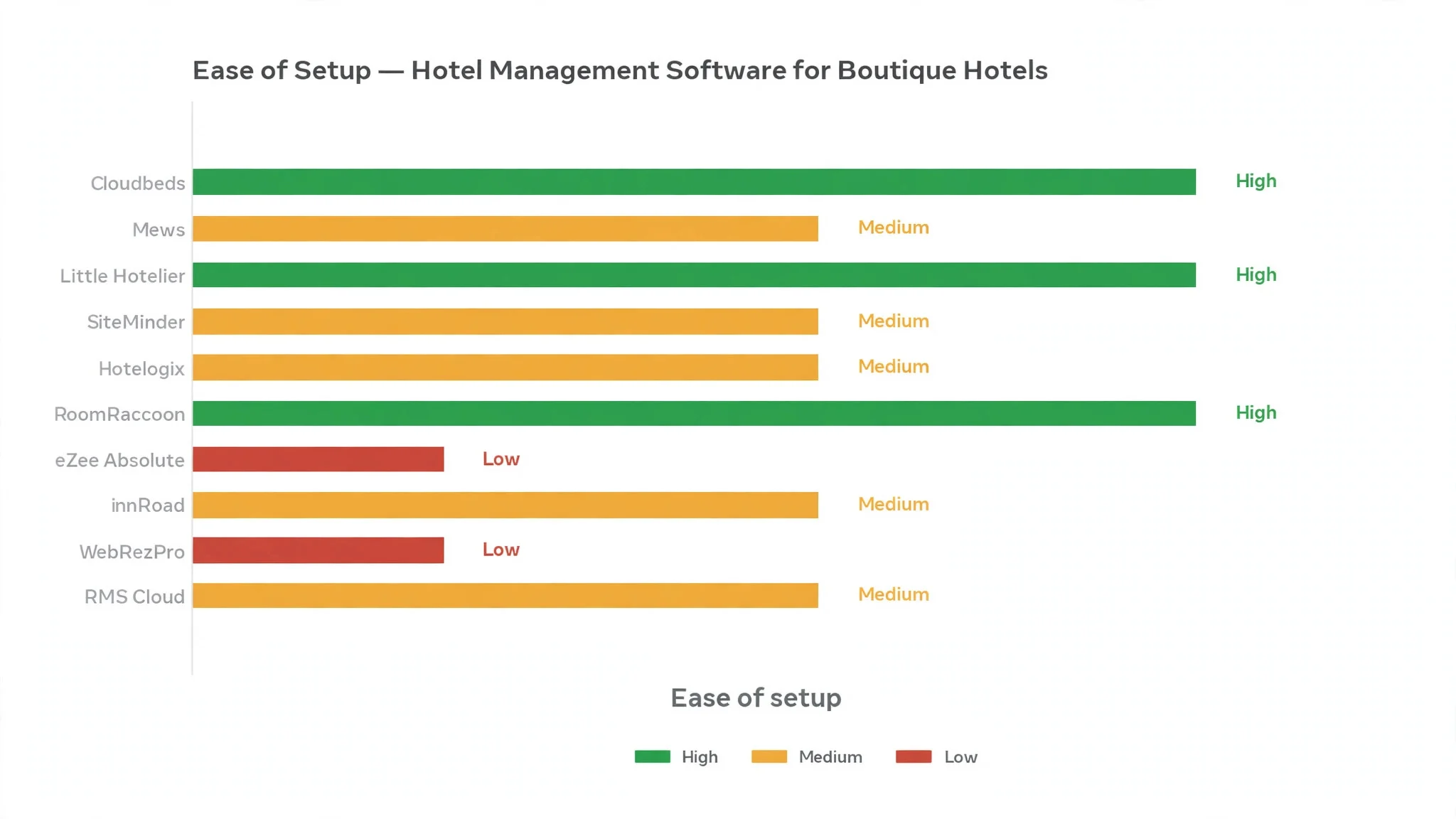
Cloudbeds and Mews sit at the top of the table, so read their reviews and see which front desk flow your boutique hotel runs best on. A system that scores High on channel coverage only helps if your property actually sells on those channels, and a system that scores High on reporting only helps if someone reads the report each week. Fit to your daily routine matters more than a long feature list.
Why the Best Hotel Management Software for Boutique Hotels Pays for Itself
The best hotel management software for boutique hotels pays for itself in the same place, which is the hour nobody budgets for. A front desk agent who spends ninety minutes each morning updating rates on five sites and retyping bookings into a spreadsheet is losing a full working day every week. A system that pushes one rate change everywhere at once hands that day back, and the saving repeats every single week.
The second saving is fewer double bookings. Most small-hotel losses are not dramatic. A room sells twice on a busy weekend, a guest arrives to find no room ready, or a rate change never reaches one channel. A connected system catches these gaps because availability lives in one place, and every channel reads the same number.
Speed of response is the third reason. When a guest asks to extend a stay by one night, a front desk agent with a live calendar answers in seconds. An agent working from spreadsheets and memory has to check three places first, and the guest is already reaching for the phone to book elsewhere.
The fourth reason is evidence for pricing decisions. A system that records which nights sold out, which channels brought the booking, and how far ahead guests booked gives an owner real numbers for rate setting. Guessing that weekends need a higher rate is very different from seeing a report that proves it, and that proof is what turns a hunch into a pricing plan.
The final reason is calmer staff. People do better work when they can see what matters today without asking anyone. A clear housekeeping board with three priorities beats a long printed list, and the tools in this ranking all help a small team keep the daily picture short and honest.
How We Put Each Property System Through Its Paces
We tested the best hotel management software for boutique hotels against the same five measures, using a simulated 24-room property with a restaurant and a spa room. Each system ran the same workload for two weeks, so Cloudbeds and the rest compare like with like.
- Channel sync speed, judged by how quickly a rate or availability change reached every connected booking site.
- Front desk clarity, measured by how fast a new agent could check a guest in and handle a room move without help.
- Housekeeping flow, scored on whether the cleaning board stayed accurate through a full same-day turnover.
- Setup speed, timed from account creation to a working property with rooms loaded and the first bookings live.
- Daily usability, judged by how fast the front desk could run the morning check and how often night staff had to ask for help.
Each measure carried equal weight except channel sync, which counted double, because a boutique system that lets a room sell twice is not doing its job. Scores run out of 100, and the order below follows the combined total, led by Cloudbeds on channel sync. Where two tools tied, we broke the tie on front desk clarity, since a system the desk team avoids is a system that fails.
We also checked the guest-facing booking engine, because direct bookings protect margin. The best systems in this ranking let a guest book in three steps on a phone, while the weakest add friction that sends the guest back to a booking site.
The 10 Tools in Detail
Each review below follows the same pattern, and every system is judged on the same ground as the best hotel management software for boutique hotels. We note what each tool does best, where it falls short, and the property it suits best, with channel sync carrying the most weight.
1. Cloudbeds
Cloudbeds is the broadest platform in this ranking, and it leads because it covers the whole boutique operation in one place. Property management, channel manager, booking engine, and payments sit together, so a rate change made at the desk reaches every sales channel without retyping. The dashboard shows occupancy, revenue, and channel performance in one view.
The trade off is learning time. Cloudbeds can do so much that a small team takes a few weeks to settle on a setup, and the sheer number of settings slows new users down. An owner who invests the setup time gets a powerful system, but a twelve-room inn that wants to start on Monday should look at simpler options first.
In the trial, load one real month of bookings with live rates and watch the Friday check-in. Time how long it takes to find a late arrival, and ask the housekeeper to update a room from a phone. If both finish in under a minute and the channel calendar reads clearly, the platform will survive contact with your team.
Our verdict. The broadest single platform here, and the best all rounder for most boutique hotels.
2. Mews
Mews is the modern pick, and it earns second place with a guest journey that feels built for design-led hotels. Check-in can happen online before arrival, payments run through the platform, and automations handle the routine messages that eat front desk time. The interface is clean, and staff pick it up fast.
The trade off is price shape on the fuller tiers, where the best automation and reporting sit. The platform also suits hotels that are comfortable running operations in the cloud, so a property with weak internet should test connectivity first. For a boutique hotel that wants the guest experience to feel effortless, that trade is worth making.
In the trial, run one online check-in from a guest phone and follow the booking from reservation to payment. Check whether the guest messages go out on time, and whether the front desk sees the same status the guest sees. If the journey feels smooth from both sides, the platform fits your property.
Our verdict. The most modern guest journey here, ideal for design-led boutique hotels.
3. Little Hotelier
Little Hotelier is the small-property specialist, and it suits inns and bed and breakfasts that need to be live fast. The booking engine, channel manager, and front desk tools come as one simple package, and most owners get rooms loaded and selling within days rather than weeks. The interface stays plain and readable.
The trade off is depth. Little Hotelier is lighter than Cloudbeds on reporting and automation, so a hotel that grows past forty rooms may outgrow it. For a small property with one person at the desk, that lightness is a strength rather than a weakness, because nothing about the system gets in the way.
In the trial, load your rooms and connect your two biggest channels, then take three bookings in one afternoon. Watch whether the calendar updates on every channel, and whether the guest confirmation reads clearly. If the setup takes a day and the bookings flow cleanly, the tool fits.
Our verdict. The fastest start here, ideal for small inns and bed and breakfasts.
4. SiteMinder
SiteMinder is the distribution specialist, and it belongs here because many boutique hotels live or die on channel reach. It connects a property to a wide set of booking sites and keeps rates and availability in sync across all of them. The rate tools help an owner push the right price to the right channel at the right time.
The trade off is that SiteMinder is strongest as a channel platform, so a hotel still needs a solid front desk system beside it. Used on its own it does not run housekeeping or the guest stay. Paired with a property management system, it removes the manual rate work that fills a boutique morning.
In the trial, connect your three biggest channels and push one rate change, then check each channel for the new price. Run it for a week and count how many times someone still updates a rate by hand. If the count falls to near zero, the connection is earning its keep.
Our verdict. The strongest channel reach here, ideal for hotels that sell widely online.
5. Hotelogix
Hotelogix is the value pick, and it earns its place with full front desk tools at a modest price shape. Reservations, housekeeping, billing, and reporting sit in one cloud system, and the interface is straightforward enough for a new agent to learn in a day. Small hotels get the core tools without paying for enterprise depth.
The trade off is polish. Hotelogix is less pretty than Mews and its guest-facing tools are lighter than the leaders, so hotels that want a slick online journey should look elsewhere. For a growing boutique hotel that needs solid daily operations first, it is a steady and honest choice.
In the trial, move one full day of operations into the tool, from check-in to checkout, and time each step. Ask the housekeeper to act from a phone, and check whether the billing matches the booking. If the day runs cleanly, the system will hold up.
Our verdict. The best value front desk system here, ideal for growing boutique hotels.
6. RoomRaccoon
RoomRaccoon is the all-in-one option for independent hotels, and it suits properties that want one dashboard for the whole day. Reservations, channel management, booking engine, and housekeeping share one screen, so the front desk never hunts across tabs. The system is built for independent hotels rather than chains, and that focus shows in the workflow.
The trade off is scale. RoomRaccoon fits independent boutique hotels well, but a property with several buildings or a large events business may want deeper tools. The reporting is solid for daily decisions, though owners who love deep revenue analysis may want more. For a single-property boutique hotel, it covers the day cleanly.
In the trial, run one busy weekend end to end, including a room move and a late checkout. Check whether the housekeeping board stayed accurate, and whether the guest invoice matched the stay. If both held up under pressure, the system is ready for your weekends.
Our verdict. The cleanest single dashboard here, ideal for independent boutique hotels.
7. eZee Absolute
eZee Absolute is the classic full-featured system, and it fits hotels that want deep control over the front desk. Reservations, housekeeping, point of sale, and reporting are all covered, and the system handles complex rate plans and packages without fuss. Hotels that run a restaurant alongside rooms get the pieces in one place.
The trade off is the learning curve. eZee Absolute carries more settings than a small inn needs, and new staff take longer to learn it than the simpler tools here. An owner who wants every control available will value that depth, while a twelve-room inn may find it heavy for daily use.
In the trial, build one rate plan with a package, like room plus breakfast, and sell it on two channels. Check whether the package price stays correct everywhere, and whether the restaurant charge lands on the right folio. If both work first time, the depth is working for you.
Our verdict. The deepest classic controls here, ideal for hotels with restaurant and package sales.
8. innRoad
innRoad is the simple operator, and it earns its place by keeping daily work obvious. Reservations, availability, and reporting sit in a clear cloud system that a new agent learns quickly. The interface avoids clutter, and the core flows, like check-in, room moves, and billing, take few clicks.
The trade off is breadth. innRoad is lighter on channel management and automation than the leaders, so a hotel that sells on many channels may need a separate channel tool beside it. For a small hotel that takes most bookings direct or through two channels, that lightness keeps the day simple.
In the trial, take five bookings in one morning, including one walk-in and one phone booking. Watch whether the calendar stays accurate, and whether the daily report matches the takings. If the morning runs without a spreadsheet beside it, the tool fits your desk.
Our verdict. The simplest daily operation here, ideal for small hotels with a light channel mix.
9. WebRezPro
WebRezPro is the steady cloud system, and it suits inns that want reliability over flash. Reservations, group bookings, housekeeping, and reporting run in one place, and the system handles group blocks and packages well. Properties that host small weddings or retreats get group tools that simpler systems lack.
The trade off is looks and guest-facing polish. WebRezPro is less modern than Mews, and its booking engine is functional rather than beautiful. For an inn that values a system that simply works every day, that trade is easy to accept, because the desk team cares about reliability first.
In the trial, build one group block for a small wedding party and manage three room changes inside it. Check whether the group billing stays clean, and whether the housekeeping board reflects the changes. If the group stays organised, the system earns its place.
Our verdict. The most reliable group handling here, ideal for inns that host small events.
10. RMS Cloud
RMS Cloud is the flexible pick, and it rounds out the ranking for properties that mix hotel rooms with serviced apartments. The system handles varied property types, rate plans, and stay lengths in one setup, which suits boutique owners who also run apartments or villas. Reporting covers the whole portfolio at once.
The trade off is setup time. RMS Cloud is flexible, and flexibility means more decisions during setup, so an owner should budget a proper onboarding week. A single small hotel may find simpler tools faster to launch. For a mixed portfolio, that setup effort pays off quickly.
In the trial, load two property types with different rate rules and take bookings for both. Check whether each property keeps its own calendar, and whether the combined report reads clearly. If both stay clean, the flexibility fits your business.
Our verdict. The most flexible setup here, ideal for owners with mixed property types.
What Boutique Hotels Should Compare Before Paying
Price shape comes first, but it is not the whole decision. A system that charges per room can look cheap for a twelve-room inn and costly for a forty-room hotel, so ask for a quote on your exact room count. Comparing the best hotel management software for boutique hotels on total cost, not headline price, matters, because add-ons change the bill fast.
Channel coverage comes next. List the booking sites that actually bring your guests, then check each one is supported. A system with two hundred channels sounds impressive, but only the five you use matter. Ask how fast a rate change reaches each channel, and what happens when a channel goes down.
The booking engine deserves a real test. Open it on a phone, try to book a room, and count the steps. Guests abandon slow or confusing booking flows, and every abandoned booking is a commission paid to a booking site instead. A clean three-step flow protects direct revenue better than any discount.
Support is the last comparison that matters. A boutique hotel has no IT team, so the vendor support line is your IT team. Ask what hours they answer, how fast they respond, and whether onboarding help is included. A cheap system with slow support costs more than a dearer one that answers in minutes.
Costly Mistakes to Avoid When Switching Systems
The first mistake is switching in peak season. A new system always has a learning week, and a busy weekend is the worst time to discover a setting is wrong. Switch in a quiet month, run both systems in parallel for two weeks, and move fully only when the team trusts the new one.
The second mistake is skipping the rate and availability check. Before go-live, compare every rate plan and every blocked date between the old system and the new one. One missed rate plan can sell rooms at last year prices for weeks before anyone notices, and the loss is hard to recover.
The third mistake is forgetting the team. A system the front desk team was never trained on will be blamed for every problem, even when the system is fine. Train the team on real bookings, not a demo, and name one person who owns the system and answers questions in the first month.
The fourth mistake is ignoring the guest data move. Guest history, preferences, and loyalty notes are worth real money, because returning guests are the cheapest bookings a hotel gets. Check what transfers, test it with a sample, and keep the old records readable for six months after the switch.
A Four Week Switch Plan That Protects Bookings
Week one is the pilot, and it should be small on purpose. Pick one real workflow, like the weekend check-in, and run it in the new system with two staff members. Watch where they get stuck, fix the room setup, and note which reports you actually read. That first week is uncomfortable, and it is the most valuable week of the switch.
Week two is about the rules. Write down who owns each stage, what done means for housekeeping, and how fast each stage should move. A system without those rules becomes a prettier version of the same confusion, while a system with them becomes a routine the team can trust.
Week three is the whole team. Roll the system out to everyone, keep the first shifts easy, and run the old system in parallel for one week only. If someone struggles with the technology rather than the work, fix the setup beside them instead of letting it become a reason to quit. Parallel running longer than a week doubles the work and kills adoption.
Week four is the decision. Judge the system on three numbers, which are the time the morning check takes, the number of bookings that went stale without anyone noticing, and the hours spent updating rates by hand. If all three moved in the right direction, keep the system and renew it. If only one moved, the system is fighting your property rather than helping it.

Best Pick by Job
A single winner does not fit every boutique property, so we matched each common situation to the tool that scored highest for that job. The best hotel management software for boutique hotels for a twelve-room inn looks different from the right pick for a forty-room design hotel, and the table below makes that split clear.
| Job | Best pick | Why it wins |
|---|---|---|
| Sells on many channels | Cloudbeds | Property management plus channel manager in one |
| Runs a design-led guest journey | Mews | Modern check-in and automation |
| Opens a small inn fast | Little Hotelier | Simple package with booking engine included |
| Needs the widest channel reach | SiteMinder | Broad connections with rate control |
| Grows on a modest budget | Hotelogix | Full front desk tools at a modest price shape |
| Wants one daily dashboard | RoomRaccoon | Reservations, channels, and housekeeping in one view |
| Sells rooms with restaurant packages | eZee Absolute | Deep controls for packages and point of sale |
| Keeps daily work simple | innRoad | Clear reservations with few clicks |
| Hosts small wedding groups | WebRezPro | Group blocks that stay organised |
| Runs rooms plus apartments | RMS Cloud | Flexible setup across property types |
If your situation does not match a row exactly, take the closest one and read that review first, starting with Cloudbeds when it fits. The gap between neighbouring tools is smaller than the gap between a system your team updates daily and one they avoid, so adoption matters more than a few points on a scorecard.
Frequently Asked Questions
Owners ask the same questions before every hotel system change, so we answered the most common ones here. The answers below are faster to judge a tool against than a vendor sales call.
How much does hotel software cost for a 20-room boutique hotel?
Most systems in this ranking charge per room or per month, so a 20-room property pays for twenty rooms plus any channel or payment add-ons. Free plans cover small trials well, but the channel and automation features that save real time usually sit on paid tiers. Check the vendor site for current pricing and confirm the total before you pay, because add-ons can change the bill.
Can one system replace our spreadsheets and channel logins completely?
It can replace the tracking spreadsheets and the separate channel logins, but not every spreadsheet. A connected system handles live availability, ownership, and status far better than a sheet, while a sheet still wins for one-off analysis and quick calculations. Most hotels keep a few sheets for finance work and move everything about who sleeps where and when into the system.
How long does it take a small team to adopt a new hotel system?
A focused team is productive inside two weeks if the switch covers one workflow first and the owner checks the dashboard daily. Adoption fails when a system launches to everyone at once with no training and no clear rules about who updates what. Start small, name the owner of each stage, and review the board together each morning for the first month.
Do these systems work for a hotel with weak internet?
Most of the systems here run in the cloud, so a stable connection matters at the front desk. A property with weak internet should test the system on its real connection during the trial, and ask the vendor about offline options for check-in. A system that freezes during a busy check-in will be abandoned fast, whatever its feature list says.
What happens to our guest history if we switch systems later?
Every system in this ranking exports reservations and guest records to common formats, so a switch is possible but never painless. Automations and rate plans do not transfer, and the team must rebuild them in the new system. Automations and rate plans never carry across, which is why a boutique hotel should trial Cloudbeds properly now instead of staying with a system that no longer fits the property.
Picking the System Your Boutique Hotel Runs On
A boutique hotel can settle this in a trial by timing the morning check, counting double bookings, and tracking the hours spent updating rates by hand. The best hotel management software for boutique hotels proves itself on the time the morning check takes, the number of double bookings, and the hours spent updating rates by hand, and a four week trial with your real rooms will show all three. Cloudbeds wins our ranking on the combined score, but the right system for your property is the one your team updates without being asked.
Run the trial on one real month with your real rooms and your real channels, and judge the system on the Friday check-in rather than the demo. If the check-in takes five minutes and the calendar tells the truth, the system is working. If the check-in takes twenty minutes and the numbers feel wrong, the system is fighting you rather than helping you. Pick the platform that makes the truth easy to see, protect the morning check, and let the calmer week pay for the subscription many times over.