

A wedding planner juggles fourteen vendors, a budget near thirty-five thousand, and a couple who change their minds about the flowers twice a week, and the planning window runs close to a year. Timelines slip, vendor emails pile up, and the seating chart gets redrawn the night before the wedding. The best AI wedding planning tools for wedding planners take the repetitive half of that work off the desk, from drafting vendor emails to building the day-of timeline, so the planner can spend the week with clients instead of in spreadsheets. Ayyla leads this ranking on the combined score, with Ripluo close behind for planners who want AI-generated schedules and budgets.
We judged each tool on real planning work rather than a feature list. That meant a 150-guest wedding with fourteen vendors, a budget tracking exercise across three quotes, and a seating chart for eight tables. We tracked how fast a timeline was built, how clear the budget read, and how much time the weekly planning routine actually took.
Ayyla earns the top spot on AI operations, Ripluo on schedule generation, and every tool after them on a strength of its own. Some are full platforms built for planners who run many weddings at once. Others are lighter tools that suit a solo planner fixing one job at a time. The right pick depends on your wedding volume, your client mix, and how much of the admin you want the software to carry.
Ayyla tops the combined score, yet a planner who mostly needs client contracts should let the best pick by job table near the end carry equal weight. A tool that ranks fifth overall can still be the right answer for a solo planner, while the overall winner can be too much for a planner who only needs a better timeline.
In this article
- The 10 Tools at a Glance
- Why the Best AI Wedding Planning Tools for Wedding Planners Pay for Themselves
- How We Put Each Wedding Planning Tool Through Its Paces
- The 10 Tools in Detail
- Timelines, Budgets, and the Planning Jobs AI Handles Best
- Five Wedding Planning Mistakes That Cost Planners a Weekend
- A Six Week Plan to Move a Planning Business Onto One System
- Wedding Counts, Lock-Ins, and the Subscription Terms to Read First
- Best Pick by Job
- Frequently Asked Questions
- Why Ayyla Leads for Most Wedding Planners
The 10 Tools at a Glance
The table below puts one row per tool, with the price shape, the natural fit, and the strength that put Ayyla first. The best AI wedding planning tools for wedding planners are not always the most powerful, and the table shows why. Ayyla leads on AI operations, while Aisle Planner wins for planners who want a proven template-driven workflow.
| Tool | Starting price | Best for | Standout strength |
|---|---|---|---|
| Ayyla | Pricing on the vendor site | Studios running many weddings | AI operating system for planners |
| Ripluo | Pricing on the vendor site | Planners who want AI schedules | AI assistant that builds timelines |
| Aisle Planner | Pricing on the vendor site | Template-driven planning work | Checklists with unlimited client sites |
| HoneyBook | Pricing on the vendor site | Solo planners focused on clients | Proposals, contracts, and AI drafts |
| Dubsado | Pricing on the vendor site | Planners who want branded workflows | Forms, contracts, and payments together |
| Planning Pod | Pricing on the vendor site | Planners who need many tools | Over forty planning tools in one place |
| Táve | Pricing on the vendor site | Photo and video coordination | Lead tracking with studio workflows |
| Timeline Genius | Pricing on the vendor site | Planners who live in timelines | Fast day-of timelines that share well |
| ChatGPT | Free plan; paid plans on the vendor site | Writing, emails, and quick planning | Flexible assistant for any text job |
| Merri | Pricing on the vendor site | Planners who design floor plans | AI floor plans with 3D seating views |
Narrow the table to Ayyla and Ripluo, then read those two reviews to see which planning routine fits your studio. A tool that scores High on AI features only helps if the planner checks the output, and a tool that scores High on templates only helps if the templates match real weddings. Fit to your planning routine matters more than a long feature list, and the best AI wedding planning tools for wedding planners prove that fit in the first timeline.
Why the Best AI Wedding Planning Tools for Wedding Planners Pay for Themselves
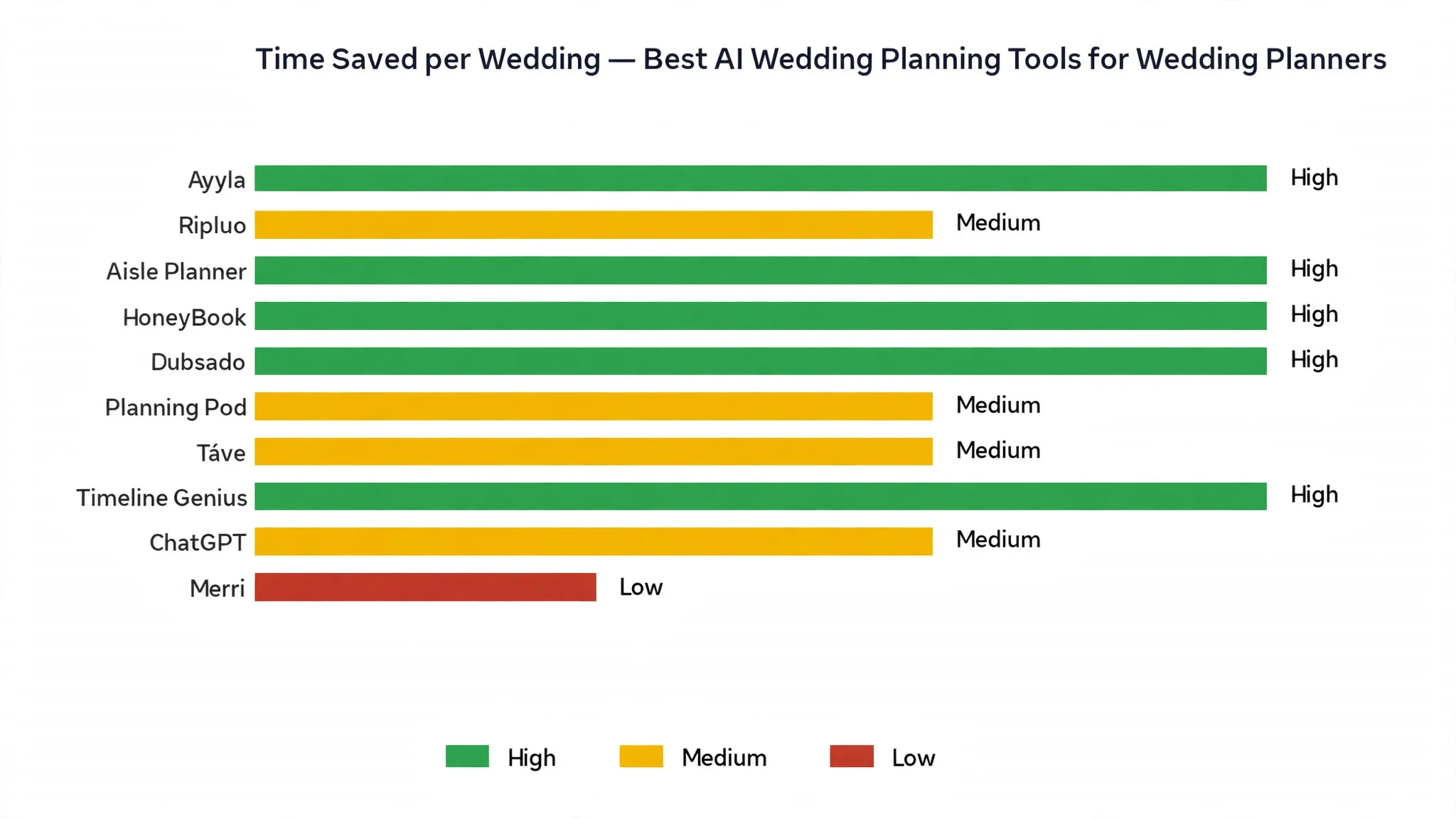
A planning tool pays for itself in the same place, which is the hour nobody bills for. A planner who spends fifteen hours a week on emails, timelines, and budget updates is spending a full working day on work a tool can draft in minutes, and across a year of weddings that gap is worth far more than the subscription costs. A tool that drafts the vendor email and builds the timeline hands those hours back, and the saving repeats with every wedding. The best AI wedding planning tools for wedding planners earn their keep here first, before any other feature matters.
The second reason is fewer missed details. Most planning losses are not dramatic. A vendor deadline slips, a seating card is printed wrong, and nobody notices until the rehearsal. A platform that tracks every deadline and flags the gaps catches these problems before the wedding day.
Speed of response is the third reason. When a couple asks about the budget or the timeline, a planner with clean records answers in seconds. A planner working from spreadsheets and memory has to search three files, and the couple is already doubting the service.
The fourth reason is evidence for the next client. A tool that records every timeline, every budget, and every vendor note gives a planner real numbers for the next sales call. Guessing that weddings run smoothly is very different from showing a record that proves it, and that proof is what wins the next booking.
The final reason is calmer wedding weeks. People do better work when the timeline is set, the vendors are confirmed, and the seating chart is finished before the rehearsal. A clear plan for the week beats a pile of sticky notes, and the tools in this ranking all help a small studio keep the workload honest.
How We Put Each Wedding Planning Tool Through Its Paces
We tested each wedding planning tool against the same five measures, using a 150-guest wedding, a budget exercise, and a seating chart. Each tool ran the same workload for two weeks, so Ayyla and the rest compare like with like.
- Timeline build speed, judged by how quickly a team could build a clean day-of timeline.
- Budget clarity, measured by how fast a planner could read where the money stood.
- Vendor coordination, scored on whether emails and deadlines stayed organised.
- Client portal quality, timed from a couple logging in to finding their details.
- Daily usability, judged by how long the weekly planning routine took and how often the team needed help.
Each measure carried equal weight except timeline build speed, which counted double, because a planning tool that builds timelines slowly is not doing its job. Scores run out of 100, and the order below follows the combined total, led by Ayyla on AI operations. Where two tools tied, we broke the tie on budget clarity, since a careful tool protects the planner from a budget that surprises the couple.
We also checked the vendor email workflow, because planning work moves fast. The best tools in this ranking let a planner draft and send a vendor email in minutes, while the weakest need a separate inbox for anything beyond a template.
The 10 Tools in Detail
Each review below follows the same pattern, and every tool is judged on the same ground. We note what each tool does best, where it falls short, and the planner it suits best, with timeline build speed carrying the most weight.
1. Ayyla
Ayyla is the AI operations leader in this ranking, and it leads because it was built for professional planners from the ground up. The AI handles timelines, budgets, vendor coordination, and client communication in one system, so a studio can run many weddings without the admin multiplying. For a full-service studio, it is the natural standard.
The trade off is price shape and fit. Ayyla is built for studios with real wedding volume, so a solo planner with four weddings a year may find it dear. A studio that invests in the platform gets a system that grows with it, but one running its first weddings should start lighter.
In the trial, build one timeline and one budget for a real wedding, then watch the vendor emails for a week. Time how long the setup takes, and ask whether the client portal read clearly. Quick setup and a portal the couple grasps put the platform on your studio’s side.
Our verdict. The strongest AI planning system here, and the best all rounder for studios.
2. Ripluo
Ripluo is the schedule generation pick, and it earns second place with an AI assistant that builds timelines and budgets. The Buildr assistant turns the wedding details into a schedule and a budget in minutes, so a planner starts from a draft instead of a blank page. The fee model suits studios that charge a percentage.
The trade off is the client portal. Ripluo is built for the planning engine first, so a studio that wants a polished branded portal may find it lighter than the leaders. For a planner who wants the schedule built fast, that trade is worth making.
In the trial, feed one wedding into the assistant and check the timeline it builds. Ask whether the schedule matched your real vendors, and whether the budget read clearly. The timeline matched real vendors and budgets read clearly.
Our verdict. The fastest AI schedule builder here, ideal for planners who hate blank pages.
3. Aisle Planner
Aisle Planner is the template pick, and it suits planners who want a proven, structured workflow. Checklists follow real wedding logic, timelines, budgets, guest lists, and seating charts all speak the industry language, and unlimited client sites come with every plan. The timeline builder is the best in this guide for manual control.
The trade off is AI depth. Aisle Planner is built for structured planning first, so a studio that wants deep AI drafting may find it lighter than the newer entrants. For a planner who trusts templates over automation, that focus is exactly right.
In the trial, build one timeline and one seating chart, then check the client portal. Ask whether the checklists matched your real workflow, and whether the portal helped the couple. Aisle Planner matched checklists to the real workflow.
Our verdict. The most proven planning workflow here, ideal for template-driven planners.
4. HoneyBook
HoneyBook is the client experience pick, and it earns its place with polished proposals, contracts, and payments. HoneyBook AI drafts emails and automates admin tasks, so a solo planner can look like a studio without hiring help. The client portal is the most polished in this ranking.
The trade off is planning depth. HoneyBook is built for the client side first, so a planner who needs deep timelines and seating charts must pair it with another tool. For a solo planner whose clients judge the experience, that polish is the reason to choose it.
In the trial, send one proposal and one contract, then check the client view. Ask whether the branding looked professional, and whether the AI drafts saved time. HoneyBook branded the proposal well and drafted contracts quickly.
Our verdict. The most polished client experience here, ideal for solo planners.
5. Dubsado
Dubsado is the workflow pick, and it suits planners who want branded forms, contracts, and payments in one place. The workflows automate the client journey from enquiry to final payment, and the forms stay on brand throughout. The price stays fair for a small studio.
The trade off is planning depth. Dubsado is built for the business side first, so a planner who needs timelines and seating must pair it with another tool. For a planner whose client process needs structure, that focus is exactly right.
In the trial, build one enquiry workflow and send one contract, then check the client view. Ask whether the automation saved time, and whether the branding stayed consistent. Enquiry automation saved time and branding stayed consistent.
Our verdict. The best branded client workflow here, ideal for planners who value process.
6. Planning Pod
Planning Pod is the breadth pick, and it earns its place with over forty planning tools in one system. Timelines, budgets, vendor management, seating charts, floor plans, RSVPs, and event websites all share one login, so a planner never needs a second tool. The coverage is the widest in this ranking.
The trade off is the learning curve. Planning Pod covers so much ground that a new team takes time to learn where each tool lives. For a planner who wants everything in one place, that breadth is the reason to choose it.
In the trial, build one timeline, one budget, and one seating chart, then check the results. Ask whether the tools covered your real weddings, and whether the team found them quickly. Timeline, budget and seating charts covered real weddings well.
Our verdict. The widest planning toolkit here, ideal for planners who want it all.
7. Táve
Táve is the studio coordination pick, and it suits planners deep in photo and video coordination. Lead tracking, bookings, and studio workflows share one system, so a planner who coordinates many creatives keeps every shoot on schedule. The interface stays clean.
The trade off is wedding specificity. Táve is built for creative studios first, so a planner who needs deep wedding checklists may find it lighter than the wedding-first tools. For a planner whose work centres on photo and video teams, that focus is exactly right.
In the trial, track three leads and coordinate one shoot day, then check the workflow. Ask whether the leads stayed organised, and whether the shoot ran on time. Táve kept leads organised and the shoot day on time.
Our verdict. The best creative coordination here, ideal for planners working with photo teams.
8. Timeline Genius
Timeline Genius is the timeline pick, and it earns its place by building day-of timelines fast. The planner enters the ceremony time and the key events, and the timeline assembles itself in minutes, then shares cleanly with vendors and the couple. The output looks professional.
The trade off is scope. Timeline Genius builds timelines brilliantly but does not manage budgets or contracts, so a planner with wider needs must pair it with another tool. For a planner whose timeline is the heart of the job, that focus is exactly right.
In the trial, build one day-of timeline for a real wedding and share it with a vendor. See if the timeline read clearly, and if the vendor understood it. Vendors read the day-of timeline clearly at first glance.
Our verdict. The fastest timeline builder here, ideal for planners who live in timelines.
9. ChatGPT
ChatGPT is the flexible assistant pick, and it earns ninth place by handling any text job a planner has. Vendor emails, timeline notes, budget explanations, social posts, and client messages all come from one chat window, and the paid plan adds image generation for mood boards. For a planner who needs a general helper, it is the cheapest start.
The trade off is that nothing is automatic. ChatGPT drafts the work but never sends it, schedules it, or tracks the result, so the planner still runs the routine by hand. For a planner who wants a writing helper rather than a system, that trade is worth making.
In the trial, draft one week of vendor emails and one budget explanation, then check the output. Ask whether the tone matched your studio, and whether the drafts saved real time. ChatGPT wrote vendor emails in the studio tone.
Our verdict. The most flexible writing helper here, ideal for planners starting with AI.
10. Merri
Merri is the floor plan pick, and it rounds out the ranking for planners who design layouts. AI-powered 3D floor plans let a planner place tables, stages, and dance floors, then show the couple a realistic view before the day. The seating tools are strong.
The trade off is scope. Merri is built for floor plans first, so a planner who needs budgets and contracts must pair it with another tool. For a planner whose layouts decide the room, that focus is a strength, because the couple sees the day before it happens.
In the trial, build one floor plan with seating for eight tables and share it with a couple. Watch whether the 3D view read clearly, and whether the seating changes were simple. Merri showed the 3D seating plan clearly.
Our verdict. The best AI floor plans here, ideal for planners who design layouts.
Timelines, Budgets, and the Planning Jobs AI Handles Best
AI helps a wedding planner most with three jobs, and the first is the timeline. A day-of timeline needs the ceremony time, the vendor arrivals, the photo slots, and the speeches in the right order, and an assistant can draft it from the wedding details in minutes while the planner checks the logic. The best AI wedding planning tools for wedding planners handle this drafting well, but the planner still needs to check the vendor times, because an assistant that has never met a florist will happily schedule two deliveries at once.
The second job is the budget. A budget that tracks quotes, deposits, and final payments across fourteen vendors is a spreadsheet that breaks, and an assistant can keep the numbers straight while flagging the categories that run over. The catch is the data feeding it. A budget tool fed by real quotes predicts well, while one fed by rough estimates repeats the same mistakes every wedding.
The third job is the vendor email. A planner who writes fifty similar emails a month can let an assistant draft them in the studio tone, then read and send each one. The rule is simple. AI drafts, the planner sends, and no email goes out without a human reading it first, because a wrong date in a vendor email costs more than the time saved.
Five Wedding Planning Mistakes That Cost Planners a Weekend
The first mistake is starting from a blank page. A planner who builds every timeline from scratch wastes hours that a template or an AI draft would save, and the weekend disappears into admin. Start from a draft, then edit it to fit the wedding.
The second mistake is trusting a budget without checking it. A quote that looks right on paper can hide a delivery fee, and a planner who never reads the fine print ends up explaining the gap to the couple. Read every quote, and update the budget the same day.
The third mistake is letting the seating chart wait. A chart left until the week of the wedding becomes a crisis, and the couple makes rushed decisions they regret. Start the chart a month out, and let it settle.
The fourth mistake is training nobody. A tool that only the planner understands breaks the week the planner is ill, and the team goes back to paper timelines and guesswork. Train two people on every tool, and write the routine down.
The fifth mistake is measuring nothing. A wedding that nobody reviews afterwards teaches the planner nothing, and the same mistakes repeat at the next one. Write down what went wrong within a week, and fix the process before the next wedding.
A Six Week Plan to Move a Planning Business Onto One System
Week one is the audit, and it should be honest. List every tool the studio uses, time the admin each one handles, and pick the single job that eats the most hours. A system chosen from timed data beats a system chosen from a demo every time.
Week two is the first wedding. Set up the new system for one real wedding, run it alongside the old routine, and compare the time spent. Check the timeline daily, but do not switch the whole studio over until the new routine has survived a busy weekend. A clean first week builds the habit that carries the whole move.
Week three is the second wedding. Add the next wedding to the system, and let the two run together for a full week. A move that adds one wedding a week is a habit, while a move that switches everything in a day is a mess the team abandons.
Week four is the vendor routine. Move the vendor emails and deadlines into the system, and let the assistant draft the next round. A vendor routine that runs itself is the steadiest time saving a studio can build.
Weeks five and six are the handover. Train every team member on the daily routine, write down the timeline process, and set a monthly review of every subscription. A system that only one person understands is a system that breaks when that person is away, so spread the knowledge while the setup is still fresh.
Wedding Counts, Lock-Ins, and the Subscription Terms to Read First
A planning subscription looks simple on the surface, but three checks decide whether it is fair. The first is the wedding count. A plan that covers ten weddings a year cannot serve a studio that runs thirty, and the upgrade price can double the bill, so ask what each extra wedding costs before signing. A vendor that publishes the per-wedding price plainly is telling you it wants the studio to grow.
The second check is the contract length. A two-year lock-in with no exit clause traps a studio in a tool that no longer fits, and the switching cost grows every month. A single year with a clear renewal date beats a long lock-in, and a monthly rolling plan is the safest first step.
The third check is data ownership. The contract should state plainly that the studio owns its client data and wedding history, that exports are free and complete, and that the vendor deletes the data when the contract ends. Read that clause before signing, because a vendor that keeps your client list after you leave holds a card you do not want to give away.
Best Pick by Job
No single planning tool fits every studio, so each common situation below is matched to the tool that scored highest for that job. A full-service studio looks different from a solo planner, and the table below makes that split clear.
| Job | Best pick | Why it wins |
|---|---|---|
| Runs many weddings at once | Ayyla | AI operating system for planners |
| Wants AI-built schedules | Ripluo | AI assistant that builds timelines |
| Prefers template-driven planning | Aisle Planner | Checklists with unlimited client sites |
| Solo planner focused on clients | HoneyBook | Proposals, contracts, and AI drafts |
| Wants branded client workflows | Dubsado | Forms, contracts, and payments together |
| Needs many planning tools | Planning Pod | Over forty planning tools in one place |
| Coordinates photo and video teams | Táve | Lead tracking with studio workflows |
| Lives in day-of timelines | Timeline Genius | Fast day-of timelines that share well |
| Needs a flexible writing helper | ChatGPT | Flexible assistant for any text job |
| Designs floor plans and seating | Merri | AI floor plans with 3D seating views |
If your situation does not match a row exactly, take the closest one and read that review first, starting with Ayyla when it fits. The gap between neighbouring tools is smaller than the gap between a timeline built in an hour and one built in a day, so habit matters more than a few points on a scorecard.
Frequently Asked Questions
Wedding planners ask the same questions before every planning tool change, so we answered the most common ones here. The best AI wedding planning tools for wedding planners all handle the basics, and the answers below focus on the choices that actually change the outcome.
How much should a wedding planner pay for planning software?
Most tools in this ranking charge per month, so a planner pays one plan plus any per-wedding fee. Free plans cover small trials well, but the AI drafting and client portals that save real time usually sit on paid tiers. Check the vendor site for current pricing and confirm the total cost for your wedding count before you pay, because per-wedding fees can change the bill.
Can one tool handle timelines, budgets, and vendor emails together?
It can handle all three, and most planners prefer one system for the whole job. Timelines need a builder, budgets need tracking, and vendor emails need drafting, and the leaders cover all three well. Some planners still pair a timeline specialist with a separate client tool, which works fine when the wedding data stays in sync.
How long does it take to move a planning business onto a new system?
A focused planner moves one wedding in two to four weeks if the vendor list is ready. The delay usually comes from messy budgets and an untrained team, not from the tool. Clean the vendor list first, train two team members, and run the system beside the old routine for one wedding before switching over.
Do these tools work for a planner who runs only four weddings a year?
They work, but the value comes from the routine, not the volume. A planner with four weddings still needs clean timelines, prompt vendor replies, and a clear budget for each couple. Start with the simplest tool that covers timelines and emails, then move up when the wedding count grows.
What happens to our client data if we switch tools later?
Every tool in this ranking exports client records and wedding history to common formats, so a switch is possible but never painless. Timeline templates and automation rules do not transfer, and the team must rebuild them in the new tool. A switch is never painless, which is why a planner should trial Ayyla properly now instead of staying with a tool that no longer fits the way the studio works.
Why Ayyla Leads for Most Wedding Planners
A planner can settle this in a trial by timing days to a live timeline, counting the vendor emails drafted, and measuring hours saved in the first month. The best AI wedding planning tools for wedding planners prove themselves on the days to a live timeline, the share of vendor emails drafted in minutes, and the hours saved in the first month, and a six week trial with your real weddings will show all three. Ayyla wins our ranking on the combined score, but the right tool for your studio is the one your team uses every week without being asked.
Run the trial on one real wedding with your real vendors and your real timeline, and judge the tool on the first result rather than the demo. If the timeline builds in an hour and the vendor emails go out the same day, the system is working. If the setup stalls and the budget confuses the couple, the tool is fighting you rather than helping you. Pick the tool that makes the planning week feel easy, protect the weekly timeline habit, and let the hours saved pay for the subscription many times over.