

Which AI link building tool should an agency buy in 2026, and how much of the outreach can it honestly hand to software? This guide compares the best ai link building tools for agencies on price, fit and the limits that only show up after launch, and it names the pick outright.
Pitchbox leads this list because its prospecting, sequencing and client reporting hold together across dozens of campaigns at once, while BuzzStream stays the cheapest credible home for the relationships behind the links.
This guide separates the research tools that find targets from the outreach platforms that send pitches and the services that sell placements outright, then prices each one at real agency volumes, so the comparison matches how an agency actually buys.
In this article
- What the Best AI Link Building Tools for Agencies Actually Automate
- The 12 Tools at a Glance
- Best Pick by Job
- The 12 Tools in Detail
- Running Your First Agency Outreach Sprint in 14 Days
- Agency Link Building Costs at 5, 15 and 40 Client Campaigns
- How Agencies Price Link Building to Clients
- Link Building Buys That Waste an Agency Budget
- Eight Checks Before You Hand a Tool to Your Outreach Team
- Frequently Asked Questions
- The Agency Link Building Bill at Three Client Counts
What the Best AI Link Building Tools for Agencies Actually Automate
The honest split in this category is between tools that find link targets, tools that run the outreach, and services that sell finished placements, and an agency usually needs one of the first two plus a research layer underneath. That is the first filter this guide applies to the best ai link building tools for agencies.
AI shows up in three places here, which are prospect scoring, personalised first lines and reply handling, and the tools that do all three save more staff time than the ones that only draft emails.
– Prospecting depth, meaning whether the tool finds targets itself or needs a list handed to it. – AI personalisation that reads the target page, not just the first name field. – Reply handling and follow-up sequencing across many client campaigns at once. – Reporting that a client can read without a walkthrough call.
The 12 Tools at a Glance
Twelve tools made the cut, spanning outreach platforms, research suites, prospecting layers and one placement service, and the table below shows where each one sits. The table below compares the best ai link building tools for agencies side by side.
| Tool | Starting price | Best for | Free option |
|---|---|---|---|
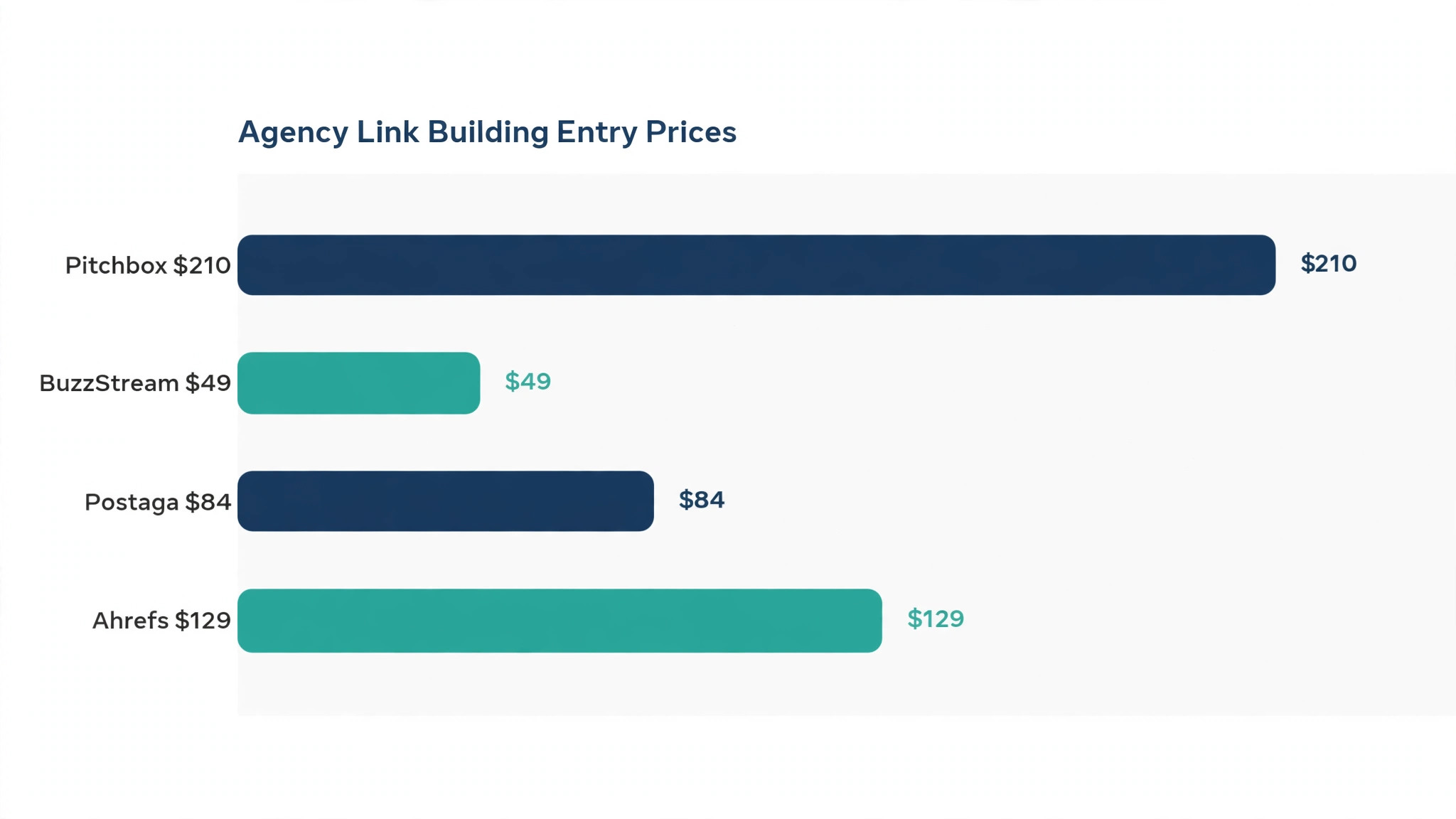
| Pitchbox | About $210 a month | agencies running many outreach campaigns at once | No free plan |
| BuzzStream | About $49 a month | digital PR teams that manage publisher relationships over years | 14-day trial |
| Respona | About $100 per placement | agencies that want finished links without running campaigns | No free plan |
| Postaga | About $84 a month | small agencies that want unlimited campaigns at a low price | 14-day trial |
| Ahrefs | About $129 a month | research and prospect filtering under any outreach stack | Free tools |
| Semrush | About $139 a month | agencies that want research, outreach and client reporting in one suite | Free plan |
| Moz Pro | About $99 a month | agencies that trust Domain Authority for prospect scoring | 30-day trial |
| Majestic | About $49 a month | link research teams that judge prospects on Trust Flow and Citation Flow | Free tools |
| Hunter | About $49 a month | finding and verifying contact emails for outreach lists | Free plan |
| SE Ranking | About $65 a month | agencies that want research plus outreach at a mid-market price | 14-day trial |
| Linkody | About $14 a month | small teams that mainly need to monitor links they already won | 30-day trial |
| Monitor Backlinks | About $25 a month | agencies that report link changes to clients every month | 14-day trial |
Best Pick by Job
A solo link builder and a forty-client agency buy different tools, so the table below matches each agency shape to its pick, with the monthly cost beside it.
| Job | Pick | Why it wins | Monthly cost |
|---|---|---|---|
| Solo link builder, three clients | Postaga | Unlimited campaigns at a small-agency price | About $84 a month |
| Growing agency, ten clients | Pitchbox | Workspaces and sequencing per client | About $420 a month on Advanced |
| Digital PR with journalist lists | BuzzStream | Relationship tracking built in | About $49 a month to start |
| Buying links without outreach | Respona | Managed placements, pay per link | About $100 per placement |
| Research layer under any stack | Ahrefs | Authority data that filters prospects | About $129 a month |
The 12 Tools in Detail
Read the tools in the order your agency works, since research comes first, outreach second, and reporting last, and the wrong order is how agencies end up paying for two tools that do the same job. Start with the tools that match your job, then check the price, because the best ai link building tools for agencies differ more on fit than on features.
1. Pitchbox
Pitchbox is the agency standard for outreach, combining prospecting, email sequences, reply handling and client reporting in one system. Its strength is scale, since workspaces, conditional sequences and native Ahrefs, Moz, Semrush and Majestic data hold together across dozens of clients.
Pro lists at about 210 dollars a month on annual billing, or 300 dollars month to month, with Advanced at about 420 dollars as the realistic agency tier. Skip it for a solo operator with two clients, because the price and setup time outweigh the benefits until campaign volume rises.
2. BuzzStream
BuzzStream is an outreach CRM built around relationships, tracking who you contacted, what they said and when to follow up. Its strength is memory, since a team can see the full history with a journalist or publisher before sending the next pitch.
Starter lists at about 49 dollars a month for one user and 1,000 contacts, with Growth at about 174 dollars adding bulk sending. Skip it when prospecting volume matters most, because it finds fewer targets on its own than Pitchbox or a research suite.
3. Respona
Respona now operates as a managed placement service, handling prospecting, outreach and content while the agency pays per confirmed link. Its strength is the absence of software work, since no seats, sequences or inboxes need managing on the agency side.
Placements cost about 100 dollars on lower-authority publishers, rising to about 500 dollars on strong ones, with volume discounts from about 3,000 dollars a month. Skip it when the client wants control over the pitch, because the outreach happens inside Respona and the agency does not see the process.
4. Postaga
Postaga is an all-in-one outreach tool with AI prospect research, site content extraction and campaign management for smaller teams. Its strength is value, since unlimited campaigns and 2,000 contacts come at a price far below the enterprise outreach platforms.
Postaga lists at about 84 dollars a month on annual billing, covering unlimited campaigns with AI-generated prospect research. Skip it once the agency passes about ten active clients, because reporting and workspace controls are thinner than Pitchbox.
5. Ahrefs
Ahrefs is the research layer most link builders trust, with backlink data, authority scores and content gap tools that find link targets. Its strength is data depth, since the index behind its authority and traffic figures is the reference point for most prospect scoring.
Starter lists at about 129 dollars a month, with higher tiers adding more tracked domains, reports and users. Skip it as a standalone link building tool, because Ahrefs finds targets and sends nothing, so outreach needs a separate platform.
6. Semrush
Semrush covers keyword research, backlink analysis, link building outreach and client reporting inside a single subscription. Its strength is breadth, since one login can serve SEO reporting, content planning and link prospecting for the whole agency.
Pro lists at about 139 a month, with Guru and Business tiers adding more projects, reports and historical data. Skip it when the agency needs deep outreach sequencing, because its outreach tools are lighter than Pitchbox or BuzzStream.
7. Moz Pro
Moz Pro pairs keyword and link research with the Domain Authority metric that many clients already recognise and ask about. Its strength is familiarity, since clients understand a Domain Authority score without a walkthrough, which shortens reporting calls.
Moz Pro lists at about 99 dollars a month, with higher tiers adding more campaigns, keywords and tracked links. Skip it when the agency needs outreach sending, because Moz Pro researches and tracks links but does not run campaigns.
8. Majestic
Majestic is a link index specialist, scoring sites on Trust Flow and Citation Flow and mapping how link equity moves between pages. Its strength is link-specific data, since its index is built for backlink analysis rather than general SEO.
Lite lists at about 49 dollars a month, with Pro and API tiers adding historical data and larger exports. Skip it as a first research tool, because its keyword and content tools are thin next to Ahrefs or Semrush.
9. Hunter
Hunter finds the email address behind a domain, verifies it, and runs simple outreach campaigns for teams that already have a list. Its strength is accuracy, since verified addresses cut bounce rates and protect the sending domain from damage.
Starter lists at about 49 dollars a month, with a free tier covering a small number of monthly searches and verifications. Skip it as a full outreach platform, because its sequencing and reporting are basic next to Pitchbox or BuzzStream.
10. SE Ranking
SE Ranking bundles rank tracking, backlink monitoring, site audits and a link building outreach module at a price below the big suites. Its strength is the bundle, since a small agency can cover tracking, research and outreach on one subscription.
Essential lists at about 65 dollars a month, with Pro and Business tiers adding more keywords, projects and users. Skip it when the agency needs the deepest link index, because its backlink data is thinner than Ahrefs or Majestic.
11. Linkody
Linkody watches the backlinks an agency has earned, alerting the team when a link disappears, changes anchor or loses authority. Its strength is vigilance, since a lost link found in a week can be recovered, while one found in a year usually cannot.
Linkody lists at about 14 dollars a month for its entry plan, making it the cheapest tool on this list by a wide margin. Skip it as a prospecting tool, because Linkody monitors existing links and does not find new targets or send pitches.
12. Monitor Backlinks
Monitor Backlinks tracks new and lost links, competitor link growth and keyword movement, then turns the changes into client-ready reports. Its strength is reporting, since the monthly change report answers the question clients actually ask, which is what changed.
The entry plan lists at about 25 dollars a month, with higher tiers adding more domains and tracked keywords. Skip it when the agency needs outreach, because Monitor Backlinks watches links and reports on them without sending a single pitch.
The tools in this guide fall into four jobs, and an agency that buys two tools for the same job wastes the second subscription, so map the workflow first. Research finds the targets, outreach sends the pitches, monitoring watches the links, and reporting proves the value, and the stack should have one tool per job with no overlap.
Running Your First Agency Outreach Sprint in 14 Days
A first sprint takes two weeks from blank list to live links, and the sequence matters more than the tool, because each step feeds the next one.
Pick one client and one page. Choose the page with the clearest value to link to, because a focused sprint beats a scattered one every time.
Build a 200-site prospect list. Pull targets from Ahrefs or Semrush, filter by authority and relevance, and drop any site that has never linked out.
Write three pitch angles. Draft one angle per prospect type, such as resource pages, broken links and expert quotes, and keep each under 120 words.
Launch and watch replies daily. Send in small batches, answer replies within a day, and pause any angle that earns no replies after fifty sends.
Report the live links. Verify each link is live, record the authority and anchor, and send the client a short report with the cost per link.
Check the sending domain health. Verify the sending domain has proper authentication and a clean reputation before the first batch, because a flagged domain hurts every client campaign at once.

Agency Link Building Costs at 5, 15 and 40 Client Campaigns
Agency pricing scales with campaigns, seats and send volume, so the table below prices the entry plan that a working agency would actually buy, not the cheapest tier on the page. The table below prices the best ai link building tools for agencies at the volume a working buyer actually reaches.
| Tool | Entry plan | Cost at volume | What changes |
|---|---|---|---|
| Pitchbox | Pro, about $210 a month annual | 2,000 emails a month | Advanced at $420 is the real baseline |
| BuzzStream | Starter, about $49 a month | 1 user, 1,000 contacts | Growth at $174 adds bulk sending |
| Postaga | About $84 a month | Unlimited campaigns | Best value for small agencies |
| Ahrefs | Starter, about $129 a month | Research only, no sending | The prospecting layer underneath |
| Semrush | Pro, about $139 a month | Research and outreach tools | Broadest suite per dollar |
| Respona | About $100 per placement | Managed placements, no seats | Pay per link, not per month |
A five-client agency running Pitchbox Pro at 210 dollars plus Ahrefs Starter at 129 dollars spends about 339 dollars a month on software, while the same agency buying placements from Respona at 100 dollars a link spends 1,000 dollars for ten links, which shows why software wins once volume rises.
How Agencies Price Link Building to Clients
Agencies price link building three ways, which are a monthly retainer, a price per live link, and a project fee for a fixed campaign, and each model shifts the risk between the agency and the client. A retainer gives the agency steady income and the client steady work, yet it hides the cost per link and invites questions about what the money bought. A per-link price is transparent and easy to sell, yet it punishes the agency when a hard niche produces few links, and a project fee suits a one-off campaign with a clear end date.
A per-link price should cover prospecting, content, outreach and reporting, not just the email that won the link, because the link is the last step of a chain that starts with research. An agency that charges 100 dollars per link while spending 60 dollars on prospecting and content earns a thin margin, and one that charges 300 dollars per link in a competitive niche may still lose money if the niche needs custom content. The honest way to set the price is to track hours per link for a quarter, add the software cost, and then add the margin, rather than copying a competitor’s rate card.
Reporting the cost per live link keeps clients honest and keeps the agency honest, since a campaign that produces ten links for 3,000 dollars costs 300 dollars per link, and the client can judge that number against the value of the ranking gain. Agencies that report links without cost invite the client to compare them with a placement service charging 100 dollars per link, which is an unfair comparison when the agency link sits on a stronger site. Show the authority, the traffic and the relevance beside the price, and the cost per link becomes a value story instead of a bill.
Software costs should be passed through openly or absorbed deliberately, and the worst choice is to hide them and then resent them. An agency that bills the client a platform fee of 50 dollars a month per campaign covers Pitchbox and Ahrefs without argument, while one that absorbs the cost must earn it back in the retainer, which means the retainer has to be higher. Either model works, yet the agency should pick one and price it in from the start, because adding a software fee six months into a relationship reads as a price rise.
Small retainers lose money in link building because the fixed work of prospecting, list building and reporting does not shrink with the budget, and a 500 dollar monthly retainer can easily cost 700 dollars in staff time. The minimum viable retainer for real link building usually sits near 1,500 dollars a month, which covers a part-time link builder, the software and a modest number of links. Agencies that accept smaller retainers should narrow the scope, such as one page and ten prospects a month, rather than promising a full programme at a price that cannot fund it.
White-label reporting decides whether a client stays, since a report that carries the agency brand, shows live links with authority scores, and explains what happens next is worth more than a spreadsheet of URLs. Pitchbox and BuzzStream both produce client-facing reports, yet the agency still needs to write the summary that ties links to rankings and traffic, because a client who cannot see the connection will cancel. Spend an hour a month on the narrative, and the retention rate will show it.
Link Building Buys That Waste an Agency Budget
Agencies lose money on link building tools in predictable ways, and the five below account for most of the wasted spend we see. Each one below wastes money on the best ai link building tools for agencies in a different way.
Buying a research tool and expecting outreach. Ahrefs and Semrush find excellent targets and send nothing, so an agency that buys only research still needs an outreach platform or a manual process behind it.
Paying for seats nobody uses. Per-seat pricing punishes agencies that add every account manager, so give seats to the people who run campaigns and reporting access to everyone else.
Trusting AI personalisation without reading it. Page-specific first lines look personal until a prospect spots a wrong detail, so read a sample of every batch before it sends.
Ignoring the reply workflow. Outreach that lands replies in a shared inbox nobody owns loses links, so the tool must route replies to the person running that client.
Buying placements and software for the same job. A placement service and an outreach platform both produce links, so run one model per client and compare the cost per live link before doubling up.
Eight Checks Before You Hand a Tool to Your Outreach Team
Run these eight checks before the team touches the tool, because a missed check here becomes a missed deadline later. Every check below applies to the best ai link building tools for agencies the same way.
- Confirm how many campaigns, seats and inboxes the plan covers.
- Check the native integrations with your research tool.
- Test AI personalisation on ten real prospect pages.
- Set up reply routing so no client reply sits unread.
- Build the client reporting template before the first send.
- Agree the cost per live link you will report on.
- Train one person per client, not the whole team at once.
- Run a two-week pilot on one client before rolling out.
Frequently Asked Questions
Can Pitchbox really run 40 client campaigns for an agency?
Pitchbox is built for that scale, with workspaces per client, conditional sequences and reporting that separates one client from another, and its Scale plan covers 25,000 emails a month across 20 inboxes. The catch is price, since Pro at about 210 dollars a month on annual billing covers only 2,000 emails and two inboxes, which fills fast across 40 clients, so most agencies at that size sit on Advanced at about 420 dollars or Scale at about 825 dollars.
The tool handles the volume, but the plan must match it, and agencies that buy Pro for 40 clients end up upgrading within a month. That is the short answer for the best ai link building tools for agencies.
Is Respona still software, or is it a placement service now?
Respona changed its model and now sells managed placements rather than software seats, charging about 100 dollars per confirmed placement on lower-authority publishers and more for stronger ones, with volume discounts from about 3,000 dollars a month. That makes it a different purchase from Pitchbox or BuzzStream, since you pay per finished link instead of per month, and Respona handles prospecting, outreach and content itself. Agencies that want control over the pitch should buy software, while agencies that want links without running campaigns should price Respona per link against their own cost per link.
Which AI link building tool is cheapest for a small agency?
BuzzStream Starter at about 49 dollars a month is the cheapest full outreach CRM here, covering one user and 1,000 contacts with sequencing and relationship tracking, though bulk sending waits for the Growth plan at about 174 dollars. Postaga at about 84 dollars a month covers unlimited campaigns with AI prospect research, which makes it the best value for a small agency that sends steadily. Hunter at about 49 dollars a month finds and verifies emails but sends nothing, so it works as a cheap layer on top of a sending tool rather than a replacement for one.
Do agencies still need Ahrefs if they buy Pitchbox?
Yes, in most cases, because Pitchbox integrates Ahrefs data into prospecting rather than replacing it, and the authority, traffic and link data that filter a good prospect from a bad one live in Ahrefs. Pitchbox without a research layer forces the team to judge prospects on thin data, which wastes sends on sites that will never link. Ahrefs Starter at about 129 dollars a month is the usual companion purchase, and Semrush Pro at about 139 dollars plays the same role for agencies that already use Semrush for client reporting.
How does Postaga compare with Pitchbox for a five-person agency?
Postaga covers unlimited campaigns at about 84 dollars a month with AI prospect research and site content extraction, which is enough for a five-person agency running a handful of clients. Pitchbox costs more, starting at about 210 dollars a month on annual billing, but adds conditional sequencing, deeper integrations with Ahrefs, Moz, Semrush and Majestic, and client reporting that Postaga cannot match. A small agency should start with Postaga and move to Pitchbox when client count, inbox count or reporting needs outgrow it, which usually happens around ten active clients.
What should an agency pay per live link in 2026?
A fair benchmark is the software cost divided by live links, so an agency spending 339 dollars a month on Pitchbox plus Ahrefs and earning 15 live links pays about 23 dollars per link in software alone, before staff time. Bought placements cost far more, with Respona charging about 100 dollars per link on lower-authority sites and 400 to 500 dollars on strong ones. Staff time dominates both models, so the honest comparison adds hours per link, and most agencies find software cheaper per link once they pass about ten links a month.
The Agency Link Building Bill at Three Client Counts
At five client campaigns, BuzzStream Starter at about 49 dollars plus Hunter at about 49 dollars costs about 98 dollars a month in software, while Pitchbox Pro at about 210 dollars plus Ahrefs at about 129 dollars costs about 339 dollars, and the cheaper stack is enough when one person runs all five campaigns. That is the bill the best ai link building tools for agencies produce at this volume.
At 15 campaigns the cheaper stack breaks, because BuzzStream Starter covers one user and 1,000 contacts, so the agency moves to Growth at about 174 dollars plus Ahrefs at 129 dollars, about 303 dollars a month, while Pitchbox Advanced at about 420 dollars plus Ahrefs at 129 dollars runs about 549 dollars and adds the workspaces and sequencing a 15-client book needs.
At 40 campaigns only Pitchbox Scale at about 825 dollars plus a research suite near 129 dollars, about 954 dollars a month, holds together, and the runner-up stack at that size costs nearly as much once extra seats and contact limits are counted, so the dearer tool wins on fit rather than price.
At five clients, the software bill runs about 339 dollars a month for Pitchbox Pro plus Ahrefs Starter, and the staff time behind it runs far higher, so the agency should price the retainer to cover both, not just the tools. A retainer of 1,500 dollars a month per client leaves room for the software, the hours and a margin, while a 500 dollar retainer leaves the agency subsidising the work.
| Scenario | Our pick | Runner-up cost | What the gap means |
|---|---|---|---|
| 5 client campaigns | BuzzStream + Hunter, about $98 | Pitchbox + Ahrefs, about $339 | Cheap stack wins while one person runs it |
| 15 client campaigns | BuzzStream Growth + Ahrefs, about $303 | Pitchbox Advanced + Ahrefs, about $549 | Pitchbox wins on workspaces and sequencing |
| 40 client campaigns | Pitchbox Scale + Ahrefs, about $954 | Respona placements, $4,000 for 40 links | Software beats per-link buying at volume |