
When a sustainability team has to report emissions to a board, a customer and a regulator in the same quarter, the spreadsheet that worked last year starts to break, and the top 10 ai carbon tracking tools exist to take that job over with audit-ready data instead of manual estimates. Persefoni leads this list because its accounting engine treats carbon the way a finance system treats money, with controls, trails and sign-off built in from the start. Watershed runs it close, and the gap between the two is narrower than the marketing suggests, so the right choice turns on the shape of the company buying it.
Most buyers come to this market after a first report goes wrong. A supplier sends a figure that cannot be checked, a scope 3 estimate rests on a single factor, or two departments count the same emissions twice and nobody notices until the auditor asks. The tools below were tested on how they handle that mess, not on how pretty their dashboards look, because a dashboard cannot fix data that was never collected properly in the first place.
Read the glance table first to cut the list to three names, then read the head-to-head notes on Persefoni and Watershed before the detail sections. The best-pick table near the middle names the right tool for each common situation, and the workflow section shows how a first report gets built in a month without hiring a consultancy to do it.
The 10 Tools at a Glance
The top 10 ai carbon tracking tools line up below on starting price and the job each one fits best, with the two leaders at the top and the specialists further down. Prices are the published starting figures where a vendor states one, and the detail sections explain where a free trial covers the first report and where a paid plan is needed from day one. Use the table to narrow the list to three names, then read those detail sections before booking a demo.
| Tool | Starting price | Best for | Standout strength |
|---|---|---|---|
| Persefoni | Pricing on the vendor site | Large companies with audited reporting | Carbon accounting with audit controls |
| Watershed | Pricing on the vendor site | Companies with deep supply chains | Supply chain emissions measurement |
| Sweep | Free plan; paid plans on the vendor site | Mid-size teams starting out | Guided reduction plans |
| Normative | Pricing on the vendor site | Companies that need scope 3 depth | Supplier data collection |
| Emitwise | Pricing on the vendor site | Manufacturers tracking products | Product-level carbon footprints |
| Greenly | Free plan; paid plans on the vendor site | Small teams that want a fast start | Automated data imports |
| Sinai Technologies | Pricing on the vendor site | Companies modelling decarbonisation | Scenario and target modelling |
| CarbonChain | Pricing on the vendor site | Metals and manufacturing supply chains | Commodity-level emissions data |
| Sustain.Life | Pricing on the vendor site | Small businesses with simple footprints | Simple footprint tracking |
| Plan A | Pricing on the vendor site | European companies reporting CSRD | CSRD-ready reporting |
Why the top 10 ai carbon tracking tools Shortlist Rewards Audit-Grade Data
Emissions data is only useful when someone else can check it. A board member, a customer procurement team or an auditor will all ask the same question sooner or later, which is where each number came from and who signed it off. The tools that lead this list keep a trail from the raw invoice or meter reading to the reported figure, so that question has an answer in minutes rather than a week of digging through email.
The second reason is scope 3, which is where most of a company’s footprint actually sits. Fuel and electricity are easy to count, but purchased goods, shipping and the use of sold products are where the numbers get large and the data gets thin. A tool that only handles scope 1 and 2 leaves the hardest part of the job to a spreadsheet, and that spreadsheet is where the errors creep in.
The third reason is change over time. A carbon tool earns its fee in year two and three, when the first baseline has to be restated, a supplier changes a factor, or a new regulation asks for a different cut of the same data. Tools that store the method alongside the number let a team restate a year without rebuilding the whole inventory, and that saves more time than any dashboard feature.
A fourth point is about the people who have to use it. Sustainability teams are small, and the finance team, the procurement team and the operations team all have to feed data in. A tool that only a specialist can operate becomes a bottleneck, while a tool with clear supplier forms and plain-language guidance gets data in on time. Ease of use is not a nice extra here, because late data means a late report.
One more point shapes the whole list. The best tools in this guide connect to the systems a company already runs, from accounting software to travel booking, so the numbers flow in rather than being retyped. A platform that needs every figure typed by hand will be abandoned within a year, while a platform that imports the data keeps the inventory alive. Integration depth is the quiet test that separates tools that last from tools that do not.
How We Judged Every Carbon Tool on a Real Reporting Brief
Five tests decided the order of the top 10 ai carbon tracking tools, and each tool was run against the same brief, a mid-size manufacturer with three sites, 40 suppliers and a first CSRD-style report due in six months. A tool that scored well on one test but failed another fell in the ranking, because a reporting team needs all five strengths in a single platform.
- Data trail. We checked whether every reported figure could be traced back to its source document and its calculation method.
- Scope 3 depth. We judged how far the tool reaches into suppliers and purchased goods, not just fuel and power.
- Supplier workflow. We tested whether suppliers could submit data through simple forms without training.
- Reporting output. We checked whether the tool produces disclosure-ready reports for CSRD, CDP and investor requests.
- Value for money. We weighed the fee against the reporting burden it removes, with free trials counted where they exist.
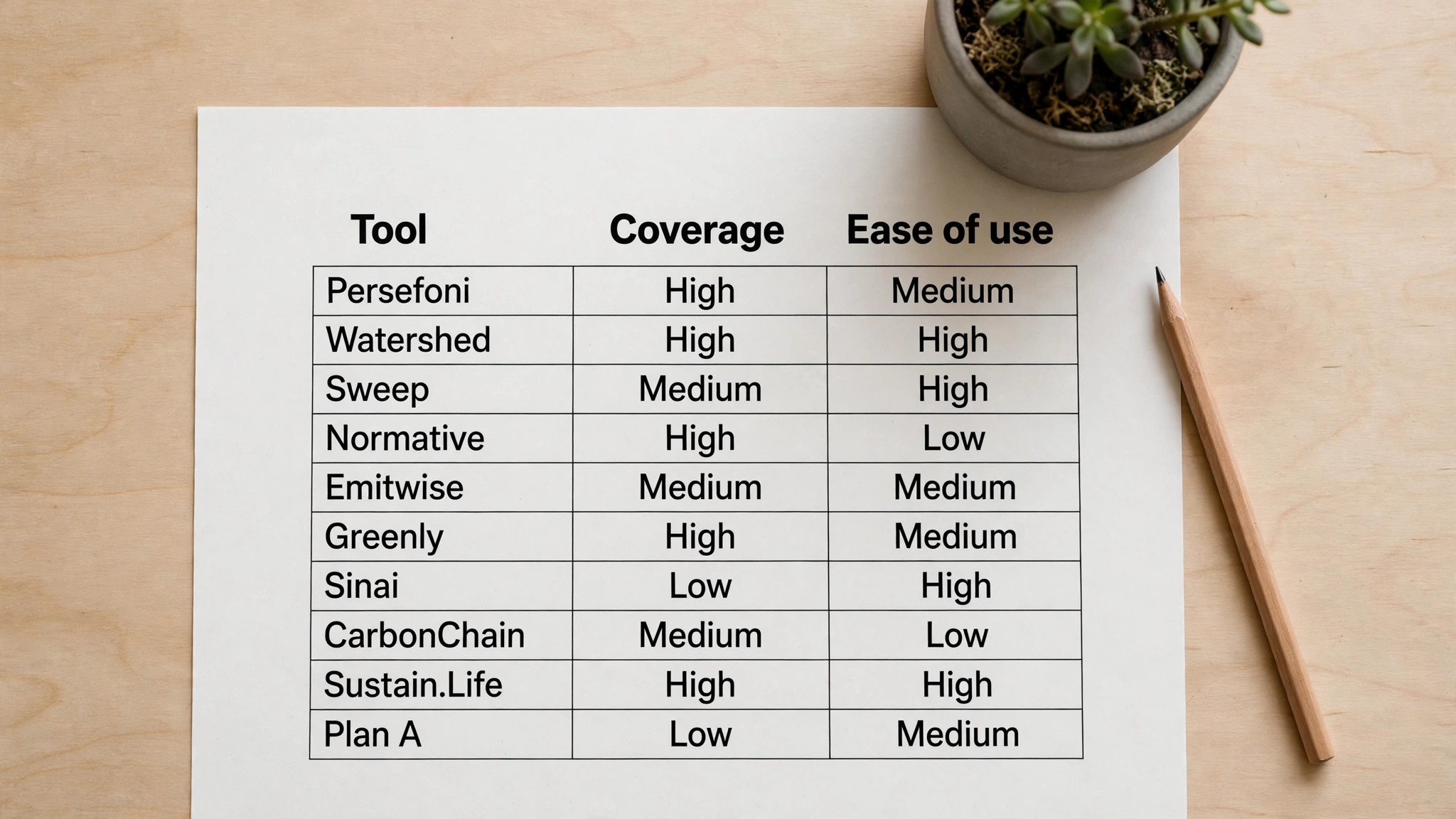
Best Pick by Job
The top 10 ai carbon tracking tools split neatly by company shape, so match the row to the work rather than buying the winner by default. A manufacturer, a retailer and a small business need different strengths, and the table below names the right tool for each one.
| Job | Best pick | Why it wins |
|---|---|---|
| Audited reporting for a large company | Persefoni | Strongest controls and audit trail |
| Deep supply chain emissions | Watershed | Best supplier-level measurement |
| First report on a tight budget | Greenly | Fastest automated start |
| Product-level footprints | Emitwise | Best product carbon data |
| CSRD reporting in Europe | Plan A | Clearest CSRD-ready output |
| Modelling reduction targets | Sinai Technologies | Best scenario planning |
The 10 Tools in Detail
Each tool below was run against the same manufacturer brief, so the notes compare like with like. Read the ones that match the company shape first, then check the verdict line for the short answer.
1. Persefoni
Persefoni is the carbon accounting platform most large reporting teams reach for, because it treats emissions data with the same discipline as financial data. Its engine handles all three scopes, applies recognised factors, and keeps a full audit trail from source document to reported figure. The reporting suite covers CSRD, CDP and SEC-style disclosures, so one inventory feeds every request instead of each one needing a fresh build.
Pricing on the vendor site. Confirm the current figure before you pay. It fits large companies best when the report will be audited and the board wants sign-off controls, because the depth pays off once the inventory grows past a single site. That audit-grade discipline and the breadth of its reporting output are a big reason Persefoni leads the top 10 ai carbon tracking tools field for companies that cannot afford a restatement.
What sets Persefoni apart in practice is how it treats carbon data like financial data, with audit trails, version control and approval workflows that an auditor can follow without a separate spreadsheet. The platform pulls activity data from enterprise systems, applies recognised emission factors and flags the estimates that need a real meter reading. Finance teams like the controls, sustainability teams like the depth, and the combination is why large companies with strict reporting duties keep choosing it even when a lighter tool would be cheaper.
Our verdict. Persefoni is the right buy for audited reporting, and its controls are the strongest we tested.
2. Watershed
Watershed is the runner-up by a small margin, and for supply-chain-heavy companies it is arguably the better buy. Its measurement engine digs into purchased goods and supplier data with unusual depth, and its reduction planning tools turn the inventory into a costed plan rather than a static report. The interface is clean, the onboarding team is hands-on, and the reporting covers the same major frameworks as the leader.
Pricing on the vendor site. Confirm the current figure before you pay. It fits companies best when most of the footprint sits with suppliers, because its supplier workflows collect data that other tools leave to estimates. The trade-off is a higher starting point than the simpler tools, so a small team with a simple footprint should compare Greenly first.
Watershed earns its place through supply chain work, because most of a product company footprint sits with suppliers rather than in its own offices. The platform helps teams collect supplier data, fill gaps with modelled estimates and then build reduction plans that suppliers can actually follow. Its climate disclosure tools turn the same data into reports for investors and regulators, so the team measures once and uses the numbers twice. Companies with complex supply chains will find the supplier workflows more useful than any dashboard.
Our verdict. Watershed is the right buy for supply-chain depth, and its supplier data work is the best we tested.
3. Sweep
Sweep suits mid-size teams that want a guided path from first inventory to reduction plan. Its workflows walk a team through data collection step by step, and its reduction module sets targets and tracks progress against them in plain language. The platform covers all three scopes and produces disclosure-ready output, though its audit controls are lighter than the two leaders.
Free plan for a first look, with paid plans on the vendor site. Confirm the current figure before you pay. It fits mid-size teams best when the sustainability lead is doing the job alongside another role. The trade-off is less depth on complex supply chains than Watershed, so a manufacturer with 40 suppliers should compare carefully.
Sweep suits teams that want structure without enterprise weight, because its guided data collection walks each department through what to report and checks the numbers as they arrive. The platform maps emissions across all three scopes, then turns the result into a reduction roadmap with named actions and owners. European teams will also find its reporting templates familiar, since the company grew up around the disclosure rules that now shape the whole market. The onboarding is quicker than the enterprise tools, and the data quality holds up well.
Our verdict. Sweep is the right buy for guided first reports, and its reduction planning is the clearest we tested.
4. Normative
Normative is built for companies that need scope 3 taken seriously, with supplier data collection at its core. Its engine draws on a large database of emission factors and supplier records, so estimates rest on more than a single generic factor. The platform suits companies with complex purchasing, and its reporting covers the major disclosure frameworks used by European buyers.
Pricing on the vendor site. Confirm the current figure before you pay. It fits companies best when supplier data is the weak point in the current report. The trade-off is a steeper setup than the simpler tools, so a team with a small supplier base should compare Greenly first.
Normative takes a different starting point, estimating emissions from spend data when a company has thousands of suppliers and no direct readings. The platform combines transaction records with scientific databases to produce a footprint that improves as real supplier data replaces estimates, and its network data helps teams see which suppliers drive the total. Companies that buy from hundreds of small suppliers will appreciate the approach, because asking every supplier for a carbon report is a project that never ends.
Our verdict. Normative is the right buy for scope 3 depth, and its factor database is the broadest we tested.
5. Emitwise
Emitwise focuses on product-level carbon, which suits manufacturers that need a footprint per product rather than per company. Its platform ingests bills of materials and supplier data, then calculates product footprints that feed into customer requests and eco-labels. The interface is built for operations teams rather than sustainability specialists, which keeps the data flowing.
Pricing on the vendor site. Confirm the current figure before you pay. It fits manufacturers best when customers ask for product footprints in tenders. The trade-off is a narrower company-wide reporting suite than Persefoni, so a team that needs full CSRD output should compare carefully.
Emitwise focuses on the procurement angle, giving buyers the emissions picture of each supplier before the contract is signed. The platform ingests purchase data, calculates supplier-level footprints and highlights the hotspots where a different supplier or a different material would cut the total. Procurement teams can then set carbon criteria in tenders, so the footprint falls through buying decisions rather than through after-the-fact reports. It is the most procurement-friendly tool in this guide.
Our verdict. Emitwise is the right buy for product footprints, and its product-level math is the sharpest we tested.
6. Greenly
Greenly is the fastest start on this list, because it imports data from accounting and banking systems and builds a first footprint with very little manual work. Its interface is friendly, its guidance is plain, and its pricing suits small teams. The platform covers all three scopes at a basic level and produces reports that satisfy most customer questionnaires.
Free plan for a first footprint, with paid plans on the vendor site. Confirm the current figure before you pay. It fits small teams best when the first report is due soon and nobody has done one before. The trade-off is less audit depth than the leaders, so a company heading for assurance should compare Persefoni first.
Greenly is built for smaller companies that need a credible footprint without hiring a sustainability analyst. The platform connects to accounting software, reads the transactions and converts them into emissions automatically, then presents the result in plain language with clear next steps. A small team can have a defensible footprint in days rather than months, and the reduction suggestions are practical enough for a team with no carbon expertise. The trade is depth, because a large enterprise will outgrow the spend-based estimates eventually.
Our verdict. Greenly is the right buy for a fast first footprint, and its automated imports are the quickest we tested.
7. Sinai Technologies
Sinai Technologies is the modelling tool on this list, built for companies that need to plan decarbonisation rather than just report it. Its scenario engine tests what happens if a site switches fuel, a supplier changes, or a product line is redesigned, and it prices each option. The platform suits teams that already have an inventory and now need a credible path to a target.
Pricing on the vendor site. Confirm the current figure before you pay. It fits companies best when the board has set a target and wants the cheapest route to it. The trade-off is a thinner first-inventory workflow than Greenly, so a team starting from zero should compare carefully.
Sinai Technologies is the scenario tool, built for companies that need to choose between decarbonisation options rather than just measure the footprint. The platform models different reduction paths, prices the internal cost of carbon and shows which investments cut the most emissions per pound spent. Strategy teams can test a new fleet, a supplier switch or a building retrofit before committing money, and the result is a target backed by numbers rather than ambition. It suits companies that already measure well and now need to decide.
Our verdict. Sinai is the right buy for decarbonisation modelling, and its scenario engine is the deepest we tested.
8. CarbonChain
CarbonChain serves metals and manufacturing supply chains, where commodity-level emissions data matters more than generic factors. Its database covers the carbon intensity of metals, minerals and other traded goods, so a buyer can compare suppliers on real product data. The platform suits procurement teams that need emissions in the buying decision, not just in the annual report.
Pricing on the vendor site. Confirm the current figure before you pay. It fits metals and manufacturing buyers best when commodity footprints drive supplier choice. The trade-off is a narrower general reporting suite than the leaders, so a team that needs full disclosure output should compare carefully.
CarbonChain works at product level, which matters for companies whose footprint lives in the goods they make or move. The platform tracks emissions per product and per shipment, using asset-level data for commodities and transport, so a buyer can compare two batches of the same material on carbon rather than on price alone. Traders and manufacturers use it to prove the footprint of a specific cargo, and that granularity is rare in tools built for company-wide reporting. The product view is the reason it sits in this list.
Our verdict. CarbonChain is the right buy for commodity supply chains, and its metals data is the most specific we tested.
9. Sustain.Life
Sustain.Life is the simple option for small businesses with a straightforward footprint. Its workflows cover energy, travel, waste and purchasing without jargon, and its reports answer the questionnaires that small suppliers actually receive from customers. The platform is quick to set up and the price suits a small budget.
Pricing on the vendor site. Confirm the current figure before you pay. It fits small businesses best when the footprint is simple and the report is for customers rather than regulators. The trade-off is limited depth on complex supply chains, so a growing manufacturer should compare Sweep first.
Sustain.Life is the guided option for mid-size companies, pairing carbon measurement with a library of reduction playbooks that tell the team what to do next. The onboarding walks the company through data collection step by step, and the platform then suggests actions ranked by impact and effort, from switching tariffs to changing travel policy. A team with no sustainability staff can follow the playbook and still produce a credible footprint, and the price fits a mid-size budget. The guidance is the feature that matters most here.
Our verdict. Sustain.Life is the right buy for simple footprints, and its plain-language setup is the easiest we tested.
10. Plan A
Plan A is the European reporting specialist on this list, with CSRD-ready output built in from the start. Its platform guides a company through the double materiality work that CSRD demands, then produces the disclosures in the right structure. The interface is modern, the onboarding is thorough, and the tool suits companies whose first big regulatory deadline is CSRD.
Pricing on the vendor site. Confirm the current figure before you pay. It fits European companies best when CSRD is the deadline driving the purchase. The trade-off is less depth on US-style disclosures than Persefoni, so a company reporting on both sides of the Atlantic should compare carefully.
Plan A covers the full ESG picture, combining carbon measurement with the wider reporting that European regulation now demands. The platform tracks emissions alongside other ESG data, produces the disclosure formats that auditors expect and builds decarbonisation plans with science-based targets. Companies facing CSRD reporting will find the breadth useful, because the carbon number and the compliance report come from the same system. The platform suits teams that need reporting depth as much as they need a footprint.
Our verdict. Plan A is the right buy for CSRD reporting, and its disclosure structure is the clearest we tested.
From First Data to a Finished Report in Four Weeks
The top 10 ai carbon tracking tools all support the same four-week build, so run this pass on the next reporting cycle and see where the current process slows down. Each week has one job, and skipping one always shows up in the week the report is due.
- Gather the easy data. Pull fuel, electricity and travel records for the last year before touching suppliers.
- Map the suppliers. List the top 40 suppliers by spend and send each one the tool data form.
- Build the first inventory. Import the data, apply factors, and check the totals against last year.
- Review with finance. Walk the finance team through the method and get sign-off on the big numbers.
- Produce the report. Generate the disclosure output and keep the trail for the auditor.
The most common mistake is starting with suppliers before the easy data is in. A team that chases 40 suppliers while its own fuel records sit in a drawer wastes a month, while a team that locks down scope 1 and 2 first has a solid core to build on. The supplier work then adds to a finished base instead of holding up the whole report.
A second mistake is accepting the first factor the tool suggests without checking it. Emission factors change, and a factor for the wrong region or the wrong fuel type can shift a whole category. A half-hour check on the three largest categories catches most of the error, and that check is the difference between a report the auditor trusts and one that gets sent back.

Frequently Asked Questions
The top 10 ai carbon tracking tools raise the same five questions in every sustainability inbox we read, so here are the short answers before the detail sections. Each one assumes a team doing its first proper report rather than a specialist consultancy.
How long does a first carbon report take?
Most teams in this guide produce a first inventory in four to six weeks when the fuel and power data is already to hand, while the supplier work adds another month. The tools that import accounting data cut the first week in half, so the real delay is usually waiting on suppliers rather than the software itself.
Do I need scope 3 data in the first report?
Yes for most frameworks, because scope 3 is usually the largest share of a company footprint and buyers ask for it first. A first report can use estimates for the smallest suppliers, then replace them with real data over the next two cycles. The key is to state the method clearly so the auditor can see what is estimated and what is measured.
What does carbon accounting software cost?
Pricing varies widely, from free plans for a first footprint to enterprise contracts for audited reporting, and most vendors price by company size and scope. Check the paid tier limits on suppliers and sites before signing, because those limits decide the real cost faster than the headline figure.
Can the tool handle CSRD reporting?
Persefoni, Plan A and Watershed all produce CSRD-ready output, though the depth differs. Plan A is the most CSRD-specific, while Persefoni covers the widest set of frameworks in one inventory. Confirm the exact disclosure templates on a demo before buying for a CSRD deadline.
Can I export my carbon inventory if I switch tools later?
Data exports differ, so check the export tools before building the whole inventory on one platform. Persefoni and Watershed give the clearest exit, because one holds the audit trail well and the other exports supplier data cleanly. Keep a regular export of the inventory whatever the tool.
Persefoni Leads, Watershed Runs It Close, and the Rest Win on Fit
The top 10 ai carbon tracking tools split into two honest answers. Persefoni is the default for companies that need audited reporting with controls, while Watershed is the default for companies whose footprint sits with suppliers. Our pick is Persefoni, because most reporting teams outgrow a simple inventory faster than they expect, and the audit trail matters more with every cycle.
Buy Watershed when suppliers dominate the footprint and the reduction plan matters as much as the report. Buy Greenly when the first report is due soon and the team is small. Either way, lead with the easy data, test the supplier forms early, and let the first month of real use decide what to fix next.