

A budget that nobody follows is worse than no budget at all, because it adds guilt to the same spending. The difference between a budget that works and one that dies in week two is rarely willpower. It is the tool. A tool that matches how you think about money gets opened every day, while one that fights your habits gets abandoned by February. The top 10 budgeting software in this ranking were tested the way a real household would use them, with real bills, real debt and real months where the plan fell apart.
We tested ten platforms over eight weeks, running the same household budget through each one, with income, rent, food, transport, debt payments and savings goals. YNAB leads the ranking on the combined score, because its give every dollar a job method changes behaviour rather than just recording it. PocketSmith takes second place for households who want to see the future, with forecasts that stretch months ahead.
This guide is written for a person or a household that wants control of its money without becoming an accountant. Every tool below was judged on the questions that decide whether a budget survives. How fast can a transaction be recorded. How clearly does it show what is left to spend. How much of the work happens without manual typing. The order below follows those answers for households weighing YNAB, not the size of any feature list.
Budgeting software does four practical jobs. It connects to bank accounts and imports transactions, it sorts spending into categories, it shows what is left in each category, and it tracks progress toward a goal such as debt payoff or a deposit. The tools in this ranking differ mainly in how much they automate and how clearly they show the future.
In this article
The 10 Tools at a Glance
The table below distils eight weeks of testing into one row per tool, with the price shape, the natural fit and the strength that earned its place. The top 10 budgeting software are not always the most automated, and the table shows why. YNAB leads on behaviour change, while PocketSmith leads on forecasting and Goodbudget leads on the envelope method.
| Tool | Starting price | Best for | Standout strength |
|---|---|---|---|
| YNAB | Pricing on the vendor site | Households who want behaviour change | Give every dollar a job, with live coaching |
| PocketSmith | Free plan; paid plans on the vendor site | Households who plan months ahead | Forecasts that show the future clearly |
| Goodbudget | Free plan; paid plans on the vendor site | Households who love envelope budgeting | Digital envelopes that are easy to follow |
| EveryDollar | Free plan; paid plans on the vendor site | Households who want a simple zero based plan | Simple zero based budgeting with a clean app |
| Empower Personal Dashboard | Free plan | Households who want budgeting plus investing | Net worth and budgeting in one free view |
| Quicken Simplifi | Pricing on the vendor site | Households who want spending watched | Spending watchlists with clear alerts |
| Tiller | Pricing on the vendor site | Households who love spreadsheets | Bank feeds inside a real spreadsheet |
| Monarch | Pricing on the vendor site | Households who want a modern all rounder | Clean design with goals and reports |
| PocketGuard | Free plan; paid plans on the vendor site | Households who want a simple safe to spend number | In my pocket figure that prevents overspend |
| Honeydue | Free plan | Couples who budget together | Shared budgeting built for two people |
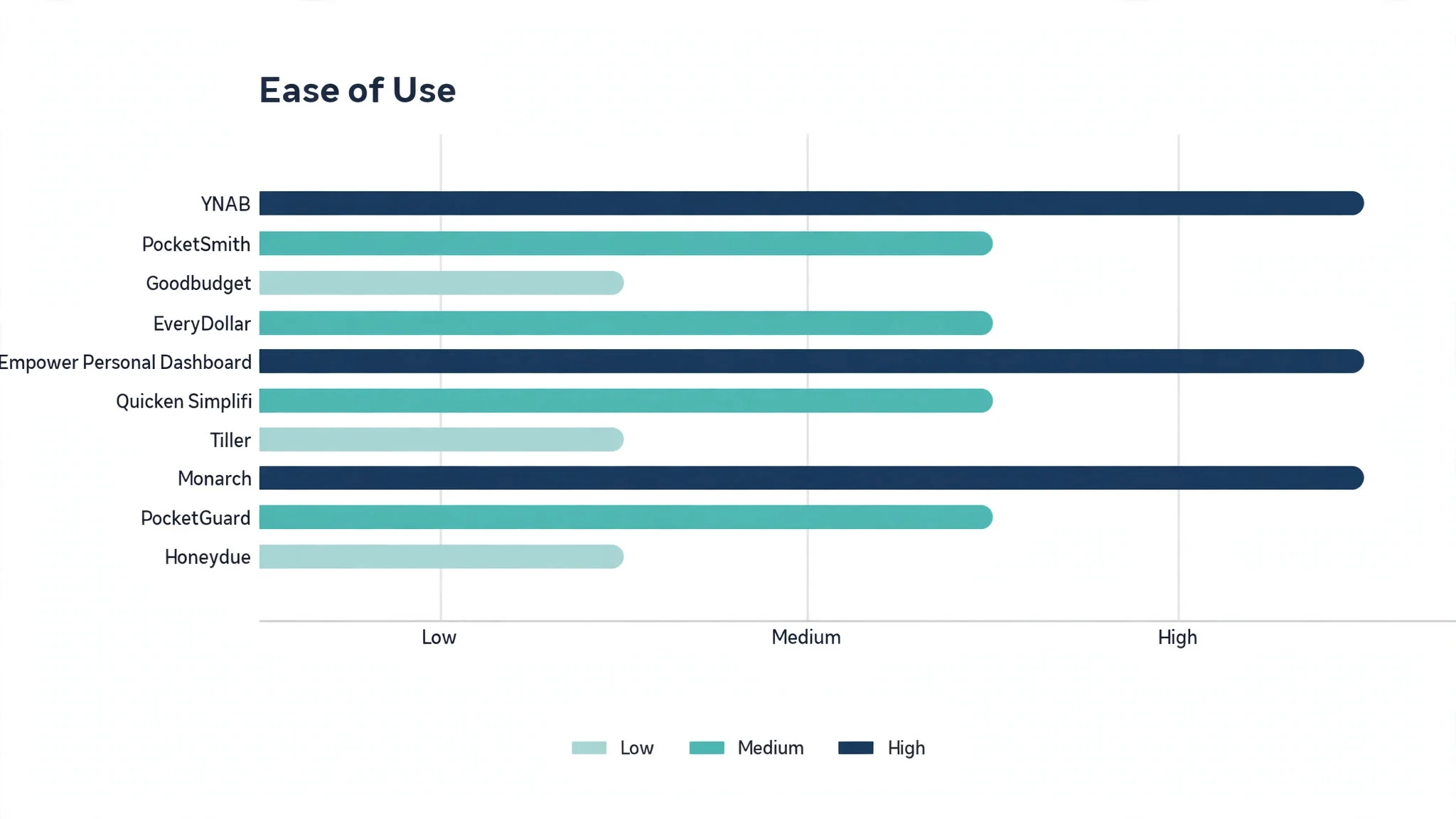
Use the table to cut the list to two or three candidates, then let the detail reviews of YNAB and PocketSmith decide between them. A tool that scores High on automation is only useful if it connects to your bank, and a tool that scores High on reporting is only useful if you actually read the reports. The detail reviews below score that balance for YNAB wherever a real number was honestly measurable.
One more filter before the detail. Check whether the tool supports the accounts you actually hold, because a platform that cannot connect to your bank will need manual entry for every transaction. Ask how it handles a joint account or a shared household before you commit, since the answer decides whether the tool fits your real life.
Why the Top 10 Budgeting Software Matter in 2026
Most households do not overspend because they are careless. They overspend because they cannot see what is left until the money is gone, and by then the month is already lost. The top 10 budgeting software matter because they show the remaining money while it can still change a decision, at the shop rather than at the bank statement.
Awareness is the first reason. A household that sees food spending rise in week two can cook more in week three, while one that discovers it on the statement cannot change anything. The better tools in this ranking update the category balance the moment a transaction lands, so the warning arrives in time to act. That single habit saves more money than any coupon.
Debt payoff is the second reason. A household with a clear payoff plan and a tool that shows the shrinking balance will stick with it, while one with a vague intention will drift. The tools that rank highest here let the user set a payoff date, show the interest saved by paying extra, and celebrate the milestones. That visible progress is what keeps a long payoff going.
Savings is the third reason. A household that pays itself first, by moving money to savings on payday, builds a buffer without feeling the loss. The tools that automate that transfer and show the growing balance make saving the default rather than the leftover. We tested the goal tracking on every tool, and the results shaped the ranking.
Arguments are the fourth reason, and they are the one nobody admits. Money is the most common argument in a household, and most of those arguments are really about surprise. A shared budget that both partners can see removes the surprise, because the spending is visible to both before the conversation starts. The tools that share well prevent more arguments than any budgeting book.
The fifth reason is the future. A household that can see six months ahead can plan for the car service, the school trip and the holiday without borrowing, while one that lives month to month will fund every surprise with debt. The tools in this ranking that forecast ahead turn surprises into plans, and that shift is what separates a household that copes from one that is in control.
How We Tested Every Budgeting Tool
We ran each tool through eight weeks of real household budgeting, with the same income, bills, food, transport, debt payments and savings goals entered into every platform. The top 10 budgeting software were scored on five measures that matter to a household rather than a vendor.
- Bank connection, measured by how reliably the tool imported transactions and how quickly a new purchase appeared in the right category.
- Category clarity, judged by how clearly the tool showed what was left to spend in each category, and how easy it was to move money between categories.
- Goal tracking, judged by how well the tool handled a debt payoff plan and a savings goal, and how clearly it showed progress.
- Forecasting, judged by how far ahead the tool could show the household’s money position and how accurate that forecast proved.
- Daily usability, judged by how long it took to check the budget, record a cash purchase and fix a wrongly categorised transaction.
Each measure carried equal weight except bank connection, which counted double, because a budget that cannot see transactions is not a budget at all. Scores run out of 100, and the order below follows the combined total, led by YNAB on Bank connection. Where two tools tied, we broke the tie on category clarity, since a clear remaining balance is what a household checks every day.
We also checked the mobile experience, because a budget that only works on a desktop will not be checked at the shop, which is where the decision happens. The best tools in this ranking give a phone app that shows the remaining balance in seconds, while the weakest leave the user guessing until they get home. That gap matters more as cash spending falls and card spending rises.
Best Pick by Job
A single winner does not fit every household, so we matched each common situation to the tool that scored highest for that job. The top 10 budgeting software for a household paying off debt look different from the right pick for a couple budgeting together, and the table below makes that split clear.
| Job | Best pick | Why it wins |
|---|---|---|
| Wants behaviour change | YNAB | Give every dollar a job, with live coaching |
| Plans months ahead | PocketSmith | Forecasts that show the future clearly |
| Loves envelope budgeting | Goodbudget | Digital envelopes that are easy to follow |
| Wants a simple zero based plan | EveryDollar | Simple zero based budgeting with a clean app |
| Wants budgeting plus investing | Empower Personal Dashboard | Net worth and budgeting in one free view |
| Wants spending watched | Quicken Simplifi | Spending watchlists with clear alerts |
| Loves spreadsheets | Tiller | Bank feeds inside a real spreadsheet |
| Wants a modern all rounder | Monarch | Clean design with goals and reports |
| Wants a simple safe to spend number | PocketGuard | In my pocket figure that prevents overspend |
| Budgets as a couple | Honeydue | Shared budgeting built for two people |
If your situation does not match a row exactly, take the closest one and read that review first, starting with YNAB when it fits. The gap between neighbouring tools is smaller than the gap between a tool you open daily and one you avoid, so fit to your habits matters more than a few points on a scorecard.
One habit deserves a mention. The households who get the most from any tool in this ranking check the remaining balance before any unplanned purchase over a set amount, and they move money between categories the same day. That brief routine is what keeps a budget honest, and no feature can do the same job.
The 10 Tools in Detail
Each review below follows the same pattern for YNAB. We cover what the tool does best, where it falls short, and the household that will gain the most from it. Where the vendor site listed a price we could verify, it appears in the review for YNAB and PocketSmith, and where the price sits behind a sales call or a plan page, the review says so.
1. YNAB
YNAB is the behaviour specialist, and it leads this ranking because it changes how people think about money rather than just recording it. Its method gives every dollar a job before the month starts, ages money so spending comes from last month’s income, and teaches the habit through short lessons. For a household that has tried budgeting and failed, that teaching is the whole product.
The top 10 budgeting software need a method that survives a bad month, and YNAB is strongest here too. When spending goes over in one category, the tool shows exactly which category can cover it, so the budget bends instead of breaking. The trade off is price and learning time, since YNAB costs more than the free tools and takes a few weeks to feel natural.
Our verdict. The strongest behaviour change here, and the best all rounder for households who want control.
2. PocketSmith
PocketSmith is the forecasting specialist, and it earns second place by showing the future clearly. Its calendar forecast stretches months ahead, showing when bills land, when the balance dips and when a goal is reached. For a household planning a holiday, a car purchase or a debt free date, that forward view is worth a lot.
The trade off is complexity. PocketSmith has more settings than the simpler tools, and a household that wants a quick daily check may find it heavier than needed. A planner who loves the forecast will find it the best pick on this list, while one who wants simplicity should look at PocketGuard or EveryDollar.
Our verdict. The best future view here, ideal for households who plan months ahead.
3. Goodbudget
Goodbudget is the envelope specialist, and it earns its place by turning the old cash envelope method into a clean digital system. Money is divided into envelopes for food, transport, fun and bills, and the balance in each envelope is always visible. For a household that thinks in envelopes, that clarity is the whole point.
The limitation is automation. Goodbudget relies on manual entry for many transactions, since its bank connection is limited in some regions. A household that is happy to enter spending by hand will find it ideal, while one that wants full bank sync should look higher up this list.
Our verdict. The best envelope budgeting here, ideal for households who love the envelope method.
4. EveryDollar
EveryDollar is the simplicity specialist, and it earns its place with a clean zero based budget that anyone can understand. Income minus planned spending equals zero, every dollar is assigned, and the app shows the remaining balance clearly. For a household that wants a simple plan without a learning curve, that clarity is the point.
The trade off is that bank sync sits on the paid plan, so the free version needs manual entry. A household that is happy to enter transactions or pay for the sync will find it a good fit, while one that wants free automatic imports should look at Empower or PocketGuard.
Our verdict. The simplest zero based plan here, ideal for households who want a clean start.
5. Empower Personal Dashboard
Empower Personal Dashboard is the free all rounder specialist, and it earns its place by giving budgeting plus investing in one free view. It tracks spending, shows net worth, and monitors investments beside the budget, so a household can see the whole financial picture. For a household that wants a free tool with real depth, it is hard to beat.
The limitation is that its budgeting is lighter than the dedicated tools, and its focus is wealth rather than daily spending control. A household that wants a free overview will find it ideal, while one that needs strict category control should look at YNAB.
Our verdict. The best free overview here, ideal for households who want budgeting plus investing.
6. Quicken Simplifi
Quicken Simplifi is the watchlist specialist, and it earns its place by watching spending and warning before it goes wrong. It builds spending watchlists, flags unusual transactions and shows a clear spending plan for the month. For a household that wants an early warning rather than a monthly report, that alert is valuable.
The trade off is that Simplifi is newer and lighter on long term planning than PocketSmith or YNAB. A household that wants clear alerts and a simple plan will find it a good fit, while one that needs deep forecasting should look higher up this list.
Our verdict. The best spending alerts here, ideal for households who want an early warning.
7. Tiller
Tiller is the spreadsheet specialist, and it earns its place by putting bank feeds inside a real spreadsheet. Transactions flow into Google Sheets or Excel automatically, and the household can build any report, chart or plan it wants. For a household that loves spreadsheets and wants total control, that freedom is unmatched.
The limitation is that Tiller is a feed plus a spreadsheet, not a finished budgeting app, so the household has to build its own system. A spreadsheet lover will find it the best pick on this list, while one who wants a ready made app should choose a tool higher up.
Our verdict. The best spreadsheet budgeting here, ideal for households who love spreadsheets.
8. Monarch
Monarch is the modern all rounder specialist, and it earns its place with a clean design that covers budgeting, goals and reports in one place. It connects to banks, tracks net worth, and lets couples share a household view. For a household that wants a modern tool that does everything well, it is a strong choice.
The trade off is price. Monarch is a paid tool with no free plan, so a household on a tight budget should weigh it against the free options. A household that values design and a complete feature set will find it worth the cost, while one that wants free should look at Empower or PocketGuard.
Our verdict. The most polished all rounder here, ideal for households who want a modern tool.
9. PocketGuard
PocketGuard is the simplicity specialist for overspenders, and it earns its place with one number that matters. After bills, goals and savings are set aside, it shows the amount left that is safe to spend, and that single figure prevents more overspending than any report. For a household that keeps blowing the budget, that number is the whole product.
The limitation is depth. PocketGuard is deliberately simple, and a household that wants detailed forecasting or debt planning will outgrow it. A household that needs a clear daily limit will find it ideal, while one that wants a full plan should look at YNAB or PocketSmith.
Our verdict. The clearest safe to spend number here, ideal for households who overspend.
10. Honeydue
Honeydue is the couples specialist, and it closes this ranking as the pick for two people budgeting together. It shares bills, tracks spending for both partners, and lets each person see the household picture without sharing every account. For a couple who split costs and want no surprises, that shared view is the whole point.
The trade off is that Honeydue is built for couples, and a single person will find its sharing features unused. A couple will find it the best pick on this list, while a single household should choose a general tool higher up.
Our verdict. The best shared budgeting for couples here, ideal for two people budgeting together.
How to Choose a Budgeting Method First
The method matters more than the tool, because a tool that fights your method will be abandoned. The zero based method gives every dollar a job before the month starts, and it suits households who want full control. The envelope method divides money into pots for each purpose, and it suits households who think in cash. The 50 30 20 method splits income into needs, wants and savings, and it suits households who want a simple rule.
Start with the method, then pick the tool that serves it best. YNAB and EveryDollar serve zero based budgeting, Goodbudget serves envelopes, and PocketGuard serves the simple safe to spend idea. A household that picks the tool first and the method second will spend months fighting a system that does not match how it thinks, and the budget will die in week three.
Test the method for one month before judging it. The first month is always messy, because the categories are wrong and the numbers are guesses. The second month is the real test, when the categories are fixed and the household can see whether the method fits. A method that survives the second month is the right one, and the tool that supports it is the right tool.
Finally, confirm the current price before you pay for any tool, and remember that the most expensive tool is not the best one for your method. A free tool that matches your method beats a paid tool that fights it, and the household that picks by method rather than by price will still be budgeting a year later.
Making the Budget Stick Past Month Two
Month one is exciting, month two is hard, and most budgets die in month two. The reason is rarely the numbers. It is the feeling that the budget has failed because spending went over in one category, and the household gives up instead of adjusting. The top 10 budgeting software all handle overspending the same way, by moving money from another category, and the households that learn that move are the ones that survive.
The first habit is the weekly check. Ten minutes every Sunday, looking at what is left in each category and moving money where it is needed, keeps the budget honest. A household that checks weekly catches a problem while it is small, while one that checks monthly discovers it when the money is gone.
The second habit is the realistic category. A food budget that is too low will fail every month, and the household will blame the tool instead of the number. Set the first month’s categories from the last three months of real spending, not from a wish, and adjust them in month two. A budget built on real numbers is one that can be kept.
The third habit is the fun money. A budget with no room for enjoyment will be broken, and the break will be bigger than the allowance would have been. Give every person a small amount that needs no justification, and protect it like any other category. That small freedom is what keeps the rest of the budget intact.
The fourth habit is the monthly review. Once a month, sit down together and look at the whole picture, the wins, the overspends and the progress toward the goal. A review that celebrates the wins keeps the habit alive, while one that only lists failures kills it. The households that review together are the ones still budgeting a year later.

Frequently Asked Questions
Households ask the same questions before every budgeting tool change, so we answered the most common ones here. The top 10 budgeting software answer these in their help centres, but the plain answers below are faster to judge a tool against.
Is budgeting software worth paying for?
Yes, when the tool changes behaviour rather than just recording it. A free tool that is never opened saves nothing, while a paid tool that is opened daily can save a household a real sum each month. The test is simple, and it is whether the tool is still open in month three. If it is, the price is justified.
Can budgeting software help pay off debt?
Yes, and that is one of its best uses. The tools that rank highest here let you set a payoff date, show the interest saved by paying extra, and track the shrinking balance month by month. A household with a visible payoff plan sticks with it far longer than one with a vague intention, and the interest saved is often many times the cost of the tool.
Is it safe to connect my bank account?
The tools in this ranking use bank level encryption and read only connections, which means they can see transactions but cannot move money. That is the standard for the industry, and it is safer than emailing statements or typing numbers by hand. Check that any tool you choose uses a recognised connection provider, and never share your bank password directly with a budgeting app.
What is the difference between YNAB and EveryDollar?
YNAB teaches a method, with lessons, live coaching and a system that ages your money so you spend last month’s income. EveryDollar offers a simpler zero based budget with a clean app and less teaching. A household that wants to learn a new way of thinking should pick YNAB, and one that wants a simple plan today should pick EveryDollar.
How long does it take for a budget to work?
One month to set up, two months to feel natural, and three months to see real change. The first month is messy, the second month is the real test, and by the third month the household knows its true spending and can plan with confidence. A household that quits in month one never learns what its money actually does, and that knowledge is the whole point.
The Decision Before You Download
The decision comes down to three numbers, and they are all measurable in a trial. The top 10 budgeting software prove themselves on bank connection, category clarity and whether the budget survives month two, and an eight week trial with your real money will show all three. YNAB wins our ranking on the combined score, but the right tool for your household is the one that moves your worst number the furthest.
Run the trial with your real income and your real bills, and judge the tool on the Sunday check rather than the demo. If the remaining balances are clear, the goals are moving and the budget is still alive in week eight, the system is working. If any one of those three fails, YNAB is fighting you rather than helping you. Pick the tool that makes the truth easy to see, protect the Sunday check, and let the calmer month pay for the subscription many times over.