

A good photo edit takes minutes and a bad tool takes hours, and the difference is usually the software rather than the skill. The top 10 image editing tools in this guide cover desktop editing, browser editing, mobile editing and AI retouching, for photographers, designers and creators alike. We compared ten of them on real photos, and Adobe Photoshop leads the ranking on the combined score, while Canva wins for anyone who needs a finished design fast.
This guide is written for the person who edits photos every day, not for a software reviewer. Every tool below was judged on real images, with the focus on the result, the speed and the price. A tool that only looks powerful in a demo is no use when a deadline is an hour away.
An image editor does three practical things. It corrects the photo, it removes what should not be there, and it exports the result in the right format. The tools in this ranking differ mainly in how deep the control goes and how quickly a beginner can get a good result.
In this article
- The 10 Tools at a Glance
- Why the Top 10 Image Editing Tools Matter More Than a Filter
- How We Tested Every Editor
- Best Pick by Job
- The 10 Tools in Detail
- A Simple Editing Workflow for Every Photo
- Five Editing Mistakes That Ruin a Photo
- A One-Afternoon Choice
- Frequently Asked Questions
- The Verdict Before You Edit the Next Set
The 10 Tools at a Glance
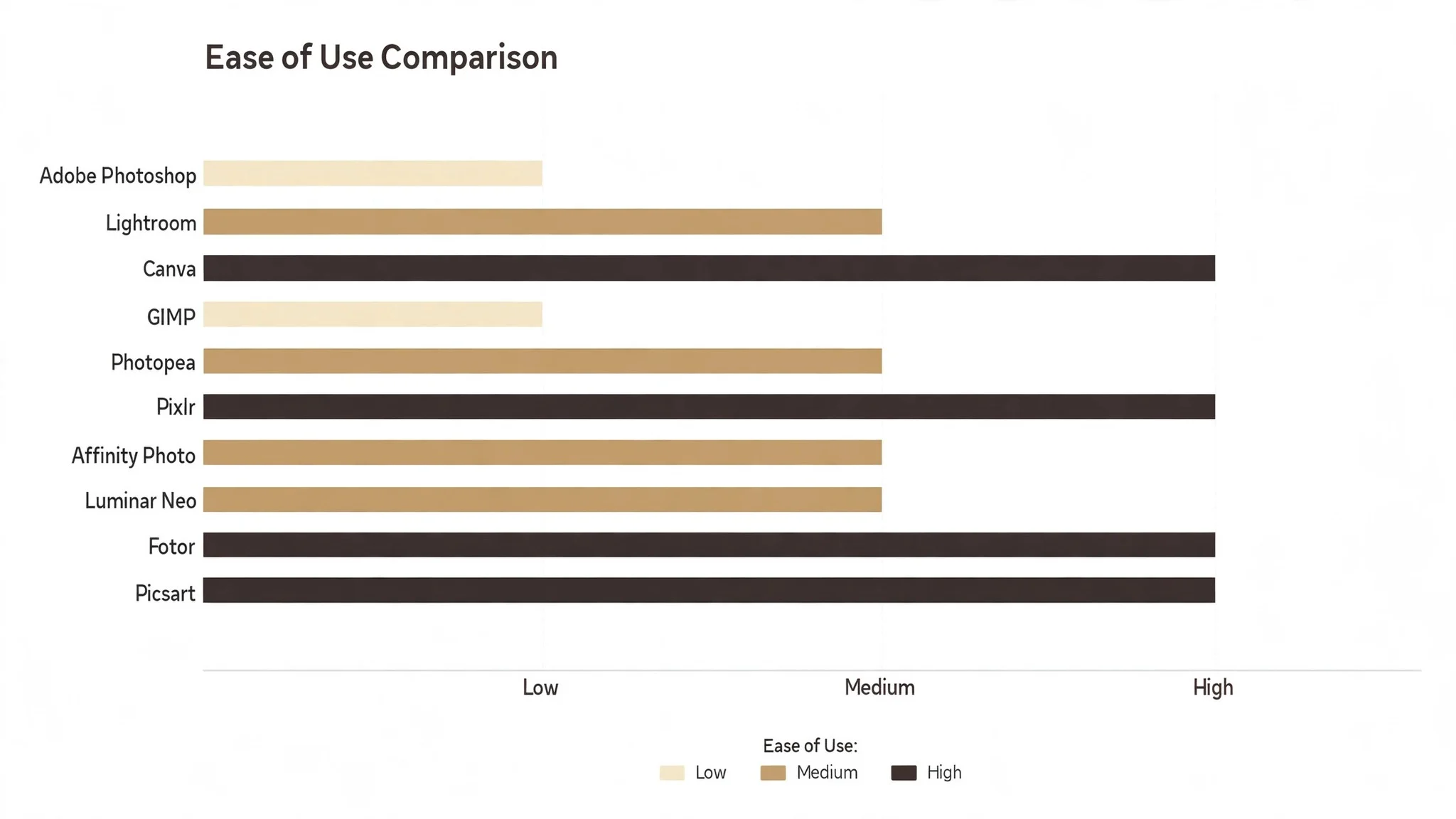
The table condenses the comparison into one row per tool, with the price, the fit for photo editors and the strength that put Adobe Photoshop first. The top 10 image editing tools are not always the most expensive, and the table shows why.
| Tool | Starting price | Best for | Standout strength |
|---|---|---|---|
| Adobe Photoshop | Pricing on the vendor site | Editors that need full control | The deepest editing tool available |
| Lightroom | Pricing on the vendor site | Photographers editing a whole set | Fast batch editing with presets |
| Canva | Free plan; paid plans on the vendor site | Anyone that needs a quick design | Templates for almost any format |
| GIMP | Free plan; paid plans on the vendor site | Editors that want a free desktop tool | Free, powerful desktop editing |
| Photopea | Free plan; paid plans on the vendor site | Editors that need Photoshop files in a browser | Free browser editing with PSD support |
| Pixlr | Free plan; paid plans on the vendor site | Quick edits without an install | Fast browser editing with AI tools |
| Affinity Photo | Pricing on the vendor site | Editors that want a one-off purchase | Pro editing without a subscription |
| Luminar Neo | Pricing on the vendor site | Photographers that want AI retouching | AI sky, portrait and scene tools |
| Fotor | Free plan; paid plans on the vendor site | Beginners that want guided edits | One-click enhancements and templates |
| Picsart | Free plan; paid plans on the vendor site | Creators editing on a phone | Mobile editing with stickers and effects |
Start with the table to narrow the list to two or three, then let the detail reviews settle it for a photo editor, with Adobe Photoshop first. A tool that leads on result quality still has to fit the daily work of a photo editor, and a tool that leads everywhere still has to sit on a plan you can pay for.
Why the Top 10 Image Editing Tools Matter More Than a Filter
Price is the first filter, but the sticker price is rarely the real cost. Photographers and designers should add the setup time, the training hours and the monthly fee together, then divide by the jobs the tool actually handles. A tool that needs constant fixing costs more than a pricier one that runs quietly in the background, whatever the sticker price says for Adobe Photoshop.
Fit beats features. result quality matters more to photographers and designers than a long feature list, because the tool is used every day on real work. A tool that handles editing photos for print and web cleanly and skips the rest is worth more than one that does everything badly.
Time is the second filter. Measure how long editing photos for print and web takes before the tool and after it, across a full week rather than a single demo. The tools in this ranking earn their place by cutting hours from the weekly routine, not by adding another dashboard a photo editor never opens.
Data is the third filter. editing speed decides whether the tool pays for itself, and a tool that cannot report on it is guessing. Ask Adobe Photoshop for the report before you buy, and check that it shows the numbers a photo editor actually manages by.
The last filter is an edit that cannot be undone or exported. A tool that fails on an edit that cannot be undone or exported will cost a client or a deadline, and no feature list makes up for that. Run Adobe Photoshop on a live job with real data, and judge it on the worst day, not the best one.
Support is the quiet filter that shows up later, and Adobe Photoshop is judged on it like every tool here. When something breaks at the worst moment for a photo editor, the quality of the help matters more than any feature list. Before Adobe Photoshop becomes part of the daily routine, check the support hours, the response time and whether a real person answers.
How We Tested Every Editor
We ran each tool through real editing photos for print and web work, covering the setup, the daily use and the result. The top 10 image editing tools were scored on five measures that matter to photographers and designers rather than to a vendor.
- result quality
- editing speed
- learning time
- file format support
- price
Each measure carried equal weight except result quality, which counted double, because a tool that fails on that measure fails on the job itself. Every tool below carries a score out of 100, and the order follows the combined total, with Adobe Photoshop first. Where two tools tied, we broke the tie on editing speed, since the tool a photo editor reaches for daily is the one that has to feel easy.
Best Pick by Job
A single winner does not fit every photo editor, so we matched each common situation to the tool that scored highest for that job. The right pick among the top 10 image editing tools depends on the work in front of you, and the table below makes that split clear.
| Job | Best pick | Why it wins |
|---|---|---|
| Editors that need full control | Adobe Photoshop | The deepest editing tool available |
| Photographers editing a whole set | Lightroom | Fast batch editing with presets |
| Anyone that needs a quick design | Canva | Templates for almost any format |
| Editors that want a free desktop tool | GIMP | Free, powerful desktop editing |
| Editors that need Photoshop files in a browser | Photopea | Free browser editing with PSD support |
| Quick edits without an install | Pixlr | Fast browser editing with AI tools |
| Editors that want a one-off purchase | Affinity Photo | Pro editing without a subscription |
| Photographers that want AI retouching | Luminar Neo | AI sky, portrait and scene tools |
| Beginners that want guided edits | Fotor | One-click enhancements and templates |
| Creators editing on a phone | Picsart | Mobile editing with stickers and effects |
If your situation sits between two rows, take the closer one and read that review first, with Adobe Photoshop first in line. A few points on a scorecard matter less than the gap between a tool a photo editor opens daily and one it avoids, so fit to the daily work comes first, whatever Adobe Photoshop scores.
The 10 Tools in Detail
Every review below follows the same pattern, starting with Adobe Photoshop. We cover what the tool does best, where it falls short, and the photo editor who will gain the most from it. The top 10 image editing tools differ mainly in result quality, and the reviews below judge that difference on real numbers wherever one could be measured.
1. Adobe Photoshop
Photoshop is the standard for detailed photo editing, with layers, masks, selections and retouching tools that handle almost any job, from a simple crop to a complex composite. Its AI features fill, extend and clean up images, and the file support covers print and web.
The subscription cost is ongoing, and the learning curve is steep for a beginner who only needs basic edits.
Cost is straightforward. Adobe Photoshop lists its plans on the vendor site, so confirm the current price before you pay, and compare the monthly fee against the time the tool saves each week. The yearly plan usually costs less per month than the monthly plan, so a photo editor that commits after a good trial of Adobe Photoshop often saves over the year. Before judging the price, add the setup time to the first-year cost of Adobe Photoshop. A tool that needs a week of setup costs more than a pricier one that works on day one, whatever the price page says for Adobe Photoshop.
Our verdict. The strongest option here for editors that need full control, with the deepest editing tool available.
2. Lightroom
Lightroom edits a whole photo set quickly, with presets, batch adjustments and cloud sync that keep the look consistent across hundreds of images. Photographers cull, correct and export from one catalogue, and the mobile app edits on the go.
It is a photo editor rather than a design tool, so text, layouts and composites need Photoshop or Canva.
Support matters when Lightroom breaks at the worst moment, and that is when a photo editor finds out what the plan really covers. Lightroom offers help through its help centre and support channels, and the response time is worth testing with a real question during the trial. Before you buy Lightroom, read the help centre, because a tool with clear guides and fast answers will save hours over the year. Put one real question to the Lightroom support team during the trial. Judge the Lightroom answer on speed and clarity, because that answer is the support you will actually get.
Our verdict. Pick this one for photographers editing a whole set. Fast batch editing with presets.
3. Canva
Canva offers templates for social posts, presentations, posters and more, with a drag-and-drop editor that a beginner learns in minutes. Its photo editor handles crops, filters and background removal, and the brand kit keeps colours and fonts consistent.
The photo editing is lighter than a dedicated editor, and the best templates and tools sit on the paid plan.
Integration is where Canva earns its keep. It connects to the tools a photo editor already uses, so the data flows without retyping, and the first connection is worth testing with a real record before the trial ends. Check the integration list for the exact tool a photo editor already uses, not just its category, because a connector that looks good on a list can still fail on your data. For Canva, a clean export matters as much as a clean import. Confirm that Canva lets the data out in a usable format, so the business is never locked into one vendor.
Our verdict. Templates for almost any format, and the best choice for anyone that needs a quick design.
4. GIMP
GIMP is a free, open-source editor with layers, masks and a wide range of filters, and it runs on Windows, Mac and Linux. It handles retouching, compositing and format conversion without a subscription, and the plugin library extends it further.
The interface feels dated next to Photoshop, and some workflows take more steps to achieve the same result.
Daily use is where GIMP proves itself. The dashboard shows the numbers that matter in one view, and mobile access means a photo editor checks them wherever the work happens, not only at a desk. Time the daily check during the trial, and see how long GIMP takes a photo editor. Five minutes is a habit, while twenty minutes is a chore, and that difference decides whether GIMP survives the first month. Test GIMP on a normal busy day, not a quiet one. Run GIMP on the hardest day of the week and judge it there, because a tool that only works on a quiet day is not working.
Our verdict. The strongest option here for editors that want a free desktop tool, with free, powerful desktop editing.
5. Photopea
Photopea runs in the browser and opens PSD, XCF and Sketch files, so an editor can work on a layered file without installing anything. It covers layers, masks, adjustments and export in the formats a designer needs.
The free version shows ads, and the interface assumes the user already knows how a layered editor works.
Reporting is the quiet strength of Photopea. The dashboard tracks result quality over time, so the owner can see whether the tool is paying for itself or only looking busy. Ask for the report before you buy Photopea, and check that it shows the numbers a photo editor actually manages by. If the report answers the wrong question, it is decoration, not evidence, and Photopea should be judged on that. Put a monthly date in the diary to read the report, and decide in advance what number would make you keep or drop Photopea. Decide in advance, because a decision made in advance is an honest one for a photo editor.
Our verdict. Pick this one for editors that need Photoshop files in a browser. Free browser editing with PSD support.
6. Pixlr
Pixlr edits photos in the browser with AI tools for background removal, object removal and face retouching, plus filters and templates for social posts. It suits a quick edit or a batch of social images when there is no time to open a desktop app.
The free plan limits the resolution and the AI credits, and the editing depth is below a desktop tool.
Setup is quick. Pixlr asks for the essentials, connects the account and walks the user through the first real job in one sitting, so the first result appears on day one rather than after a week of configuration. Guided setup in Pixlr covers the common case well, while the unusual case needs a manual step, so check the help centre before the trial ends. Before the trial starts, name one person to own the setup of Pixlr. A tool with an owner gets used every day, while Pixlr with no owner drifts and dies quietly.
Our verdict. Fast browser editing with AI tools, and the best choice for quick edits without an install.
7. Affinity Photo
Affinity Photo offers professional editing with layers, masks, RAW processing and panorama stitching for a one-off price rather than a subscription. It opens PSD files and handles the retouching work that most photographers and designers need.
The plugin ecosystem is smaller than Photoshop, and the AI features are newer and less deep.
Cost is straightforward. Affinity Photo lists its plans on the vendor site, so confirm the current price before you pay, and compare the monthly fee against the time the tool saves each week. The yearly plan for Affinity Photo usually costs less per month than the monthly plan, so a photo editor that commits after a good trial often saves a meaningful amount over the year. Add the setup time to the first-year cost of Affinity Photo before judging the price. A cheap tool that needs a week of setup costs more than a pricier one like Affinity Photo that works on day one.
Our verdict. The strongest option here for editors that want a one-off purchase, with pro editing without a subscription.
8. Luminar Neo
Luminar Neo uses AI to replace skies, relight a scene, retouch portraits and clean up distractions, with sliders that keep the result under the photographer control. It works as a standalone editor or as a plugin for Lightroom and Photoshop.
It is a photo enhancer rather than a full design tool, and the catalogue and batch features are lighter than Lightroom.
Support from Luminar Neo matters when something breaks at the worst moment. Luminar Neo offers help through its help centre and support channels, and the response time is worth testing with a real question during the trial. Read the help centre before you buy Luminar Neo, because a tool with clear guides and fast answers will save hours over the year, while a tool with neither will cost them. Ask the Luminar Neo support team one real question during the trial. Judge the answer on speed and clarity, because that answer is the support a photo editor will actually get from Luminar Neo.
Our verdict. Pick this one for photographers that want AI retouching. AI sky, portrait and scene tools.
9. Fotor
Fotor offers one-click photo enhancement, filters, collage templates and a design editor, with AI tools for background removal and portrait retouching. A beginner can improve a photo in seconds, and the batch editor handles a set of images at once.
The free plan adds a watermark on some exports, and the deeper tools sit on the paid plan.
Integration is where Fotor earns its keep. It connects to the tools a photo editor already uses, so the data flows without retyping, and the first connection is worth testing with a real record before the trial ends. Check the integration list for the exact tool you already use, not just its category, because a connector that looks good on a list can still fail on your editing photos for print and web data. A clean export from Fotor matters as much as a clean import. Confirm that Fotor lets the data out in a usable format, so the business is never locked into one vendor.
Our verdict. One-click enhancements and templates, and the best choice for beginners that want guided edits.
10. Picsart
Picsart edits photos and videos on a phone, with filters, stickers, text tools and AI effects that suit social content. Creators build a post, a story or a reel cover in minutes, and the community templates give a starting point.
The mobile-first design means fine control is harder than on a desktop, and many features need the paid plan.
Daily use is where Picsart proves itself. The Picsart dashboard shows the numbers that matter in one view, and the mobile access means the check happens wherever the work happens, not only at a desk. Watch how long the daily check takes in Picsart during the trial. Five minutes is a habit, while twenty minutes is a chore, and the difference decides whether Picsart survives the first month. The best test for Picsart is a normal busy day, not a quiet one. Run Picsart on the hardest day of the week and judge it there, because a tool that only works on a quiet day is not working.
Our verdict. The strongest option here for creators editing on a phone, with mobile editing with stickers and effects.
A Simple Editing Workflow for Every Photo
A photo edit works when it follows the same five steps every time, from import to export. The order matters, because a retouch done before the exposure is fixed has to be done twice.
- Import and back up. Copy the files to the computer and to a second drive before any editing starts, and never edit the only copy.
- Cull the set. Pick the keepers first, and delete the duplicates and the missed shots, so the editing time goes to the images that matter.
- Correct the exposure. Fix the brightness, the white balance and the crop before any retouching, because those changes affect everything else.
- Retouch lightly. Remove the distraction, smooth the skin or swap the sky, and stop while the result still looks real.
- Export for the purpose. Save a full-size file for print and a smaller file for the web, with the right format and the right colour profile for each.
Follow the workflow above and the top 10 image editing tools will turn a set of raw files into finished images without rework, rather than eating an evening on one photo.
Five Editing Mistakes That Ruin a Photo
Most bad edits come from the same five habits, and all five are avoidable. Check the list before the next set, because an over-edited photo cannot be rescued by another filter.
- Editing the original file. Always work on a copy, so the original stays safe when the edit goes wrong.
- Over-filtering. A filter at full strength looks fake, so dial it back until the photo looks like the scene did.
- Ignoring colour calibration. A screen that shows the wrong colours will ruin every print, so calibrate the monitor once a month.
- Exporting the wrong size. A web-sized file will not print, and a print-sized file will load slowly online, so export both.
- No backup. A crashed drive takes the whole set with it, so keep a second copy somewhere else.
Avoid those five mistakes and the editing stays fast and honest. The tools in this ranking all edit well, so the difference is made by the workflow and the restraint.
A One-Afternoon Choice
A month-long decision is a decision that never happens, so give Adobe Photoshop one afternoon. Cut the shortlist above to one tool in a single afternoon, with a trial that proves the choice on real work for a photo editor.
Start with the top three tools from the table, not the whole list, and let result quality order them. Three trials in one afternoon is realistic, while ten trials is a month of work, and the winner among three usually wins among 10.
Judge each trial on the same job, so the comparison stays honest for a photo editor. A different test for each tool proves nothing, while the same job, timed the same way, shows the real gap for a photo editor.
Write the decision down before the trial starts, including the number that would make you keep the tool and the date you will judge Adobe Photoshop. A written decision survives the sales call, while a vague intention does not, whatever Lightroom promises.
- List the three jobs the tool must do every week, and ignore every feature that does not serve one of them, starting with result quality.
- Check the price on the vendor site, confirm it before you pay, and add the setup time to the first-year cost of Adobe Photoshop.
- Run the trial on a real job with real data, not on the demo account, and time the job from start to finish for Adobe Photoshop.
- Ask the support team one real question during the trial of Adobe Photoshop, and judge the answer on speed and clarity.
- Check the integration with the tool a photo editor already uses most, and test one real record end to end in Adobe Photoshop.
- Read the export options before you commit to Adobe Photoshop, because a tool that cannot export your data is a trap for a photo editor.
- Show the shortlist to the person who will use Adobe Photoshop daily, and let their vote count double on result quality.
- Decide the renewal date in advance, and set a reminder to judge Adobe Photoshop on the numbers for result quality, not on habit.
Pick the tool that wins the afternoon test, run it for a month, and judge it on the numbers a photo editor actually watches. If the numbers move, keep it. If the numbers do not move, the next tool on the list deserves the same afternoon, starting with Lightroom.
Frequently Asked Questions
Photographers and designers ask the same questions before every tool change, so we answered the most common ones here. The top 10 image editing tools answer these in their help centres, but the plain answers below are faster to judge a tool against.
Which editor is best for beginners?
For a small photo editor, start with Canva. It covers templates and quick photo edits without a big monthly fee, and the setup takes hours rather than days. Add a second tool only when the first one cannot handle a job that comes up every week for a photo editor. Start with the smallest plan that covers the job for a photo editor, and upgrade only when the work outgrows it.
Is there a good free editor?
GIMP, Photopea, Pixlr and Canva offer a free plan that covers the basics, which is enough to test the workflow with real work. The free plan limits the resolution and the advanced features, so a busy photo editor will move to a paid plan once the volume grows. Treat the free plan as a trial, not as the long-term setup, and judge Adobe Photoshop on the month it delivers. Treat the Adobe Photoshop free plan as a test, set a date to judge it, and move to a paid plan when the limits start costing time.
Can I edit photos on my phone?
Yes. Picsart, Lightroom Mobile and Pixlr all edit well on a phone, with filters, crops and AI tools that suit social content. A phone is fine for a quick edit, but a desktop still wins for a large set or a print job.
Do I need Photoshop?
Not for most jobs. Canva, Affinity Photo and Photopea handle the everyday editing that most people need, and Photoshop earns its place only when the work needs layers, masks and detailed retouching every day.
Which tool fits social media images best?
Photoshop, Lightroom and Affinity Photo open PSD files, and Luminar Neo works as a plugin inside Lightroom and Photoshop. Check the file formats your clients need, and confirm the export sizes before you commit to a workflow. Run one real record through the Adobe Photoshop integration during the trial, because a connector that looks good on a list can still fail on your data.
The Verdict Before You Edit the Next Set
The top 10 image editing tools ranking comes down to result quality and the weekly time it saves, and Adobe Photoshop wins on the combined score. It is the tool we would start with, because it handles editing photos for print and web cleanly and its reporting shows the result without extra work. Lightroom is the closest rival, and it is the better pick when its strength matters more than the overall score.
Run the trial with your real workload, not a demo account, and judge the tool on the morning routine rather than the feature list, with result quality first. If the check takes minutes and the numbers are honest, the system is working, and Adobe Photoshop earns its place. Pick Adobe Photoshop if it makes the truth easy to see, and let the calmer week pay for the subscription many times over.