

A blank page is the most expensive part of writing. A marketer who stares at it for an hour has lost an hour that should have gone to the campaign, and a business that publishes one post a month because writing takes so long is losing the search traffic its rivals collect weekly. The top 10 ai copywriting tools in this guide exist to break that block, by turning a short brief into a solid first draft in minutes.
We tested each tool on real marketing work, not on a feature list. That meant writing the same five pieces in every tool, which was a product description, a landing page headline set, an email, a social post, and a blog introduction, then judging each draft for clarity, tone, and how much editing it needed. The ranking weighs how good the first draft is, how fast it arrives, and how easily the tool fits a normal workflow.
Jasper leads the ranking on the combined score, with Copy.ai close behind for teams that want fast, varied drafts. Writesonic wins for teams that want writing plus SEO help in one place, while Anyword suits marketers who need to predict which copy will perform. Jasper earns its place on brand voice, Copy.ai on quick drafts, and the rest on narrower strengths.
Jasper sits first on combined score, but a team that writes one kind of copy should treat the best pick by job table near the end as the real shortlist. A tool that ranks fifth overall can still be the right answer for a freelancer who only writes social posts, just as the overall winner can be wrong for a team that writes long-form guides every week. Match the tool to the writing, not to the rank.
In this article
- The 10 Tools at a Glance
- Why the Top 10 AI Copywriting Tools Change the Writing Week
- How We Put Each Copywriting Tool Through Its Paces
- The 10 Tools in Detail
- What a Team Actually Pays for AI Writing
- Copywriting Mistakes That Waste the Draft
- Best Pick by Job
- Frequently Asked Questions
- Picking the Copywriting Tool Your Team Writes With Daily
The 10 Tools at a Glance
The table below lines up the top 10 ai copywriting tools on the facts that decide a purchase, which are the price shape, the natural fit, and the strength that earned each rank. Jasper leads on brand voice and depth, while Copy.ai wins for teams that want fast drafts with little setup.
| Tool | Starting price | Best for | Standout strength |
|---|---|---|---|
| Jasper | Pricing on the vendor site | Teams that write on brand at scale | Brand voice with deep templates |
| Copy.ai | Free plan; paid plans on the vendor site | Teams that want fast, varied drafts | Quick drafts across many formats |
| Writesonic | Free plan; paid plans on the vendor site | Teams that want writing plus SEO | SEO help beside the writing |
| Anyword | Pricing on the vendor site | Marketers who test copy performance | Predictive scoring for each draft |
| Rytr | Free plan; paid plans on the vendor site | Freelancers who write on a budget | Low-cost writing with many tones |
| Frase | Pricing on the vendor site | Teams that write content to rank | Research and briefs beside the draft |
| Scalenut | Pricing on the vendor site | Teams that plan content around keywords | Keyword planning with AI writing |
| Hypotenuse AI | Pricing on the vendor site | Teams that write product copy fast | Bulk product descriptions that read well |
| Copysmith | Pricing on the vendor site | Ecommerce teams with many listings | Product copy at scale with checks |
| TextCortex | Free plan; paid plans on the vendor site | Teams that write inside other apps | Writing help inside browsers and docs |
Jasper and Copy.ai lead the table, so read their reviews and see which writing habit fits the copy your team produces most. A tool that scores High on speed only helps if the draft needs little fixing, and a tool that scores High on features only helps if the team actually uses them every week.
Why the Top 10 AI Copywriting Tools Change the Writing Week
Speed is the first reason a tool matters, and it is the one that changes the calendar fastest. A first draft that takes ten minutes instead of two hours frees the writer to edit, improve, and publish more, which means the business ships three posts a week instead of one. The tools in this ranking do not replace the writer, but they remove the slowest part of the job, which is the blank page.
Consistency is the second gain. A team that writes with a shared brand voice, saved templates, and the same tone settings produces copy that sounds like one business, not five different people. The best tools in this ranking store the brand voice and apply it to every draft, so a new hire writes like the business from day one.
Volume is the third reason. A business that needs fifty product descriptions, twenty emails, and ten landing pages cannot write them all by hand without hiring, and hiring takes months. A copywriting tool produces the volume in days, and the human editor spends the saved time on the pieces that matter most, which is a better use of the budget.
The final gain is testing. A marketer who can produce five headline options in a minute can test all five, while a marketer who writes one headline by hand tests only one. The tools in this ranking make variation cheap, and cheap variation is what turns good copy into copy that actually converts.
How We Put Each Copywriting Tool Through Its Paces
We ran the top 10 ai copywriting tools through the same five measures, using the same five writing jobs for every tool, which were a product description, a landing page headline set, an email, a social post, and a blog introduction. Each draft was judged on its own merits, so the scores compare like with like.
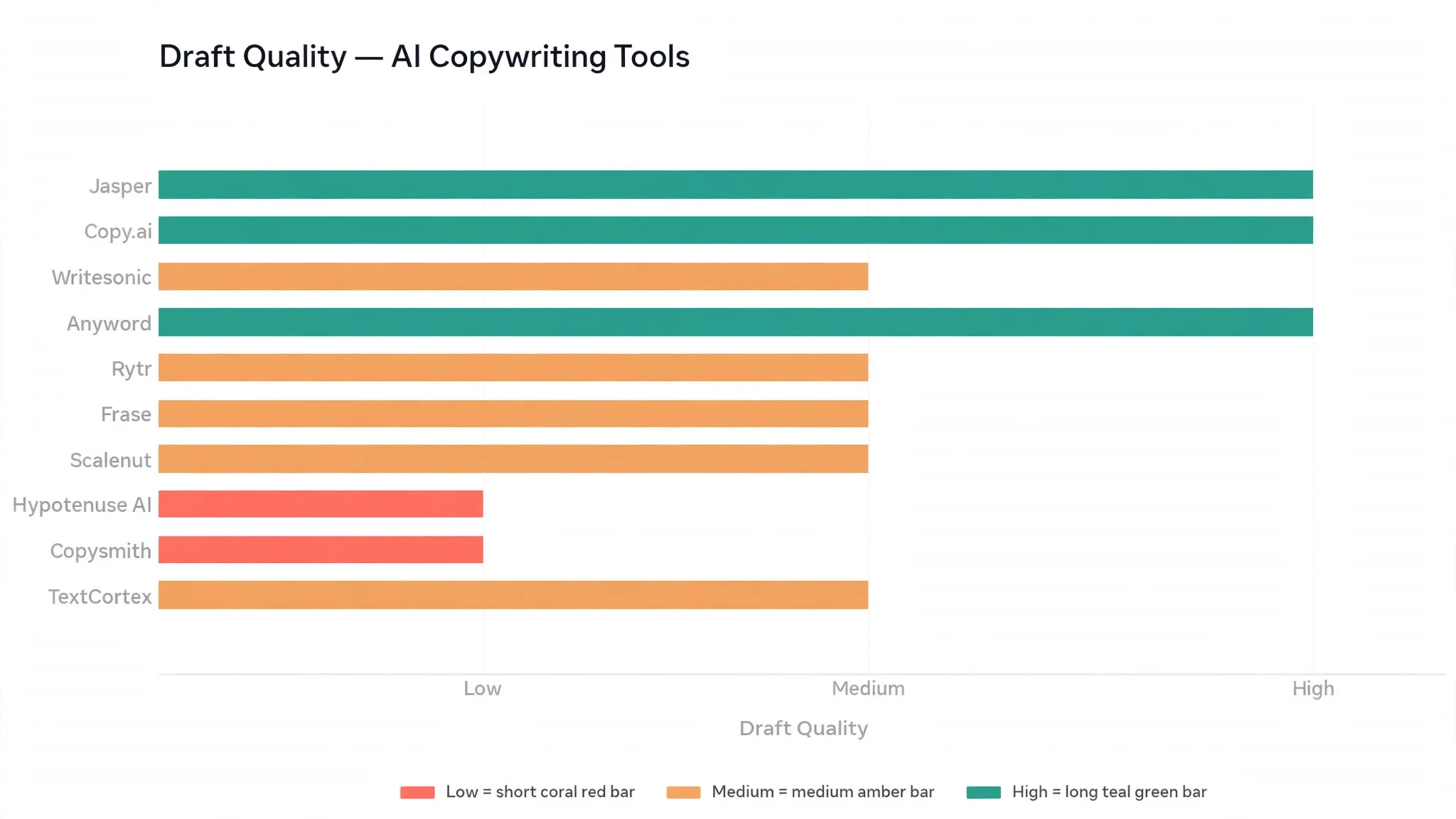
- Draft quality, judged by how clear, correct, and usable the first draft was, and how much editing it needed before it could publish.
- Speed, measured by how long each of the five jobs took, from brief to finished first draft.
- Brand fit, scored on whether the tool could hold a consistent tone and voice across all five jobs, using the same brand settings.
- Setup speed, timed from account creation to the first finished draft, including any brand voice setup and template choice.
- Daily usability, judged by how easily a marketer could brief, draft, and edit during normal work, without asking for help or opening a manual.
Each measure carried equal weight except draft quality, which counted double, because a copywriting tool that produces drafts nobody can use is not doing its job. Scores run out of 100, and the order below follows the combined total, led by Jasper on brand voice and depth.
The 10 Tools in Detail
Each review below judges the top 10 ai copywriting tools on the same ground. We note what each tool does best, where it falls short, and the team it suits best, with draft quality carrying the most weight.
1. Jasper
Jasper tops the top 10 ai copywriting tools on the combined score, and it earns the lead with brand voice controls that keep a team’s writing consistent at scale. The tool learns the business tone from past copy, applies it to every new draft, and offers templates for the formats a marketing team actually uses, from ads to long-form posts. For a team that writes a lot and needs it all to sound like one brand, that consistency is the point.
The strengths run beyond the voice. The long-form editor handles full articles with structure, the AI can rewrite and expand a draft without losing the tone, and the integrations cover the tools a content team already uses. The collaboration features let several writers work in one workspace with shared brand settings.
The limits are price and the learning curve. Jasper costs more than the budget tools in this ranking, and the depth rewards a team that invests time in the brand voice setup. A solo writer who only needs short drafts will find much of it unused, while a team that publishes daily will feel the difference in every piece.
In the trial, write the same landing page in Jasper and in one rival, using the same brand notes. Check which draft sounds more like your business, and how much editing each one needed. If Jasper wins on both, the brand voice is real.
Our verdict. The best on-brand writing here, and the safest first pick for most teams.
2. Copy.ai
Copy.ai is the speed pick, and it earns second place by producing varied drafts fast with very little setup. The workflows turn a short brief into several options in seconds, and the templates cover ads, emails, social posts, and product copy. For a team that needs many drafts quickly, Copy.ai is the workhorse.
The strengths are the speed and the variety. The tool generates several versions of each piece, so the writer picks the best and edits from there, and the free plan covers enough to test the whole flow properly. The workflows can chain steps together, which suits a team that repeats the same writing jobs every week.
The limits are depth and long-form. Copy.ai is strongest on short-form copy, and the long-form editor is lighter than Jasper or Frase, so a team that writes full guides will need more. The brand voice controls are good but less deep than Jasper, and heavy use needs a paid tier.
In the trial, write five social posts and one email in Copy.ai, and time the whole job. Check whether the variety helped you pick a better draft, and whether the editing took minutes. If the job finished fast and the copy sounded right, the speed is real.
Our verdict. The fastest varied drafts here, ideal for teams that write a lot of short copy.
3. Writesonic
Writesonic is the SEO pick, and it suits teams that want writing plus search help in one place. The tool drafts copy, checks it against the search results, and suggests the structure and keywords that help a page rank. For a team that writes to be found, that combined help saves a second tool.
The strengths are the SEO depth and the range. The article writer handles long-form pieces, the templates cover ads and landing pages, and the chatbot and image tools add extras a content team will use. The free plan covers the basics, which is enough to test the writing properly.
The limits are the polish and the price shape. The drafts are solid but sometimes need more editing than Jasper for brand tone, and the credit system needs a little thought to plan. Teams that write mostly short copy will find the SEO features more than they need.
In the trial, write one blog introduction with the SEO tools turned on and check whether the structure and suggestions helped. Read the draft for tone, and see how much editing it needed. If the SEO help was useful and the draft read well, the combination fits.
Our verdict. The best writing plus SEO here, ideal for teams that write to rank.
4. Anyword
Anyword is the performance pick, and it earns its place by predicting which copy will work before it is published. Each draft gets a predictive score based on past performance data, and the tool can tailor the copy to a specific audience. For a marketer who spends real money on ads, that prediction is worth more than any template.
The strengths are the scoring and the audience targeting. The tool shows why a draft scores well or badly, the blog wizard builds a full post from a brief, and the data-driven suggestions help a team improve over time. The integrations cover the main ad platforms.
The limits are price and scope. Anyword costs more than the budget tools, and the predictive features need the team to use the platform regularly to learn from it. A team that writes mostly organic content will get less value than a team that runs paid ads every week.
Our verdict. The best performance prediction here, ideal for marketers who spend on ads.
5. Rytr
Rytr is the budget pick, and it suits freelancers who need good writing for very little money. The tool covers the main formats, offers many tones, and the free plan is genuinely usable for light work. For a freelancer starting out, or a small business watching every expense, Rytr is the honest choice.
The strengths are the price and the simplicity. The interface is plain and quick, the tone selector helps a writer match the audience, and the paid tier stays well below most rivals. The tool handles short copy well, and the browser extension lets a writer draft inside other apps.
The limits are depth and long-form. Rytr is best on short pieces, and the long-form output needs more editing than Jasper or Frase. The brand voice controls are lighter, and a team that writes at scale will feel the ceiling sooner than with the bigger tools.
Our verdict. The best low-cost writing here, ideal for freelancers on a budget.
6. Frase
Frase is the research pick, and it earns its place by building the brief before the draft. The tool analyses the top search results for a topic, shows what the ranking pages cover, and turns that research into an outline the writer can follow. For a team that writes content to rank, that research is the difference between a guess and a plan.
The strengths are the research and the briefs. The content briefs are thorough, the AI writer drafts from the outline, and the optimisation score shows how the draft compares with the pages it needs to beat. The question research finds what readers actually ask, which shapes better articles.
The limits are the writing depth and the price. Frase is a research and SEO tool first, so the raw drafting is lighter than Jasper, and the price suits teams that publish regularly. A team that only needs short copy will find it more than they need.
Our verdict. The best research beside the draft here, ideal for teams that write to rank.
7. Scalenut
Scalenut is the planning pick, and it suits teams that plan content around keywords. The tool finds the keywords worth targeting, groups them into clusters, and turns each cluster into a brief the AI can draft from. For a team that runs a content calendar, that planning saves hours every month.
The strengths are the keyword planning and the briefs. The cluster reports show the topics worth covering, the AI writer drafts from a solid outline, and the optimisation tools check the draft against the competition. The interface keeps the whole plan visible in one place.
The limits are the writing polish and the learning curve. The drafts are solid but sometimes need more editing for tone than Jasper, and the keyword planning takes a session to learn. A team that writes without an SEO plan will get less value from the depth.
Our verdict. The best keyword planning here, ideal for teams that run a content calendar.
8. Hypotenuse AI
Hypotenuse AI is the product copy pick, and it earns its place by writing product descriptions in bulk that actually read well. The tool takes a product name and a few details, and returns a description that sounds like a person wrote it, with the key features and benefits in place. For an ecommerce team with hundreds of listings, that bulk quality is the point.
The strengths are the bulk flow and the quality. The batch tool handles many products at once, the tone controls keep the listings consistent, and the image tools add visuals to the copy. The pricing is fair for the volume it handles, and the setup is quick.
The limits are scope. Hypotenuse AI is built for product and ecommerce copy, so a team that writes blog posts and emails will find it narrow, and the long-form tools are lighter than Frase or Jasper. A general marketing team will need a second tool for the rest of the work.
Our verdict. The best bulk product copy here, ideal for ecommerce teams with many listings.
9. Copysmith
Copysmith is the ecommerce scale pick, and it suits teams with many listings to write and check. The tool generates product descriptions, ad copy, and landing page text in bulk, and the built-in checks flag plagiarism and quality issues before anything publishes. For a team that ships copy at volume, those checks are the safety net.
The strengths are the volume and the checks. The bulk generation handles large catalogues, the templates cover the formats an ecommerce team needs, and the integrations cover the main store platforms. The team features let several writers work together with shared settings.
The limits are the general writing depth. Copysmith is built for ecommerce, so a team that writes thought leadership or long guides will find it narrow, and the brand voice controls are lighter than Jasper. The pricing suits teams with real volume.
Our verdict. The best ecommerce copy at scale here, ideal for teams with large catalogues.
10. TextCortex
TextCortex is the everywhere pick, and it rounds out the ranking with writing help inside the apps a team already uses. The browser extension and integrations bring AI writing into documents, email, and web tools, so the writer never has to open a separate app to draft. For a team that writes in many places, that reach is the appeal.
The strengths are the reach and the free start. The free plan covers a real monthly allowance, the templates handle the common formats, and the knowledge bases let the tool write from the team’s own documents. The interface is clean, and the setup takes minutes.
The limits are depth. TextCortex writes well but does not match Jasper on brand voice depth or Frase on research, and the long-form tools are lighter than the specialists. A team that wants the deepest single-purpose tool will look higher up this list.
Our verdict. The best writing inside other apps here, ideal for teams that write everywhere.
What a Team Actually Pays for AI Writing
The top 10 ai copywriting tools differ most on how the credits work, and the cheapest price per word is not always the cheapest month. A tool that sells words cheaply can cost more if the team regenerates the same piece five times, while a tool with a monthly plan can be the bargain for a team that writes every day. Before choosing, work out how much the team really writes in a month, then compare the total across two or three finalists.
Free plans deserve a hard look. Copy.ai, Writesonic, Rytr, and TextCortex all offer a free start, but each one limits something different, which is words here, features there, and long-form depth elsewhere. A free plan that covers the real weekly writing is a gift. A free plan that runs out halfway through the month is just a trial, so test it against the real workload, not the quietest week.
Watch the seat maths too. Most tools charge per user each month, which suits a solo writer, but a team of five pays five times the headline price. Check what the whole team costs before committing, because the price that looks cheap for one person can grow quickly when the content team expands.

Copywriting Mistakes That Waste the Draft
The first mistake is publishing the first draft untouched. AI copy is a starting point, not a finished piece, and a draft that goes live without a human edit will read generic, repeat itself, and miss the details that make the business sound real. Edit every draft for facts, tone, and the specific claims only the business can make, and the copy will sound like a person wrote it.
The second mistake is briefing badly. A tool given a vague brief returns vague copy, while a tool given the audience, the offer, the tone, and one example returns a draft worth editing. Spend five minutes on the brief, and the draft will need five minutes of editing instead of fifty. The brief is the cheapest quality control in the whole workflow.
The third mistake is letting every writer use different settings. A team where one person uses a formal tone, another uses slang, and a third uses no brand voice at all produces copy that sounds like five businesses. Set the brand voice once, share the templates, and review the output together each week until the whole team sounds like one business.
Best Pick by Job
No single winner fits every team, so the tools below are matched to the job instead of the rank. Find the row that matches what your team writes most, then start the trial with that copywriting tool.
| Job | Best pick | Why it wins |
|---|---|---|
| Writes on brand at scale | Jasper | Brand voice with deep templates |
| Wants fast, varied drafts | Copy.ai | Quick drafts across many formats |
| Writes to rank on search | Writesonic | SEO help beside the writing |
| Tests copy performance | Anyword | Predictive scoring for each draft |
| Writes on a budget | Rytr | Low-cost writing with many tones |
| Researches before writing | Frase | Research and briefs beside the draft |
| Plans content by keyword | Scalenut | Keyword planning with AI writing |
| Writes product copy fast | Hypotenuse AI | Bulk product descriptions that read well |
| Runs a large catalogue | Copysmith | Product copy at scale with checks |
| Writes inside other apps | TextCortex | Writing help inside browsers and docs |
If your situation does not match a row exactly, take the closest one and read that review first, starting with Jasper when it fits. The gap between neighbouring tools is smaller than the gap between a team that edits every draft and one that publishes the first version, so the editing habit matters more than a few points on a scorecard.
Frequently Asked Questions
Marketers ask the same questions before choosing from the top 10 ai copywriting tools, so the plain answers are here, based on how these tools actually work on real writing jobs.
Will AI copy sound robotic to our readers?
It can, if it goes live unedited, but it does not have to. A draft that a human edits for facts, tone, and the specific details of the business reads like a person wrote it, because a person did finish it. The tools in this ranking produce the first draft, and the human produces the final voice, so budget time for the edit on every piece.
How much editing does an AI draft need?
It depends on the piece and the tool. Short copy like ads and product descriptions often needs only a few minutes of fixes, while long-form articles need a proper edit for structure, facts, and tone. Expect to spend a third of the time you would have spent writing from scratch, and treat the tool as a fast first draft rather than a finished writer.
Can these tools match our brand voice?
Yes, and the depth differs by tool. Jasper, Copy.ai, and Anyword all offer brand voice settings that learn from past copy, and the best results come from feeding the tool real examples of the business writing. Set the voice once, test it on five different formats, and adjust until the drafts sound like the business.
Do AI tools help with SEO?
Some do, and the depth differs. Writesonic, Frase, and Scalenut all build SEO into the writing, with keyword suggestions, briefs, and optimisation scores. The rest write well but need a separate SEO tool for the ranking work. A team that writes to rank should weigh the SEO-led tools first.
Is it safe to use AI copy for client work?
Yes, with the same care as any other draft. Check the facts, remove anything the tool invented, and make sure the copy matches what the client actually offers. The tools in this ranking do not check facts for the writer, so the human edit is where the accuracy comes from. A client will judge the copy, not the tool that drafted it.
Picking the Copywriting Tool Your Team Writes With Daily
The top 10 ai copywriting tools prove their worth in the first week, and the proof is simple to measure. Write the same five pieces in two tools, count the editing minutes each draft needed, and read both as a customer would. If one draft needs ten minutes of fixes and the other needs an hour, the choice is made.
Jasper wins our ranking on the combined score, but the right tool for your team is the one whose drafts your writers actually enjoy editing. Run the trial on real briefs from your own business, judge it on the finished copy rather than the demo, and pick the tool that makes the blank page disappear fastest. A fast first draft and a careful human edit will pay for the subscription many times over.