

A food bank runs on donated food, donated money and donated time, and the software that tracks all three decides how much reaches the shelves. A donor who gives online in two minutes is a donor who gives again, and a volunteer who signs up without a phone call is a volunteer who shows up. The best nonprofit tools for food banks keep the giving easy, the donor records honest, and the food drives organised. Zeffy leads this ranking on the combined score, with Bloomerang close behind for food banks that want deep donor retention work.
We judged each tool on real food bank work rather than a feature list. That meant setting up a donation page for a holiday food drive, recording a first-time donor, running a small fundraising event, and thanking the donors who gave last month. We tracked how fast each job finished, how the donor record read, and how a volunteer coordinator coped when fifty donors gave in one weekend.
Zeffy earns the top spot on zero-fee fundraising, Bloomerang on retention depth, and every tool after them on a strength of its own. Some are full donor systems built for growing nonprofits. Others are lighter fundraising tools that suit a small food bank with a volunteer team. The right pick depends on how many donors you have, who runs the fundraising, and how much of the follow-up you want the tool to handle.
Zeffy tops the combined score, yet a food bank that raises money in one main way should let the best pick by job table near the end carry equal weight. A tool that ranks fifth overall can still be the right answer for a small pantry, while the overall winner can be more than a new food bank needs.
In this article
- The 8 Tools at a Glance
- Why the Best Nonprofit Tools for Food Banks Pay for Themselves
- How We Put Each Food Bank Tool Through Its Paces
- The 8 Tools in Detail
- Donations, Donor Records and Food Drives: The Jobs That Decide the Shortlist
- Five Mistakes That Cost Food Banks Donors
- A Four Week Fundraising Setup for a Small Food Bank
- What to Check in the Free Plan Before You Commit
- Best Pick by Job
- Frequently Asked Questions
- Why Zeffy Leads Our Food Bank Tool Ranking
The 8 Tools at a Glance
The table below puts one row per tool, with the price shape, the natural fit, and the strength that put Zeffy first. The best nonprofit tools for food banks are not always the most powerful, and the table shows why. Zeffy leads on zero fees, while Givebutter wins for food banks that want fundraising and a CRM for free.
| Tool | Starting price | Best for | Standout strength |
|---|---|---|---|
| Zeffy | Free plan | Small food banks on a tight budget | Zero platform and transaction fees |
| Bloomerang | Pricing on the vendor site | Food banks that keep donors | Retention scoring and engagement meter |
| DonorPerfect | Pricing on the vendor site | Food banks with complex fundraising | Deep donor CRM and reporting |
| Little Green Light | Pricing on the vendor site | Food banks leaving spreadsheets | Cheapest paid donor database |
| Givebutter | Free plan; paid plans on the vendor site | Food banks that fundraise and track donors | Free fundraising with a built-in CRM |
| Donorbox | Pricing on the vendor site | Food banks that want simple forms | Fast donation forms with low fees |
| GiveLively | Free plan | Small food banks that want free tools | Free fundraising with text-to-give |
| Blackbaud Raiser’s Edge NXT | Pricing on the vendor site | Large food banks with big donor files | Enterprise donor management at scale |
Narrow the table to Zeffy and Bloomerang, then read those two reviews to see which fundraising routine fits your food bank. A tool that scores High on zero fees only helps if the budget is truly tight, and a tool that scores High on retention only helps if someone works the donor list. Fit to your donor count and your team matters more than a long feature list.
Why the Best Nonprofit Tools for Food Banks Pay for Themselves
The best nonprofit tools for food banks pay for themselves in the same place, which is the donor who gives again. A food bank that thanks a donor quickly, shows where the money went, and asks again at the right time keeps far more donors than one that goes quiet after the first gift. Across a year of giving, those returning donors are worth far more than the tool costs.
The second reason is every dollar reaching the shelves. A fundraising platform that takes a percentage of every gift quietly eats the food budget, while a zero-fee platform lets the whole gift buy food. For a food bank where a dollar buys several meals, the fee difference is not a rounding error, it is dinner for a family.
The third reason is a donor record the whole team can trust. A food bank that knows who gave, when they gave, and what they care about can thank the right people, invite the right donors to the right event, and spot the lapsed donor before they disappear. A clean record turns a list of names into a community.
The fourth reason is volunteer time saved. A tool that lets a donor give online, a volunteer sign up from a phone, and a coordinator see the whole drive at a glance saves hours every week. Those hours go back to sorting food and serving families, which is the work the tool exists to support.
The final reason is calmer fundraising. A food bank with a clear donation page, a working donor list and a simple event tool stops scrambling before every drive and starts planning the next one. The tools in this ranking all help a food bank keep that calm, and a calm food bank is one donors keep trusting with their money.
How We Put Each Food Bank Tool Through Its Paces
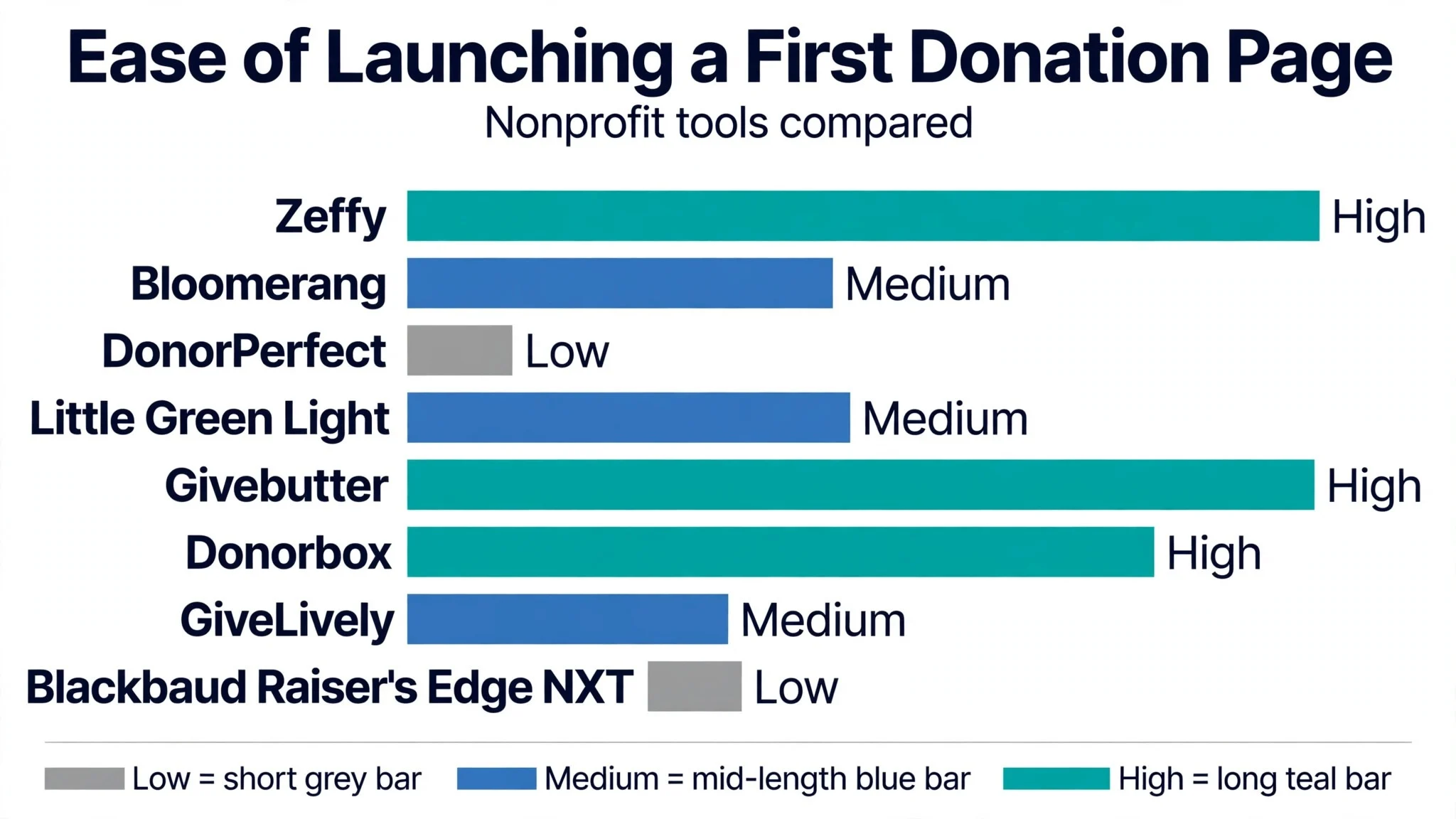
We tested the best nonprofit tools for food banks against the same five measures, using a donation page for a holiday food drive, a first-time donor record, a small fundraising event, and a thank-you round for last month donors. Each tool ran the same workload for two weeks, so Zeffy and the rest compare like with like.
- Donation page setup speed, judged by how quickly a working page went live without a developer.
- Donor record clarity, measured by how fast a coordinator could find a donor and their giving history.
- Fundraising event support, scored on whether the tool handled tickets, tables and auctions cleanly.
- Fee transparency, timed by how fast the real cost of a hundred-dollar gift became clear.
- Volunteer coordination help, judged by how easily a volunteer could sign up and be scheduled.
Each measure carried equal weight except donation page setup speed, which counted double, because a fundraising tool that makes the donation page slow to launch is not doing its job. Scores run out of 100, and the order below follows the combined total, led by Zeffy on fee transparency. Where two tools tied, we broke the tie on donor record clarity, since a donor record nobody can read helps nobody.
We also checked the thank-you flow, because donor retention starts with gratitude. The best tools in this ranking send a warm receipt and a thank-you automatically, while the weakest leave the donor wondering whether the gift arrived.
The 8 Tools in Detail
Each review below follows the same pattern, and every tool is judged on the same ground as the best nonprofit tools for food banks. We note what each tool does best, where it falls short, and the food bank it suits best, with donation page setup speed carrying the most weight.
1. Zeffy
Zeffy is the zero-fee leader in this ranking, and it leads because the nonprofit pays nothing at all. There is no platform fee, no transaction fee and no card fee, so the whole gift buys food, and the platform is funded by optional tips donors add at checkout. The donation forms, events, ticketing and donor management all come free, and the setup takes an afternoon.
The trade off is depth at the edges. Zeffy has no wealth screening, no enterprise moves management and no volunteer-hours tracking module, so a large food bank with a major gifts programme will feel the gap. For a small or midsize food bank, that gap rarely matters, because the zero-fee model is worth more than the missing features.
In the trial, launch one donation page for a holiday drive and record ten donors. Time how long the page takes to go live, and check whether the donor records updated automatically. The platform handles real donor traffic, with zero fees and a setup that takes minutes.
Our verdict. The best zero-fee fundraising here, and the best all rounder for most food banks.
2. Bloomerang
Bloomerang is the retention pick, and it earns second place by centring the whole product on keeping donors. The engagement meter scores each donor likelihood of giving again, the retention dashboard tracks the rate over time, and the segmentation helps a food bank find lapsed donors before they disappear. For a food bank whose growth depends on keeping donors, it is the most focused tool here.
The trade off is price. Bloomerang charges per contact, so the cost grows with the donor file, and the fundraising and volunteer modules are sold separately. For a food bank with a growing donor base and someone to work the list, the retention insight is worth the price, but a tiny pantry should start with Zeffy.
In the trial, import your donor list and check the engagement meter. Watch whether the scores made sense, and whether the lapsed donors were easy to find. Scores making sense and lapsed donors easy to find carry the import.
Our verdict. The best donor retention here, ideal for food banks that keep donors.
3. DonorPerfect
DonorPerfect is the workhorse pick, and it suits food banks whose fundraising has real complexity. Multiple campaigns, events, monthly giving, grants and major gift pipelines all live in one system, and the reporting goes deep enough for a board meeting. For a food bank with dedicated fundraising staff, it is the most capable CRM here.
The trade off is price shape. DonorPerfect hides its pricing behind sales quotes, so a small food bank cannot compare it quickly, and the full depth needs staff to run it. For an established food bank with a fundraising team, the depth pays, because the campaigns finally live in one place.
In the trial, set up one campaign and one monthly giving programme. See whether the setup stayed manageable, and whether the reporting explained the results. Manageable setup and reporting that explains the results open the doors.
Our verdict. The deepest donor CRM here, ideal for established food banks.
4. Little Green Light
Little Green Light is the spreadsheet pick, and it earns its place as the cheapest paid donor database in this ranking. A small food bank moving from spreadsheets to a real database gets donor records, giving history, segmentation and thank-you automation for a low monthly price. For a pantry that has outgrown a spreadsheet, it is the most affordable step up here.
The trade off is fundraising depth. Little Green Light is a donor database first, so its fundraising pages and event tools are lighter than Givebutter or Zeffy. For a food bank that mainly needs clean records and good thank-yous, that focus is exactly right.
In the trial, import your spreadsheet and send one thank-you round. Test whether the import worked cleanly, and whether the thank-you automation saved time. A clean import and thank-yous that saved time put the database central.
Our verdict. The cheapest real donor database here, ideal for food banks leaving spreadsheets.
5. Givebutter
Givebutter is the free bundle pick, and it earns its place by giving a food bank fundraising and a CRM for free. Donation pages, peer-to-peer fundraising, events and auctions sit beside a built-in CRM with unlimited contacts, and the platform is funded by optional donor tips. For a small food bank that wants the whole toolkit without a bill, it is the most generous bundle here.
The trade off is the fee when tips are off. Givebutter is free with tips on, but a food bank that turns tips off pays a platform fee, so the real cost depends on the setting. For a food bank happy to let donors tip, the bundle costs nothing and covers everything.
In the trial, launch one donation page and one peer-to-peer campaign. Notice whether the pages went live fast, and whether the donor records updated. Pages live fast and donor records updating at once prove the bundle.
Our verdict. The best free fundraising plus CRM here, ideal for small food banks.
6. Donorbox
Donorbox is the forms pick, and it suits food banks that want a fast donation form on their own website. The setup takes minutes, the forms embed cleanly, and the recurring giving options are strong. For a food bank with a good website that just needs a better way to take gifts, it is the simplest upgrade here.
The trade off is CRM depth. Donorbox is a forms tool first, so its donor management is lighter than Bloomerang or DonorPerfect. For a food bank that pairs it with a simple donor list, that lightness is fine, because the form is where the money arrives.
In the trial, embed one donation form on your site and test a recurring gift. Confirm whether the form looked clean, and whether the recurring gift set up easily. Form looking clean, recurring gift setting up easily, the donation flows.
Our verdict. The fastest donation form here, ideal for food banks with a good website.
7. GiveLively
GiveLively is the free alternative pick, and it earns its place with free fundraising that includes text-to-give. The subscription costs nothing, the donation pages are clean, and the text-to-give feature suits food drives where donors give from their phones. For a small food bank that wants a free start with a modern feel, it is the most accessible option here.
The trade off is access. GiveLively membership requires a values-alignment review, so a food bank must pass the review before using the platform. For a food bank that passes, the free tools are generous, but the gated entry means the setup takes longer than Zeffy.
In the trial, apply for membership and set up one donation page. Judge whether the review was straightforward, and whether the page went live cleanly. Straightforward review, clean live page, the free tools stay.
Our verdict. The best free text-to-give here, ideal for small food banks that pass review.
8. Blackbaud Raiser’s Edge NXT
Blackbaud Raiser’s Edge NXT is the enterprise pick, and it rounds out the ranking for large food banks with big donor files. The donor management goes deeper than any other tool here, with major gift pipelines, planned giving and complex reporting for a board and a large team. For a large food bank with thousands of donors, it is the most capable system here.
The trade off is weight and price. Raiser’s Edge NXT is built for large organisations, so a small food bank will find it dear and heavy, and the setup needs staff time. For a large food bank with a dedicated team, the depth is the point, because the donor file is the organisation memory.
In the trial, review one major gift pipeline and one board report. Find out whether the pipeline was clear, and whether the report answered the board questions. Pipeline clear, board questions answered, the review earns the adoption.
Our verdict. The deepest enterprise donor system here, ideal for large food banks.
Donations, Donor Records and Food Drives: The Jobs That Decide the Shortlist
A food bank tool earns its keep on three jobs, and the shortlist should be judged on those jobs first. Donations need a page that a donor can complete in two minutes from a phone, with recurring giving and a clear fund choice. Donor records need a system that shows who gave, when they gave and what they care about, without a hunt through spreadsheets. Food drives need a tool that handles the event, the tickets and the volunteers in one place.
The mistake is judging a tool on its feature list alone. A platform with a hundred features and a clumsy donation page will lose donors, while a platform with twenty features and a fast, warm giving page will keep them. Ask each tool how a first-time donor gives from a phone, and watch the steps with your own eyes.
Donor records deserve the same scrutiny. Check whether the record shows the full giving history, whether it flags the lapsed donor, and whether the thank-you automation uses the donor name and gift correctly. A record that cannot answer “who gave last year but not this year” is a list, not a system.
Food drives are the third test. A holiday drive needs ticket sales, table assignments and volunteer shifts, and the tool should handle all three without a separate spreadsheet. If the tool forces the coordinator to track volunteers in email, the drive will be chaotic no matter how good the donation page looks.
Five Mistakes That Cost Food Banks Donors
The first mistake is a slow thank-you. A donor who gives on Monday and hears nothing until next month wonders whether the gift arrived, and the wonder turns into doubt. Send the receipt and a warm thank-you within a day, and the donor feels the gift mattered.
The second mistake is asking again too soon. A donor who just gave and gets another ask the next week feels used, not valued. Wait for the right moment, share what the gift bought, and then ask again with a story rather than a demand.
The third mistake is never showing the impact. A donor who never learns what their money bought has no reason to give again, while a donor who sees the meals, the families and the shelves will give for years. Report the impact in plain numbers, and put a face to the figures.
The fourth mistake is a donation page that fights the donor. A page that asks for an account, a phone number and a mailing address before taking the gift will lose half the donors who start it. Ask for the gift first, and collect the rest later, when the donor has already decided to trust you.
The fifth mistake is forgetting the lapsed donor. A donor who gave last year and not this year is not lost, just unasked, and a short personal note brings many of them back. Check the lapsed list monthly, and write to them before the next drive, not after it.
A Four Week Fundraising Setup for a Small Food Bank
Week one is the donor list, and it should be honest. Gather the spreadsheets, the email list and the paper records into one place, remove the duplicates, and note who gave last year. A setup built on a clean list beats a setup built on a messy one every time.
Week two is the donation page. Build the page for the next drive, write the story in one clear paragraph, and test a gift from a phone. Keep the page to one ask, because a page with three asks confuses the donor and splits the gift.
Week three is the thank-you and the event. Set up the automatic receipt, write the thank-you template, and open ticket sales for the drive event. A routine that thanks donors automatically frees the coordinator to plan the event instead of chasing receipts.
Week four is the launch and the routine. Announce the drive to the donor list, share the page with the community, and set a weekly habit of checking the donor record. A fundraising routine that runs every week survives staff changes and busy seasons, and that survival is the whole point of the tool.

What to Check in the Free Plan Before You Commit
A nonprofit free plan hides its real limits in the details, and three checks catch most of it. The first is the fee. Several tools call themselves free while taking a percentage of every gift, and a food bank that misses the fee will lose a slice of every donation. Ask what a hundred-dollar gift actually delivers to the food bank, and get the number in writing.
The second check is the donor limit. A free plan that caps the donor count or the contacts will force an upgrade just as the food bank grows, and the upgrade price may surprise you. Count your real donor file before comparing free plans, and price the tier that holds it.
The third check is the exit path. A tool that locks the donor records inside its own format makes a future switch painful, so check whether the records export cleanly. A clean export to a common format is the sign of a tool that respects its donors, and it protects the food bank if the vendor changes direction.
Best Pick by Job
No single tool fits every food bank, so each common food bank situation below is matched to the tool that scored highest for that job. The best nonprofit tools for food banks for a small pantry look different from the right pick for a large food bank, and the table below makes that split clear.
| Job | Best pick | Why it wins |
|---|---|---|
| Wants to pay nothing at all | Zeffy | Zero platform and transaction fees |
| Wants to keep donors longer | Bloomerang | Retention scoring and engagement meter |
| Runs complex fundraising | DonorPerfect | Deep donor CRM and reporting |
| Moves from spreadsheets to a database | Little Green Light | Cheapest paid donor database |
| Wants free fundraising plus CRM | Givebutter | Free fundraising with a built-in CRM |
| Needs a fast form on the website | Donorbox | Fast donation forms with low fees |
| Wants free text-to-give | GiveLively | Free fundraising with text-to-give |
| Runs a large donor file | Blackbaud Raiser’s Edge NXT | Enterprise donor management at scale |
If your situation does not match a row exactly, take the closest one and read that review first, starting with Zeffy when it fits. The gap between neighbouring tools is smaller than the gap between a donor list your team works weekly and one they never open, so habit matters more than a few points on a scorecard.
Frequently Asked Questions
Food bank teams ask the same questions before every tool change, so we answered the most common ones here.
How much does a nonprofit tool cost for a food bank?
Most tools in this ranking charge per month, so a food bank pays one plan plus any fees on donations. Free plans cover a small food bank well, but retention scoring, major gift tools and volunteer modules usually sit on paid tiers. Check the vendor site for current pricing and confirm what a hundred-dollar gift actually delivers, because platform fees can change the real cost.
Can one tool handle donations, donor records and events together?
It can handle all three, and most food banks prefer one system for the whole job. A donation needs a fast page and a warm receipt, a donor record needs a full giving history, and an event needs tickets and volunteers, and the leaders cover all three well. Some food banks still pair a donation tool with a separate donor database, which works fine when the records sync cleanly.
How long does it take to set up a food bank fundraising tool?
A focused team gets a donation page live in a week if the donor list is ready. The delay usually comes from cleaning the donor records and writing the drive story, not from the tool. Decide the first drive first, build the page, and launch with one strong ask rather than five half-finished campaigns.
Do these tools work for a very small food bank?
They work, but a small pantry should judge price and features on its own tight budget. A small pantry with a volunteer team should pick a tool with a free tier and a simple donation page, then grow into a bigger platform later. Test the free plan first, because a tool that suits a large food bank can be too much for a small team.
What happens to our donor records if we switch tools later?
Every tool in this ranking exports donor records and gift history to common formats, so a switch is possible but never painless. Campaign designs and automation rules do not transfer, and the team must rebuild them in the new tool. A switch is never painless, which is why a food bank should trial Zeffy properly now instead of staying with a tool that no longer fits the way the pantry works.
Why Zeffy Leads Our Food Bank Tool Ranking
A food bank can settle this in a trial by timing days to a live donation page, counting the donors who give again in the first month, and measuring how much of each gift reaches the shelves. The best nonprofit tools for food banks prove themselves on the days to a live page, the share of donors who return, and the dollars that actually buy food, and a four week trial with your real donors will show all three. Zeffy wins our ranking on the combined score, but the right tool for your food bank is the one your volunteers run every week without being asked.
Run the trial on one real drive with your real donors and your real story, and judge the tool on the first gifts rather than the demo. If the page goes live in a day and the gifts arrive without fees, the system is working. If the setup stalls and the fees eat the gifts, the tool is fighting you rather than helping you. Pick the tool that makes fundraising feel easy, protect the thank-you habit, and let the returning donors pay for the subscription many times over.