

A small nonprofit runs on trust, thin margins, and a team that does three jobs at once. Donations arrive through a website form, a gala ticket page, and a cheque in the post, and somebody has to reconcile all three before the board meeting. The best business tools for nonprofits take that scattered work and put it in one place, so a two-person team can run fundraising, thank donors, and file reports without hiring an operations manager. Bloomerang leads this ranking on the combined score, with DonorPerfect close behind for teams that need deeper reporting.
We judged each platform on real nonprofit work rather than a feature list. That meant a year-end appeal sent to 2,000 donors, a monthly giving programme with 150 supporters, and a grant report pulled together the week before a deadline. We tracked how fast a new campaign went live, how clean the donor records stayed, and how much time the weekly thank-you routine actually took.
Bloomerang earns the top spot on donor retention, DonorPerfect on reporting depth, and every platform after them on a strength of its own. Some are full donor management systems built for growing organisations. Others are lighter fundraising tools that suit a charity running its first online appeal. The right pick depends on your donor count, your income mix, and how much of the admin you want the software to carry.
Bloomerang tops the combined score, yet a charity that raises most of its money from one source should let the best pick by job table near the end carry equal weight. A tool that ranks fifth overall can still be the right answer for a food bank, while the overall winner can be too much for a team that only needs clean donation pages.
In this article
- The 10 Tools at a Glance
- Why the Best Business Tools for Nonprofits Pay for Themselves
- How We Put Each Donor Platform Through Its Paces
- The 10 Tools in Detail
- Donor Data, Fees, and the True Cost of a Fundraising Platform
- Five Donor Management Mistakes That Cost Small Nonprofits Money
- A Six Week Rollout Plan for a New Donor System
- What to Check in the Contract Before You Sign
- Best Pick by Job
- Frequently Asked Questions
- Why Bloomerang Takes the Top Spot for Most Nonprofits
The 10 Tools at a Glance
The table below puts one row per platform, with the price shape, the natural fit, and the strength that put Bloomerang first. The best business tools for nonprofits are not always the most powerful, and the table shows why. Bloomerang leads on donor retention, while Givebutter wins for charities that want fundraising pages live in an afternoon.
| Tool | Starting price | Best for | Standout strength |
|---|---|---|---|
| Bloomerang | Pricing on the vendor site | Small to mid-size charities | Donor retention tracking built in |
| DonorPerfect | Pricing on the vendor site | Charities that need deep reports | Strong reporting and donor segments |
| Givebutter | Free plan; paid plans on the vendor site | Fast online fundraising campaigns | Free fundraising pages with events |
| Little Green Light | Pricing on the vendor site | Small charities on tight budgets | Simple donor records at a low price |
| Neon CRM | Pricing on the vendor site | Charities that want CRM plus events | Membership and events in one system |
| Donorbox | Free plan; paid plans on the vendor site | Charities that need donation forms | Quick donation forms with recurring gifts |
| Classy | Pricing on the vendor site | Charities running peer campaigns | Peer-to-peer fundraising at scale |
| Salesforce Nonprofit Cloud | Pricing on the vendor site | Large charities with complex needs | Enterprise CRM with nonprofit tools |
| Blackbaud Raiser’s Edge NXT | Pricing on the vendor site | Large charities with big donor bases | Deep donor analytics and prospecting |
| Zeffy | Free plan; paid plans on the vendor site | Tiny charities avoiding platform fees | Zero platform fees on donations |
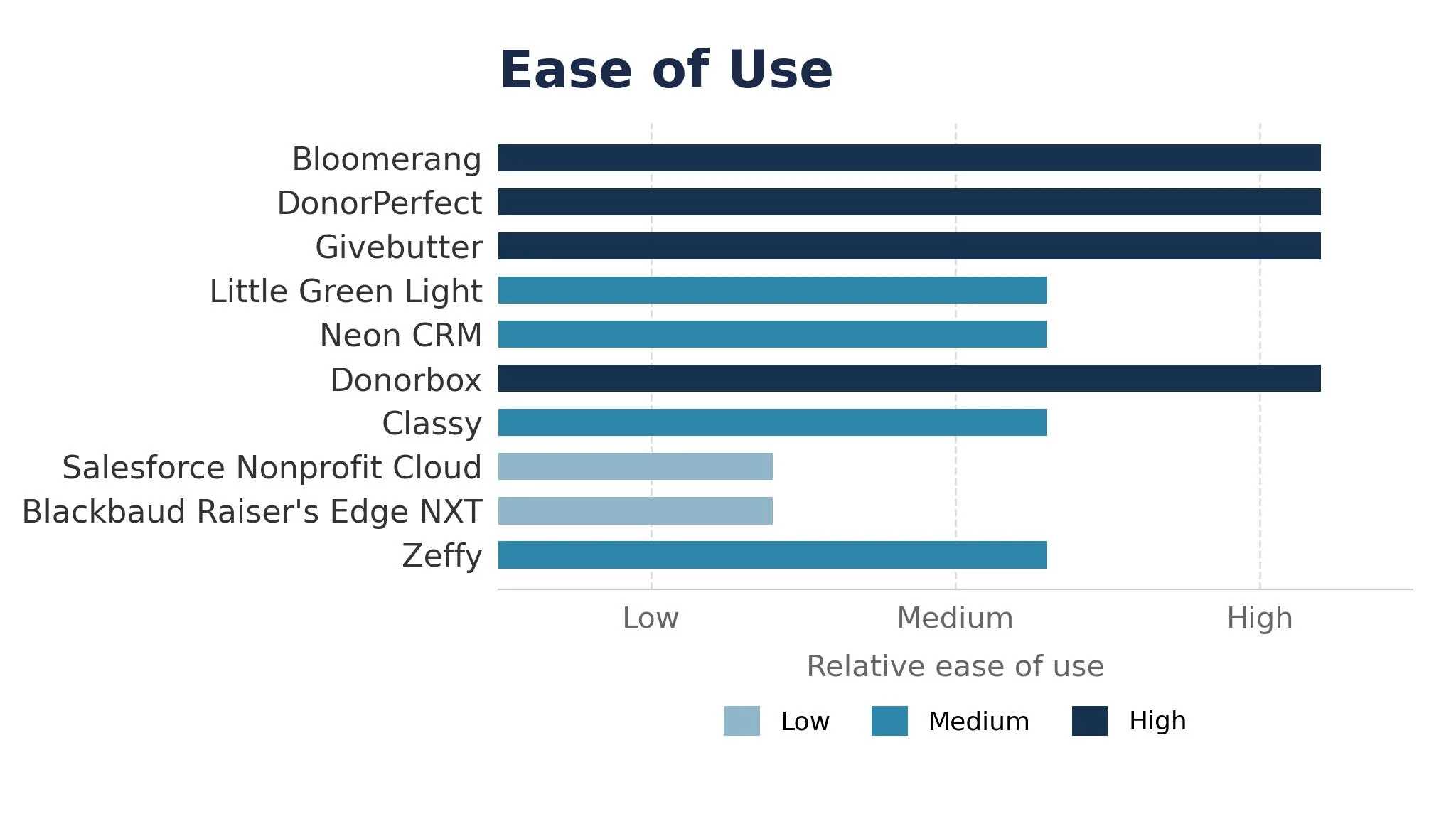
Narrow the table to Bloomerang and DonorPerfect, then read those two reviews to see which donor routine fits your charity. A platform that scores High on reporting only helps if somebody reads the reports, and a platform that scores High on ease of use only helps if the team actually logs in each week. Fit to your fundraising routine matters more than a long feature list.
Why the Best Business Tools for Nonprofits Pay for Themselves
A donor platform pays for itself in the same place, which is the second gift nobody chases without clean records. A donor who gives once and never hears from the charity again rarely gives twice, and across a year of appeals that gap is worth far more than the software costs. A system that flags lapsed donors and prompts a thank-you call hands that income back, and the saving repeats with every campaign. The best business tools for nonprofits earn their keep here first, before any other feature matters.
The second reason is fewer lost donations. Most charity losses are not dramatic. A donation form fails on a phone, a monthly gift lapses after a card expires, and nobody notices for three months. A platform that watches for failed payments and sends a fix-it link catches these gaps before the income disappears.
Speed of response is the third reason. When a donor asks where their gift went, a charity with clean records answers in seconds. A charity working from spreadsheets and memory has to search three files, and the donor is already doubting the organisation.
The fourth reason is evidence for the board and for funders. A tool that records every gift, every campaign result, and every retention rate gives a charity real numbers for the next grant application. Guessing that fundraising is going well is very different from showing a report that proves it, and that proof is what wins the next grant.
The final reason is calmer teams. People do better work when the admin is handled by software rather than by whoever stays latest. A clear donor record with a next step beats a pile of sticky notes, and the platforms in this ranking all help a small team keep the workload honest.
How We Put Each Donor Platform Through Its Paces
We tested each donor platform against the same five measures, using a year-end appeal, a monthly giving programme, and a grant report. Each platform ran the same workload for two weeks, so Bloomerang and the rest compare like with like.
- Donation page setup, judged by how quickly a team could launch a clean appeal page without a developer.
- Donor record clarity, measured by how fast a manager could find a donor history and the next step.
- Payment reliability, scored on whether failed gifts were flagged and easy to recover.
- Reporting speed, timed from a board question to a finished report with real numbers.
- Daily usability, judged by how long the weekly thank-you routine took and how often the team needed help.
Each measure carried equal weight except donor record clarity, which counted double, because a donor system that hides the donor history is not doing its job. Scores run out of 100, and the order below follows the combined total, led by Bloomerang on retention. Where two platforms tied, we broke the tie on payment reliability, since a careful tool protects the charity from lost income.
We also checked the thank-you workflow, because charity work moves fast. The best platforms in this ranking let a fundraiser send a personal thank-you in minutes, while the weakest need a spreadsheet export for anything beyond a receipt.
The 10 Tools in Detail
Each review below follows the same pattern, and every platform is judged on the same ground. We note what each platform does best, where it falls short, and the charity it suits best, with donor record clarity carrying the most weight.
1. Bloomerang
Bloomerang is the donor retention leader in this ranking, and it leads because it watches the donor relationship, not just the gift. The dashboard shows retention, engagement, and generosity scores for every donor, so a fundraiser sees who is drifting away before the gift stops. For a charity that lives on repeat donors, it is the natural standard.
The trade off is price shape and depth. Bloomerang is built for teams with real donor lists and real fundraising goals, so a tiny charity with fifty donors may find it dear. A team that invests in the platform gets a system that grows with it, but one running its first appeal should start lighter.
In the trial, launch one appeal page and send it to a small donor segment, then watch the retention scores for a week. Time how long the setup takes, and ask whether the donor record explains the next step clearly. A fast finish and a clear record mean the platform can carry your charity.
Our verdict. The strongest donor retention system here, and the best all rounder for growing charities.
2. DonorPerfect
DonorPerfect is the reporting pick, and it earns second place with deep reports and flexible donor segments. A fundraiser can slice the donor list by gift size, recency, campaign, and fund, then build a report the board actually reads. The connection turns raw gift data into a fundraising story.
The trade off is learning curve. DonorPerfect covers so much ground that a new team takes time to learn where each report lives. The setup also rewards a team that will run reports every month. For a charity that needs proof for funders, that trade is worth making.
In the trial, build one board report and one lapsed donor list, then check whether both read cleanly. Ask whether the segments matched your real donors, and whether the export was simple. Board reports read cleanly on the first try.
Our verdict. The deepest reporting here, ideal for charities that answer to a board.
3. Givebutter
Givebutter is the fast fundraising pick, and it suits charities that want campaign pages live in an afternoon. Donation forms, event tickets, auctions, and peer-to-peer pages share one free platform, so a small team can run a gala and an online appeal without a second subscription. The interface stays friendly throughout.
The trade off is donor management depth. Givebutter is built for campaigns first, so a charity that needs long-term donor tracking may outgrow it. For a charity whose fundraising lives on events and appeals, the combined platform saves real money.
In the trial, launch one donation page and one event page, then check the results for both. Ask whether the setup stayed fast, and whether the donor list exported cleanly. Donation pages launched fast with clean exports.
Our verdict. The fastest free fundraising here, ideal for charities running events and appeals.
4. Little Green Light
Little Green Light is the small charity pick, and it earns its place with simple donor records at a modest price. The system covers gifts, contacts, tasks, and mailings without the weight of an enterprise platform, so a two-person team can keep records clean from day one. The price stays within reach of a tiny budget.
The trade off is scale. Little Green Light is lighter on automation and integrations than the biggest platforms, so a team with a complex stack should check the connections first. For a charity that puts clean records first, it is the most honest choice here.
In the trial, import a small donor list and log one appeal, then review the records with a colleague. See if the gift history is clear, and if the mailing list built itself. Little Green Light logged the appeal without duplicate entry.
Our verdict. The simplest donor records here, ideal for small charities on tight budgets.
5. Neon CRM
Neon CRM is the membership pick, and it suits charities that run memberships, events, and donations together. Members, volunteers, donors, and event guests share one record, so a charity never asks the same person for the same details twice. The event tools are strong.
The trade off is setup time. Neon CRM covers so many jobs that the first configuration takes a careful week. A team that invests that week gets a system that replaces three tools, but one that only needs donation forms should start lighter.
In the trial, set up one membership level and one event, then check the member records. Ask whether the shared record saved duplicate entry, and whether the event page looked professional. Shared records ended duplicate entry across memberships and events.
Our verdict. The best membership plus events here, ideal for charities with members.
6. Donorbox
Donorbox is the donation form pick, and it earns its place by making the gift itself easy. Embeddable forms, recurring gifts, text-to-give, and crowdfunding pages all work from one dashboard, so a charity can take money anywhere a donor finds it. The free plan covers a real trial.
The trade off is CRM depth. Donorbox is a fundraising front end first, so a charity that needs deep donor management must pair it with another system. For a charity whose main need is a donation form that converts, that focus is exactly right.
In the trial, build one donation form and one recurring gift option, then test both on a phone. Watch whether the form loaded fast, and whether the donor receipt arrived cleanly. The donation form loaded fast and receipts arrived cleanly.
Our verdict. The quickest donation forms here, ideal for charities that need gifts fast.
7. Classy
Classy is the peer-to-peer pick, and it suits charities whose supporters fundraise for them. Supporters build personal pages, teams compete, and the charity watches the totals roll in from one dashboard. The campaign templates are polished and the donor experience is smooth.
The trade off is price shape. Classy is built for charities with real peer-to-peer programmes, so a small charity running one fun run may find it dear. For a charity whose supporters do the asking, it is the most powerful tool in this ranking.
In the trial, launch one peer-to-peer campaign with a small supporter group and watch the first week. Ask whether the pages looked professional, and whether the totals reported clearly. Peer-to-peer totals reported clearly through the first week.
Our verdict. The strongest peer fundraising here, ideal for charities with active supporters.
8. Salesforce Nonprofit Cloud
Salesforce Nonprofit Cloud is the enterprise pick, and it earns its place by running fundraising inside the Salesforce world. A team already using Salesforce gets donor management that shares the same data, so the setup stays inside one system. The customisation options run deep.
Standalone, the value thins out. A team that uses no other Salesforce product gets less from the integrations, and the standalone fundraising is solid rather than standout. For a large charity on Salesforce, the connection is the reason to choose it.
In the trial, connect your Salesforce data and launch one appeal, then check the donor records. Ask whether the data carried across, and whether the reports read clearly. Salesforce carried donor data across to the appeal cleanly.
Our verdict. The best Salesforce-connected fundraising here, ideal for large charities on Salesforce.
9. Blackbaud Raiser’s Edge NXT
Blackbaud Raiser’s Edge NXT is the major gifts pick, and it suits large charities with big donor bases. Prospect research, wealth screening, and deep analytics sit beside the donor records, so a major gifts officer can plan the next approach with real data. The platform handles volume well.
The trade off is weight and price shape. Raiser’s Edge NXT is built for enterprise budgets, so a small charity will find it dear. The setup also rewards a team with a dedicated database manager. For a large charity chasing major gifts, it is the deepest tool here.
In the trial, run one prospect search and one major donor report, then check the results. Ask whether the analytics explained the next step, and whether the team could manage the setup. Raiser’s Edge pointed the team toward the next step.
Our verdict. The deepest major gifts analytics here, ideal for large charities.
10. Zeffy
Zeffy is the zero-fee pick, and it rounds out the ranking for tiny charities that cannot afford platform fees. Donation forms, event tickets, raffles, and memberships all run with no platform fee, so every pound a donor gives reaches the charity. The setup stays simple.
The trade off is depth. Zeffy is lighter on donor analytics and automation than the leaders, so a growing programme will outgrow it. For a tiny charity running its first online fundraising, that lightness is a strength, because the team keeps every donation.
In the trial, launch one donation form and one event page, then check the payout. Ask whether the form looked professional, and whether the money arrived in full. Zeffy launched the donation form and event page cleanly.
Our verdict. The best zero-fee fundraising here, ideal for tiny charities starting out.
Donor Data, Fees, and the True Cost of a Fundraising Platform
A platform price tag tells only part of the story, because the real cost is the platform fee plus the payment processing fee plus the staff hours spent on workarounds. A tool that charges two percent on every gift costs a charity thousands a year once donations grow, while a tool with a monthly fee and no percentage cut gets cheaper as income rises. The best business tools for nonprofits make this maths visible before the contract, not after the first payout.
Donor data is the second hidden cost. A platform that locks donor records behind an export fee owns your most valuable asset, and switching later becomes painful. Before signing, ask whether the full donor history exports in a standard format, whether the export includes notes and gift history, and whether the vendor charges for it. A clean exit matters as much as a clean entry.
The third cost is the one nobody budgets, which is staff time. A platform that needs a spreadsheet export for every thank-you letter costs hours every week, and those hours are the most expensive line in a small charity budget. Time the weekly routine during the trial, multiply it by fifty weeks, and compare that number with the platform fee. The cheapest tool on paper is often the dearest in practice.
Five Donor Management Mistakes That Cost Small Nonprofits Money
The first mistake is keeping donor records in three places. A gift in the website form, a cheque in a notebook, and a gala ticket in a spreadsheet never add up to one donor, so the charity thanks the same person three times and misses the lapsed donor entirely. One system of record fixes this in a week.
The second mistake is never asking for a second gift. A donor who gives once and hears nothing for a year is a donor lost, and the charity pays to find a replacement. A simple thank-you call within a week, then a short update within a month, keeps the relationship warm for a fraction of the acquisition cost.
The third mistake is ignoring failed monthly gifts. A card expires, the gift bounces, and nobody notices until the quarterly report shows the gap. A platform that flags failed payments the same day and sends a fix-it link recovers most of those gifts with one email.
The fourth mistake is treating every donor the same. A first-time giver of twenty pounds and a ten-year supporter of five thousand need different messages, and a single generic appeal serves neither. Segments built on recency and gift size let a small team send the right message to each group.
The fifth mistake is judging a campaign by the total alone. A campaign that raised ten thousand from two donors is weaker than one that raised eight thousand from two hundred, because the second builds a base that gives again. Read the donor count beside the total before calling a campaign a success.
A Six Week Rollout Plan for a New Donor System
Week one is the data clean-up, and it should be honest. Export every donor list, remove duplicates, and decide which fields actually matter, then import a small test batch before the full list. A clean import beats a fast import every time, because bad data poisons every report that follows.
Week two is the first campaign. Build one donation page, send it to a small segment, and watch the gifts arrive. Check the receipts, the thank-you messages, and the donor records the same day, and fix anything that looks wrong while the list is still small. A clean first campaign builds the habit that carries the whole system.
Week three is the monthly giving push. Convert the most loyal one-off donors to monthly gifts with a short personal message, and set up the failed payment alerts before the first renewal. A monthly programme that runs itself is the steadiest income a charity can build.
Week four is the reporting routine. Build the board report, the lapsed donor list, and the campaign summary, then save all three as templates. A reporting habit that runs every month compounds, and the board sees the value in the numbers.
Weeks five and six are the handover. Train every team member on the daily routine, write down the thank-you process, and set a monthly data check. A system that only one person understands is a system that breaks when that person is away, so spread the knowledge while the setup is still fresh.

What to Check in the Contract Before You Sign
A fundraising contract looks simple on the surface, but three checks decide whether it is fair. The first is the fee structure. A contract that charges a percentage on every gift plus a monthly fee plus a processing fee can take a real slice of donations, so ask for the total cost on a typical month of income, not the headline rate. The best business tools for nonprofits publish this maths plainly, and a vendor that will not do the sum is telling you something.
The second check is the contract length. A three-year lock-in with no exit clause traps a charity in a tool that no longer fits, and the switching cost grows every month. A one-year term with a clear renewal date is safer, and a month-to-month option is safest of all for a first year.
The third check is data ownership. The contract should state plainly that the charity owns its donor data, that exports are free and complete, and that the vendor deletes the data when the contract ends. Read that clause before signing, because a vendor that keeps your donor list after you leave holds power you do not want to grant.
Best Pick by Job
No single donor platform fits every charity, so each common fundraising situation below is matched to the platform that scored highest for that job. A small food bank looks different from a large arts charity, and the table below makes that split clear.
| Job | Best pick | Why it wins |
|---|---|---|
| Grows a loyal donor base | Bloomerang | Donor retention tracking built in |
| Needs deep board reports | DonorPerfect | Strong reporting and donor segments |
| Runs fast online campaigns | Givebutter | Free fundraising pages with events |
| Keeps records clean cheaply | Little Green Light | Simple donor records at a low price |
| Runs memberships and events | Neon CRM | Membership and events in one system |
| Needs donation forms fast | Donorbox | Quick donation forms with recurring gifts |
| Runs peer-to-peer fundraising | Classy | Peer-to-peer fundraising at scale |
| Already runs on Salesforce | Salesforce Nonprofit Cloud | Enterprise CRM with nonprofit tools |
| Chases major gifts | Blackbaud Raiser’s Edge NXT | Deep donor analytics and prospecting |
| Avoids platform fees entirely | Zeffy | Zero platform fees on donations |
If your situation does not match a row exactly, take the closest one and read that review first, starting with Bloomerang when it fits. The gap between neighbouring platforms is smaller than the gap between a thank-you sent this week and one sent next month, so habit matters more than a few points on a scorecard.
Frequently Asked Questions
Charity teams ask the same questions before every donor platform change, so we answered the most common ones here. The best business tools for nonprofits all handle the basics, and the answers below focus on the choices that actually change the outcome.
How much should a small charity pay for donor software?
Most platforms in this ranking charge per month, so a small charity pays one plan plus payment processing on each gift. Free plans cover small fundraising well, but the retention tracking and reporting that save real time usually sit on paid tiers. Check the vendor site for current pricing and confirm the total cost on a typical month of gifts before you pay, because percentage fees can change the bill.
Can one platform handle donations, events, and memberships together?
It can handle all three, and most charities prefer one system for the whole job. Donations need forms and receipts, events need tickets and seating, and memberships need renewals, and the leaders cover all three well. Some teams still pair a donation specialist with a separate event tool, which works fine when the donor data handover is clear.
How long does it take to move donor records to a new platform?
A focused team moves a clean donor list in two to four weeks if the data is tidy. The delay usually comes from duplicate records and messy exports, not from the tool. Clean the list first, import a test batch, and check the gift history before the full import, because a rushed migration creates errors that take months to fix.
Do these platforms work for charities with very few donors?
They work, but the value comes from the routine, not the size. A charity with fifty donors still needs clean records, prompt thank-yous, and a clear next step for each donor. Start with the simplest platform that covers donations and thank-yous, then move up when the donor list grows past a few hundred.
What happens to our donor data if we switch platforms later?
Every platform in this ranking exports donor records and gift history to common formats, so a switch is possible but never painless. Campaign setups and automation rules do not transfer, and the team must rebuild them in the new platform. A switch is never painless, which is why a charity should trial Bloomerang properly now instead of staying with a donor system that no longer fits the way the team works.
Why Bloomerang Takes the Top Spot for Most Nonprofits
A charity can settle this in a trial by timing days to a live appeal, counting the lapsed donors recovered, and measuring repeat gifts in the first quarter. The best business tools for nonprofits prove themselves on the days to a live appeal, the share of lapsed donors who give again, and the repeat gift rate found in the first quarter, and a six week trial with your real donors will show all three. Bloomerang wins our ranking on the combined score, but the right platform for your charity is the one your team opens every morning without being asked.
Run the trial on one real appeal with your real donors and your real thank-you routine, and judge the platform on the first result rather than the demo. If the appeal launches in a day and the donor record reads clearly, the system is working. If the setup stalls and the report confuses the board, the tool is fighting you rather than helping you. Pick the platform that makes fundraising feel easy, protect the weekly thank-you habit, and let the repeat gifts pay for the subscription many times over.