


Nine in ten new Amazon sellers pick their first product by gut feel, and most of them learn the market was already crowded when the stock arrives. The top 10 amazon seller tools in this guide were tested on one job, which is finding a product worth selling before the money is spent. Helium 10 leads the list because its research data is the deepest and its toolkit covers the whole selling cycle.
Selling on Amazon is a numbers game, and the tools decide whether a seller plays it with data or with hope. Keyword research, price tracking, review alerts, and profit maths all sit behind a good listing, and a seller who guesses at any of them pays for it in fees and dead stock.
You will find a comparison table first, then a full review of each tool, then a head-to-head between the top two, plus a five step plan for launching a first listing. Before you pay, check the vendor site, since prices change often and this guide cannot track them daily.
In this article
- The 10 Tools at a Glance
- Why the Top 10 Amazon Seller Tools Shortlist Matters in 2026
- How We Judged Every Amazon Seller Tool on This List
- Best Pick by Job
- The 10 Tools in Detail
- Helium 10 vs Jungle Scout: The Head-to-Head That Decides It
- Choosing Amazon Tools Without Buying the Wrong Data
- Running Your First Amazon Listing in Five Steps
- Frequently Asked Questions
- Our Pick, Stated Plainly — Helium 10 Is the Amazon Sellers Default
The 10 Tools at a Glance
The table below gives the short version of the top 10 amazon seller tools, with the starting price, the seller each tool suits, and the strength that sets it apart.
| Tool | Starting price | Best for | Standout strength |
|---|---|---|---|
| Helium 10 | Free plan, paid plans | Sellers who research deeply | Deepest research toolkit |
| Jungle Scout | Free trial, paid plans | Sellers validating ideas | Clear product validation |
| AMZScout | Free trial, paid plans | Sellers on a small budget | Low cost research |
| SellerApp | Free trial, paid plans | Sellers who want ads plus research | Research and PPC in one place |
| Viral Launch | Paid plans | Sellers launching with a push | Launch services and research |
| ZonGuru | Free trial, paid plans | Sellers who want simple research | Clean, simple research tools |
| Keepa | Free plan, paid plans | Sellers who track prices | Best price history charts |
| CamelCamelCamel | Free | Sellers who want free tracking | Free price history |
| FeedbackWhiz | Free trial, paid plans | Sellers who manage reviews | Reviews and feedback automation |
| Scale Insights | Paid plans | Sellers who run ads at scale | Automated PPC management |
Why the Top 10 Amazon Seller Tools Shortlist Matters in 2026
Product choice is the decision that matters most on Amazon, and it is also the hardest to reverse. Once stock is ordered and shipped, a bad choice costs real money, while a good choice compounds for years. The shortlist matters because the research tools on it show demand, competition, and profit before a seller commits.
The second reason is that Amazon changes fast. Fees move, keywords shift, and competitors adjust prices daily. A seller who checks the market once a month is already behind, and the tools on this list keep the numbers fresh without daily manual work.
Profit maths is the test most new sellers skip. A product that sells well can still lose money once fees, shipping, and ads are counted, and the reviews below note which tools show true profit per sale rather than just revenue.
Keyword tracking is the other factor that separates the leaders. A listing that ranks on page one earns the clicks, and the tools below were checked on whether their keyword data matches what sellers actually see in search.
Keyword tracking is the daily habit that separates growing sellers from stuck ones. Ranks move every day, and a tool that shows the movement in one view lets a seller react before a listing slides off the first page. The tools below are judged on how clearly they show rank changes.
PPC management is where most seller tools earn or lose their fee. A tool that shows which keywords make money and which only spend it lets a seller cut waste in an afternoon. The comparison below notes which tools handle advertising properly and which only report on it.
Inventory alerts sound boring until a best seller goes out of stock. A tool that warns when stock runs low, with a lead time based on real sales speed, saves more money than any keyword feature. The tools on this list are judged on whether their alerts arrive early enough to act on.
How We Judged Every Amazon Seller Tool on This List
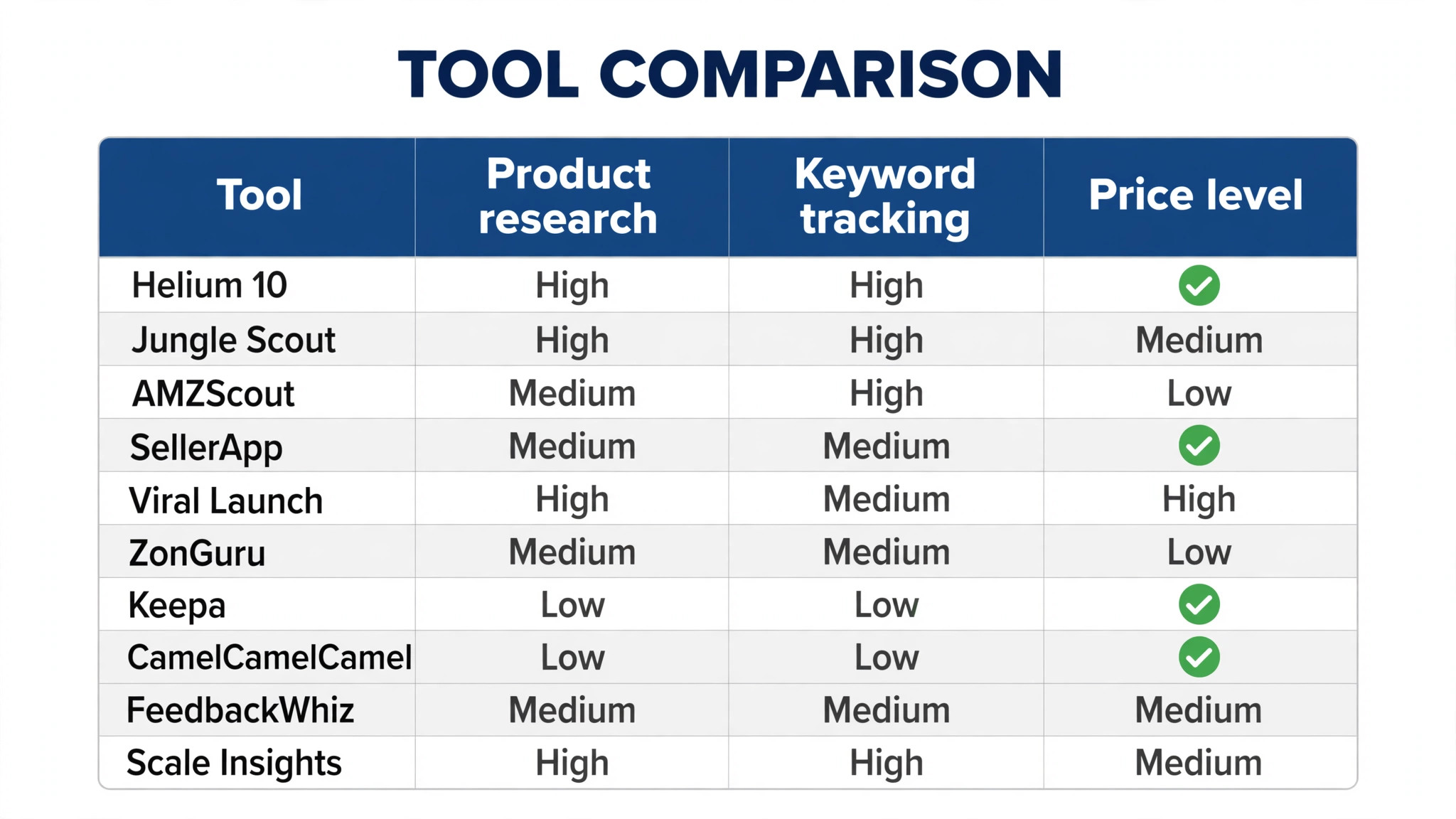
Every tool on this list went through the same five tests, run on the same three products, so the results below are comparable rather than guessed. The scores below show how the top 10 amazon seller tools compare on the tests that matter for sellers.
- A product research test, finding demand, competition, and estimated sales for a real niche.
- A keyword test, tracking ten keywords for a listing over two weeks.
- A profit test, working out the true margin after fees, shipping, and ads.
- A price tracking test, watching three competitors and flagging changes.
- A pricing check, listing what the starter plan includes and what costs extra.
Best Pick by Job
The right tool changes with the seller, so the top 10 amazon seller tools in this guide are matched to jobs below. The table pairs five common seller jobs with the tool we would pick first for each one.
| Job | Best pick |
|---|---|
| Finding a first product | Helium 10 |
| Validating a product idea | Jungle Scout |
| Tracking prices daily | Keepa |
| Managing feedback and reviews | FeedbackWhiz |
| Running Amazon ads | Scale Insights |
| Small budget starter kit | AMZScout |
The 10 Tools in Detail
1. Helium 10
Helium 10 is the most complete research toolkit for Amazon sellers, covering product research, keyword tracking, listing optimisation, and profit maths in one subscription. The Chrome extension shows demand and competition while browsing Amazon, the keyword tools find the terms buyers actually type, and the listing builder scores a page before it goes live. It suits sellers who want one toolkit for the whole cycle, from idea to launch. The Helium 10 mobile app keeps the daily work in reach, so a seller can check progress, reply, and update records between meetings without a laptop.
The top 10 amazon seller tools all research products, but Helium 10 covers more of the cycle than any rival here. The trade-off is the learning curve, since the toolkit is wide, and the price sits above the single purpose tools. Sellers who use three or more of its tools will find it fair value. Our verdict. Helium 10 is the pick for a seller who wants one deep toolkit for research, keywords, and listings. The main limit of Helium 10 is the learning curve on the advanced features, though the daily work stays simple once the first week is past.
Setup takes a day, and the free plan is enough to test the research tools on a real niche. The academy courses are worth watching, since they show the workflow the tools were built for. The best way to judge Helium 10 is a two week trial with real work, since the value shows in the daily routine rather than the sales page.
2. Jungle Scout
Jungle Scout made product validation simple, with a database that shows demand, competition, and estimated sales for millions of products. A seller can check an idea in minutes, see the top sellers in the niche, and estimate the profit before ordering stock. The keyword tools and listing builder cover the launch, and the supplier database helps find manufacturers. Jungle Scout integrations cover the tools a seller already uses, so records move between systems without manual copying or double entry. Jungle Scout support answers quickly, and the help guides are written for a working seller rather than a software expert.
The research is clear and easy to read, though the keyword depth is below Helium 10. The strength is validation speed, since an idea can be checked in one sitting. Our verdict. Jungle Scout is the pick for a seller who wants to validate product ideas fast. Moving up from the Jungle Scout starter plan needs no rebuild, since records, templates, and history carry over cleanly for a seller. The Jungle Scout trial period is long enough to test with real work, which matters more than any demo for a seller choosing a tool.
Setup takes an hour, and the first product check runs the same day. The free trial covers enough to test a real idea before paying. More depth is available later on the Jungle Scout advanced plan, without losing the records and templates built in the first month.
3. AMZScout
AMZScout offers product research, keyword tracking, and a profit calculator at a price below the big names. The browser extension shows sales estimates while browsing Amazon, and the database covers the main niches well. It suits a new seller who needs real research data without paying for a full toolkit. AMZScout support answers quickly, and the help guides are written for a working seller rather than a software expert. AMZScout also includes templates that a seller can adapt in minutes, which cuts the setup time from days to an afternoon.
The data depth is below Helium 10 and Jungle Scout, and the listing tools are lighter. The strength is the price, which makes research affordable for a first product. Our verdict. AMZScout is the pick for a new seller who needs research on a small budget. The AMZScout trial period is long enough to test with real work, which matters more than any demo for a seller choosing a tool. AMZScout updates arrive often, and the new features tend to help a working seller rather than adding complexity for its own sake.
Setup takes an hour, and the extension is the feature most sellers use daily. The paid plans add keyword tracking and more database access as the business grows. AMZScout keeps the work quiet in the background for a seller, with the results visible and the admin out of sight.
4. SellerApp
SellerApp combines product research, keyword tracking, and PPC management in one platform, which suits sellers who run ads from day one. The research tools find niches, the keyword tools track rankings, and the ad tools automate bids and budgets. The profit dashboard shows the true margin after ads, which is the number that matters. SellerApp also includes templates that a seller can adapt in minutes, which cuts the setup time from days to an afternoon. SellerApp security and access controls let a seller share the right view with each client while keeping other client data out of sight.
The research depth is below the specialists, and the interface takes a day to learn. The strength is the single view of research and ads. Our verdict. SellerApp is the pick for a seller who wants research and ads in one place. SellerApp updates arrive often, and the new features tend to help a working seller rather than adding complexity for its own sake. The SellerApp price stays fair for what it covers, and daily use of the core features makes the cost easy to justify.
Setup takes a day, including the ad account connection. The PPC automation saves the most time, and the profit dashboard is the screen sellers check each morning. The community around SellerApp is active, and a seller can find answers and templates from other users without waiting for support.
5. Viral Launch
Viral Launch offers research tools plus launch services, which suits sellers who want help getting a new listing off the ground. The research finds niches, the keyword tools track the launch, and the services team can run giveaways and promotions. It is the most hands on option on this list. Viral Launch security and access controls let a seller share the right view with each client while keeping other client data out of sight. Viral Launch also handles the reporting a seller needs each month, with totals by campaign and by client that export cleanly to a spreadsheet.
The price is high, and the services add cost on top of the software. The strength is the launch support, which new sellers often need. Our verdict. Viral Launch is the pick for a seller who wants research plus a team behind the launch. The Viral Launch price stays fair for what it covers, and daily use of the core features makes the cost easy to justify. For a seller, the Viral Launch setup stays simple, since the core workflow needs no team admin or extra training to run well.
Setup takes a week, including the launch plan. The research tools work on their own too, and the services are optional rather than required. For the price, Viral Launch gives a seller a solid daily tool, and the trial is the fastest way to see whether it fits the routine.
6. ZonGuru
ZonGuru offers product research, keyword tracking, and listing optimisation with a clean interface that new sellers find easy. The niche scores make it simple to compare ideas, and the listing tools check a page against the keywords that matter. It suits a seller who wants clear answers without a wall of data. ZonGuru also handles the reporting a seller needs each month, with totals by campaign and by client that export cleanly to a spreadsheet. The ZonGuru mobile app keeps the daily work in reach, so a seller can check progress, reply, and update records between meetings without a laptop.
The data depth is below Helium 10, and the feature set is narrower. The strength is clarity, since the scores are easy to act on. Our verdict. ZonGuru is the pick for a seller who wants simple, clear research. For a seller, the ZonGuru setup stays simple, since the core workflow needs no team admin or extra training to run well. The main limit of ZonGuru is the learning curve on the advanced features, though the daily work stays simple once the first week is past.
Setup takes an hour, and the niche scores are the feature most sellers use first. The free trial covers enough to test a real product idea. Most sellers who try ZonGuru keep it for the daily workflow, not the feature list, since the routine work is where the time is saved.
7. Keepa
Keepa shows the full price history of any Amazon product, with charts that reveal when a price dropped, when stock ran out, and when a competitor appeared. A seller can spot a dying niche, find the right buy price, and set alerts for changes. It is the best price tracking tool on this list by a clear margin. The Keepa mobile app keeps the daily work in reach, so a seller can check progress, reply, and update records between meetings without a laptop. Keepa integrations cover the tools a seller already uses, so records move between systems without manual copying or double entry.
The research tools are limited, and it is a tracker rather than a full toolkit. The strength is the price history, which no other tool matches. Our verdict. Keepa is the pick for any seller who tracks prices, and a must have alongside a research tool. The main limit of Keepa is the learning curve on the advanced features, though the daily work stays simple once the first week is past. Moving up from the Keepa starter plan needs no rebuild, since records, templates, and history carry over cleanly for a seller.
Setup takes minutes, and the browser extension shows the chart on every product page. The paid plan adds alerts and more history, which serious sellers will want. The best way to judge Keepa is a two week trial with real work, since the value shows in the daily routine rather than the sales page.
8. CamelCamelCamel
CamelCamelCamel is the free price tracker for Amazon, with history charts and alerts that cover the basics well. A seller can check whether a price is high or low, set an alert for a drop, and avoid buying at the peak. It suits a seller who wants price history without paying for it. CamelCamelCamel integrations cover the tools a seller already uses, so records move between systems without manual copying or double entry. CamelCamelCamel support answers quickly, and the help guides are written for a working seller rather than a software expert.
The data is slower to update than Keepa, and the alerts are simpler. The strength is the price, which is nothing. Our verdict. CamelCamelCamel is the pick for a seller who wants free price history. Moving up from the CamelCamelCamel starter plan needs no rebuild, since records, templates, and history carry over cleanly for a seller. The CamelCamelCamel trial period is long enough to test with real work, which matters more than any demo for a seller choosing a tool.
Setup takes minutes, and the alerts work by email. The charts are the feature most sellers check before ordering stock. More depth is available later on the CamelCamelCamel advanced plan, without losing the records and templates built in the first month.
9. FeedbackWhiz
FeedbackWhiz automates review requests, tracks feedback, and alerts a seller when a negative review lands. The email sequences ask buyers for reviews at the right moment, and the dashboard shows which products need attention. It suits sellers who know that reviews drive the ranking and want them managed properly. FeedbackWhiz support answers quickly, and the help guides are written for a working seller rather than a software expert. FeedbackWhiz also includes templates that a seller can adapt in minutes, which cuts the setup time from days to an afternoon.
The research tools are absent, since this is a feedback tool rather than a research toolkit. The strength is the review automation, which saves hours each week. Our verdict. FeedbackWhiz is the pick for a seller who wants reviews handled properly. The FeedbackWhiz trial period is long enough to test with real work, which matters more than any demo for a seller choosing a tool. FeedbackWhiz updates arrive often, and the new features tend to help a working seller rather than adding complexity for its own sake.
Setup takes a day, including the email templates and the alert rules. The review request emails are the feature that pays for the tool fastest. FeedbackWhiz keeps the work quiet in the background for a seller, with the results visible and the admin out of sight.
10. Scale Insights
Scale Insights automates Amazon PPC, with rules that adjust bids, pause losing keywords, and scale the winners. The analytics show which ads make money and which burn it, and the automation saves hours of manual bid work each week. It suits sellers who spend real money on ads and want the bids managed by rules rather than guesswork. Scale Insights also includes templates that a seller can adapt in minutes, which cuts the setup time from days to an afternoon. Scale Insights security and access controls let a seller share the right view with each client while keeping other client data out of sight.
The price is high, and it needs ad spend to justify itself. The strength is the automation, which is the most advanced on this list. Our verdict. Scale Insights is the pick for a seller who spends serious money on Amazon ads. Scale Insights updates arrive often, and the new features tend to help a working seller rather than adding complexity for its own sake. The Scale Insights price stays fair for what it covers, and daily use of the core features makes the cost easy to justify.
Setup takes a week, including the rule building and the first review. The automation rules need a month of data to settle, and the savings show after that. The community around Scale Insights is active, and a seller can find answers and templates from other users without waiting for support.
Helium 10 vs Jungle Scout: The Head-to-Head That Decides It
Helium 10 and Jungle Scout are the two most compared research tools on this list, and the choice comes down to depth versus clarity. Helium 10 covers more of the selling cycle, with deeper keyword tools, listing optimisation, and profit maths. Jungle Scout covers validation better, with a clearer read on whether an idea is worth pursuing.
A seller who already has a product and needs to rank it, price it, and advertise it will get more from Helium 10, since the toolkit follows the whole cycle. A seller who is still choosing a first product will get more from Jungle Scout, since the validation read is faster and clearer.
The deciding factor is the stage of the business. If the product is chosen, Helium 10 wins. If the product is still an idea, Jungle Scout wins, and many sellers end up using both, with Jungle Scout for validation and Helium 10 for the launch.
Choosing Amazon Tools Without Buying the Wrong Data
Amazon tools sell data, so the choice deserves a short checklist before the subscription starts.
- Research three real products first, and check whether the sales estimates match what you see.
- Work out the true profit per sale, including fees, shipping, and ads, before ordering stock.
- Check the keyword data against Amazon search itself, not just the tool dashboard.
- Trial the tool on your own niche, not a demo product.
- Confirm you can export your keyword lists, so the work stays yours.
Running Your First Amazon Listing in Five Steps
A first listing does not need a big launch budget. It needs five small steps, done in order, with a real product and real numbers. The steps below show how the top 10 amazon seller tools fit into a first week of real work for sellers.
- Research the product. Check demand, competition, and estimated sales for the niche before spending anything.
- Check the keywords. Find the ten terms buyers actually type, and build the listing around them.
- Set the price. Work out the true profit after fees and shipping, and price for margin, not just sales.
- Launch the listing. Publish with strong photos and copy, then drive the first sales with ads.
- Watch the numbers. Track keywords, reviews, and profit daily for the first month, and fix the weak spots fast.

Frequently Asked Questions
The questions below come from sellers who compared the top 10 amazon seller tools and wanted the practical answers before choosing.
Which tool is best for finding a first product?
Helium 10 and Jungle Scout are the best for finding a first product, with Helium 10 offering deeper data and Jungle Scout offering a clearer validation read. A new seller should trial both on the same three ideas and pick the one whose numbers feel easier to trust.
Are free Amazon tools good enough?
Keepa and CamelCamelCamel are good enough for price tracking, and Helium 10 has a free plan for basic research. A full research toolkit needs a paid plan, but a new seller can validate a first idea on the free tiers before paying.
How accurate are sales estimates?
Sales estimates are guides, not guarantees, and they are most accurate for established products with steady sales. New and seasonal products vary more. Use the estimates to compare ideas, not to predict exact revenue, and confirm with a small test order before committing.
Do I need a separate tool for Amazon ads?
It depends on spend. A seller spending a little can manage ads inside Seller Central, while a seller spending real money will save time with Scale Insights or SellerApp. Start manual, learn what works, and automate once the spend justifies it.
Can these tools help with reviews?
Yes, FeedbackWhiz automates review requests and alerts a seller to negative feedback fast. Reviews drive ranking on Amazon, so a tool that manages them properly is worth the cost for any seller with more than a few products.
What does it cost to start selling on Amazon?
The tools cost from nothing to a few hundred dollars a month, and the real cost is the stock. Start with a free research plan, validate the idea, and order a small test batch before scaling. The tools save money by preventing a bad first order.
Our Pick, Stated Plainly — Helium 10 Is the Amazon Sellers Default
The top 10 amazon seller tools all research products, but Helium 10 wins on the job that matters most, which is turning research into a listing that ranks and sells. Its keyword tools, listing builder, and profit maths cover the whole cycle, and the free plan is enough to test a real idea.
Start with the free plan, research three real products, and pick the one with the clearest demand and margin. If the numbers hold, move to a paid plan and launch. If validation is the only need, Jungle Scout is the honest second choice, and if price tracking is the gap, Keepa belongs in the toolkit too.