

A small brand lives or dies on the unboxing. The buyer who opens a parcel and finds a shirt in a plain poly bag with someone else’s logo will not remember the brand, but the buyer who opens a parcel with a branded tag, a thank-you card and a shirt that feels premium will come back. The best print on demand tools for small brands in this guide were judged on that whole experience, not just the print. Printful leads the ranking on brand control and consistent quality, while Fourthwall wins for brands built around a creator and a community.
We tested each service the way a small brand owner would, by launching a small store, ordering samples, and checking what the buyer actually receives. We compared print quality, packaging, delivery times and the cost per order after every fee, using the same designs across apparel, accessories and home goods. A service that scored well had to make a small brand look like a serious one.
Each service below earns its place on a different strength, from Printful on brand control down. Some are fulfilment platforms that power a brand’s own store. Others are creator platforms that combine the store, the merch and the audience in one place. The right pick depends on whether the brand sells through its own shop or through a community, and on how much control the owner wants over the parcel.
Printful leads the combined score, yet a brand judging it against one kind of parcel should read the best pick by job table near the end before the overall order. A service that ranks sixth overall can still be the right answer for a brand that sells at events, just as the overall winner can be wrong for a brand that needs the fastest possible delivery. Read the whole guide, then match the service to the brand, not to the rank.
In this article
The 10 Tools at a Glance
The table below puts one row per service, with the price shape, the natural fit for a buyer, and the strength that put Printful first. The best print on demand tools for small brands are not always the cheapest, and the table shows why. Printful leads on brand control, while Gooten wins for brands that want unusual products in the catalogue.
| Tool | Starting price | Best for | Standout strength |
|---|---|---|---|
| Printful | Free plan; paid plans on the vendor site | Brands that want full control | Branded packaging and in-house quality |
| Printify | Free plan; paid plans on the vendor site | Brands comparing margins | Huge provider network and catalogue |
| Gelato | Free plan; paid plans on the vendor site | Brands selling internationally | Local printing in 30 plus countries |
| Gooten | Free plan; paid plans on the vendor site | Brands that want unusual products | Niche home goods and smart routing |
| Apliiq | Free plan; paid plans on the vendor site | Fashion brands that want labels | Private labelling and premium apparel |
| SPOD | Free plan; paid plans on the vendor site | Brands that need fast shipping | Production in as little as 48 hours |
| CustomCat | Free plan; paid plans on the vendor site | Brands selling in volume | Low base costs for high-volume sellers |
| Fourthwall | Free plan; paid plans on the vendor site | Creator-led brands with fans | Storefront, merch and memberships together |
| Bonfire | Free plan; paid plans on the vendor site | Brands running campaigns and causes | Campaign pages with no upfront cost |
| TeeMill | Free plan; paid plans on the vendor site | Eco-minded brands selling apparel | Sustainable printing with returns programme |
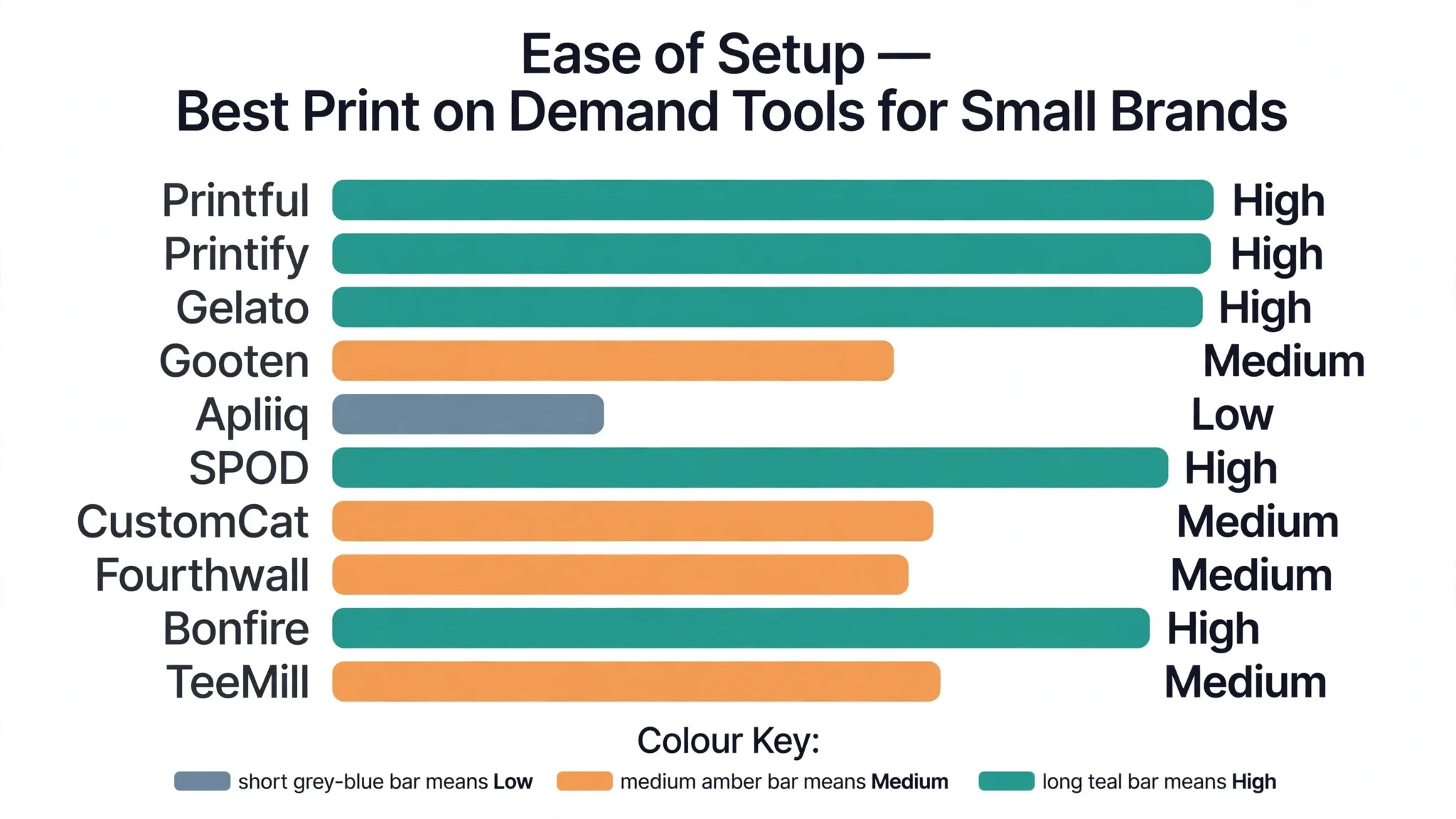
Printful and Printify sit at the top of the table, so read their reviews and see which fulfilment habit fits the parcel your brand sends. A service that scores High on brand control is only useful if it ships on time, and a service that scores High on catalogue size is only useful if the products feel premium in hand. Fit to the brand’s actual customers matters more than a long feature list.
What the Best Print on Demand Tools for Small Brands Must Deliver
The first need is a parcel that looks like the brand. A buyer judges a small brand by what arrives in the post, and a generic parcel tells them the brand is a middleman. The best print on demand tools for small brands offer branded packing slips, custom labels and packaging that carries the brand’s name, so the buyer remembers who they bought from.
The second need is consistency across reorders. A customer who buys a second shirt expects the same colour, the same fit and the same print quality as the first. A service that varies between batches will lose repeat buyers one at a time, and repeat buyers are the cheapest revenue a small brand has.
The third need is margin that survives the fees. A small brand works on thin margins, so the base cost, the shipping and the platform cut all matter. A service with a low headline price but high shipping can leave less profit than a pricier service with free or cheap delivery. Work out the full cost per order before choosing.
The fourth need is a store that fits the brand. Some brands sell through their own website, some through a marketplace, and some through a creator page with memberships. The print partner should plug into the channel the brand already uses, rather than forcing a new one.
The final need is room to grow. A brand that starts with ten shirts a month may sell five hundred a year later, and the print partner should handle that growth without a painful migration. Check whether the service supports volume discounts, warehousing and a wider catalogue before committing to it.
How We Scored Each Print Partner
We tested the best print on demand tools for small brands against the same five measures, using identical designs across apparel, accessories and home goods. Each service printed the same products, so Printful and the rest compare like with like, and every sample was judged blind where possible.
- Brand control, judged by custom packaging, packing slips, labels and whether the brand or the printer reached the buyer.
- Print quality, measured by colour accuracy against the original file, sharpness, and how the print survived two washes.
- Fulfilment speed, timed from order placement to delivery, with attention to how often the estimate was met.
- Margin after fees, scored on the full cost per order, including base price, shipping and platform cuts.
- Ease of use, judged by how long setup took, from account creation to a live product with correct mockups.
Each measure carried equal weight except brand control, which counted double, because a small brand that cannot control its own parcel is not building a brand at all. Scores run out of 100, and the order below follows the combined total, led by Printful on brand control. Where two services tied, we broke the tie on print quality, since a beautiful parcel cannot save a poor print.
We also ordered samples from every service in the ranking, because a product photo cannot show how a parcel feels to open. A print that looks sharp on screen can arrive faded on a hoodie, and packaging that looks premium in a photo can feel flimsy in hand, so every review below reflects what actually arrived at the door, not what the service promised in its catalogue.
The 10 Tools in Detail
Each review below follows the same pattern for Printful, and every other service is judged on the same ground. We note what each service does best, where it falls short, and the buyer it suits best, with brand control carrying the most weight.
1. Printful
Printful is the brand-control leader in this ranking, and it leads because it prints in its own facilities and lets the brand own the parcel. Custom packing slips, branded labels and consistent in-house quality mean the buyer receives a product that looks like it came from the brand, not from a printer. The catalogue covers apparel, home goods and accessories, and the store integrations are strong.
The trade off is cost. Printful’s base prices sit above the cheapest providers, so margins are thinner on low-priced items. A brand selling budget tees will feel the difference. For a brand whose reputation rides on every parcel, that premium buys the consistency and control that cheaper services struggle to match.
In the trial, order one apparel sample and one home good before listing anything, then check the packaging, the packing slip and the print against the original file. Wash the apparel twice and check whether the print holds. If the parcel feels like the brand, the service will protect it at scale.
Our verdict. The strongest brand control here, and the best all rounder for small brands selling under their own name.
2. Printify
Printify is the margin service, and it earns second place by connecting brands to a network of hundreds of print providers. The brand picks a provider by price, location and rating for each product, which keeps base costs low and margins healthy. The catalogue is enormous, and the free plan makes a proper trial easy.
The trade off is variability. Quality depends on the provider chosen, so two orders of the same product can differ if they come from different printers. A brand must order samples from each provider it uses, and keep a shortlist of the ones that pass. For a brand that watches every cent of margin, that homework is worth it.
In the trial, pick one provider per product type and order a sample from each before going live. Compare the prints, the packaging and the shipping times side by side. If one provider stands out, route the best sellers through it and keep the rest as backup.
Our verdict. The best margins here, ideal for brands that compare costs carefully.
3. Gelato
Gelato is the international service, and it fits brands whose buyers live in many countries. It routes each order to a local printer in one of more than 30 countries, so shipping is faster and cheaper than sending everything from one warehouse. The catalogue covers apparel, posters and photo products, and the platform plugs into the main store systems.
The trade off is that quality varies by country, since the local partner does the printing. A product printed in one country can differ slightly from the same file printed in another. Brands selling mostly in one market will not notice, but those with a global audience should sample from their top buyer countries.
In the trial, place test orders shipping to the countries where most buyers live, then compare the prints and delivery times. Check whether colours stay consistent across regions. If the results line up, the local production model will save real money on shipping.
Our verdict. The best global fulfilment here, ideal for brands with buyers in several countries.
4. Gooten
Gooten is the niche-catalogue service, and it suits brands that want products other providers do not carry. The catalogue leans toward home goods, travel accessories and specialty items, and the smart routing sends each order to the most efficient manufacturer in the network. White-label fulfilment means no Gooten branding reaches the buyer.
The trade off is that the catalogue is narrower on apparel, and the platform is built for volume rather than beginners. A brand that wants a simple tee shop will find the interface more complex than it needs. For a brand that wins on unusual products, the range is the point.
In the trial, pick three niche products the brand could not find elsewhere and order a sample of each. Check the quality, the packaging and the delivery time. If the products feel premium and the routing is fast, the niche catalogue is a genuine advantage.
Our verdict. The most distinctive catalogue here, ideal for brands that stand out on product choice.
5. Apliiq
Apliiq is the fashion-labelling service, and it fits brands building a real clothing label. Woven labels, private labelling, embroidery and premium apparel options let a small brand look like an established fashion house. The platform handles the decoration and the fulfilment, so the owner focuses on design and marketing.
The trade off is price and pace. The labelling and premium options cost more than basic printing, and the platform is apparel-focused, so brands selling home goods will need another service. For a fashion brand where the label is the product, that premium is the whole point.
In the trial, order one labelled garment and one embroidered piece, then check the label quality, the stitching and the fabric feel. Compare the finished garment with a retail brand at the same price. If it holds up, the service is building a real label, not just printing shirts.
Our verdict. The best private labelling here, ideal for fashion brands building a label.
6. SPOD
SPOD is the speed service, and it earns its place with production in as little as 48 hours. A brand that sells at events, runs flash campaigns or needs a fast restock will feel the difference, because orders move from checkout to shipping in days rather than a week. The platform integrates with the main store systems, and the product range covers the apparel essentials well.
The trade off is a narrower catalogue than the leaders, and less brand customisation on packaging. A brand that needs unusual products or deep packaging control will look elsewhere. For a brand where speed decides the sale, SPOD is the fastest option here.
In the trial, place an order on a Monday and track it to delivery, noting the production time and the shipping speed. Check the print quality on arrival. If the order arrives fast and the print is clean, the speed is real rather than promised.
Our verdict. The fastest production here, ideal for brands that sell on tight deadlines.
7. CustomCat
CustomCat is the volume service, and it suits brands selling in larger numbers. The base costs are low, which protects margins when orders run into the hundreds, and the catalogue covers apparel, home goods and accessories. The platform is built for sellers who know their numbers and want the per-unit cost down.
The trade off is that the interface is more functional than friendly, and the brand customisation is lighter than Printful’s. A brand that needs deep packaging control will find the options limited. For a brand selling in volume, the low base cost is the argument.
In the trial, work out the full cost per order at the brand’s expected volume, including shipping, then compare it with two other services. Order a sample to check quality. If the margin is clearly better and the quality holds, the volume model is working.
Our verdict. The best volume margins here, ideal for brands selling in larger numbers.
8. Fourthwall
Fourthwall is the creator-platform pick, and it suits brands built around a person and a community. The platform combines a storefront, merchandise, memberships and audience tools in one place, so a creator can sell merch, offer exclusive products and keep the community close. The print quality is solid, and the brand owns the storefront.
The trade off is that it is built for creators, so a brand without an audience will not use its best features. The product range is narrower than the big fulfilment platforms. For a creator-led brand, the combined storefront and community is worth more than a wider catalogue.
In the trial, set up a storefront with five products and one membership tier, then ask a follower to buy through it. Check the checkout, the parcel and the print. If the whole flow feels like the brand, the platform is doing its job.
Our verdict. The best creator storefront here, ideal for brands built around a community.
9. Bonfire
Bonfire is the campaign pick, and it fits brands that sell through campaigns, causes and events. The platform lets a brand launch a campaign page with no upfront cost, sell shirts for a limited time, and keep the profit after the campaign closes. It suits fundraisers, clubs, teams and brands that launch in bursts rather than selling year-round.
The trade off is that it is campaign-based, so a brand that needs a permanent store will find the model limiting. The product range is apparel-focused, and the per-unit margin is thinner than a fulfilment service. For a brand that sells in campaigns, the zero-upfront model is the point.
In the trial, run one small campaign with a clear end date and a modest goal. Check the campaign page, the ordering flow and the final payout. If the campaign hits its goal and the shirts arrive on time, the model works for the brand’s rhythm.
Our verdict. The best campaign selling here, ideal for brands that launch in bursts.
10. TeeMill
TeeMill is the sustainable pick, and it earns its place with eco-minded printing and a returns programme. The platform prints on organic cotton, uses water-based inks, and takes back worn garments for remaking, which suits brands whose customers care about sustainability. The storefront is clean, and the print quality on apparel is strong.
The trade off is scope. TeeMill is apparel-focused, so a brand selling home goods will need another service, and the product range is narrower than the leaders. For a brand whose story is sustainability, the credentials are the point, and the customers will notice.
In the trial, order one tee and check the fabric, the print and the packaging. Read the sustainability claims on the site and check whether they are specific and verifiable. If the product feels premium and the claims hold up, the brand story is real.
Our verdict. The most sustainable printing here, ideal for eco-minded apparel brands.
The Numbers That Decide Your Margin
The first number is the base cost, which is what the printer charges for the product and the print. It varies widely between services and between providers on the same service, so compare the same product across two or three services before choosing. The best print on demand tools for small brands keep the base cost low without cutting quality, and the difference shows up in every order.
The second number is shipping, which buyers notice and brands often forget. A service with cheap printing but expensive shipping can leave less profit than a pricier service with free or local delivery. Work out the shipping cost to the countries where most buyers live, and include it in the price, not as a surprise at checkout.
The third number is the platform cut. Some services take a share of each sale, some charge a monthly fee, and some do both. Add the cut to the base cost and shipping, then check what is left. A brand that skips this step will discover the margin is gone after the first month.
The fourth number is the return rate. A product that arrives wrong, damaged or late will be returned, and the brand pays for the return in money and in reputation. A service with consistent quality keeps returns low, which protects the margin better than a small saving on base cost.
The fifth number is the repeat purchase rate. A buyer who comes back costs nothing to acquire, so the margin on the second order is far higher than on the first. A brand that invests in packaging, quality and a thank-you note will see that rate rise, and the rise is worth more than any discount on printing.
Building a Brand Buyers Remember
Start with the parcel, because it is the first physical contact the buyer has with the brand. A branded tag, a packing slip with the brand’s name, and a short thank-you note cost little and change how the product feels. A parcel that looks considered tells the buyer the brand cares, and that feeling is what brings them back.
Next, keep the catalogue tight. A brand with fifty mediocre products looks like a marketplace, while a brand with ten strong products looks like a label. Choose the products that fit the brand’s story, drop the rest, and make each one excellent. The catalogue should feel curated, not crowded.
Then, tell the story on the product page. A shirt is not just a shirt, it is the fabric, the print, the fit and the reason the brand made it. Write product descriptions that explain those details, show the product on a real person, and let the buyer picture wearing it.
After that, protect the quality promise. Order a sample of every new product, check it properly, and only then list it. A brand that lists products it has never held is gambling with its reputation, and the first bad review costs more than a dozen samples.
Finally, ask buyers to come back. A thank-you note with a small discount on the next order, a follow-up email after delivery, and a request for a photo of the product in use all turn a one-time buyer into a repeat customer. The best small brands grow through their buyers, not through ads.

Best Pick by Job
A single winner does not fit every brand, so we matched each common situation to the service that scored highest for that job. The best print on demand tools for small brands for a fashion label look different from the right pick for a creator with a community, and the table below makes that split clear.
| Job | Best pick | Why it wins |
|---|---|---|
| Sells under your own brand name | Printful | Branded packaging and in-house quality |
| Wants the healthiest margins | Printify | Huge provider network and catalogue |
| Sells to buyers worldwide | Gelato | Local printing in 30 plus countries |
| Wants products nobody else sells | Gooten | Niche home goods and smart routing |
| Builds a fashion label | Apliiq | Private labelling and premium apparel |
| Needs orders shipped fast | SPOD | Production in as little as 48 hours |
| Sells in larger volumes | CustomCat | Low base costs for high-volume sellers |
| Runs a creator-led brand | Fourthwall | Storefront, merch and memberships together |
| Sells through campaigns | Bonfire | Campaign pages with no upfront cost |
| Sells sustainable apparel | TeeMill | Eco printing with a returns programme |
If your situation does not match a row exactly, take the closest one and read that review first, starting with Printful when it fits. The gap between neighbouring services is smaller than the gap between a parcel that feels like a brand and one that feels like a warehouse, so brand control matters more than a few points on a scorecard.
Frequently Asked Questions
Brand owners ask the same questions before every print partner change, so we answered the most common ones here. The best print on demand tools for small brands answer these in their help centres, but the plain answers below are faster to judge a service against.
Do I need to hold any stock with a print on demand service?
No, and that is the core advantage. Nothing is printed until a customer orders and pays, so there is no inventory to buy, store or clear out. The brand uploads designs, the service prints and ships each order, and the brand keeps the margin. Unsold designs cost nothing beyond the time spent creating them.
Can the packaging carry my brand instead of the printer’s?
It depends on the service. Fulfilment services like Printful and Apliiq usually offer branded or neutral packing slips and labels, and some offer custom packaging. Creator and campaign platforms vary, so check the packaging options before choosing. A service that ships under its own brand will not build yours.
How do I work out the real margin per order?
Add the base cost, the shipping cost and any platform cut, then subtract the total from the selling price. Do this for the countries where most buyers live, because shipping changes the answer. A service that looks cheap on base cost can be expensive once shipping is counted, so compare the full cost, not the headline price.
What should I check in a sample order?
Check the print against the original file in daylight, feel the fabric or material, wash apparel twice, and look at the packaging and the packing slip. A sample that passes all four checks is a service worth using. A sample that fails any of them will fail again at scale, with real buyers.
How long does delivery usually take?
It varies by service and by where the buyer lives. Services with local production often deliver in under a week, while others can take longer depending on the product and the destination. Check the delivery estimates for your main buyer countries during the trial, and state them honestly on the store page.
The Final Word for Your Brand
A small brand can settle this in a trial by opening the parcel a buyer receives, counting the margin left after every cost, and timing delivery to the countries where buyers live. The best print on demand tools for small brands prove themselves on the parcel the buyer opens, the margin left after every cost is counted, and the delivery time to the countries where buyers live, and a two week trial with real orders will show all three. Printful wins our ranking on the combined score, but the right service for a brand is the one whose parcel feels like the brand itself.
Order the samples, open them as a buyer would, and judge the service on the physical product rather than the demo. If the print matches the file, the packaging carries the brand, and the delivery arrives on time, the partnership will hold. If the parcel looks generic or the print fades after two washes, no feature list will save it. Pick the partner that makes a small brand look like a serious one, and let the unboxing do the selling.