

A venue receives an enquiry on Monday, and the reply goes out on Thursday, because the sales manager was running an event and the proposal took an hour to build. By Thursday the client has booked somewhere else, and the venue never learns why. The best AI event planning tools for venues exist for that exact loss, because a venue that answers slowly loses bookings to one that answers fast, and the difference is not the room, it is the reply.
The problem is not the venue. It is the workflow. An enquiry that arrives by email, a proposal built in a spreadsheet, a floor plan drawn by hand, and a BEO typed from memory are four steps that each take time, and the time adds up to a lost booking. A tool that answers the enquiry, builds the proposal and draws the floor plan in minutes turns a three-day reply into a same-day one, and the same-day reply wins the booking.
This guide compares the best ai event planning tools for venues on price, fit and day-to-day use, and it ends with a clear pick for each job.
In this article
- Why a Venue Loses Bookings It Should Have Won
- How We Judged the Best AI Event Planning Tools for Venues
- The 8 Tools at a Glance
- Best Pick by Job
- The 8 Tools in Detail
- Win the Booking in Five Steps
- What Event Planning Tools Cost a Venue Each Month
- Five Mistakes That Lose a Venue Bookings
- Frequently Asked Questions
- Our Pick, Stated Plainly (Tripleseat)
Why a Venue Loses Bookings It Should Have Won
Before comparing prices, run through this checklist for best ai event planning tools for venues, which covers the six things that decide whether the tool earns its keep.
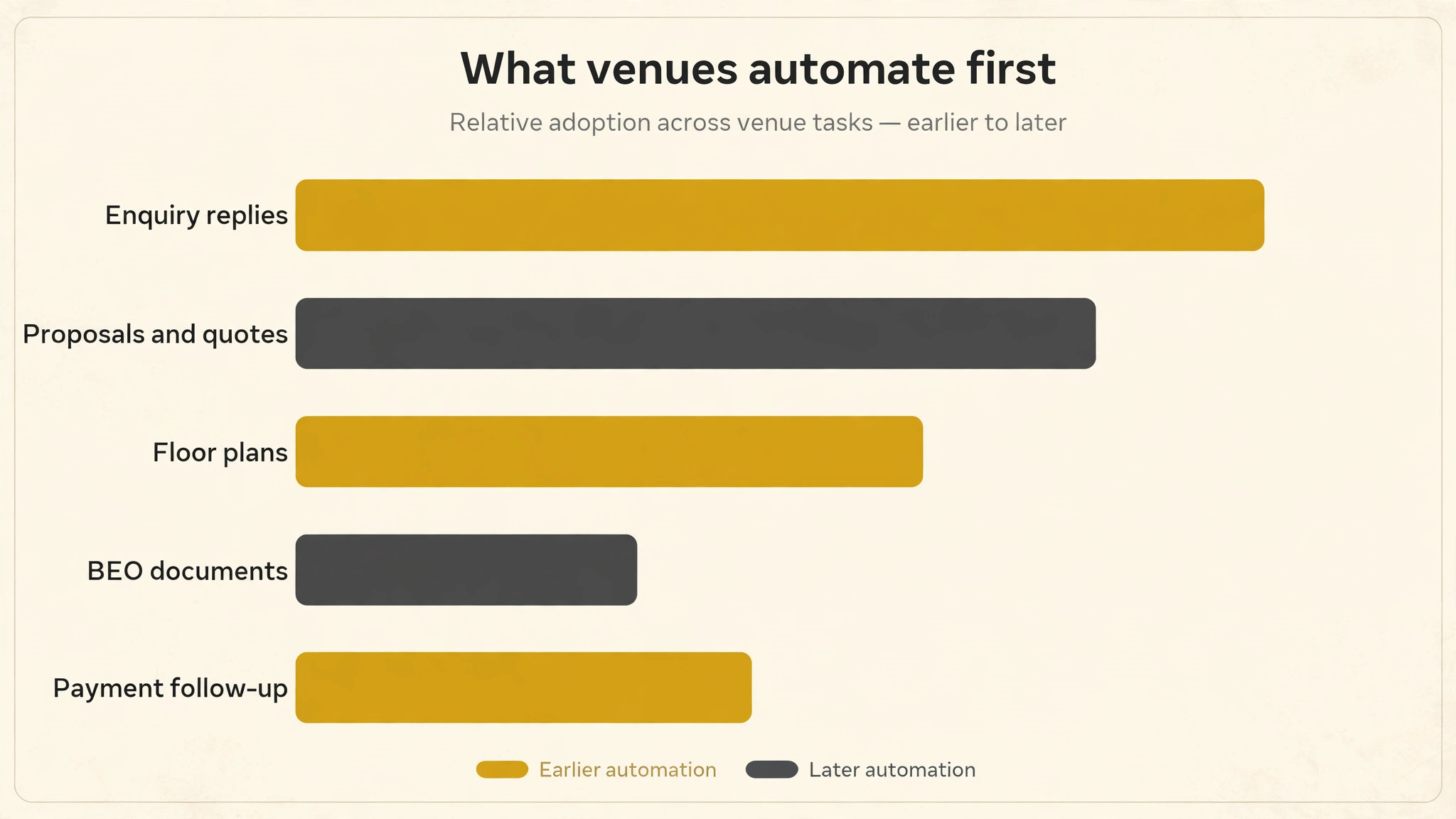
- Enquiry replies the same day, because a slow reply loses the booking to a faster venue.
- Proposals built in minutes, so the sales team sends five a day rather than one.
- Floor plans the client can see, because a client who sees the room books it faster.
- BEOs that match the proposal, so the kitchen and the client agree on the same numbers.
- Payment follow-up that runs on its own, because a deposit chased late is a booking at risk.
- A price the venue’s event volume covers, because a tool that costs more than a booking a month is hard to justify.
How We Judged the Best AI Event Planning Tools for Venues
We judged each tool on the booking, which is whether the venue wins the event. A tool scored well when it answered enquiries fast, when it built proposals and BEOs without retyping, and when it showed the client the room before they visited. A tool lost points when it was a fine planning tool but could not sell the event, because a venue that plans well but books slowly still loses to the one that answers first.
Judged as a shortlist led by Tripleseat, the scores below reflect the tools as they stand in 2026, with starting prices taken from the vendor sites and from roundups published this year.
- Enquiry speed, because the first reply often wins the booking.
- Proposal and BEO flow, so the documents match and take minutes, not hours.
- Floor plan visuals, because a client who sees the room books faster.
- Payment follow-up, so deposits arrive on time and bookings stay firm.
- Price against event volume, so a quiet venue is not paying for an enterprise system.
The 8 Tools at a Glance
Here is how the best ai event planning tools for venues compare on price, fit and standout strength, so the shortlist is visible in one place.
| Tool | Starting price | Best for | Standout strength |
|---|---|---|---|
| Tripleseat | From $375 a venue a month | venues that run many events and need the full sales workflow | Tripleseat is the standard event management platform for venues, covering lead capture, proposals, BEOs, payments and reporting from 375 dollars a venue a month. It is built for venues that run events every week and need the whole workflow in one place. |
| Perfect Venue | From $199 a month on annual billing | independent venues that want a simpler Tripleseat | Perfect Venue covers enquiries, proposals, contracts and payments from 199 dollars a month on annual billing, and it is built for independent venues that want the core workflow without the enterprise price. Its interface is cleaner than Tripleseat, and its setup is faster. |
| Cvent Event Diagramming | From $49 a month | venues that need floor plans and room layouts | Cvent Event Diagramming, formerly Social Tables, creates interactive floor plans and seating charts from 49 dollars a month, and it suits a venue that sells the room as much as the food. Clients can see the layout before they book, which closes deals faster. |
| Planning Pod | From $59 a month | venues and planners who want floor plans plus event management | Planning Pod combines floor plans, timelines, checklists and client management from 59 dollars a month, and it suits a venue that wants the planning side as well as the sales side. Its floor plan builder is strong, and its price is low for what it covers. |
| MyVenueHQ | From $49 a month | small venues that want a simple enquiry and booking system | MyVenueHQ covers enquiries, quotes, bookings and payments from 49 dollars a month, and it is built for small venues that want a simple system without enterprise complexity. Its setup is quick, and its price is low. |
| Cvent | Pricing on the vendor site | large venues and hotels that need the full event platform | Cvent is the large event platform used by hotels and conference centres, covering registration, venue sourcing, event marketing and management, and its pricing is shown on the vendor site. It suits a venue that runs large events and needs the deepest feature set. |
| Event Temple | Pricing on the vendor site | hotels and venues that want a modern sales CRM | Event Temple is a modern event sales CRM for hotels and venues, covering leads, proposals, BEOs and reporting, and its pricing is shown on the vendor site. It suits a venue that wants a clean, modern interface rather than a legacy system. |
| Whova | Pricing on the vendor site | venues that run conferences with an attendee app | Whova is an event platform with registration, an attendee app, networking and agenda management, and its pricing is shown on the vendor site. It suits a venue that runs conferences and wants the attendee experience as well as the planning. |
Best Pick by Job
Our pick among the best ai event planning tools for venues is Tripleseat, and the table below matches the right tool to the job at hand, because the best tool depends on what the reader is actually doing.
Use the table above as a shortlist for best ai event planning tools for venues, not a final answer, and run the top two trials in the same week before paying for a year.
| Job | Best pick | Why |
|---|---|---|
| Small venue, simple bookings | MyVenueHQ | Simple system from $49 a month |
| Independent venue, full workflow cheaper | Perfect Venue | Core workflow from $199 a month |
| Venue that needs floor plans only | Cvent Event Diagramming | Floor plans from $49 a month |
| Large venue or hotel | Cvent | Full platform for large events |
| Best overall for most venues | Tripleseat | Full sales workflow from $375 a venue a month |
The 8 Tools in Detail
The best ai event planning tools for venues below are listed with the price, the fit and the reason to skip each one, so the decision is visible tool by tool.
1. Tripleseat
Tripleseat is built for venues that run many events and need the full sales workflow. It starts from $375 a venue a month.
Tripleseat is the standard event management platform for venues, covering lead capture, proposals, BEOs, payments and reporting from 375 dollars a venue a month. It is built for venues that run events every week and need the whole workflow in one place.
Its BEO and proposal flow is the reason venues pick it, because the documents that used to take an hour now take minutes.
Skip it when the venue runs a handful of events a year, because 375 dollars a month is a lot for a quiet calendar.
In the trial, check Tripleseat against the checklist above, and confirm the $375 a venue a month plan covers the job before paying.
2. Perfect Venue
Perfect Venue is built for independent venues that want a simpler Tripleseat. It starts from $199 a month on annual billing.
Perfect Venue covers enquiries, proposals, contracts and payments from 199 dollars a month on annual billing, and it is built for independent venues that want the core workflow without the enterprise price. Its interface is cleaner than Tripleseat, and its setup is faster.
Its price and simplicity suit a venue that wants the workflow without a long implementation.
Skip it when the venue needs deep reporting or integrations, because Perfect Venue is simpler than Tripleseat.
In the trial, check Perfect Venue against the checklist above, and confirm the $199 a month on annual billing plan covers the job before paying.
3. Cvent Event Diagramming
Cvent Event Diagramming is built for venues that need floor plans and room layouts. It starts from $49 a month.
Cvent Event Diagramming, formerly Social Tables, creates interactive floor plans and seating charts from 49 dollars a month, and it suits a venue that sells the room as much as the food. Clients can see the layout before they book, which closes deals faster.
Its visual floor plans are the feature, because a client who can see the room is more likely to book it.
Skip it when the venue needs the full sales workflow, because diagramming is a layout tool, not a CRM.
In the trial, check Cvent Event Diagramming against the checklist above, and confirm the $49 a month plan covers the job before paying.
4. Planning Pod
Planning Pod is built for venues and planners who want floor plans plus event management. It starts from $59 a month.
Planning Pod combines floor plans, timelines, checklists and client management from 59 dollars a month, and it suits a venue that wants the planning side as well as the sales side. Its floor plan builder is strong, and its price is low for what it covers.
Its combination of planning and diagrams suits a venue that manages the event as well as selling it.
Skip it when the venue needs a deep sales CRM, because Planning Pod is a planning tool first.
In the trial, check Planning Pod against the checklist above, and confirm the $59 a month plan covers the job before paying.
5. MyVenueHQ
MyVenueHQ is built for small venues that want a simple enquiry and booking system. It starts from $49 a month.
MyVenueHQ covers enquiries, quotes, bookings and payments from 49 dollars a month, and it is built for small venues that want a simple system without enterprise complexity. Its setup is quick, and its price is low.
Its simplicity is the point, because a small venue does not need a tool that takes a month to learn.
Skip it when the venue runs complex multi-day events, because MyVenueHQ is built for simpler bookings.
In the trial, check MyVenueHQ against the checklist above, and confirm the $49 a month plan covers the job before paying.
6. Cvent
Cvent is built for large venues and hotels that need the full event platform. Pricing is on the vendor site.
Cvent is the large event platform used by hotels and conference centres, covering registration, venue sourcing, event marketing and management, and its pricing is shown on the vendor site. It suits a venue that runs large events and needs the deepest feature set.
Its scale is the reason to pick it, because no other tool here handles a thousand-person conference the same way.
Skip it when a published price is needed, because Cvent prices by quote.
In the trial, check Cvent against the checklist above, and confirm the quoted plan covers the job before paying.
7. Event Temple
Event Temple is built for hotels and venues that want a modern sales CRM. Pricing is on the vendor site.
Event Temple is a modern event sales CRM for hotels and venues, covering leads, proposals, BEOs and reporting, and its pricing is shown on the vendor site. It suits a venue that wants a clean, modern interface rather than a legacy system.
Its modern design and speed suit a venue team that wants a tool that feels current.
Skip it when a published price is needed, because Event Temple prices by quote.
In the trial, check Event Temple against the checklist above, and confirm the quoted plan covers the job before paying.
8. Whova
Whova is built for venues that run conferences with an attendee app. Pricing is on the vendor site.
Whova is an event platform with registration, an attendee app, networking and agenda management, and its pricing is shown on the vendor site. It suits a venue that runs conferences and wants the attendee experience as well as the planning.
Its attendee app is the feature, because a conference where attendees can network and see the agenda is a better event.
Skip it when a published price is needed, because Whova prices by quote.
In the trial, check Whova against the checklist above, and confirm the quoted plan covers the job before paying.
Win the Booking in Five Steps
The five steps below are the checklist we would follow for best ai event planning tools for venues, in the order that wastes the least time.
Answer the enquiry within the hour. Set up the tool to reply to every enquiry with a real answer within an hour, even if it is just a holding reply with available dates. A venue that answers in an hour wins bookings from one that answers in three days, and the tool makes the fast reply easy.
Send the proposal the same day. Build the proposal from a template with the client’s details filled in, and send it the same day the enquiry arrives. A proposal that takes a week to build is a proposal that arrives after the client has chosen.
Show the floor plan before the visit. Send the client a floor plan with their layout before they visit, so they arrive already picturing their event in the room. A client who has seen the layout is closer to booking than one who has only read a description.
Confirm the BEO early and in writing. Send the BEO as soon as the details are agreed, and get it signed before the event week. A BEO agreed early prevents the misunderstandings that ruin events, and the tool should make it a two-minute job.
Chase the deposit automatically. Set the tool to remind the client about the deposit, so the booking stays firm without the sales team chasing. A deposit paid on time is a booking that will not cancel, and an automatic reminder is the cheapest insurance.
What Event Planning Tools Cost a Venue Each Month
The monthly bill for best ai event planning tools for venues runs from the cheapest entry point to the top tier, and the right budget depends on volume rather than brand.
The monthly bill for event planning tools runs from 49 dollars a month for Cvent Event Diagramming or MyVenueHQ to 59 dollars for Planning Pod, 199 dollars for Perfect Venue on annual billing, and 375 dollars a venue a month for Tripleseat. Most venues that run events weekly land on Tripleseat at 375 dollars or Perfect Venue at 199 dollars, because those are the tools with the full sales workflow. A small venue that only needs floor plans can start at 49 dollars, and a large hotel will pay a quoted price for Cvent.
The cost that venues forget is the booking the tool wins. A venue that charges 5,000 dollars for a wedding and wins one extra booking a month because it answered faster has earned far more than the 375 dollar bill. The tool pays for itself when it wins a single booking, and that is a low bar. The expensive choice is not the tool, it is the enquiry that went unanswered for three days.
A venue should treat the enquiry reply as the sale, not as admin before it. The client who receives a fast, specific reply feels wanted, and the venue that sends it wins the booking, while the one that waits three days loses to a faster competitor. The tool that drafts the reply in minutes makes the fast answer easy, and the easy answer is the one that actually goes out. That is the whole value.
The floor plan is a sales tool, not just a planning document. A client who sees their wedding or conference laid out in the room can picture the event, and a client who can picture it is closer to booking than one who has only read a description. Send the layout before the visit, and let the room sell itself, because the room is the product.
A venue that measures its reply time learns fast. The enquiry answered in an hour books at a higher rate than one answered in a day, and the difference is visible in the numbers within a month. Track the reply time, the proposal time and the booking rate, and the tool that improves them is the one worth paying for. A venue that does not measure keeps losing bookings it never knew it had.
A venue should treat the site visit as the sale, not as a tour, because the client who visits has already shortlisted the venue and only needs a reason to say yes. Walk the client through the room as their event, not as an empty hall, and show them where the head table goes and where the dance floor fits. A venue that sells the event during the visit books it, while one that only shows the room sends the client to the next venue.
Seasonal pricing is the easiest revenue a venue can add, because a Saturday in December costs the venue the same as a Saturday in June while the demand is completely different. The tool should make it easy to price by date, so the peak dates earn more and the quiet dates fill with a lower rate. A venue with one flat price all year is leaving money on the peak dates and leaving quiet dates empty.
The post-event thank you is the cheapest marketing a venue will ever send, because a happy client who gets a thank you within a week is far more likely to recommend the venue. Send it with a photo from the event if the client agrees, and ask for a review while the memory is fresh. A venue that never follows up after the event relies on luck for its next booking, while one that does builds a referral stream.
A venue that confirms the final guest count a week before the event avoids the two most expensive mistakes, which are ordering food for guests who never arrive and running out of chairs for guests who do. The tool should make the final count a single step, with the kitchen and the floor team seeing the same number. A count agreed late is a count that costs money, and the venue pays for it either way.
Five Mistakes That Lose a Venue Bookings
Answering enquiries late. An enquiry answered in three days is an enquiry lost, because the client has already booked elsewhere. Answer within the hour, even with a holding reply.
Building proposals from scratch each time. A proposal built from a blank document takes an hour and invites errors, while a template takes minutes. Use the template, and fill in the client’s details.
Sending a BEO that does not match the proposal. A BEO with different numbers from the proposal creates a dispute on the event day, when it is too late to fix. Let the tool generate the BEO from the proposal, so the numbers always match.
Never showing the floor plan. A client who has not seen the room imagines it smaller than it is, and a floor plan corrects that. Send the layout before the visit, not after.
Chasing deposits by memory. A deposit chased late is a booking at risk, and a sales team that relies on memory will forget one. Let the tool remind the client automatically.
Frequently Asked Questions
These are the questions readers ask most about best ai event planning tools for venues, answered with the prices and limits above.
How much do event planning tools cost a venue?
A small venue can start at 49 dollars a month for Cvent Event Diagramming or MyVenueHQ, while Planning Pod costs 59 dollars a month, Perfect Venue costs 199 dollars a month on annual billing, and Tripleseat costs 375 dollars a venue a month. Cvent, Event Temple and Whova price by quote. Most venues that run events weekly land on Tripleseat or Perfect Venue, because those cover the full sales workflow.
Which event planning tool is best for venues?
Tripleseat is the best pick for most venues, because it covers lead capture, proposals, BEOs, payments and reporting from 375 dollars a venue a month, and it is the standard the industry knows. Perfect Venue at 199 dollars a month is the pick for an independent venue that wants the core workflow without the enterprise price, while a venue that only needs floor plans should start with Cvent Event Diagramming at 49 dollars.
Is Tripleseat worth 375 dollars a month?
Yes, when the venue runs events weekly, because one extra booking won by a fast reply covers the bill many times over. A venue that charges several thousand dollars per event only needs to win one booking a month that it would otherwise have lost, and the tool has paid for itself. A venue that runs a handful of events a year should pick Perfect Venue at 199 dollars or MyVenueHQ at 49 dollars instead.
What is a BEO, and why does it matter?
A BEO, or banquet event order, is the document that tells the kitchen, the bar and the floor staff exactly what the client ordered, from the menu to the room setup to the timing. It matters because the proposal is a sales document while the BEO is an operations document, and when the two disagree, the event goes wrong. A tool that generates the BEO from the proposal keeps the numbers the same, which is the simplest way to prevent a dispute on the event day.
Can a small venue use event planning software?
Yes, MyVenueHQ at 49 dollars a month and Planning Pod at 59 dollars are built for small venues, with enquiries, quotes, bookings and floor plans without enterprise complexity. A small venue does not need Tripleseat at 375 dollars, and should start with the tool that fits its volume. The right tool is the one the team actually uses every day, not the one with the longest feature list.
Do these tools handle floor plans?
Cvent Event Diagramming at 49 dollars a month and Planning Pod at 59 dollars are the floor plan tools here, with interactive layouts and seating charts the client can see before visiting. Tripleseat and Perfect Venue focus on the sales workflow, and many venues pair them with a diagramming tool. A venue that sells the room as much as the food should have a floor plan tool, because a client who sees the layout books faster.
Our Pick, Stated Plainly (Tripleseat)
Our pick for most venues is Tripleseat, because it is the standard that covers the whole sales workflow, from the enquiry to the BEO, and it is the tool the industry knows. It costs 375 dollars a venue a month, which is real money, yet one extra booking won by a fast reply covers it many times over. The exception is an independent venue that wants the core workflow cheaper, where Perfect Venue at 199 dollars is the honest choice, and a small venue that only needs floor plans, where Cvent Event Diagramming at 49 dollars is enough.
Start with the trial, load the next month’s enquiries, and send the first proposal through the tool the same day. If the reply goes out in an hour and the client books, the tool has earned its place. If the workflow still takes days, the problem is the process, not the tool, and no software will fix a team that does not answer.