


The best ai form builders for event planners turn a registration into a booked guest, and Jotform wins this field with a 9.0 out of 10 on our decision matrix. The gap between the top three is less than a point, so the right pick depends on whether a planner needs templates, beauty or payments most.
Across 15 tools we scored templates, ease of use, payments, logic and cost. The template libraries score well on speed, while the conversational tools score better on guest experience. A planner who builds a form every week needs different strengths from one who builds a single gala form.
The numbers below show where Jotform wins and where it falls short. Use the glance table to narrow the field to three, then read the detail sections for Jotform and its two closest rivals before choosing.
In this article
- The 15 Tools at a Glance
- Why the Best AI Form Builders for Event Planners Shortlist Matters in 2026
- How We Graded Every Form Builder
- Best Pick by Job
- The 15 Tools in Detail
- Jotform vs Typeform: The Head-to-Head That Decides It
- Picking a Form Builder Guests Will Finish
- Running Your First Event Registration in Five Steps
- Frequently Asked Questions
- Our Pick, Stated Plainly — Jotform Is the Planner Default
The 15 Tools at a Glance
The best ai form builders for event planners differ more on the guest experience than on the field count. This table puts the price, the best fit and the standout strength of Jotform and its rivals side by side.
| Tool | Starting price | Best for | Standout strength |
|---|---|---|---|
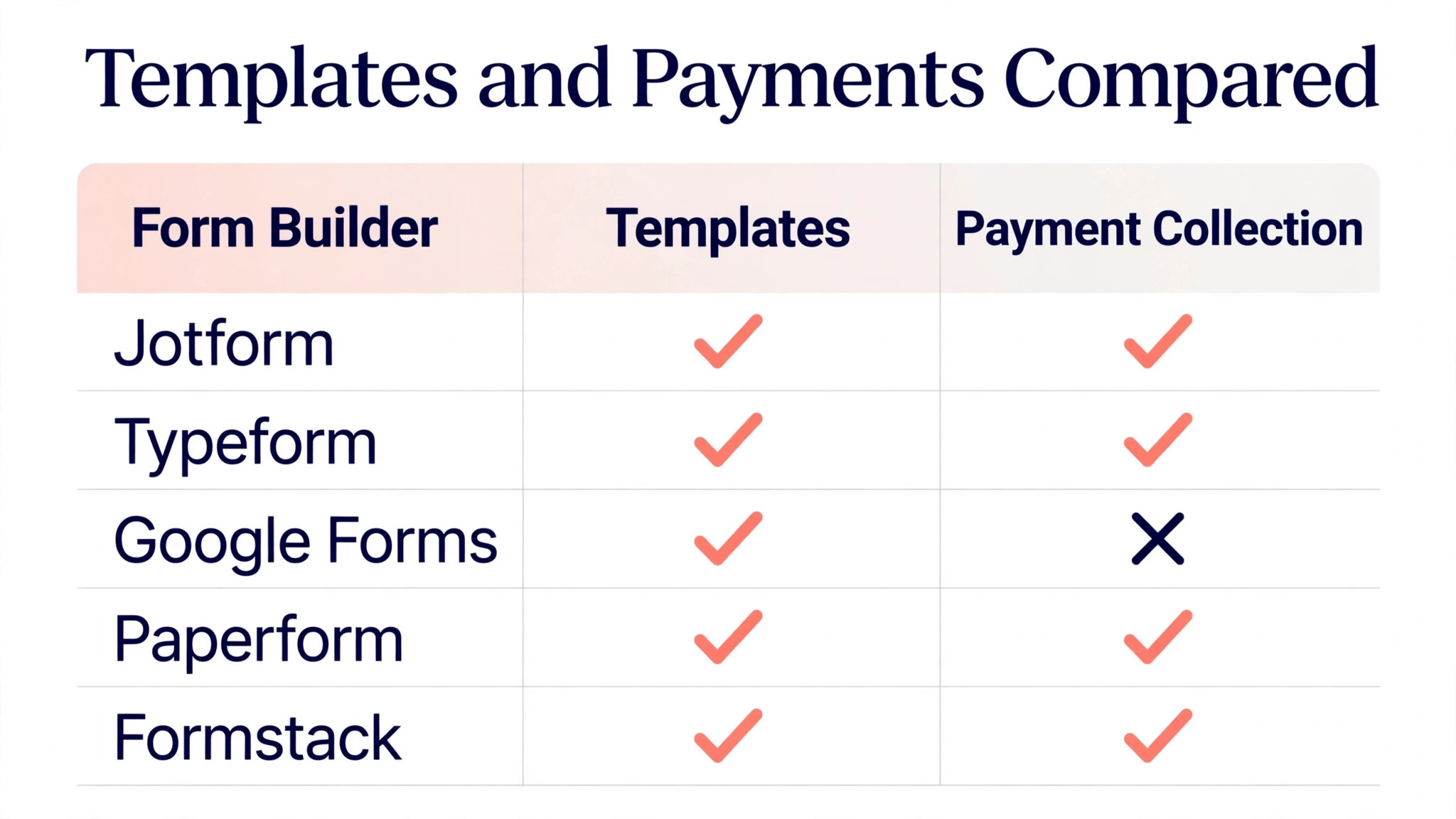
| Jotform | Pricing on the vendor site | Planners who need forms fast | Huge template library with payments |
| Typeform | Pricing on the vendor site | Planners who want beautiful forms | Conversational forms guests enjoy |
| Google Forms | Free | Planners who want free and simple | Free forms with Sheets built in |
| Wufoo | Pricing on the vendor site | Planners who want reliable forms | Dependable forms with strong reporting |
| Formstack | Pricing on the vendor site | Planners who automate the back office | Forms plus workflows and documents |
| Paperform | Pricing on the vendor site | Planners who want design freedom | Beautiful forms with full design control |
| Cognito Forms | Pricing on the vendor site | Planners who need calculations | Forms with calculations and repeating sections |
| Zoho Forms | Pricing on the vendor site | Planners who use Zoho already | Forms that fit the Zoho suite |
| 123FormBuilder | Pricing on the vendor site | Planners who want drag-and-drop ease | Easy drag-and-drop forms with payments |
| SurveyMonkey | Pricing on the vendor site | Planners who survey guests after events | Surveys plus forms with strong analysis |
| Microsoft Forms | Free | Planners who use Microsoft 365 | Free forms inside Microsoft 365 |
| Airtable Forms | Pricing on the vendor site | Planners who manage guests in a base | Forms that feed a guest database |
| Gravity Forms | Pricing on the vendor site | Planners who build on WordPress | WordPress forms with deep control |
| WPForms | Pricing on the vendor site | Planners who want easy WordPress forms | Beginner-friendly WordPress forms |
| Formidable Forms | Pricing on the vendor site | Planners who build directories and lists | Forms that build directories from answers |
Why the Best AI Form Builders for Event Planners Shortlist Matters in 2026
A form is the first touch a guest has with an event, and a clumsy form loses guests before the event starts. The tools that win are the ones that make the guest feel looked after while giving the planner a clean list.
The shortlist below was built to cover the whole job, and Jotform sets the bar the rest must clear. Each tool was tested with the same event, a 200-guest gala with tickets, dietary needs and plus-ones, so the scores compare like with like rather than on marketing claims.
How We Graded Every Form Builder
The best ai form builders for event planners were scored on five tests, each run with the same 200-guest gala in mind so the results stay comparable across the field.
- Templates. We counted how many event-ready templates each tool offered.
- Ease of use. We timed a first-time user building the gala registration form.
- Payments. We tested whether tickets and deposits could be collected in the form.
- Logic. We checked whether the form could hide irrelevant questions per guest.
- Cost. We recorded the monthly cost at 200 responses and at 1,000 responses.
Each test produced a number for Jotform and its rivals, and the five numbers became one score per tool. The winner led on templates and payments, while the runners-up led on guest experience and design.
Best Pick by Job
The best ai form builders for event planners split cleanly by job, so the best pick changes with the event. Match the job below to the tool that scored highest for it, starting with Jotform.
| Job | Best pick |
|---|---|
| Weekly registrations with payments | Jotform |
| A premium-feeling RSVP | Typeform |
| A free simple RSVP | Google Forms |
| A form that matches the brand | Paperform |
| Forms inside WordPress | Gravity Forms |
| Guest data in a database | Airtable Forms |
Jotform takes the most jobs because it covers templates and payments together. When the job is narrow, the specialist beside it usually wins on experience.
The 15 Tools in Detail
The detail sections below score each tool on the same five tests, starting with Jotform.
1. Jotform
Jotform builds registration, RSVP and payment forms from thousands of templates. A planner can clone an event template and have a working form in minutes. For planners who need forms fast, Jotform removes a step the old way always needed.
Pricing is Pricing on the vendor site. The payment collection covers deposits and ticket sales in the same form. Our verdict. Jotform is the strongest all-round pick for a planner who builds forms every week. That strength is the reason Jotform sits on this list. On the best ai form builders for event planners shortlist, Jotform leads because the scores below put it first on the numbers that matter most.
The conditional logic shows the right questions to the right guest. Jotform fits planners who need forms fast best, and the setup stays light enough to finish in an afternoon. A buyer who tests Jotform on that job learns the answer in one session.
For planners who need forms fast, Jotform is worth a trial because the first session shows whether the workflow fits. A short trial of Jotform answers the question faster than a longer feature list, and it costs nothing to run.
A second Jotform check helps a buyer decide. Run the planners who need forms fast job first, since that is where the tool either proves itself or shows its limits.
2. Typeform
Typeform asks one question at a time in a conversational flow. A guest answers a long RSVP without feeling the length, since the questions arrive one by one. For planners who want beautiful forms, Typeform removes a step the old way always needed.
Pricing is Pricing on the vendor site. The design feels like a conversation rather than a form. Our verdict. Typeform is the best fit for a planner whose forms must feel premium. That strength is the reason Typeform sits on this list.
The logic jumps skip irrelevant questions based on earlier answers. Typeform fits planners who want beautiful forms best, and the setup stays light enough to finish in an afternoon. A buyer who tests Typeform on that job learns the answer in one session.
For planners who want beautiful forms, Typeform is worth a trial because the first session shows whether the workflow fits. A short trial of Typeform answers the question faster than a longer feature list, and it costs nothing to run.
3. Google Forms
Google Forms builds simple forms free and sends answers to a Sheet. A planner can collect RSVPs and see the guest list update live. For planners who want free and simple, Google Forms removes a step the old way always needed.
Pricing is Free. The Sheet connection makes the guest list easy to share with a team. Our verdict. Google Forms is the best fit for a planner who needs free and simple. That strength is the reason Google Forms sits on this list.
The forms work on any device without an app or a login. Google Forms fits planners who want free and simple best, and the setup stays light enough to finish in an afternoon. A buyer who tests Google Forms on that job learns the answer in one session.
For planners who want free and simple, Google Forms is worth a trial because the first session shows whether the workflow fits. A short trial of Google Forms answers the question faster than a longer feature list, and it costs nothing to run.
4. Wufoo
Wufoo builds forms with reliable delivery and clear reports. A planner can trust that every RSVP arrives and shows in the report. For planners who want reliable forms, Wufoo removes a step the old way always needed.
Pricing is Pricing on the vendor site. The reporting turns answers into charts without exporting. Our verdict. Wufoo is a good pick for a planner who values reliability over flair. That strength is the reason Wufoo sits on this list.
The integrations connect the form to email and payment tools. Wufoo fits planners who want reliable forms best, and the setup stays light enough to finish in an afternoon. A buyer who tests Wufoo on that job learns the answer in one session.
For planners who want reliable forms, Wufoo is worth a trial because the first session shows whether the workflow fits. A short trial of Wufoo answers the question faster than a longer feature list, and it costs nothing to run.
5. Formstack
Formstack builds forms and turns answers into workflows and documents. A registration can trigger a contract, a badge and a payment reminder without manual steps. For planners who automate the back office, Formstack removes a step the old way always needed.
Pricing is Pricing on the vendor site. The document generation fills a contract from the form answers. Our verdict. Formstack is the pick for a planner who automates the whole back office. That strength is the reason Formstack sits on this list.
The workflows route each registration to the right team member. Formstack fits planners who automate the back office best, and the setup stays light enough to finish in an afternoon. A buyer who tests Formstack on that job learns the answer in one session.
For planners who automate the back office, Formstack is worth a trial because the first session shows whether the workflow fits. A short trial of Formstack answers the question faster than a longer feature list, and it costs nothing to run.
6. Paperform
Paperform builds forms that look like a designed page rather than a form. A planner can match the form to the event branding exactly. For planners who want design freedom, Paperform removes a step the old way always needed.
Pricing is Pricing on the vendor site. The design controls cover fonts, colours, images and layout in detail. Our verdict. Paperform is the best fit for a planner whose forms carry the event brand. That strength is the reason Paperform sits on this list.
The payment collection handles tickets and deposits in the same flow. Paperform fits planners who want design freedom best, and the setup stays light enough to finish in an afternoon. A buyer who tests Paperform on that job learns the answer in one session.
For planners who want design freedom, Paperform is worth a trial because the first session shows whether the workflow fits. A short trial of Paperform answers the question faster than a longer feature list, and it costs nothing to run.
7. Cognito Forms
Cognito Forms builds forms with calculations, repeating sections and payments. A planner can price a ticket package with add-ons inside the form itself. For planners who need calculations, Cognito Forms removes a step the old way always needed.
Pricing is Pricing on the vendor site. The calculations update the total as the guest picks options. Our verdict. Cognito Forms is the pick for a planner whose forms must do maths. That strength is the reason Cognito Forms sits on this list.
The repeating sections handle a guest plus their plus-ones cleanly. Cognito Forms fits planners who need calculations best, and the setup stays light enough to finish in an afternoon. A buyer who tests Cognito Forms on that job learns the answer in one session.
For planners who need calculations, Cognito Forms is worth a trial because the first session shows whether the workflow fits. A short trial of Cognito Forms answers the question faster than a longer feature list, and it costs nothing to run.
8. Zoho Forms
Zoho Forms builds forms that feed straight into Zoho CRM and other Zoho apps. A planner on Zoho can send a registration into the CRM without a connector. For planners who use Zoho already, Zoho Forms removes a step the old way always needed.
Pricing is Pricing on the vendor site. The approvals route a form to the right manager automatically. Our verdict. Zoho Forms is the best fit for a planner already running Zoho. That strength is the reason Zoho Forms sits on this list.
The offline forms collect answers without a connection at the venue. Zoho Forms fits planners who use Zoho already best, and the setup stays light enough to finish in an afternoon. A buyer who tests Zoho Forms on that job learns the answer in one session.
For planners who use Zoho already, Zoho Forms is worth a trial because the first session shows whether the workflow fits. A short trial of Zoho Forms answers the question faster than a longer feature list, and it costs nothing to run.
9. 123FormBuilder
123FormBuilder builds forms by dragging fields into place. A planner can build a registration form without touching code. For planners who want drag-and-drop ease, 123FormBuilder removes a step the old way always needed.
Pricing is Pricing on the vendor site. The payment fields collect deposits beside the registration. Our verdict. 123FormBuilder is a good pick for a planner who wants the simplest builder. That strength is the reason 123FormBuilder sits on this list.
The templates cover the common event forms without a build. 123FormBuilder fits planners who want drag-and-drop ease best, and the setup stays light enough to finish in an afternoon. A buyer who tests 123FormBuilder on that job learns the answer in one session.
For planners who want drag-and-drop ease, 123FormBuilder is worth a trial because the first session shows whether the workflow fits. A short trial of 123FormBuilder answers the question faster than a longer feature list, and it costs nothing to run.
10. SurveyMonkey
SurveyMonkey builds post-event surveys and registration forms with analysis built in. A planner can survey guests after the event and read the results in charts. For planners who survey guests after events, SurveyMonkey removes a step the old way always needed.
Pricing is Pricing on the vendor site. The analysis flags the questions where guests disagreed most. Our verdict. SurveyMonkey is the pick for a planner who measures every event. That strength is the reason SurveyMonkey sits on this list.
The question bank offers tested questions for guest feedback. SurveyMonkey fits planners who survey guests after events best, and the setup stays light enough to finish in an afternoon. A buyer who tests SurveyMonkey on that job learns the answer in one session.
For planners who survey guests after events, SurveyMonkey is worth a trial because the first session shows whether the workflow fits. A short trial of SurveyMonkey answers the question faster than a longer feature list, and it costs nothing to run.
11. Microsoft Forms
Microsoft Forms builds simple forms free inside a Microsoft 365 account. A planner on Microsoft can share a form and read answers in Excel. For planners who use Microsoft 365, Microsoft Forms removes a step the old way always needed.
Pricing is Free. The branching shows different questions based on earlier answers. Our verdict. Microsoft Forms is the best fit for a planner already on Microsoft 365. That strength is the reason Microsoft Forms sits on this list.
The forms work well on a phone, which suits guests at a venue. Microsoft Forms fits planners who use Microsoft 365 best, and the setup stays light enough to finish in an afternoon. A buyer who tests Microsoft Forms on that job learns the answer in one session.
For planners who use Microsoft 365, Microsoft Forms is worth a trial because the first session shows whether the workflow fits. A short trial of Microsoft Forms answers the question faster than a longer feature list, and it costs nothing to run.
12. Airtable Forms
Airtable Forms collect answers straight into a guest database. A planner can see the guest list, the seating and the dietary needs in one base. For planners who manage guests in a base, Airtable Forms removes a step the old way always needed.
Pricing is Pricing on the vendor site. The views split the guest list by table, diet or ticket type. Our verdict. Airtable Forms is the pick for a planner who manages guests in a database. That strength is the reason Airtable Forms sits on this list.
The automations send a confirmation when a guest registers. Airtable Forms fits planners who manage guests in a base best, and the setup stays light enough to finish in an afternoon. A buyer who tests Airtable Forms on that job learns the answer in one session.
For planners who manage guests in a base, Airtable Forms is worth a trial because the first session shows whether the workflow fits. A short trial of Airtable Forms answers the question faster than a longer feature list, and it costs nothing to run.
13. Gravity Forms
Gravity Forms builds advanced forms inside WordPress. A planner with a WordPress site can run registration without a separate service. For planners who build on WordPress, Gravity Forms removes a step the old way always needed.
Pricing is Pricing on the vendor site. The add-ons connect payments, email and CRM from the same form. Our verdict. Gravity Forms is the best fit for a planner whose site runs on WordPress. That strength is the reason Gravity Forms sits on this list.
The conditional logic handles complex ticket packages cleanly. Gravity Forms fits planners who build on WordPress best, and the setup stays light enough to finish in an afternoon. A buyer who tests Gravity Forms on that job learns the answer in one session.
For planners who build on WordPress, Gravity Forms is worth a trial because the first session shows whether the workflow fits. A short trial of Gravity Forms answers the question faster than a longer feature list, and it costs nothing to run.
14. WPForms
WPForms builds forms inside WordPress with a drag-and-drop builder. A planner can build a registration form in WordPress in minutes. For planners who want easy WordPress forms, WPForms removes a step the old way always needed.
Pricing is Pricing on the vendor site. The templates cover RSVP, registration and contact forms. Our verdict. WPForms is a good pick for a planner who wants WordPress forms without a learning curve. That strength is the reason WPForms sits on this list.
The payment add-on collects deposits beside the registration. WPForms fits planners who want easy WordPress forms best, and the setup stays light enough to finish in an afternoon. A buyer who tests WPForms on that job learns the answer in one session.
For planners who want easy WordPress forms, WPForms is worth a trial because the first session shows whether the workflow fits. A short trial of WPForms answers the question faster than a longer feature list, and it costs nothing to run.
15. Formidable Forms
Formidable Forms turns form answers into directories, lists and calculators. A planner can build a vendor directory or a guest list page from registrations. For planners who build directories and lists, Formidable Forms removes a step the old way always needed.
Pricing is Pricing on the vendor site. The views display the answers as a searchable list on the site. Our verdict. Formidable Forms is the pick for a planner who publishes the answers as a list. That strength is the reason Formidable Forms sits on this list.
The calculators price a package from the guest choices. Formidable Forms fits planners who build directories and lists best, and the setup stays light enough to finish in an afternoon. A buyer who tests Formidable Forms on that job learns the answer in one session.
For planners who build directories and lists, Formidable Forms is worth a trial because the first session shows whether the workflow fits. A short trial of Formidable Forms answers the question faster than a longer feature list, and it costs nothing to run.
Jotform vs Typeform: The Head-to-Head That Decides It
Jotform wins on speed and payments. A planner builds a working registration in minutes and collects money in the same form, while Typeform wins on the guest feeling, since one question at a time feels like a conversation rather than paperwork.
The cost picture favours Jotform for high volume and Typeform for a premium single event. A planner running weekly events will feel the template library every week, while a planner running one gala will feel the guest experience more.
Our matrix puts Jotform ahead by 0.5 points, with the gap coming from templates and payments. Typeform closes the gap for a planner whose form is part of the event experience itself.
Picking a Form Builder Guests Will Finish
A form fails when guests abandon it halfway. Pick for completion first, and let the feature list follow.
- Count the questions a guest must answer and cut every one that is not needed.
- Test the form on a phone, since most guests register from one.
- Check whether payments work inside the form or send the guest elsewhere.
- Ask a friend to complete the form and time how long it takes.
- Run a small test with twenty guests before opening it to two hundred.
A finished form beats a powerful form that guests abandon. Start with completion, then check the payments.
Running Your First Event Registration in Five Steps
The best ai form builders for event planners reward a short structured first run. Five steps take a planner from a blank form to a guest list that fills itself.
- Pick the template. Start from the closest event template instead of a blank form.
- Set the tickets. Add the ticket types, the prices and the plus-one rule before any other field.
- Test with a friend. Ask a friend to register on a phone and watch where they pause.
- Open the form. Share the link with the guest list and watch the first twenty registrations arrive.
- Check the list daily. Read the guest list each morning and fix any field that guests keep skipping.
The first registration teaches more than any demo. Keep the questions few, test on a phone, and the guest list will fill itself.
Frequently Asked Questions
The best ai form builders for event planners raise the same questions from planners, and the answers below use the scores from this guide.
How many questions should a registration form ask?
Ten or fewer is the safe range for most events. Every extra question costs completions, so ask only what the planner needs to seat, feed and charge the guest.
Can I collect payments inside the form?
Yes, and the leaders on this list all do it. Collecting inside the form keeps the guest in one flow, while sending them elsewhere loses a share of buyers at the jump.
Do guests prefer one question at a time or a full page?
One question at a time feels lighter for a long RSVP, while a full page is faster for a short form. Match the style to the length, and test both with real guests when unsure.
What happens when a guest needs to change an answer?
The better tools let a guest edit their own response through a link. Check the edit flow before buying, since a planner who must edit every change by hand loses hours.
Should the form match the event branding?
It should, since the form is often the first branded touch a guest sees. A form that looks like the invitation builds trust, while a plain form feels like a chore.
Why does Jotform lead this guide?
It leads on templates and payments, which are the two things a planner touches every week. The beautiful tools win on feeling, but the template library saves hours on every single event.
Our Pick, Stated Plainly — Jotform Is the Planner Default
The best ai form builders for event planners narrow to one default when the scores are added up, and that default is Jotform. It wins on templates, it collects payments in the same form, and it builds a working registration in minutes.
Start with Jotform, keep Typeform beside it for a premium-feeling RSVP, and use Google Forms when the budget is zero. That order fills the guest list and keeps the payments tidy.