

A small caterer takes a wedding booking on a napkin, loses the dietary notes, and spends the week before the event rebuilding the menu from memory. That lost napkin is the problem the best catering software for small caterers in this guide solves, and Caterease is our pick, because it covers the whole job from first quote to final invoice.
Catering fails on organisation, not on cooking. A great menu means nothing if the guest count is wrong, the invoice is late, or the dietary notes are lost. The tools below keep the whole event in one place, so the food gets the attention.
Use this guide as a checklist. Check the menus, the proposals and the price, then choose the one that fits the events and the way the kitchen works.
A caterer who cooks brilliantly but organises poorly loses the bookings a weaker cook keeps. The tools below hold the details, so the food gets the attention it deserves.
A caterer who plans well cooks calmly. The tools below hold the guest counts, the dietary lists and the timings, so the kitchen can focus on the food.
In this article
- The 8 Tools at a Glance
- Why the Best Catering Software for Small Caterers Shortlist Matters in 2026
- How We Judged Every Catering Tool for Small Caterers on This List
- Best Pick by Job
- The 8 Tools in Detail
- The Pre-Purchase Checklist for Catering Software
- Running a Wedding Weekend in Five Steps
- Caterease vs Total Party Planner: The Head-to-Head That Decides It
- Five Catering Mistakes That Ruin a Wedding
- Frequently Asked Questions
- Let the Software Hold the Details, So You Can Cook
The 8 Tools at a Glance
Start with the table below and mark the ones that fit your events. It sets the best catering software for small caterers side by side on price, best use and standout strength, so the field narrows in a minute.
| Tool | Starting price | Best for | Standout strength |
|---|---|---|---|
| Caterease | Free trial | Small caterers who want full control | Purpose-built for catering |
| Total Party Planner | Free trial | Caterers who run many events | Event management depth |
| CaterZen | Pricing on the vendor site | Caterers who want simple online ordering | Online ordering |
| Curate | Pricing on the vendor site | Caterers who want polished proposals | Proposal design |
| Planning Pod | Pricing on the vendor site | Caterers who plan large events | Large event planning |
| HoneyBook | Free trial | Caterers who want client management | Client management |
| Tripleseat | Pricing on the vendor site | Venues that cater in-house | Venue and catering together |
| FoodStorm | Pricing on the vendor site | Caterers who take many orders | Order management |
Why the Best Catering Software for Small Caterers Shortlist Matters in 2026
A catering business runs on details. Guest counts, dietary needs, courses and timings all change in the final week, and a tool that cannot track them costs the caterer money and reputation. The shortlist below was judged on detail handling first.
Proposals decide who wins the work. A polished quote with a clear menu and price beats a plain email, and the tools below were judged on how good their proposals look.
Invoices decide whether the work pays. A caterer who invoices late or forgets a deposit loses cash flow, which is why the shortlist weighs invoicing and payments alongside the menus.
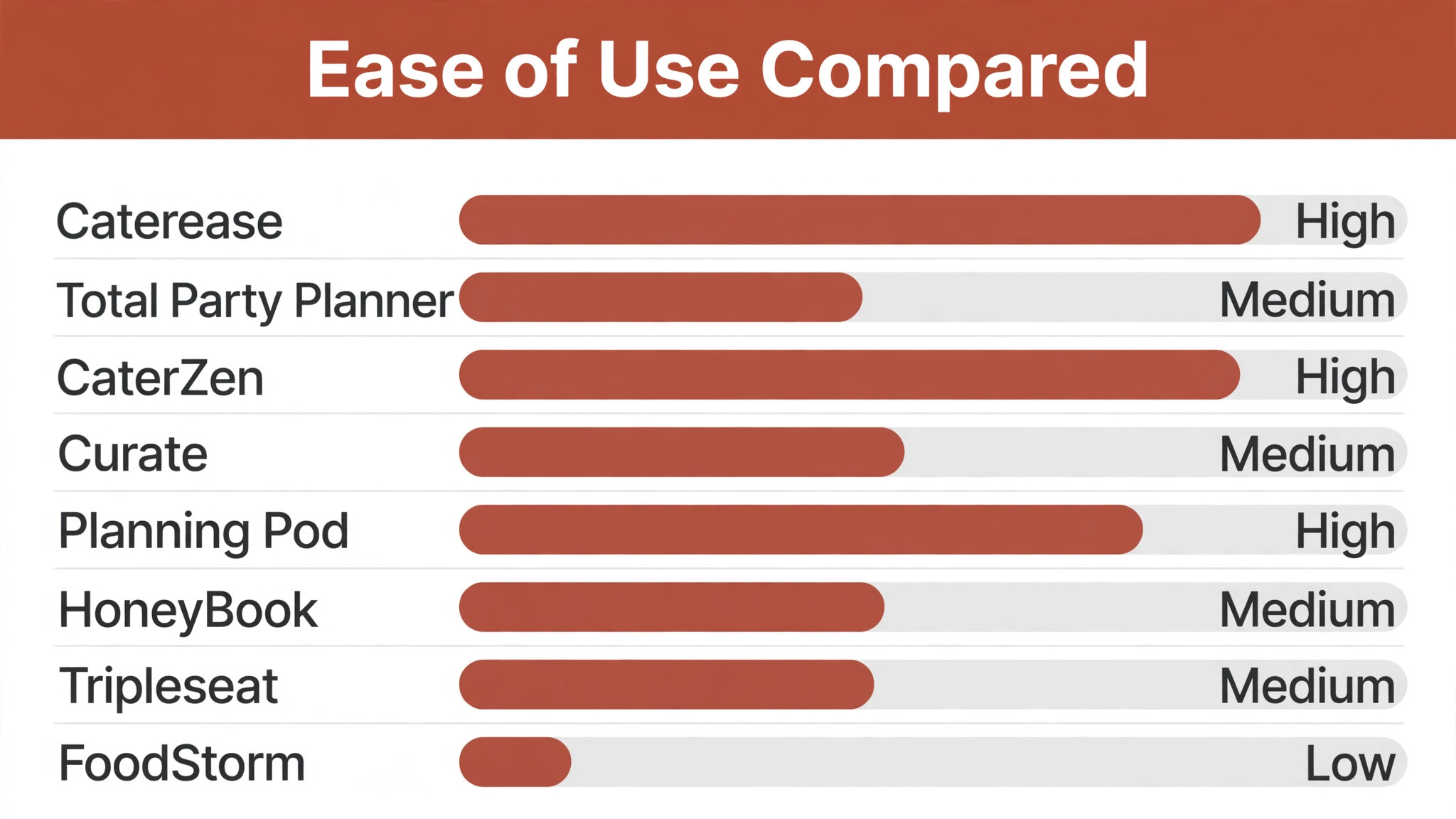
Small teams need simple tools. A caterer with three staff cannot spend a day learning software, so the tools below were judged on how fast a new user can run a real event.
Per-event pricing decides the real cost. A tool that charges by the event punishes a busy season, while a flat monthly fee stays steady. Check what a full month of events costs before signing.
Tastings decide whether the client signs. A menu on paper is a promise, while a tasting is proof, and a tool that tracks tastings keeps the pipeline honest. The shortlist weighs tasting notes alongside proposals.
Supplier tracking decides whether the food arrives. A caterer who forgets an order scrambles on the day, while one who tracks suppliers serves calmly. The shortlist weighs supplier tools alongside menus.
Staff scheduling decides whether the day runs. A team that knows its shifts serves smoothly, while one that guesses causes chaos. The shortlist weighs scheduling alongside invoicing.
How We Judged Every Catering Tool for Small Caterers on This List
Each of the best catering software for small caterers faced the same five checks, so the ranking below rests on hands-on use rather than vendor claims.
- Event handling. We planned a wedding for a hundred guests and counted how many details each tool tracked.
- Proposal quality. We built a quote for a real menu and judged how polished it looked.
- Invoicing speed. We turned a quote into an invoice and timed how fast the payment went out.
- Team usability. We handed each tool to a new user and counted how long a real event took to set up.
- Price honesty. We compared the advertised price with the price a real caterer pays after the trial ends.
Scores come from a working month of real events, not a demo menu. The tools at the top kept the details straight and the invoices on time.
Best Pick by Job
The event type picks the software. The table below pairs the best catering software for small caterers with the work each one does best.
| Job | Best pick | Why it wins |
|---|---|---|
| Small caterer who wants full control | Caterease | Menus, proposals and invoices in one system. |
| Caterer running many events | Total Party Planner | Event, staff and payment management together. |
| Caterer whose clients order online | CaterZen | Online ordering pages with delivery scheduling. |
| Caterer who wins work with proposals | Curate | Polished proposals with menus and photos. |
| Venue catering in-house | Tripleseat | Venue bookings and catering in one place. |
| Caterer with many daily orders | FoodStorm | Order and kitchen management at volume. |
The 8 Tools in Detail
The eight reviews below share a frame: the strongest feature, the main weakness, and the caterer it fits.
1. Caterease
Caterease handles menus, proposals, events and invoices in one system built for catering, so a small caterer stops juggling spreadsheets. Its event planning tools track guests, courses and dietary needs, which keeps a busy weekend organised.
Among the best catering software for small caterers, Caterease kept winning the daily-use checks, because it stays simple even as the workload grows. Proposals and invoices go out from the same place, so a quote becomes a booking without retyping.
Caterease covers catering well, but its interface feels dated and its price rises with the features. Small caterers may find the setup heavier than expected.
A caterer who wants a modern simple tool should skip Caterease and try CaterZen, then return to Caterease when full control matters.
Caterease fits a small caterer who wants one system for the whole job. Its menus, proposals and invoices live together, so a quote becomes a booking without retyping.
Caterease offers a free trial, so you can test the core features before paying. Caterease sets up in an afternoon, and most of the defaults are sensible. It fits small caterers who want full control.
Our verdict. Caterease wins because it covers the whole catering job, from first quote to final invoice.
2. Total Party Planner
Total Party Planner manages events, menus, staff and payments in one place, so a caterer sees the whole weekend at a glance. Its proposal builder creates polished quotes fast, with menus and pricing pulled straight from the system.
Staff scheduling and task lists keep the team aligned on the day, which cuts the chaos of a big event. Buyers who need Caterers who run many events will find Total Party Planner covers it without extra paid add-ons.
Total Party Planner is strong on events, but its price suits busier caterers and its catering tools are part of a wider event system. Small caterers may overpay.
A small caterer with a few events a month should skip Total Party Planner and choose Caterease, then upgrade when the event count grows.
Total Party Planner fits a caterer who runs many events each weekend. Its staff scheduling and task lists keep the team aligned when the pressure rises.
Total Party Planner offers a free trial, so you can test the core features before paying. Total Party Planner sets up in an afternoon, and most of the defaults are sensible. It fits caterers who run many events.
Our verdict. Total Party Planner is the pick for caterers who run many events and need tight control.
3. CaterZen
CaterZen builds online ordering pages for caterers, so clients order and pay without a phone call. Its menu builder handles packages, add-ons and dietary options, which keeps orders accurate.
Delivery and pickup scheduling run through the same page, so the kitchen knows what to prepare and when. CaterZen keeps Caterers who want simple online ordering front and centre, so the main job never hides behind menus.
CaterZen handles online ordering well, but its event planning is thinner than a full catering system, and it suits takeaway orders more than weddings. Complex events may need more.
A caterer who runs weddings should skip CaterZen and choose Caterease, then use CaterZen only for online orders.
CaterZen fits a caterer whose clients order online. Its ordering pages and delivery scheduling keep the kitchen informed without phone calls.
CaterZen lists its pricing on the vendor site, so check the current plans before you commit. CaterZen sets up in an afternoon, and most of the defaults are sensible. It fits caterers who want simple online ordering.
Our verdict. CaterZen suits caterers whose clients prefer to order online.
4. Curate
Curate creates beautiful proposals with menus, photos and pricing, so a quote looks as good as the food. Its event management tracks guests, courses and timelines, which keeps the plan and the proposal in sync.
Invoices and payments flow from the proposal, so a booking moves forward without extra admin. For Caterers who want polished proposals, Curate is the option we would hand to a new hire first.
Curate makes beautiful proposals, but its price is high and its back-office tools are simpler than the leaders. Caterers who need deep event control may want more.
A caterer who needs deep event management should skip Curate and choose Total Party Planner, then use Curate only for polished proposals.
Curate fits a caterer who wins work with beautiful proposals. Its menus and photos make a quote look as good as the food tastes.
Curate lists its pricing on the vendor site, so check the current plans before you commit. Curate sets up in an afternoon, and most of the defaults are sensible. It fits caterers who want polished proposals.
Our verdict. Curate fits caterers who win work with polished proposals.
5. Planning Pod
Planning Pod manages large events with floor plans, timelines and vendor coordination in one workspace. Its catering tools handle menus, tastings and dietary needs alongside the wider event plan.
Client portals share updates and documents, so the client stays informed without constant calls. Planning Pod suits buyers who want Caterers who plan large events without a long setup.
Planning Pod handles large events, but its catering tools are part of a wider system and its price suits bigger teams. Small caterers may find it too much.
A small caterer should skip Planning Pod and choose Caterease, then consider it only when the events become large and complex.
Planning Pod fits a caterer who plans large complex events. Its floor plans and vendor coordination keep the whole event in one workspace.
Planning Pod lists its pricing on the vendor site, so check the current plans before you commit. Planning Pod sets up in an afternoon, and most of the defaults are sensible. It fits caterers who plan large events.
Our verdict. Planning Pod is the choice for caterers who plan large, complex events.
6. HoneyBook
HoneyBook pairs proposals, contracts and invoices in one flow, so a catering client moves from inquiry to booking smoothly. Its templates speed up quotes and contracts, which saves hours on every new client.
Payment reminders and scheduling keep the money and the calendar in order. Buyers who need Caterers who want client management will find HoneyBook covers it without extra paid add-ons.
HoneyBook manages clients well, but its catering-specific tools are thinner than a dedicated system, and its price covers features a caterer may never use.
A caterer who needs menus and dietary tracking should skip HoneyBook and choose Caterease, then use HoneyBook only for client management.
HoneyBook fits a caterer who values client management. Its templates and payment reminders keep the money and the calendar in order.
HoneyBook offers a free trial, so you can test the core features before paying. HoneyBook sets up in an afternoon, and most of the defaults are sensible. It fits caterers who want client management.
Our verdict. HoneyBook suits caterers who want client management as much as catering tools.
7. Tripleseat
Tripleseat manages venue bookings and catering together, so a venue sees the room and the menu in one place. Its sales tools track leads, proposals and contracts, which keeps the pipeline visible.
Reporting shows which events earn the most, so the venue can focus on what works. Tripleseat keeps Venues that cater in-house front and centre, so the main job never hides behind menus.
Tripleseat suits venues, but its catering tools are built for in-house teams and its price is aimed at venues, not small caterers. Independent caterers may find it a poor fit.
An independent caterer should skip Tripleseat and choose Caterease, then use Tripleseat only when working inside a venue.
Tripleseat fits a venue that caters its own events. Its booking and catering tools share one system, so the room and the menu stay in sync.
Tripleseat lists its pricing on the vendor site, so check the current plans before you commit. Tripleseat sets up in an afternoon, and most of the defaults are sensible. It fits venues that cater in-house.
Our verdict. Tripleseat fits venues that cater their own events and need both sides in one system.
8. FoodStorm
FoodStorm handles catering orders, menus and deliveries in one system, so a busy kitchen stays on top of the day. Its online ordering and invoicing keep orders accurate, and the kitchen display shows what to prepare next.
Customer records and order history make repeat orders fast, which suits caterers with regular clients. For Caterers who take many orders, FoodStorm is the option we would hand to a new hire first.
FoodStorm handles orders well, but its event planning is thinner than a full catering system and its interface feels dated. Caterers who run weddings may need more.
A caterer who runs weddings should skip FoodStorm and choose Caterease, then use FoodStorm only for high-volume orders.
FoodStorm fits a caterer who processes many orders a day. Its kitchen display and order history keep a busy day on track.
FoodStorm lists its pricing on the vendor site, so check the current plans before you commit. FoodStorm sets up in an afternoon, and most of the defaults are sensible. It fits caterers who take many orders.
Our verdict. FoodStorm is the pick for caterers who process a high volume of orders.
The Pre-Purchase Checklist for Catering Software
Any catering tool worth the money should pass these five checks. Ten minutes now saves a wedding season of chaos.
- Read the pricing page twice. Check what the renewal costs, what the event limit is, and what counts as an extra user.
- Test support with a real question. Ask about per-event pricing and judge the answer by its speed and its honesty.
- Export your events on day one. A painful export now means a painful move later, when the booking history matters most.
- Ask who else opens the tool daily. A tool the team will open every morning beats a stronger one they avoid.
- Check the mobile experience. If half the work happens in a kitchen or a venue, a weak mobile view will cost you daily.
Running a Wedding Weekend in Five Steps
The best catering software for small caterers was all tested with this five-step sequence, and it is the fastest honest check a buyer can run.
Run it on a trial account with a real event from next month. A day with a real event beats a month of sales demos.
- Build the menu. Enter the courses, the dietary options and the per-head price, so the quote writes itself.
- Send the proposal. Share the menu and the price with the client, and track when they open it.
- Confirm the details. Lock the guest count, the timings and the dietary notes a week before the event.
- Plan the day. Assign staff, set the service times, and print the run sheet for the kitchen.
- Invoice on the day. Send the final invoice while the event is fresh, and chase the deposit before the next booking.

Caterease vs Total Party Planner: The Head-to-Head That Decides It
Neither Caterease nor Total Party Planner is weak, and the honest answer is that both do the job. The deciding factor is fit. Caterease suits buyers who want a system built for catering, while Total Party Planner suits buyers who run many events and need deep event management.
We ran the same task through Caterease and Total Party Planner three times. Caterease finished first twice and produced the cleaner result, while Total Party Planner caught up only when the task grew into a multi-event weekend. For the everyday job of running a single event well, that consistency is what tips the balance.
The tie-breaker for Caterease is what happens after month one. Caterease stays simple as the event list grows, while Total Party Planner asks for more setup and more admin as the team grows. Caterers that plan to grow with Caterease should weigh that future cost, not just the first invoice.
On paper Caterease and Total Party Planner look close, but a month of daily use pulls them apart. Caterease keeps the core job one click away, while Total Party Planner buries it a level deeper in menus that slow every session. That Caterease gap matters more than any feature table, because it repeats dozens of times a day.
The monthly fee differs more than it looks. Caterease charges a monthly fee for the full system, while CaterZen costs less for online ordering alone, so a caterer who mainly takes orders should weigh the fee against the features.
A tasting sells the menu. Invite the client to taste the key dishes before the event, and the proposal writes itself.
Dietary notes deserve their own list. A single page with every guest need, printed for the kitchen, prevents the mistakes that ruin a wedding.
Deposits keep cash flow healthy. A deposit on booking and a balance before the event means the caterer never funds a wedding from their own pocket.
The run sheet is the bible of the day. One printed page with timings, staff and courses keeps the whole team aligned when the pressure rises.
Photos of past events win new work. A few good pictures on the proposal show the client what their day could look like.
A thank-you note after the event brings the next booking. Clients who felt looked after recommend the caterer to the next couple.
A menu should fit the kitchen, not just the client. A dish the team cannot serve for a hundred guests is a promise that breaks on the day.
Seasonal ingredients keep the food honest and the costs down. A menu built around the season tastes better and prices lower.
Staff briefings should happen before the event, not during it. A team that knows the timings and the dietary list serves smoothly.
Leftovers should be planned, not discovered. A clear plan for surplus food saves waste and sometimes feeds the staff well.
A caterer should photograph every setup. A library of real setups sells the next event better than any brochure.
Vendor relationships matter as much as recipes. A reliable supplier who delivers on time is worth more than a cheaper one who does not.
A backup plan for rain is not optional. An outdoor event without a wet-weather plan becomes a crisis, while one with a plan just moves inside.
The bar and the food should share one timeline. A drinks service that runs late holds up the courses, and the kitchen should know the bar plan.
A post-event debrief improves the next one. Ten minutes with the team after the event catches the mistakes while they are fresh.
Referrals are the cheapest marketing a caterer has. A happy couple tells their friends, and a short thank-you note keeps the caterer in mind.
A tasting menu should be short. Three dishes that show the range beat ten that confuse the client and tire the kitchen.
A caterer should confirm the final numbers twice. Once a week before, and once the day before, so the kitchen never cooks for ghosts.
Five Catering Mistakes That Ruin a Wedding
Most caterers lose bookings over small event mistakes. The five below ruin the most weddings.
- Confirming the guest count too late. A count that changes the day before leaves the kitchen short, while a count locked a week out lets the team prepare. Lock the count seven days before.
- Forgetting the dietary list. A guest with no safe plate remembers the wedding for the wrong reason, while a clear list keeps everyone fed. Print the dietary list for the kitchen.
- Invoicing weeks after the event. An invoice sent late gets paid late, and cash flow suffers while the next event waits. Invoice on the day, while the event is fresh.
- Skipping the tasting. A client who never tastes the menu signs on faith, while one who tastes signs with confidence. Offer a tasting before the contract.
- Running the day without a run sheet. A team without timings guesses, and guessing under pressure causes mistakes. Print one run sheet and give it to everyone.
Frequently Asked Questions
The six questions below are the ones buyers ask most about the best catering software for small caterers, answered without hedging.
What is the best catering software for a small caterer?
Caterease is the best overall for menus, proposals and invoices in one system. Total Party Planner suits caterers who run many events, and CaterZen covers online ordering.
How much does catering software cost?
Most tools on this list start with a free trial, then charge a monthly subscription. Check whether the price covers one user or the whole team, and whether events are limited.
Do I need catering software if I only do a few events a month?
Yes, if the events are complex. Even a few events a month involve menus, dietary notes and invoices, and a tool keeps them straight better than a spreadsheet.
What is the difference between Caterease and Total Party Planner?
Caterease focuses on catering from quote to invoice in one system. Total Party Planner adds deeper event management, staff scheduling and task lists for busy weekends.
Can catering software handle dietary requirements?
The tools on this list track dietary needs per guest, so the kitchen knows who needs a gluten-free or vegan plate without a separate list.
How do I move from spreadsheets to catering software?
Start with one upcoming event. Enter the menu, the guest list and the price, then run the event in the tool. Once the team trusts it, move the rest over.
How far ahead should a caterer confirm the guest count?
Seven days before the event. A count locked a week out gives the kitchen time to prepare, while a count that changes the day before causes waste or shortage.
Should a caterer ask for a deposit?
Yes, on booking, with the balance before the event. A deposit protects the caterer from cancellations and keeps cash flow healthy through the season.
Let the Software Hold the Details, So You Can Cook
When the best catering software for small caterers is judged on daily use rather than feature lists, one default emerges for most buyers, and the rest of this guide explains why.
Take the trial, run a real event through it, and trust what you see. The right tool shows its value in a week of real events. That first week with Caterease tells you more than any review can.
If Caterease falls short, Total Party Planner covers multi-event weekends well, and CaterZen handles online orders. New software with the old napkin routine changes nothing. Enter every detail once, let the tool carry it, and cook with a clear head.
Start with one event, not the whole season. Enter the menu, the guests and the price, run it in the tool, and move the rest over once the team trusts it.
Keep a file of every event. A record of what worked and what did not makes the next event smoother, and the client sees the care.