

Late payment is the most common cash flow problem a small firm faces, and it usually starts with an invoice that was hard to pay. The top 10 invoicing software in this guide send professional invoices, chase late payers automatically and show which clients pay slowly. We compared ten of them on real billing, and FreshBooks leads the ranking on the combined score, while QuickBooks Online wins for firms that want invoicing inside full accounting.
This guide is written for the owner who sends invoices between jobs, not for an accountant. Every tool below was judged on real invoices, real payment times and real chasing, with the focus on the days between sending and being paid. A tool that only looks tidy in a demo is no use when the rent is due.
An invoicing tool does three practical things. It sends a clear invoice, it makes payment easy, and it reminds the client when the money is late. The tools in this ranking differ mainly in how much of the accounting sits behind the invoice and how fast the money arrives.
In this article
- The 10 Tools at a Glance
- Why the Top 10 Invoicing Software Matter to Cash Flow
- How We Tested Every Invoicing Tool
- Best Pick by Job
- The 10 Tools in Detail
- Getting Paid Faster in Thirty Days
- Five Invoicing Mistakes That Delay Payment
- Picking Your Invoicing Tool in One Afternoon
- Frequently Asked Questions
- The Verdict Before You Send the Next Invoice
The 10 Tools at a Glance
One row per tool below carries the price, the natural fit and the strength that earned its place, led by FreshBooks on days to payment. The top 10 invoicing software are not always the most expensive, and the table shows why.
| Tool | Starting price | Best for | Standout strength |
|---|---|---|---|
| FreshBooks | Pricing on the vendor site | Freelancers who invoice for time | Time tracking that flows into invoices |
| QuickBooks Online | Pricing on the vendor site | Small firms that need full accounting | Invoicing inside a complete accounting system |
| Xero | Pricing on the vendor site | Firms that want clean, simple accounting | Easy invoicing with strong bank feeds |
| Zoho Invoice | Free plan; paid plans on the vendor site | Small firms that want invoicing free | Free invoicing with no monthly fee |
| Wave | Free plan; paid plans on the vendor site | Solo owners that need free accounting | Free invoicing and accounting |
| Square Invoices | Free plan; paid plans on the vendor site | Sellers already using Square | Invoices that match Square payments |
| HoneyBook | Pricing on the vendor site | Creative firms that sell a service | Invoices plus contracts and client flow |
| Invoice Ninja | Free plan; paid plans on the vendor site | Freelancers that want open-source control | Free self-hosted invoicing |
| PayPal Invoicing | Free plan; paid plans on the vendor site | Sellers whose clients pay by PayPal | Invoices clients can pay in one click |
| BILL | Pricing on the vendor site | Firms that automate payables too | Invoicing plus bill pay automation |
Use the table to cut the list to two or three candidates, then let the detail reviews of FreshBooks and QuickBooks Online decide between them. High marks on one measure mean little unless FreshBooks fits the work a small business owner actually does, and full marks mean little unless the plan that unlocks them is affordable.
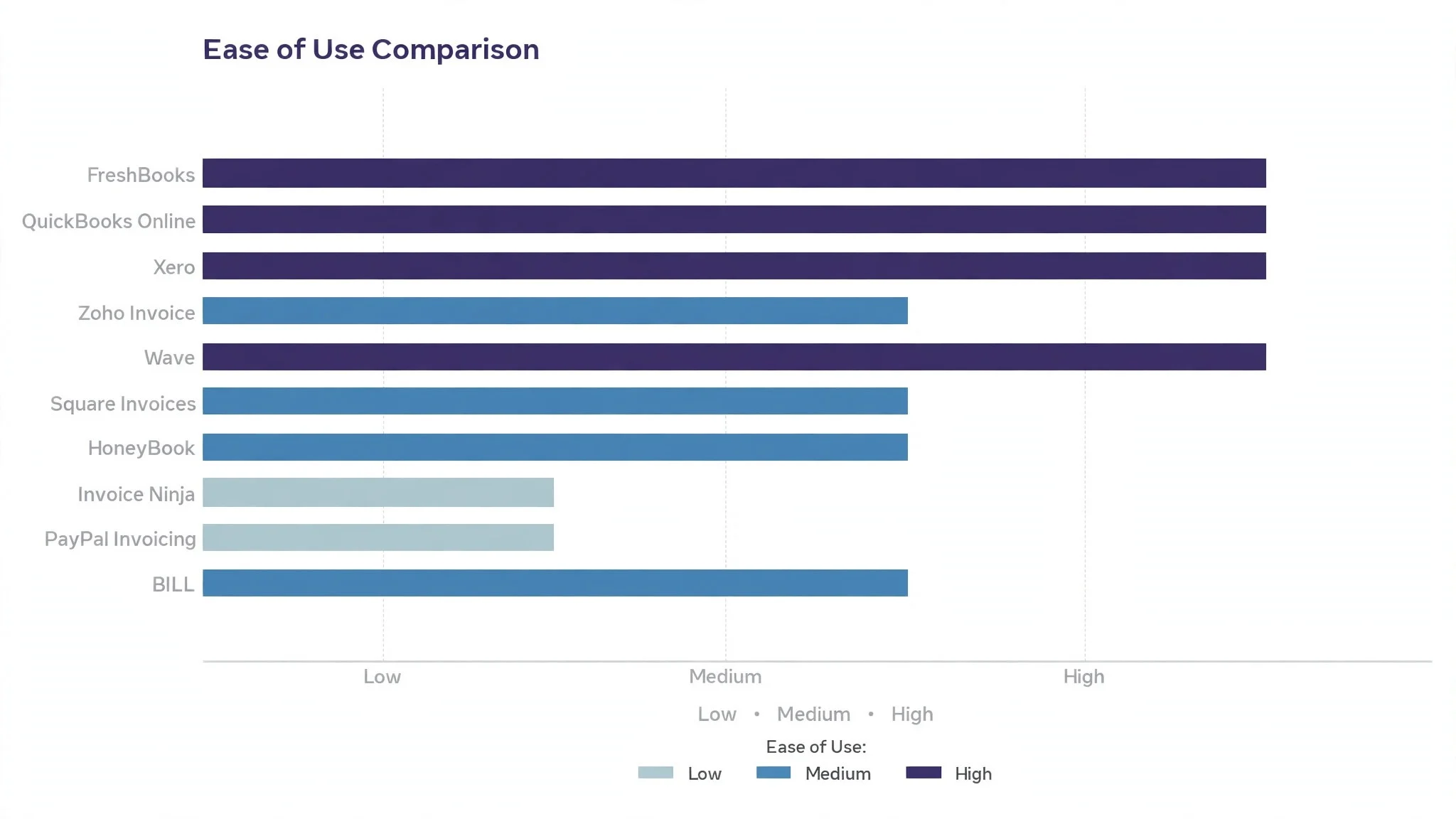
Why the Top 10 Invoicing Software Matter to Cash Flow
Price is the first filter, but the sticker price is rarely the real cost. Small firms should add the setup time, the training hours and the monthly fee together, then divide by the jobs the tool actually handles. A cheap tool that needs constant fixing costs more than a pricier one that runs quietly, and FreshBooks is the quiet one here.
Fit beats features. days to payment matters more to small firms than a long feature list, because the tool is used every day on real work. A tool that handles sending invoices and getting paid cleanly and skips the rest is worth more than one that does everything badly.
Time is the second filter. Measure how long sending invoices and getting paid takes before the tool and after it, across a full week rather than a single demo. Tools here earn their place by cutting hours from the weekly routine, and FreshBooks cuts the most on days to payment.
Data is the third filter. payment options decides whether the tool pays for itself, and a tool that cannot report on it is guessing. Before you buy, ask for the report from FreshBooks and check that it shows the numbers you actually manage by.
The last filter is an invoice a client cannot pay. A tool that fails on an invoice a client cannot pay will cost a client or a deadline, and no feature list makes up for that. Run FreshBooks on a live job with real data, and judge it on the worst day, not the best one.
Support is the quiet filter that shows up later for a small business owner using FreshBooks. When FreshBooks breaks at the worst moment, the quality of the help matters more than the feature list. Check the support hours, the response time and whether a real person answers, before FreshBooks becomes part of the daily routine.
How We Tested Every Invoicing Tool
We ran each tool through real sending invoices and getting paid work, covering the setup, the daily use and the result. The top 10 invoicing software were scored on five measures that matter to small firms rather than to a vendor.
- days to payment
- payment options
- reminder automation
- accounting depth
- cost per invoice
Each measure carried equal weight except days to payment, which counted double, because a tool that fails on that measure fails on the job itself. Every tool below carries a score out of 100, and the order follows the combined total, with FreshBooks first. Ties went to the tool that scored higher on days to payment, because a small business owner judges FreshBooks on the daily routine, not on the feature list.
Best Pick by Job
A single winner does not fit every small business owner, so we matched each common situation to the tool that scored highest for that job. The right pick among the top 10 invoicing software depends on the work in front of you, and the table below makes that split clear.
| Job | Best pick | Why it wins |
|---|---|---|
| Freelancers who invoice for time | FreshBooks | Time tracking that flows into invoices |
| Small firms that need full accounting | QuickBooks Online | Invoicing inside a complete accounting system |
| Firms that want clean, simple accounting | Xero | Easy invoicing with strong bank feeds |
| Small firms that want invoicing free | Zoho Invoice | Free invoicing with no monthly fee |
| Solo owners that need free accounting | Wave | Free invoicing and accounting |
| Sellers already using Square | Square Invoices | Invoices that match Square payments |
| Creative firms that sell a service | HoneyBook | Invoices plus contracts and client flow |
| Freelancers that want open-source control | Invoice Ninja | Free self-hosted invoicing |
| Sellers whose clients pay by PayPal | PayPal Invoicing | Invoices clients can pay in one click |
| Firms that automate payables too | BILL | Invoicing plus bill pay automation |
If no row matches your situation exactly, take the closest one and read that review first, starting with FreshBooks. A few points on a scorecard matter less than the gap between a tool a small business owner opens daily and one it avoids, so fit to the daily work comes first, whatever FreshBooks scores.
The 10 Tools in Detail
Each review below follows the same pattern for FreshBooks. We cover what the tool does best, where it falls short, and the small business owner who will gain the most from it. The top 10 invoicing software differ mainly in days to payment, and the reviews below weigh that difference wherever a real number could be measured.
1. FreshBooks
FreshBooks tracks time, turns it into an invoice in a few clicks, and chases late payments with automatic reminders. Freelancers see which clients pay slowly, accept card payments online, and reconcile expenses without a spreadsheet.
It is built for service businesses rather than product sellers, so inventory and multi-currency features are thinner than QuickBooks.
Cost is straightforward. FreshBooks lists its plans on the vendor site, so confirm the current price before you pay, and compare the monthly fee against the time the tool saves each week. A yearly plan usually costs less per month, so a small business owner that commits to FreshBooks after a good trial often saves a meaningful amount over the year. Add the setup time to the first-year cost of FreshBooks before judging the price. A cheap tool that needs a week of setup costs more than a pricier one like FreshBooks that works on day one.
Our verdict. The strongest option here for freelancers who invoice for time, with time tracking that flows into invoices.
2. QuickBooks Online
QuickBooks Online pairs invoicing with bank feeds, expense tracking, payroll and tax reports, so the invoice is part of the books rather than a separate tool. It handles recurring invoices, estimates and multi-currency billing, and the accountant can log in directly.
The price rises with each tier, and the interface can feel heavy for a freelancer who only sends a few invoices a month.
Support from QuickBooks Online matters when something breaks at the worst moment. QuickBooks Online offers help through its help centre and support channels, and the response time is worth testing with a real question during the trial. Read the QuickBooks Online help centre before you buy, because clear guides and fast answers save hours over the year, while neither costs them. Ask the QuickBooks Online support team one real question during the trial. Judge the QuickBooks Online answer on speed and clarity, because that answer is the support you will actually get.
Our verdict. Pick this one for small firms that need full accounting. Invoicing inside a complete accounting system.
3. Xero
Xero sends professional invoices, tracks payments and reconciles bank feeds automatically, with a clean interface that a non-accountant can learn quickly. It supports multi-currency invoicing and connects to hundreds of apps, from payroll to inventory.
Payroll support varies by country, and the entry plan caps the number of invoices per month.
Integration is where Xero earns its keep. It connects to the tools a small business owner already uses, so the data flows without retyping, and the first connection is worth testing with a real record before the trial ends. Check whether Xero connects to the exact tool you already use, not just its category, because a connector that looks good on a list can still fail on your data. A clean export from Xero matters as much as a clean import. Confirm that Xero lets the data out in a usable format, so the business is never locked into one vendor.
Our verdict. Easy invoicing with strong bank feeds, and the best choice for firms that want clean, simple accounting.
4. Zoho Invoice
Zoho Invoice is free for small businesses, with unlimited invoices and customers on the free plan, plus time tracking, expenses and payment links. It suits a freelancer or small firm that needs professional invoices without a monthly subscription.
It is an invoicing tool rather than full accounting, so a growing firm will pair it with Zoho Books or another ledger.
Daily use is where Zoho Invoice proves itself. The dashboard shows the numbers that matter in one view, and with Zoho Invoice the check happens wherever the work happens, not only at a desk. Watch how long the daily check takes during the Zoho Invoice trial. Five minutes is a habit, while twenty minutes is a chore, and the difference decides whether Zoho Invoice survives the first month. Test Zoho Invoice on a normal busy day, not a quiet one. Run Zoho Invoice on the hardest day of the week and judge it there, because a tool that only works on a quiet day is not working.
Our verdict. The strongest option here for small firms that want invoicing free, with free invoicing with no monthly fee.
5. Wave
Wave offers free invoicing and accounting for small businesses, with bank connections, receipt scanning and payment processing as paid add-ons. Owners send invoices, track income and expenses, and see a simple profit and loss without a subscription.
Wave is US and Canada focused, and support is limited on the free plan, so a business that needs help fast may feel the gap.
Reporting is the quiet strength of Wave. The dashboard tracks days to payment over time, so the owner can see whether the tool is paying for itself or only looking busy. Ask for the report before you buy Wave, and check that it shows the numbers a small business owner actually manages by. A report from Wave that answers the wrong question is decoration, not evidence. Set a monthly date to read the Wave report, and decide in advance what number would make you keep or drop the tool. A decision made in advance is an honest one, and Wave should be judged against it.
Our verdict. Pick this one for solo owners that need free accounting. Free invoicing and accounting.
6. Square Invoices
Square Invoices lets a seller send an invoice, accept a card payment online, and see the money land in the same Square account as their counter sales. It suits a business that already takes Square payments and wants invoices without a new system.
The free plan charges a processing fee per payment, and the invoicing features are simpler than a dedicated accounting tool.
Setup is quick. Square Invoices asks for the essentials, connects the account and walks the user through the first real job in one sitting, so the first result appears on day one rather than after a week of configuration. Guided setup in Square Invoices covers the common case well, while the unusual case needs a manual step, so check the help centre before the trial ends. Name one person to own the Square Invoices setup before the trial starts. Square Invoices with an owner gets used every day, while a tool with no owner drifts and dies quietly.
Our verdict. Invoices that match Square payments, and the best choice for sellers already using Square.
7. HoneyBook
HoneyBook combines invoices with contracts, proposals, questionnaires and client portals, so a photographer or designer can book a client, sign a contract and collect payment in one flow. Automated reminders chase late invoices, and the pipeline shows every project at a glance.
The monthly cost is higher than an invoice-only tool, and the accounting features are lighter than QuickBooks.
Cost is straightforward. HoneyBook lists its plans on the vendor site, so confirm the current price before you pay, and compare the monthly fee against the time the tool saves each week. The yearly plan usually costs less per month than the monthly plan, so a small business owner that commits after a good trial of HoneyBook often saves over the year. Add the setup time to the first-year cost before judging the price of HoneyBook. A tool that needs a week of setup costs more than a pricier one that works on day one, whatever the price page says for HoneyBook.
Our verdict. The strongest option here for creative firms that sell a service, with invoices plus contracts and client flow.
8. Invoice Ninja
Invoice Ninja offers free invoicing with quotes, expenses, time tracking and client portals, and it can be self-hosted for full control of the data. It supports many payment gateways and currencies, which suits freelancers with international clients.
The interface is less polished than the big brands, and self-hosting needs technical setup.
When something breaks at the worst moment, the support behind Invoice Ninja matters more than the feature list. Invoice Ninja offers help through its help centre and support channels, and the response time is worth testing with a real question during the trial. Before you buy Invoice Ninja, read the help centre, because a tool with clear guides and fast answers will save hours over the year. Ask the support team one real question about Invoice Ninja during the trial. Judge the answer on speed and clarity, because that answer is the support you will actually get from Invoice Ninja.
Our verdict. Pick this one for freelancers that want open-source control. Free self-hosted invoicing.
9. PayPal Invoicing
PayPal Invoicing lets a seller send an invoice that the client pays with a PayPal account or a card, without the seller setting up a payment gateway. It suits freelancers whose clients already use PayPal, and the invoice tracking shows when a client views and pays.
The fees per payment are higher than some processors, and the invoicing features are basic compared with a full accounting tool.
Integration is where PayPal Invoicing earns its keep. It connects to the tools a small business owner already uses, so the data flows without retyping, and the first connection is worth testing with a real record before the trial ends. Check the integration list for the exact tool a small business owner already uses, not just its category, because a connector that looks good on a list can still fail on your data. For PayPal Invoicing, a clean export matters as much as a clean import. Confirm that PayPal Invoicing lets the data out in a usable format, so the business is never locked into one vendor.
Our verdict. Invoices clients can pay in one click, and the best choice for sellers whose clients pay by PayPal.
10. BILL
BILL automates accounts payable and receivable, so a firm can send invoices, collect payments, approve bills and pay vendors from one dashboard. It syncs with QuickBooks, Xero and other ledgers, and the approval workflows keep spending under control.
It is built for firms with real bill volume, so a freelancer with a handful of invoices a month will find it heavy and costly.
Daily use is where BILL proves itself. The BILL dashboard shows the numbers that matter in one view, and the mobile access means the check happens wherever the work happens, not only at a desk. Watch how long the daily check takes in BILL during the trial. Five minutes is a habit, while twenty minutes is a chore, and that difference decides whether BILL survives the first month. The best test for BILL is a normal busy day, not a quiet one. Run BILL on the hardest day of the week and judge it there, because a tool that only works on a quiet day is not working.
Our verdict. The strongest option here for firms that automate payables too, with invoicing plus bill pay automation.
Getting Paid Faster in Thirty Days
A firm can cut its average payment time in thirty days without losing a single client. The fix is a clear invoice, an easy payment link and a polite reminder that goes out on time, every time.
- List the overdue invoices. Write down every unpaid invoice, the client and the days overdue, and sort the list by the amount owed.
- Send a polite reminder. Remind each late client once, with the invoice attached and a payment link in the email, and note the date you sent it.
- Add payment links. Put a card payment link on every new invoice, so the client can pay in one click instead of posting a cheque.
- Set recurring invoices. Automate the regular monthly invoices, so they go out on the same day every month without anyone remembering.
- Review every Friday. Spend fifteen minutes each Friday checking what arrived, what is late and what needs a second reminder.
Follow the fix above and the top 10 invoicing software will cut the average payment time within a month, rather than letting the cash flow drift.

Five Invoicing Mistakes That Delay Payment
Most late payments come from the same five habits, and all five are fixable this week. The tools in this ranking automate the fix, but only if the owner sets them up properly.
- Vague invoice terms. An invoice without a due date is an invitation to pay late, so put the date and the payment options on every invoice.
- No payment link. A client who has to phone the bank will pay tomorrow, while a client with a link pays today.
- Chasing by phone only. A phone call is easy to forget, while a written reminder with the invoice attached is easy to act on.
- No late fee policy. A clear late fee, stated on the invoice, makes the due date real, so agree the policy and print it.
- One spreadsheet for every client. A spreadsheet hides the late payers, while a proper tool lists them every morning.
Avoid those five mistakes and the money starts arriving on time. The tools in this ranking all send good invoices, so the difference is made by the reminder and the payment link.
Picking Your Invoicing Tool in One Afternoon
A month-long decision is a decision that never happens, so give FreshBooks one afternoon. The shortlist above can be cut to one tool in a single afternoon, with a trial of FreshBooks that proves the choice on real work.
Start with FreshBooks, QuickBooks Online and one more from the table, not the whole list. Three trials in one afternoon is realistic, while ten trials is a month of work, and the winner among three usually wins among 10.
Judge each trial on the same job, so the comparison between FreshBooks and QuickBooks Online stays honest. A different test for each tool proves nothing, while the same job, timed the same way, shows the real gap between FreshBooks and QuickBooks Online.
Write the decision down before the trial starts, including the number that would make you keep the tool and the date you will judge FreshBooks. A written decision survives the sales call, while a vague intention does not, whatever QuickBooks Online promises.
- List the three jobs FreshBooks must do every week, and ignore every feature that does not serve one of them.
- Check the price of FreshBooks on the vendor site, confirm it before you pay, and add the setup time to the first-year cost.
- Run the FreshBooks trial on a real job with real data, not on the demo account, and time the job from start to finish.
- Ask the FreshBooks support team one real question during the trial, and judge the answer on speed and clarity.
- Check the FreshBooks integration with the tool you already use most, and test one real record end to end.
- Read the export options in FreshBooks before you commit, because a tool that cannot export your data is a trap.
- Show the shortlist to the person who will use FreshBooks daily, and let their vote count double.
- Decide the renewal date in advance, and set a reminder to judge FreshBooks on the numbers, not on habit.
Pick the tool that wins the afternoon test, run it for a month, and judge it on the numbers for days to payment. If the numbers move, keep it. If they do not, QuickBooks Online deserves the same afternoon.
Frequently Asked Questions
Small firms ask the same questions before every tool change, so we answered the most common ones here. The top 10 invoicing software answer these in their help centres, but the plain answers below are faster to judge a tool against.
How much does invoicing software cost?
The cost of FreshBooks depends on the plan and the size of the team, so check the vendor site for the current price and confirm it before you pay. Most tools here charge monthly or yearly, and the yearly plan usually costs less per month, FreshBooks included. Start FreshBooks with the free plan or the trial, measure the saving over a month, and only then commit to a paid plan. Yearly billing usually costs less per month, so commit only after the trial proves FreshBooks saves money.
Is there a free invoicing option?
Zoho Invoice, Wave and Square Invoices offer a free plan that covers the basics, which is enough to test the workflow with real work. The free plan limits the advanced features and the support, so a busy small business owner will move to a paid plan once the volume grows. Treat the FreshBooks free plan as a trial, not as the long-term setup. The free plan is a test, so set a date to judge FreshBooks, and move to a paid plan when the limits start costing time.
How do I get clients to pay faster?
Switching is possible, but it takes planning. Export the invoice history and the client list from the old tool, check what the new one imports, and run both side by side for two weeks. The tools in this ranking that import cleanly are FreshBooks and QuickBooks Online, and a trial run with real data will show the gaps before the old subscription ends. Keep the old tool running until the new one has handled two full weeks of real work without a gap.
Can I send invoices in other currencies?
FreshBooks, QuickBooks Online, Xero and BILL sync with bank feeds and the main accounting tools, so payments reconcile automatically. Check that your bank is supported, and confirm the export format your accountant needs. Test the FreshBooks integration with one real record during the trial, because a connector that looks good on a list can still fail on your data.
Which tool fits a freelancer best?
For a small small business owner, start with Zoho Invoice. It covers unlimited invoices with no monthly fee without a big monthly fee, and the setup takes hours rather than days. Add a second tool only when FreshBooks cannot handle a job that comes up every week. Start with the smallest plan that covers the job, and upgrade only when the work outgrows FreshBooks.
The Verdict Before You Send the Next Invoice
The top 10 invoicing software ranking comes down to days to payment and the weekly time it saves, and FreshBooks wins on the combined score. It is the tool we would start with, because it handles sending invoices and getting paid cleanly and its reporting shows the result without extra work. QuickBooks Online is the closest rival, and it is the better pick when its strength matters more than the overall score.
Run the trial with your real workload, not a demo account, and judge FreshBooks on the morning routine rather than the feature list. If the check takes minutes and the numbers are honest, FreshBooks is working. Pick FreshBooks if it makes the truth easy to see, and let the calmer week pay for the subscription many times over.