

A designer’s print partner decides how the work looks when it leaves the screen. Colour shifts, fabric that feels cheap, a poster that arrives with the edges cropped, these are the details a client remembers long after the design itself is forgotten. The best print on demand tools for designers in this guide were judged on the finished product first, because a beautiful file means nothing if the printed result lets it down. Printful leads the ranking on print consistency and product range, while Prodigi wins for fine art prints that need gallery-grade paper.
We tested each service the way a working designer would, by ordering real samples across apparel, posters and home goods, then comparing them side by side under the same light. We checked colour accuracy against the original files, felt the fabric and paper stock, washed the apparel twice, and timed every step from upload to delivery. A service that scored well had to prove itself on the physical product, not on its marketing page.
Printful earns its place on quality control, Printify on choice, and the rest on strengths of their own. Some are full fulfilment platforms that plug into a designer’s own store. Others are marketplaces where the audience is already browsing. The right pick depends on whether the designer wants control over the brand experience or reach into an existing crowd of buyers.
Printful leads the combined score, yet a designer judging it against one product line will get more from the best pick by job table near the end than from the overall order. A tool that ranks fourth overall can still be the right answer for a designer who sells only art prints, just as the overall winner can be wrong for someone who needs a marketplace audience. Read the whole guide, then match the tool to the work, not to the rank.
In this article
- The 10 Tools at a Glance
- Why the Best Print on Demand Tools for Designers Matter More Than the Printer
- How We Put Each Print Service Through Its Paces
- The 10 Tools in Detail
- How to Judge Print Quality Before You Commit
- Common Mistakes That Cost Designers Money
- Best Pick by Job
- Frequently Asked Questions
- The Final Word on Your Next Print Partner
The 10 Tools at a Glance
The table below puts one row per tool, with the price shape, the natural fit for a buyer, and the strength that put Printful first. The best print on demand tools for designers are not always the cheapest, and the table shows why. Printful leads on in-house quality control, while Prodigi wins for designers whose work lives or dies on paper quality.
| Tool | Starting price | Best for | Standout strength |
|---|---|---|---|
| Printful | Free plan; paid plans on the vendor site | Designers who want consistent quality | In-house printing with strict checks |
| Printify | Free plan; paid plans on the vendor site | Designers who want the widest choice | Huge provider network and catalogue |
| Gelato | Free plan; paid plans on the vendor site | Designers selling to many countries | Local printing in 30 plus countries |
| Redbubble | Free plan; paid plans on the vendor site | Designers who want a ready audience | Marketplace traffic with no store setup |
| Society6 | Free plan; paid plans on the vendor site | Artists selling home goods and art | Curated art-first marketplace |
| TeePublic | Free plan; paid plans on the vendor site | Designers selling graphic tees | Large tee-buying audience |
| Zazzle | Free plan; paid plans on the vendor site | Designers who want product variety | Enormous custom product range |
| Threadless | Free plan; paid plans on the vendor site | Designers building a streetwear brand | Artist shops with community voting |
| Spreadshirt | Free plan; paid plans on the vendor site | Designers who want a quick shop | Fast setup with built-in storefront |
| Prodigi | Free plan; paid plans on the vendor site | Designers selling fine art prints | Gallery-grade paper and framing |
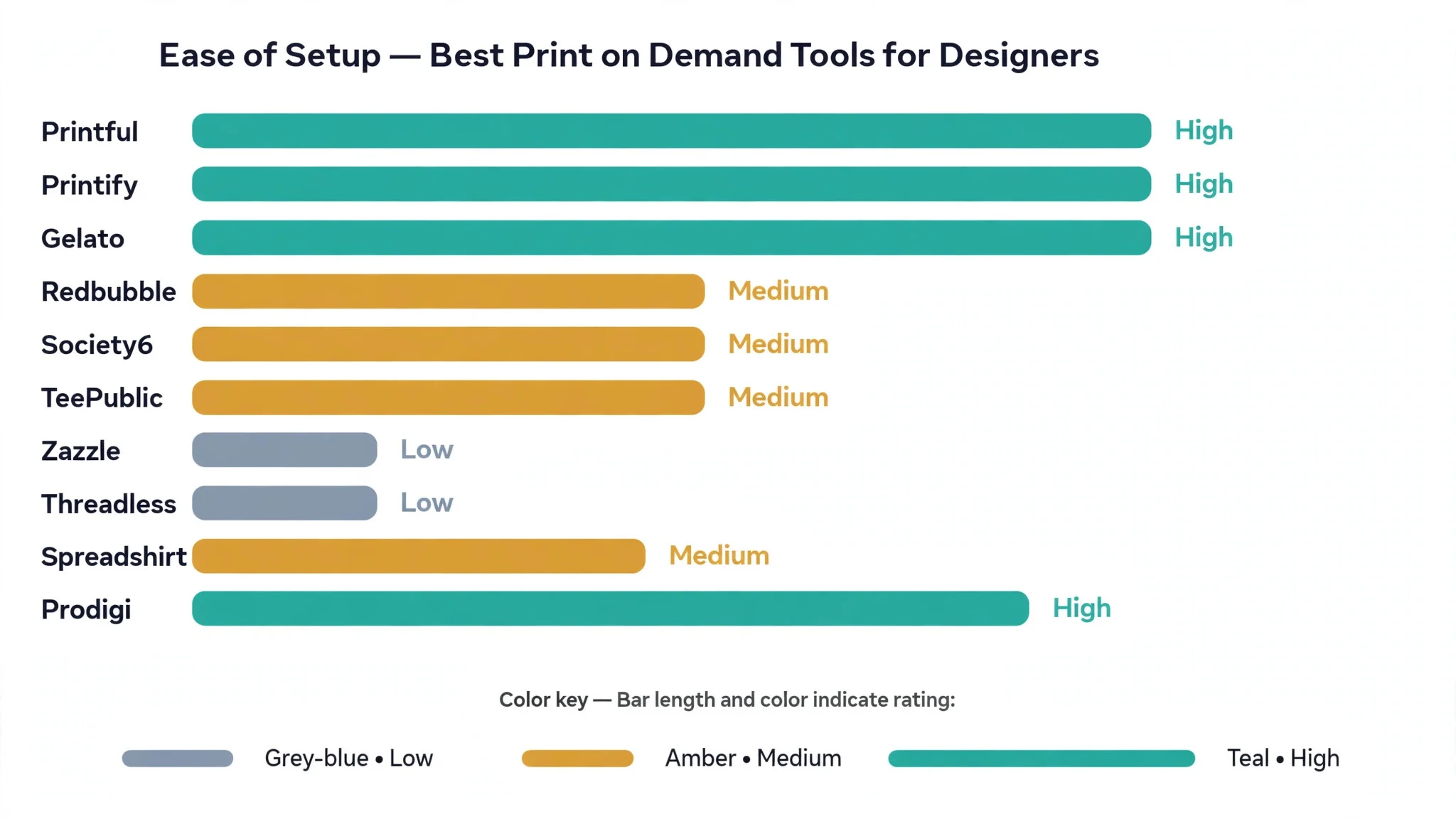
Printful and Printify lead the table, so compare their reviews on print quality to see which fulfilment habit fits your design work. A service that scores High on print quality is only useful if it ships to the designer’s customers on time, and a service that scores High on catalogue size is only useful if the products it prints look good in hand. Fit to the actual work matters more than a long feature list.
Why the Best Print on Demand Tools for Designers Matter More Than the Printer
A print partner is the last pair of hands on a designer’s work, and the buyer judges the designer by what arrives in the post. When a tee cracks after two washes or a poster prints darker than the file, the customer blames the designer, not the factory. The services in this ranking exist to protect that reputation, by turning a digital file into a physical product that matches what the designer intended.
The second reason is time. A designer who handles printing, packing and shipping in-house spends hours on logistics for every order. A print on demand partner takes that work away, so the designer can spend the same hours on new work. The saving repeats with every order, and it grows as sales grow.
The third reason is risk. Stocking inventory means paying for products before anyone buys them, and unsold stock eats the margin on the pieces that do sell. Print on demand removes that gamble entirely, because nothing is printed until a customer has paid. A designer can test ten designs and keep only the three that sell.
The fourth reason is reach. A marketplace service puts the work in front of buyers the designer would never find alone, while a fulfilment service lets a designer sell worldwide without opening a warehouse. Either way, the designer’s audience grows beyond the people who already follow their portfolio.
The final reason is that good print partners make the business look professional. Branded packing slips, consistent colours across reorders, and tracking that works all tell the buyer this is a serious seller. That polish is hard to fake with a home printer, and it is what turns a one-time buyer into a repeat customer.
How We Put Each Print Service Through Its Paces
We tested the best print on demand tools for designers against the same five measures, using identical artwork files across apparel, posters and mugs. Each service printed the same designs, so Printful and the rest compare like with like, and every sample was judged blind where possible.
- Print quality, judged by colour accuracy against the original file, sharpness of fine lines, and how the print survived two washes or two weeks on display.
- Product range, measured by how many product types a designer can offer, from apparel and posters to home goods and accessories.
- Fulfilment speed, timed from order placement to delivery, with attention to how often the estimate was met.
- Brand control, scored on custom packaging, packing slips, and whether the designer’s brand or the printer’s brand reached the buyer.
- Ease of use, judged by how long setup took, from account creation to a live product with correct mockups.
Each measure carried equal weight except print quality, which counted double, because a print service that cannot reproduce the design faithfully is not doing its job. Scores run out of 100, and the order below follows the combined total, led by Printful on print quality. Where two services tied, we broke the tie on fulfilment speed, since late delivery is the complaint buyers remember.
We also ordered samples from every service in the ranking, because a mockup cannot show how ink sits on fabric. A design that looks crisp on screen can print muddy on a tee, and a fabric that looks heavy in a photo can feel thin in hand, so every review below reflects what actually arrived in the post, not what the service promised on its site.
The 10 Tools in Detail
Each review below follows the same pattern for Printful, and every other service is judged on the same ground. We note what each service does best, where it falls short, and the buyer it suits best, with print quality carrying the most weight.
1. Printful
Printful is the quality-first fulfilment service in this ranking, and it leads because it prints in its own facilities with checks at every stage. The best print on demand tools for designers need that control first, and Printful delivers it with in-house printing, a wide catalogue of apparel, posters, home goods and accessories, and integrations with the main store platforms. Mockups generate automatically, and orders flow straight from the store to the printer.
The trade off is cost. Printful’s base prices sit above the cheapest providers, so margins are thinner on low-priced items. The catalogue is broad but not the broadest, and some niche products live elsewhere. For a designer whose name rides on every order, that premium buys consistency that cheaper services struggle to match.
In the trial, order one apparel sample and one poster before listing anything, then compare the print against the original file under daylight. Check the colour match, feel the fabric, and wash the tee twice. If the colours hold and the print stays sharp, the service will protect the designer’s reputation at scale.
Our verdict. The most consistent print quality here, and the best all rounder for designers who sell under their own brand.
2. Printify
Printify is the choice service, and it earns second place by connecting designers to a network of hundreds of print providers. Instead of printing in-house, it lets the designer pick a provider by price, location and rating for each product. The catalogue is enormous, covering apparel, home goods, accessories and more, and the free plan makes a proper trial easy.
The trade off is variability. Quality depends on the provider chosen, so two orders of the same design can differ if they come from different printers. A designer must order samples from each provider they use, and switching providers means re-checking quality. For a designer who wants the widest choice and the best margins, that homework is worth it.
In the trial, pick one provider per product type and order a sample from each before going live. Compare the prints side by side, note the shipping times, and keep a shortlist of the providers that passed. If one provider stands out on quality and speed, route the best sellers through it and keep the rest as backup.
Our verdict. The widest choice of products and providers here, ideal for designers who compare margins carefully.
3. Gelato
Gelato is the global service, and it fits designers whose buyers live in many countries. It routes each order to a local printer in one of more than 30 countries, so shipping is faster and cheaper than sending everything from one warehouse. The catalogue covers apparel, posters, wall art and photo products, and the platform plugs into the main store systems.
The trade off is that quality varies by country, since the local partner does the printing. A poster printed in one country can differ slightly from the same file printed in another. Designers selling mostly in one market will not notice, but those with a global audience should sample from their top two or three buyer countries.
In the trial, place test orders shipping to the countries where most buyers live, then compare the prints. Check whether colours stay consistent across regions and whether delivery times match the estimates. If the results line up, the local production model will save real money on shipping and cut delivery times sharply.
Our verdict. The best global fulfilment here, ideal for designers with buyers in several countries.
4. Redbubble
Redbubble is the marketplace pick, and it suits designers who want buyers without building a store. The designer uploads artwork, Redbubble applies it to dozens of products, and the marketplace brings the traffic. There is no inventory, no store setup and no customer service to handle, which makes it the easiest start in this ranking.
The trade off is margin and control. Redbubble sets the base prices and takes its cut, so the designer earns a smaller share per sale than on a fulfilment service. There is no custom packaging and no direct relationship with the buyer. For a designer testing whether an audience likes the work, that trade is acceptable.
In the trial, upload five strong designs and watch which ones get views and sales over a month. Note which products sell best, and use that data to decide what deserves a fuller store elsewhere. If one design clearly leads, it is worth building a branded home for it on a fulfilment service.
Our verdict. The easiest audience here, ideal for designers testing designs before committing to a store.
5. Society6
Society6 is the art-first marketplace, and it fits designers whose work belongs on walls and in homes. The catalogue leans toward art prints, tapestries, bedding, furniture and home goods, with a curated feel that suits illustration and photography. The audience comes looking for art, not just merchandise, which lifts the perceived value of the work.
The trade off is narrower apparel and a smaller buyer pool than the biggest marketplaces. Designers whose work is mostly graphic tees will find the range thin, and the marketplace takes its share of every sale. For an illustrator or photographer selling statement pieces, the art-first audience is the point.
In the trial, upload the strongest pieces as large-format prints and framed options, then compare how they present against the competition. Check the paper and print quality with a sample order, and note whether the framing options match the price. If the finished print looks like something a gallery would hang, the marketplace is earning its cut.
Our verdict. The most art-focused marketplace here, ideal for illustrators and photographers selling home pieces.
6. TeePublic
TeePublic is the tee specialist, and it suits designers whose work sells best on apparel. The marketplace audience comes looking for graphic tees, so a strong design can find buyers fast without any marketing spend. Uploading is simple, the product range covers tees, hoodies, stickers and phone cases, and the designer pays nothing upfront.
The trade off is that the audience expects low prices, which squeezes margins. Discounts and sales are frequent, so the designer earns less per shirt than on a fulfilment service. There is also little brand control, since the buyer shops TeePublic, not the designer’s shop. For a designer with bold graphic work, the volume makes up for the thinner cut.
In the trial, upload ten designs across different styles and watch which ones move in the first month. Note the price points that sell, and compare the earnings per design against a fulfilment service. If a few designs clearly lead, they are candidates for a higher-margin home elsewhere.
Our verdict. The strongest tee audience here, ideal for graphic designers who sell in volume.
7. Zazzle
Zazzle is the variety pick, and it fits designers who want to put artwork on almost anything. The product range runs into the thousands, from mugs and posters to skateboards and wrapping paper, and the customisation tools let buyers personalise many items. The marketplace brings steady traffic, and the designer can also open a branded store inside it.
The trade off is quality inconsistency across such a wide range. Some products print beautifully while others feel generic, so a designer must sample the products they actually plan to sell. The interface is also busier than the leaders, which slows setup. For a designer who wants breadth above all, the range is unmatched.
In the trial, pick the five products most likely to sell and order a sample of each. Compare print quality and packaging, and drop any product that falls short. If three or more pass cleanly, the catalogue depth is a genuine advantage rather than a distraction.
Our verdict. The widest product range here, ideal for designers who sell across many product types.
8. Threadless
Threadless is the community pick, and it suits designers building a streetwear brand with a following. Artist shops give the designer a branded storefront, and community voting and design challenges bring exposure that a plain marketplace does not. The print quality on apparel is solid, and the brand carries credibility with buyers who know the name.
The trade off is scale. Threadless is smaller than the biggest marketplaces, so organic traffic is thinner, and the designer must bring some of their own audience. The product range is also apparel-heavy, with less for home goods. For a designer with a style that fits streetwear culture, the community is worth more than raw traffic.
In the trial, open an artist shop with the strongest six designs and enter one design challenge. Watch where the traffic comes from, and note whether the challenge brings new followers. If the shop gains steady visitors, the community effect is working and the brand is building.
Our verdict. The best community for streetwear designers here, ideal for building a brand with a following.
9. Spreadshirt
Spreadshirt is the quick-start pick, and it fits designers who want a shop live fast. The built-in storefront needs little setup, the design tools are simple, and the marketplace adds extra traffic on top. Apparel is the core strength, with tees, hoodies and accessories printing reliably, and the platform handles payments and fulfilment.
The trade off is that the design tools are basic compared with a full fulfilment service, and margins sit in the middle of the pack. Designers who want deep customisation or premium packaging will find the options limited. For a designer who wants to start selling this week rather than next month, the speed is the point.
In the trial, build the shop in one sitting and list five designs, then order a sample tee and hoodie. Check the print quality and the delivery time, and ask a friend to buy through the shop to test the checkout. If the whole flow feels smooth, the platform will scale with the designer’s catalogue.
Our verdict. The fastest shop setup here, ideal for designers who want to start selling quickly.
10. Prodigi
Prodigi is the fine art specialist, and it earns its place with gallery-grade printing for posters and framed art. The paper options include fine art and photographic stock that cheaper services do not offer, and framing is available as part of the order. It plugs into the main store platforms, so a designer can sell museum-quality prints without holding stock.
The trade off is scope. Prodigi is built for prints and wall art, not apparel, so a designer selling tees needs another service beside it. The per-print cost is higher than a mass-market printer, which suits premium pricing but not bargain buyers. For a designer whose prints sell as art, that quality is the whole business.
In the trial, order the same image on two paper stocks and compare them under daylight. Check the colour depth, the paper feel, and how the framed option arrives. If the print looks like work from a professional lab, the premium is justified and the service deserves the art catalogue.
Our verdict. The best fine art print quality here, ideal for designers selling premium prints.
How to Judge Print Quality Before You Commit
Start with a sample order, and treat it as the most important money spent on the whole setup. Order the same design from two or three services, then lay the samples side by side in daylight. Look at colour accuracy first, since a file that prints too dark or too warm will disappoint every buyer. Then check fine lines and small text, which reveal whether the printer holds detail or blurs it.
Feel the materials next. A tee should feel substantial, not thin and scratchy, and a poster should feel like real paper, not a photocopy. Wash the apparel twice and check whether the print cracks or fades. The best print on demand tools for designers pass this test without drama, while weak services show their flaws by the second wash.
Ask about consistency too. A service that prints well once but varies across reorders will damage the brand slowly, one disappointed buyer at a time. Check reviews for complaints about variation, and reorder the same product a month later to see if it matches. Consistency across reorders matters more than a single perfect sample.
Finally, check the unboxing. The packaging, the packing slip and the branding on the box are part of the product the buyer receives. A plain poly bag with another company’s logo tells the buyer the designer is a middleman. Branded or neutral packaging keeps the focus on the designer’s work, which is where it belongs.

Common Mistakes That Cost Designers Money
The first mistake is skipping the sample order. Designers who list products they have never held are gambling with their reputation, and the first bad review costs more than a dozen samples. Order the sample, check it properly, and only then go live.
The second mistake is pricing by guesswork. A designer who sets prices without knowing the base cost, shipping and fees will discover the margin is gone after the first month. Work out the full cost per order, including the platform cut, then set prices that leave room for profit and for the occasional reprint.
The third mistake is uploading low-resolution files. A design that looks fine on a laptop screen can print soft and blurry at poster size, because print needs far more pixels than a screen. Prepare files at the printer’s recommended resolution, and check the service’s file requirements before uploading.
The fourth mistake is putting every design on every product. A design that works on a tee can look lost on a mug, and a poster design can look wrong on a tote bag. Match each design to the products where it genuinely fits, and the catalogue will look curated instead of scattered.
The fifth mistake is ignoring the shipping story. A buyer who waits three weeks for a tee will not come back, no matter how good the print is. Check delivery times to the countries where buyers actually live, and set expectations on the store page before the order is placed.
Best Pick by Job
A single winner does not fit every designer, so we matched each common situation to the service that scored highest for that job. The best print on demand tools for designers for an illustrator look different from the right pick for a streetwear brand, and the table below makes that split clear.
| Job | Best pick | Why it wins |
|---|---|---|
| Sells under your own brand | Printful | In-house quality and brand control |
| Wants the widest product choice | Printify | Huge provider network and catalogue |
| Sells to buyers worldwide | Gelato | Local printing in 30 plus countries |
| Tests designs with no store | Redbubble | Ready audience and zero setup |
| Sells art prints and home goods | Society6 | Art-first audience and curated range |
| Sells graphic tees in volume | TeePublic | Large tee-buying audience |
| Puts art on unusual products | Zazzle | Enormous custom product range |
| Builds a streetwear brand | Threadless | Artist shops with community voting |
| Needs a shop live this week | Spreadshirt | Fast setup with built-in storefront |
| Sells premium fine art prints | Prodigi | Gallery-grade paper and framing |
If your situation does not match a row exactly, take the closest one and read that review first, starting with Printful when it fits. The gap between neighbouring services is smaller than the gap between a service whose prints match the file and one whose prints do not, so sample quality matters more than a few points on a scorecard.
Frequently Asked Questions
Designers ask the same questions before every print partner change, so we answered the most common ones here. The best print on demand tools for designers answer these in their help centres, but the plain answers below are faster to judge a service against.
Do I need to hold any stock with a print on demand service?
No, and that is the core advantage. Nothing is printed until a customer orders and pays, so there is no inventory to buy, store or clear out. The designer uploads files, the service prints and ships each order, and the designer keeps the margin. Unsold designs cost nothing beyond the time spent creating them.
How do I check print quality before I start selling?
Order a sample of each product you plan to sell, using the same files your customers will buy. Compare the print against the original file in daylight, wash apparel twice, and check the paper or fabric feel. A service worth using will match the file closely and survive washing without cracking or fading.
Can I use my own branding on the packaging?
It depends on the service. Fulfilment services like Printful and Prodigi usually offer branded or neutral packing slips, and some offer custom packaging. Marketplaces like Redbubble and TeePublic ship under their own brand, so the buyer sees the marketplace, not the designer. Check the packaging options before choosing.
What file format and resolution should I upload?
Most services accept PNG files with a transparent background for apparel, and high-resolution JPEG or PNG for posters and prints. Aim for the resolution the service recommends for each product size, usually 300 dots per inch at the printed size. A file that is too small will print soft, so prepare artwork at full print size from the start.
How long does delivery usually take?
It varies by service and by where the buyer lives. Fulfilment services with local production often deliver in under a week, while marketplaces can take longer depending on the product and the destination. Check the delivery estimates for your main buyer countries during the trial, and state them honestly on the store page.
The Final Word on Your Next Print Partner
A designer can settle this in a trial by judging the sample print, timing delivery, and counting the margin left after every cost. The best print on demand tools for designers prove themselves on the sample print, the delivery time, and the margin left after every cost is counted, and a two week trial with real orders will show all three. Printful wins our ranking on the combined score, but the right service for a designer is the one whose prints match the file every time.
Order the samples, compare them in daylight, and judge the service on the physical product rather than the demo. If the print matches the file, the fabric feels right, and the delivery arrives on time, the partnership will hold. If the colours shift or the print cracks after two washes, no feature list will save it. Pick the partner that makes the work look as good in hand as it does on screen, and let the quality do the selling.