


A sales team lives or dies on its list. Every bad address in a campaign is a message that never arrives, a bounce that hurts the sender reputation, and a rep who waits for a reply that will never come. Worse, a list full of dead addresses makes the whole domain look untrustworthy, so even the good messages start landing in spam. The best email verification tools for sales teams exist to clean that list before a single message goes out.
We tested each tool on real sales work, not on a feature list. That meant running the same mixed list through every verifier, which was a thousand addresses with good contacts, typos, dead domains, catch-alls, and role accounts mixed together. The ranking weighs how accurately the tool sorts the good from the bad, how fast it works, and how easily it fits the way a sales team already works.
ZeroBounce leads the ranking on the combined score, with NeverBounce close behind for teams that want simple bulk cleaning at scale. Hunter wins for teams that find and verify contacts in one flow, while Clearout suits teams that want credit-based pricing with no monthly tie-in. ZeroBounce earns its place on accuracy, NeverBounce on scale, and the rest on strengths of their own.
ZeroBounce leads the combined score, while a sales team that verifies lists one way should treat the best pick by job table near the end as the real shortlist. A tool that ranks fifth overall can still be the right answer for a team that only verifies lists once a month, just as the overall winner can be wrong for a team that verifies addresses one at a time inside a CRM. Match the tool to the workflow, not to the rank.
In this article
- The 10 Tools at a Glance
- Why the Best Email Verification Tools for Sales Teams Protect the Whole Pipeline
- How We Put Each Verification Tool Through Its Paces
- The 10 Tools in Detail
- What a Sales Team Actually Pays to Keep a List Clean
- Verification Mistakes That Hurt Deliverability
- Best Pick by Job
- Frequently Asked Questions
- Choosing the Verifier Your Sales Team Trusts
The 10 Tools at a Glance
The table below lines up the best email verification tools for sales teams on the facts that decide a purchase, which are the price shape, the natural fit, and the strength that earned each rank. ZeroBounce leads on accuracy and extras, while NeverBounce wins for teams that want bulk cleaning without fuss.
| Tool | Starting price | Best for | Standout strength |
|---|---|---|---|
| ZeroBounce | Pricing on the vendor site | Teams that want accuracy plus extras | Deep checks with scoring and monitoring |
| NeverBounce | Pricing on the vendor site | Teams that clean big lists often | Fast bulk cleaning with simple credits |
| Hunter | Free plan; paid plans on the vendor site | Teams that find and verify together | Finder plus verifier in one flow |
| Clearout | Pricing on the vendor site | Teams that want pay-as-you-go | Credit pricing with no monthly plan |
| Emailable | Pricing on the vendor site | Teams that want clear results | Clean verdicts with real-time checks |
| BriteVerify | Pricing on the vendor site | Teams that verify at the point of entry | Real-time checks inside forms |
| MillionVerifier | Pricing on the vendor site | Teams that clean lists on a budget | Low-cost bulk verification |
| Snov.io | Free plan; paid plans on the vendor site | Teams that run outreach end to end | Finder, verifier, and sender in one |
| DeBounce | Pricing on the vendor site | Teams that want simple list cleaning | Straight bulk checks at a fair price |
| Verifalia | Free plan; paid plans on the vendor site | Teams that need detailed reporting | Thorough checks with clear reports |
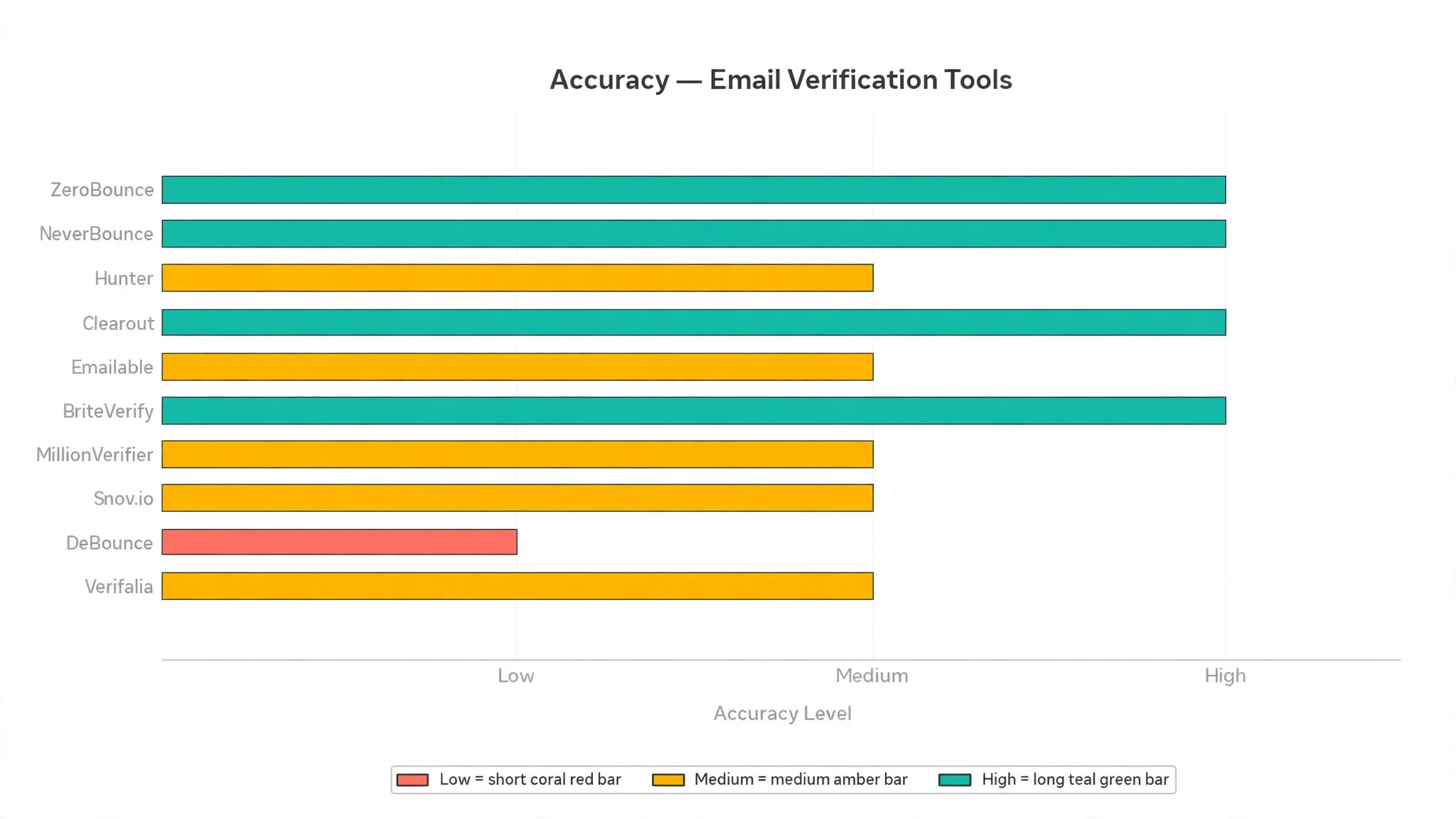
ZeroBounce and NeverBounce lead the table, so compare their reviews on accuracy to see which verifier fits the way your sales team sends. A tool that scores High on speed only helps if the results are accurate enough to trust, and a tool that scores High on price only helps if the team actually uses it every week.
Why the Best Email Verification Tools for Sales Teams Protect the Whole Pipeline
Bounce rate is the number that quietly decides whether a sales campaign works. When too many messages bounce, inbox providers start treating the whole domain with suspicion, and the next campaign lands in spam even for the good addresses. A verifier that catches the dead addresses before sending keeps the bounce rate low, and a low bounce rate keeps the domain trusted.
The second gain is time. A rep who works a list of five hundred names and finds a hundred dead addresses has lost a morning to silence. A verified list means every call, every follow-up, and every personal note goes to a real person, so the same morning produces real conversations instead of dead ends and auto-replies.
Deliverability is the third reason, and it is the one most teams underrate. An address can exist and still be a bad target, which is a catch-all that accepts everything, a role account nobody reads, or a disposable address made for one signup. Good verifiers flag those risky types separately, so the team can decide whether to mail them, watch them, or drop them entirely.
The final gain is honest reporting. A campaign sent to a clean list gives clean numbers, so open rates and reply rates mean something. A campaign sent to a dirty list produces numbers that lie, because the bounces hide the real response rate. Verification turns the campaign report into evidence the team can act on.
How We Put Each Verification Tool Through Its Paces
We ran the best email verification tools for sales teams through the same five measures, using a test list of one thousand addresses with known good, bad, risky, and catch-all entries mixed together. Each tool checked the same list, so the scores compare like with like.
- Accuracy, judged by how correctly the tool sorted the known good addresses from the known bad ones, including typos, dead domains, and disposable addresses.
- Speed, measured by how long the full thousand-address list took to verify, from upload to finished results.
- Result clarity, scored on whether the verdicts were easy to read and act on, with risky addresses flagged separately from clearly bad ones.
- Setup speed, timed from account creation to the first verified list, including any integration with a CRM or a form.
- Daily usability, judged by how easily a sales rep could verify a single address during normal work, without opening a manual or asking for help.
Each measure carried equal weight except accuracy, which counted double, because a verifier that gets the answers wrong is worse than no verifier at all. Scores run out of 100, and the order below follows the combined total, led by ZeroBounce on accuracy and depth.
The 10 Tools in Detail
Each review below judges the best email verification tools for sales teams on the same ground. We note what each tool does best, where it falls short, and the team it suits best, with accuracy carrying the most weight.
1. ZeroBounce
ZeroBounce tops the best email verification tools for sales teams on the combined score, and it earns the lead with the deepest checks in this ranking. Beyond the basic syntax and domain tests, it scores each address for quality, flags risky types like catch-alls and disposable addresses, and watches the sender reputation with a dedicated monitoring tool. For a team that mails at volume, that depth is the difference between a clean list and a guessed one.
The strengths run beyond the checks. Bulk lists verify fast, the API fits into a CRM or a signup form, and the activity data shows which addresses have engaged before. The scoring system gives the team a simple way to decide what to mail and what to drop, instead of a bare valid or invalid verdict.
The limits are price and complexity. ZeroBounce costs more than the budget tools in this ranking, and the credit system needs a little thought to plan. Smaller teams that verify a few hundred addresses a month may find the extras more than they need, and the interface rewards a user who spends an hour learning it.
In the trial, run a thousand-address list and check the accuracy against the addresses you already know are good or bad. Look at how the risky addresses are flagged, and whether the score helps you decide what to keep. If the verdicts match what you know, the depth is real.
Our verdict. The most thorough verifier here, and the safest pick for teams that mail at volume.
2. NeverBounce
NeverBounce is the bulk cleaning specialist, and it earns second place by making large list cleaning fast and simple. Upload a list, watch it verify, and download the clean result with clear verdicts. The system handles big files without fuss, and the credit pricing means a team pays for what it checks rather than a monthly seat it may not use.
The strengths are speed and simplicity. The bulk engine processes thousands of addresses quickly, the results sort cleanly into valid, invalid, and risky, and the integrations cover the main CRMs and email platforms. Real-time verification at the point of entry is available too, which stops bad addresses entering the list in the first place.
The limits are depth. NeverBounce checks thoroughly but offers fewer extras than ZeroBounce, with no sender monitoring or engagement scoring of the same kind. Teams that want the richest verdicts may find the results a little plain, though for most sales lists plain and accurate is exactly right.
In the trial, upload the biggest list the team has and time the full run. Check whether the risky addresses are flagged clearly, and whether the download sorts into a file the team can use straight away. If the list comes back clean and fast, the bulk engine fits.
Our verdict. The fastest bulk cleaner here, ideal for teams that verify big lists often.
3. Hunter
Hunter is the find-and-verify pick, and it suits sales teams that build lists as well as clean them. The finder locates email addresses for a person or a domain, and the verifier checks each one before it reaches the list. That single flow removes the gap where bad addresses creep in between finding and mailing.
The strengths are the joined-up workflow and the free start. The free plan covers a small number of searches and verifications each month, which is enough to test the system properly. The browser extension lets a rep find and verify an address while reading a company website, and the campaigns tool can send the outreach too.
The limits are verification depth. Hunter verifies well but does not go as deep as ZeroBounce on scoring or risky-address analysis, and the credit limits on lower tiers can pinch a team that finds and verifies at volume. Teams that only clean lists, and never find new contacts, will get less value.
In the trial, find five real prospects on their company sites and verify each address before adding it to a list. Check whether the finder and the verifier agree, and whether the flow feels fast. If the whole loop takes minutes, the joined-up design is working.
Our verdict. The best finder plus verifier here, ideal for teams that build their own lists.
4. Clearout
Clearout is the pay-as-you-go pick, and it earns its place with credit pricing that suits teams with uneven volume. A team that verifies ten thousand addresses in January and none in February pays for January only, with no monthly plan ticking over in the quiet months. For seasonal sales teams, that shape matters more than a small price difference.
The strengths are the pricing shape and the clear verdicts. Bulk lists, single checks, and real-time API verification all work from the same credit balance, and the results flag catch-alls, role accounts, and disposable addresses separately. The integrations cover the main CRMs, and the interface stays plain and readable.
The limits are extras. Clearout verifies well but offers less of the monitoring and engagement data that ZeroBounce provides, and the support is solid rather than standout. Teams that want the deepest analysis will look further up this list, while teams that want fair, simple pricing will stop here.
Our verdict. The fairest pay-as-you-go pricing here, ideal for teams with uneven volume.
5. Emailable
Emailable is the clarity pick, and it suits teams that want results they can read at a glance. Verdicts are plain, the risky addresses are flagged with reasons, and the dashboard shows the health of each list without jargon. For a sales manager who needs to trust the list and move on, that clarity is worth a lot.
The strengths are the clean results and the real-time option. The API checks addresses as they enter a form or a CRM, which stops bad data at the door, and the bulk engine handles large lists without fuss. The pricing is credit-based, so a team pays for the checks it runs.
The limits are depth and scale. Emailable does not offer the monitoring tools or the engagement scoring of the leaders, and very large teams may find the reporting lighter than they need. It is a verifier first, not a full deliverability platform, and teams that want the extras will need a second tool.
Our verdict. The clearest results here, ideal for managers who want plain verdicts.
6. BriteVerify
BriteVerify is the point-of-entry pick, and it earns its place by checking addresses the moment they are typed. A form, a signup page, or a CRM entry gets a live check before the bad address ever reaches the list, which means the database stays clean from day one instead of needing a monthly purge.
The strengths are the real-time API and the simplicity. The checks are fast, the integration is straightforward, and the results are a plain valid or invalid with the risky types flagged. For a team that collects addresses through forms and events, that live check saves more work than any bulk cleaner.
The limits are bulk depth. BriteVerify handles bulk lists too, but its heart is the real-time check, and the bulk reporting is lighter than ZeroBounce or NeverBounce. Teams that mostly clean old lists, rather than catching bad addresses at entry, will get less value from it.
Our verdict. The best live check at entry here, ideal for teams that collect addresses through forms.
7. MillionVerifier
MillionVerifier is the budget pick, and it suits teams that clean large lists without spending much. The per-address cost sits well below most rivals, and the bulk engine handles big files reliably, which makes it a sensible choice for a team that verifies tens of thousands of addresses on a tight budget.
The strengths are price and bulk handling. The checks cover syntax, domain, mailbox, and disposable detection, and the results sort into the usual valid, invalid, and risky groups. The API works for real-time checks too, and the credits never expire, which suits teams with irregular volume.
The limits are polish and extras. The interface feels plainer than the leaders, the reporting is basic, and there is no sender monitoring or engagement scoring. Teams that want the richest verdicts or the slickest workflow will pay more elsewhere, while teams that want cheap, honest bulk cleaning will stay here.
Our verdict. The cheapest bulk cleaning here, ideal for large lists on a tight budget.
8. Snov.io
Snov.io is the outreach pick, and it suits sales teams that want finding, verifying, and sending in one place. The finder locates addresses, the verifier checks them, and the outreach tools send the campaign and track the replies, all inside a single system. For a small sales team, that single login replaces three tools.
The strengths are the joined-up flow and the free start. The free plan covers a small monthly allowance, which is enough to test the whole loop properly. The browser extension finds addresses on company sites and social profiles, and the drip campaigns handle follow-ups without extra software.
The limits are verification depth. The verifier is solid but does not match ZeroBounce for scoring or risky-address analysis, and the credits are shared across finding, verifying, and sending, so heavy use in one area eats the allowance for the others. Teams that only need verification will find simpler tools cheaper.
Our verdict. The best all-in-one outreach flow here, ideal for small teams that send their own campaigns.
9. DeBounce
DeBounce is the simple bulk pick, and it earns its place by doing list cleaning well at a fair price. Upload a list, get clear verdicts, and download the clean result, with no monthly plan and no complicated settings. For a team that cleans a list once a month and wants the job done, DeBounce is hard to beat on simplicity.
The strengths are the price and the plain workflow. The checks cover the essentials, including syntax, domain, mailbox, and disposable detection, and the results are easy to sort. The API is available for teams that want real-time checks, and the credits never expire.
The limits are extras and polish. DeBounce offers less of the monitoring, scoring, and engagement data that the leaders provide, and the interface is functional rather than beautiful. Teams that want deep analysis will look higher up this list, while teams that want a clean list at a fair price will stop here.
Our verdict. The simplest fair-priced bulk cleaner here, ideal for monthly list cleaning.
10. Verifalia
Verifalia is the reporting pick, and it rounds out the ranking with thorough checks and clear reports. The verification covers syntax, domain, mailbox, and disposable detection, and the results come with the detail a manager needs to explain the list quality to a client or a boss. For teams that report on list health, that detail matters.
The strengths are the depth of the reports and the free start. The free plan covers a daily allowance, which is enough for small regular checks, and the API supports both single and bulk verification. The pricing is credit-based, so a team pays for the checks it runs rather than a monthly seat.
The limits are speed and brand reach. Verifalia is thorough but not the fastest bulk engine in this ranking, and its integrations are thinner than the bigger names. Teams that verify very large lists weekly may prefer NeverBounce, while teams that value the reports will stay here.
Our verdict. The clearest verification reports here, ideal for teams that must show list quality.
What a Sales Team Actually Pays to Keep a List Clean
The best email verification tools for sales teams differ most on how the credits work, and the cheapest price per check is not always the cheapest month. A tool that sells credits cheaply can cost more if the team re-verifies the same list twice, while a tool with a monthly plan can be the bargain for a team that checks addresses every single day. Before choosing, work out how many addresses the team verifies in a real month, then compare that total across two or three finalists.
Credit expiry deserves a hard look. MillionVerifier, Clearout, and DeBounce sell credits that never expire, which suits a team with uneven volume, while monthly plans suit a team that verifies steadily all year. A plan that fits the team’s real rhythm saves more than a small difference in the per-check price, so match the billing shape to the workload, not just the headline rate.
Watch the re-verification habit too. A list that is verified once and then left for a year slowly goes stale, because people change jobs and domains close. The tools in this ranking make re-checking cheap, and a team that re-verifies its active list every quarter keeps the bounce rate low all year. Budget for that quarterly clean, not just the first one.

Verification Mistakes That Hurt Deliverability
The first mistake is verifying once and never again. A list that was clean in January is not clean in July, because people leave jobs, companies close, and inboxes fill up. Re-verify the active list every quarter, and verify new addresses at the point of entry, so the list stays clean instead of needing a rescue every six months.
The second mistake is mailing the risky addresses anyway. A catch-all or a role account might accept the message, but it might also bounce, sit unread, or mark the message as spam. Treat risky as a separate group, mail it carefully or not at all, and watch the results before deciding. A team that mails every risky address undoes half the value of verifying.
The third mistake is trusting a single verdict on a critical contact. When one address matters, which is a key prospect or a big account, verify it with a second tool or check the company website directly. Verifiers are accurate, but no single check is perfect, and a five-minute manual check on the ten most important contacts is time well spent.
Best Pick by Job
No single winner fits every sales team, so the tools below are matched to the job instead of the rank. Find the row that matches your list size and sending habit, then start the trial with that verifier.
| Job | Best pick | Why it wins |
|---|---|---|
| Wants the most thorough checks | ZeroBounce | Deep checks with scoring and monitoring |
| Cleans big lists often | NeverBounce | Fast bulk cleaning with simple credits |
| Finds and verifies together | Hunter | Finder plus verifier in one flow |
| Has uneven monthly volume | Clearout | Credit pricing with no monthly plan |
| Wants plain, clear verdicts | Emailable | Clean results with real-time checks |
| Collects addresses in forms | BriteVerify | Live checks at the point of entry |
| Cleans lists on a budget | MillionVerifier | Low-cost bulk verification |
| Runs outreach end to end | Snov.io | Finder, verifier, and sender in one |
| Cleans a list once a month | DeBounce | Simple bulk checks at a fair price |
| Must show list quality | Verifalia | Thorough checks with clear reports |
If your situation does not match a row exactly, take the closest one and read that review first, starting with ZeroBounce when it fits. The gap between neighbouring tools is smaller than the gap between a team that verifies every list and one that never does, so the habit matters more than a few points on a scorecard.
Frequently Asked Questions
Sales managers ask the same questions before choosing from the best email verification tools for sales teams, so the plain answers are here, based on how these tools actually work on real lists.
How accurate is email verification, really?
Good verifiers get the clear cases right almost every time, which is the working addresses and the dead domains. The hard cases are the catch-alls and the risky addresses, where the tool can only say the address might work. Treat those as a separate group, and expect a small share of any list to stay uncertain no matter which tool checks it.
How often should a sales team verify its list?
Verify new addresses as they arrive, and re-verify the active list every quarter. People change jobs, companies close, and domains lapse, so a list goes stale by a few percent every month. A quarterly clean keeps the bounce rate low all year, and it costs far less than the lost replies from mailing a stale list.
Can verification fix a domain that already lands in spam?
It helps, but it is not a cure on its own. Cleaning the list stops the bounces that hurt the sender reputation, and a clean list is the first step back to the inbox. A domain with a damaged reputation also needs time, steady volume, and good engagement before inbox providers trust it again, so pair verification with a careful sending habit.
What is a catch-all address, and should we mail it?
A catch-all is a domain set to accept mail to any address, even ones that do not exist, so the verifier cannot confirm whether a real person sits behind it. Some catch-alls are real inboxes, and some are traps. Mail them separately from the main list, watch the bounces and replies, and drop the ones that never engage.
Do these tools work inside a CRM?
Yes, most of them do. ZeroBounce, NeverBounce, Hunter, Clearout, Emailable, and Snov.io all offer integrations or an API that connects to the main CRMs, so a rep can verify an address without leaving the contact record. Check the integration list for your CRM before choosing, because the depth of the connection differs by tool.
Choosing the Verifier Your Sales Team Trusts
The best email verification tools for sales teams prove their worth in the first campaign, and the proof is simple to measure. Send to a verified list and a dirty list side by side, then compare the bounce rate, the reply rate, and the number of real conversations each one produces. If the verified list bounces less and replies more, the system is working.
ZeroBounce wins our ranking on the combined score, but the right tool for your team is the one the reps actually use before every send. Run the trial on a real list with addresses you already know are good or bad, judge it on accuracy rather than the demo, and pick the verifier that makes a clean list the easy option. A clean list and a trusted domain will pay for the subscription many times over.