

A text message gets read. Email sits unopened, social posts scroll past, but a short message on a phone is read within minutes, and a business that uses that well reaches customers nothing else can reach. The top 10 sms platforms exist to send those messages at scale, with delivery reports, opt-out handling, and automation a small team can run. Twilio leads this ranking on the combined score, with Plivo close behind for teams that want developer-friendly messaging at a low cost.
We judged each platform on work a business really does. That meant sending a promotional campaign, an appointment reminder, and a two-way support conversation, then reading the delivery reports. We tracked how fast a campaign went out, how the replies read, and how a small team coped when a customer replied STOP.
Twilio earns the top spot on API depth, Plivo on value, and every platform after them on a strength of its own. Some are full messaging platforms built for teams that send thousands of texts a day. Others are lighter tools that suit a small shop sending reminders. The right pick depends on your volume, your use case, and how much of the messaging routine you want the platform to run.
Twilio tops the combined score, yet a business that only needs one kind of message should let the best pick by job table near the end carry equal weight. A platform that ranks fifth overall can still be the right answer for a clinic sending reminders, while the overall winner can be more than a first campaign needs.
In this article
- The 10 Tools at a Glance
- Why the Top 10 SMS Platforms Pay for Themselves
- How We Put Each SMS platform Through Its Paces
- The 10 Tools in Detail
- SMS vs Email: What Each Message Does Best
- Five SMS Mistakes That Lose Customers Fast
- A Four Week SMS Plan for a Small Business
- What to Check in a Delivery Report Before You Trust It
- Best Pick by Job
- Frequently Asked Questions
- Twilio First, Then the Rest of the Shortlist
The 10 Tools at a Glance
The table below puts one row per platform, with the price shape, the natural fit, and the strength that put Twilio first. The top 10 sms platforms are not always the most expensive, and the table shows why. Twilio leads on API depth, while SimpleTexting wins for teams that want campaigns without code.
| Tool | Starting price | Best for | Standout strength |
|---|---|---|---|
| Twilio | Free plan; paid plans on the vendor site | Teams that want messaging by API | Deepest SMS API with global reach |
| Plivo | Free plan; paid plans on the vendor site | Teams that want API messaging at low cost | Developer messaging with low rates |
| MessageBird | Free plan; paid plans on the vendor site | Teams that want messaging across channels | SMS beside chat and voice in one place |
| ClickSend | Free plan; paid plans on the vendor site | Teams that want simple business texting | Simple campaigns with an easy dashboard |
| TextMagic | Free plan; paid plans on the vendor site | Small teams that want quick campaigns | Fast campaigns with two-way texting |
| SimpleTexting | Free plan; paid plans on the vendor site | Teams that want campaigns without code | No-code campaigns with keywords |
| EZ Texting | Free plan; paid plans on the vendor site | Teams that want marketing texts fast | Marketing campaigns with simple lists |
| Attentive | Pricing on the vendor site | Ecommerce teams that want SMS sales | SMS marketing built for online stores |
| Klaviyo | Free plan; paid plans on the vendor site | Stores that want SMS beside email | SMS tied to email marketing data |
| Sinch | Pricing on the vendor site | Teams that want global messaging scale | Global SMS with enterprise delivery |
Narrow the table to Twilio and Plivo, then read those two reviews to see which messaging routine fits your business. A platform that scores High on delivery only helps if your messages reach the right country, and a platform that scores High on automation only helps if the triggers are set up right. Fit to your messaging routine matters more than a long feature list.
Why the Top 10 SMS Platforms Pay for Themselves
The first reason is messages that get read. A text with a ninety percent open rate beats an email with twenty percent, and across a year of campaigns that gap is worth far more than the platform costs. A campaign that reaches the customer hands that attention back, and the gain repeats with every send.
The second reason is fewer missed appointments. Most business losses are not dramatic. A customer forgets a booking, the slot sits empty, and nobody notices until the day is over. A reminder text sent the day before catches these gaps, because the customer confirms or reschedules in one reply.
The third reason is faster support. When a customer can reply to a text, the conversation finishes in minutes. A customer working through email waits hours for each reply, and the problem grows while the thread drags on.
The fourth reason is proof for the next campaign. A platform that records which messages get read, which links get clicked, and which offers convert gives a business real numbers for the next send. Guessing which message works is very different from showing a report that proves it, and that proof is what shapes a better campaign.
How We Put Each SMS platform Through Its Paces
We tested the top 10 sms platforms against the same five measures, using a promotional campaign, an appointment reminder, and a two-way support conversation. Each platform ran the same workload for two weeks, so Twilio and the rest compare like with like.
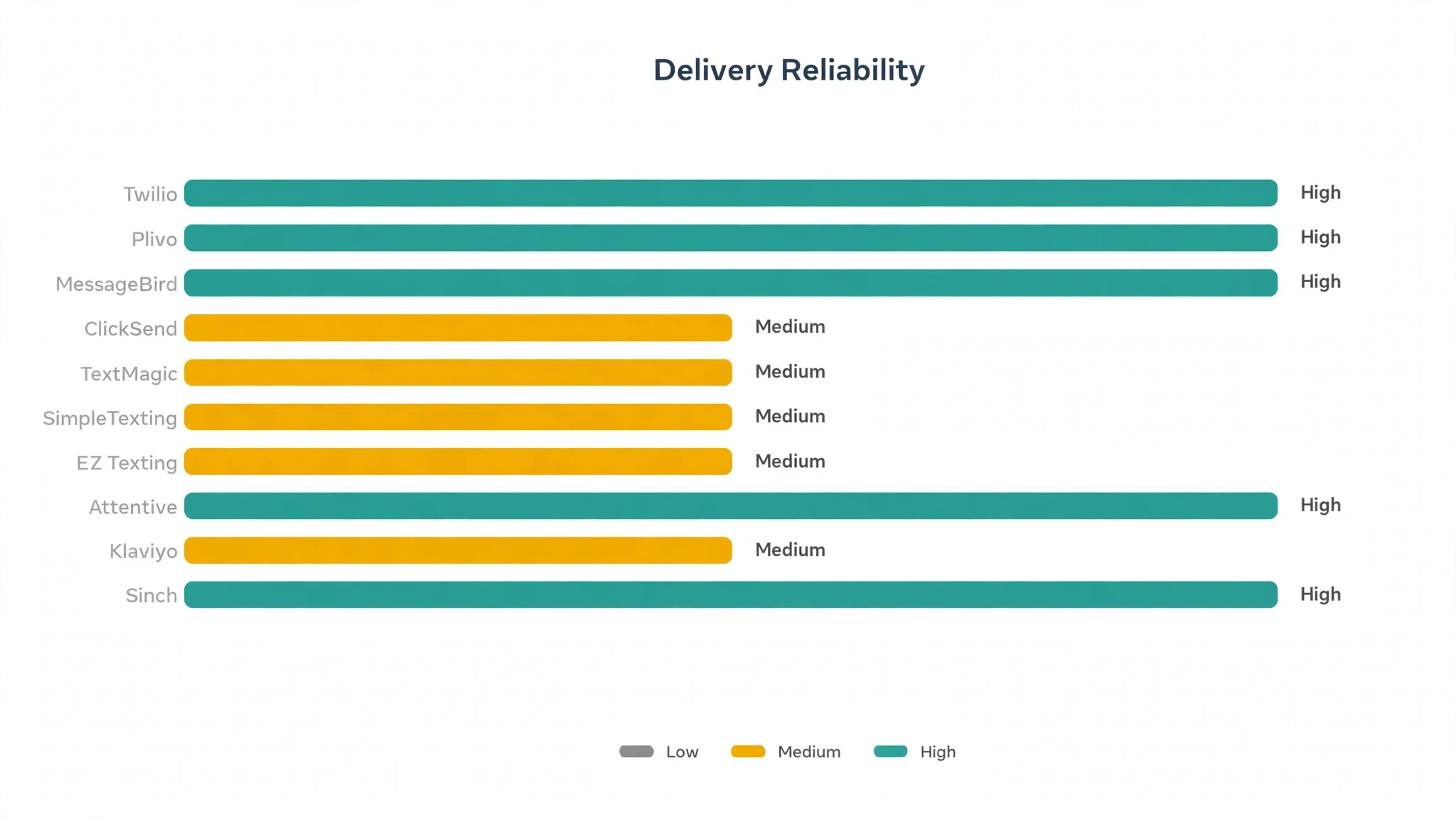
- Delivery reliability, judged by how many test messages arrived fast and intact.
- Campaign speed, measured by how fast a team could build and send a campaign without code.
- Two-way handling, scored on how clearly replies and opt-outs were managed.
- Automation depth, timed from setting a trigger to the first automatic message going out.
- Daily usability, judged by how long the end-of-day review took and how often the team needed to ask for help.
Each measure carried equal weight except delivery reliability, which counted double, because a messaging platform that loses texts is not doing its job. Scores run out of 100, and the order below follows the combined total, led by Twilio on API depth. Where two platforms tied, we broke the tie on delivery reliability, since a reliable platform protects the business from messages that never arrive.
We also checked the compliance view, because messaging work moves fast. The best platforms in this ranking handle opt-outs and consent cleanly, while the weakest need manual checks before a campaign goes out.
The 10 Tools in Detail
Each review below follows the same pattern, and every platform is judged on the same ground as the top 10 sms platforms. We note what each platform does best, where it falls short, and the business it suits best, with delivery reliability carrying the most weight.
1. Twilio
Twilio is the API leader in this ranking, and it leads because its messaging API covers the world. Send texts from code, receive replies through webhooks, and track delivery per message across dozens of countries. A team that builds messaging into its own product gets the control it needs.
The trade off is developer need. Twilio is built for teams with a developer, so a business owner without one may find the setup harder. A team that builds messaging into software gets a platform that grows with it, but one sending simple campaigns should start lighter.
In the trial, send a hundred test messages through the API and read the delivery reports. Watch whether the messages arrived fast, and whether the replies came back cleanly. Twilio delivered a hundred messages fast with clear reports.
Our verdict. The deepest SMS API here, and the best all rounder for teams that build messaging in.
2. Plivo
Plivo is the value pick, and it earns second place with developer messaging at low rates. The API covers the same ground as Twilio for most use cases, with clear pricing and solid delivery across many countries.
The trade off is ecosystem size. Plivo is lighter on extra services than the biggest platforms, so a team that wants voice, video, and chat in one place must look elsewhere. For a team that mainly sends texts, that low cost is exactly right.
In the trial, send a hundred test messages and compare the cost with your usual provider. See if the delivery matched, and if the API stayed simple. A hundred test messages cost less than the usual provider.
Our verdict. The best low-cost SMS API here, ideal for teams that send texts by code.
3. MessageBird
MessageBird is the omnichannel pick, and it suits teams that want SMS beside chat and voice. One platform handles texts, WhatsApp, and calls, so a customer conversation can move between channels without starting over.
The trade off is SMS depth. MessageBird covers many channels, and its SMS features are solid rather than standout. For a team that talks to customers on several channels, the combined view is worth it.
In the trial, send a campaign by SMS and continue one reply on chat. Ask whether the conversation stayed in one thread, and whether the delivery reports read clearly. One thread held the whole conversation with clear delivery reports.
Our verdict. The best SMS plus chat in one place here, ideal for teams on several channels.
4. ClickSend
ClickSend is the simple pick, and it earns its place with business texting that just works. Campaigns, reminders, and two-way replies share one easy dashboard, and the setup takes an afternoon.
The trade off is API depth. ClickSend is lighter on developer tools than the API leaders, so a team that builds messaging into software must look elsewhere. For a business that sends campaigns from a dashboard, that simplicity is a strength.
In the trial, build a campaign and send it to a test list of fifty contacts. Check whether the build stayed fast, and whether the replies landed in one inbox. The campaign builder sent fifty messages in one go.
Our verdict. The simplest business texting here, ideal for teams that send from a dashboard.
5. TextMagic
TextMagic is the quick pick, and it suits small teams that want campaigns out fast. Lists import cleanly, messages send in bulk, and replies arrive in a shared inbox the team can answer together.
The trade off is automation depth. TextMagic is lighter on complex triggers than the leaders, so a team that wants deep automation must add another tool. For a small team sending reminders and offers, that speed is exactly right.
In the trial, import a list and send a reminder campaign to fifty contacts. Watch whether the import stayed clean, and whether the replies were easy to answer. TextMagic imported the list cleanly and answered replies easily.
Our verdict. The fastest small-team campaigns here, ideal for teams sending reminders fast.
6. SimpleTexting
SimpleTexting is the no-code pick, and it earns its place with campaigns that need no developer. Keywords, auto-replies, and scheduled sends all work from the dashboard, so a marketing team runs messaging alone.
The trade off is API depth. SimpleTexting is built for dashboard users first, so a team that wants deep API control must look elsewhere. For a team that runs campaigns without code, that no-code design is the reason to choose it.
In the trial, set up a keyword campaign and an auto-reply, then test both with five phones. See if the setup stayed simple, and if the replies triggered correctly. SimpleTexting ran the keyword campaign without any setup fuss.
Our verdict. The best no-code SMS campaigns here, ideal for marketing teams without developers.
7. EZ Texting
EZ Texting is the marketing pick, and it suits teams that want marketing texts fast. Lists, segments, and scheduled campaigns share one view, and the reporting shows which message drove replies.
The trade off is two-way depth. EZ Texting is stronger on outbound marketing than on long support conversations, so a team that needs deep two-way chat must look elsewhere. For a team that sends offers, the marketing focus is exactly right.
In the trial, send a promotional campaign to a test list and read the reply report. Ask whether the build stayed fast, and whether the replies were easy to track. Reply reports showed every response in a single view.
Our verdict. The best marketing text campaigns here, ideal for teams that send offers.
8. Attentive
Attentive is the ecommerce pick, and it earns its place with SMS marketing built for online stores. Texts tie to carts, purchases, and browsing, so a store can send an abandoned-cart reminder that actually converts.
The trade off is fit outside ecommerce. Attentive is built for online stores first, so a clinic or a service business gets less from its features. For an ecommerce store, the sales tie-in is the reason to choose it.
In the trial, send an abandoned-cart text to a test group and watch the recovery rate. Check whether the store data carried across, and whether the message read well. Abandoned-cart texts pulled store data without any retyping.
Our verdict. The best SMS for online stores here, ideal for ecommerce teams that sell by text.
9. Klaviyo
Klaviyo is the combined pick, and it suits stores that want SMS beside email. One platform holds the customer data, so a text and an email can share the same segment and the same offer without duplicate lists.
The trade off is SMS depth. Klaviyo is stronger on email than on pure SMS, so a team that sends texts all day may want a specialist. For a store that already runs email on Klaviyo, the combined data is worth it.
In the trial, build one segment and send it a text and an email together. Watch whether the data stayed in sync, and whether the reports showed both channels. Klaviyo synced the segment across text and email together.
Our verdict. The best SMS beside email here, ideal for stores already on Klaviyo.
10. Sinch
Sinch is the global pick, and it closes the ranking with enterprise delivery across the world. Large volumes, many countries, and strong delivery reporting suit a team that messages customers everywhere.
The trade off is small-team ease. Sinch is built for scale, so a small business may find the setup heavier than a simple dashboard tool. For a team sending texts across many countries, that global reach is exactly right.
In the trial, send test messages to three countries and read the delivery reports. See if the messages arrived fast, and if the reporting stayed clear. Messages reached three countries fast with clear delivery reports.
Our verdict. The best global SMS delivery here, ideal for teams messaging across many countries.
SMS vs Email: What Each Message Does Best
An SMS and an email answer different questions, and the right choice depends on the urgency. A text gets read in minutes and suits reminders, alerts, and short offers, while an email suits long messages, receipts, and content a customer saves. A business that sends everything by text annoys customers, while a business that sends everything by email gets ignored.
For most businesses, the text comes first for time-sensitive messages. The reminder is under the business control, and sending it costs little. The top 10 sms platforms in this guide handle reminders well, so the business can grow into email work when the text routine is solid.
Email becomes useful when the message needs detail and a record. A customer with a long invoice needs an email, while a customer with an appointment tomorrow needs a text. The practical rule is simple, and it saves the business complaints every week.
A second gain comes from timing. A reminder sent the evening before an appointment gets read and acted on, while the same reminder sent a week early gets forgotten. Schedule time-sensitive texts close to the event, and keep marketing texts to mid-morning when people have time to read them.
Five SMS Mistakes That Lose Customers Fast
The first mistake is texting without permission. A business that messages people who never opted in breaks trust and the law, and the complaints arrive fast. Collect consent clearly, record it, and honour every opt-out at once.
The second mistake is texting too often. A business that sends a text every day trains customers to ignore them, while a business that sends one a week gets read. Send less, and make each message worth opening.
The third mistake is a message with no clear action. A text that rambles without a link or a reply option leaves the customer guessing, while a short text with one clear step gets a response. Write the action first, and cut the rest.
The fourth mistake is ignoring replies. A customer who replies to a text expects an answer, and a business that never reads replies loses that customer. Watch the inbox daily, and answer every reply the same day.
The fifth mistake is no delivery check. A business that never reads delivery reports cannot know which messages failed, so the same customers keep missing reminders. Read the delivery report weekly, and fix the numbers that fail most.
The fix for all five is a short weekly review. Read the delivery and reply reports, note the message that performed best, and copy its style for the next send. A business that learns from one message a week soon writes texts customers actually want to open.
A Four Week SMS Plan for a Small Business
Week one is the list, and it should be honest. Gather the customers who opted in, check the numbers are current, and remove the ones who opted out. A campaign built from a clean list beats one built from an old spreadsheet every time.
Week two is the first send. Send one reminder campaign to a small test group, watch the delivery and replies, and let it run without interference. Check the inbox daily, but do not send a second campaign yet. A clean first send builds the habit that carries the whole routine.
Week three is the result and the next send. Read the delivery data with the team, write down what worked, and send the next campaign to the full list the same week. A routine that sends one useful text a week is a habit worth keeping, while a routine that spams daily goes stale.
Week four is the routine. Set a weekly message slot, a shared opt-in list, and a short report that shows every send and every reply. A habit that runs every week compounds, and the reply numbers show the value in plain terms.

What to Check in a Delivery Report Before You Trust It
A delivery report looks simple on the surface, but three checks decide whether it is real. The first is the delivery rate. A report showing every message delivered is a hint, not a verdict, while a report with a small failure rate carries weight. Ask the platform to show failed numbers beside the delivered ones, and ignore any report that hides the failures.
The second check is the reply rate. A campaign with no replies may have reached the wrong people, and the team wastes money on silence. The replies should match the message, the opt-outs should stay low, and the tracking should count every reply once. A quick look at the reply numbers catches the targeting errors that ruin otherwise good campaigns.
The third check is the timing view. A message sent at midnight reads differently from one sent at noon, and the average hides the timing problem. Read the report by send time before trusting the campaign, because a badly timed text is not a good text. A careful team checks the timing, writes down what it found, and only then tells the business the campaign is done.
Best Pick by Job
No single SMS platform fits every business, so each common messaging situation below is matched to the platform that scored highest for that job. The top 10 sms platforms for a developer team look different from the right pick for a small shop, and the table below makes that split clear.
| Job | Best pick | Why it wins |
|---|---|---|
| Wants messaging by API | Twilio | Deepest SMS API with global reach |
| Wants API messaging at low cost | Plivo | Developer messaging with low rates |
| Wants messaging across channels | MessageBird | SMS beside chat and voice in one place |
| Wants simple business texting | ClickSend | Simple campaigns with an easy dashboard |
| Wants quick campaigns | TextMagic | Fast campaigns with two-way texting |
| Wants campaigns without code | SimpleTexting | No-code campaigns with keywords |
| Wants marketing texts fast | EZ Texting | Marketing campaigns with simple lists |
| Wants SMS sales for ecommerce | Attentive | SMS marketing built for online stores |
| Wants SMS beside email | Klaviyo | SMS tied to email marketing data |
| Wants global messaging scale | Sinch | Global SMS with enterprise delivery |
If your situation does not match a row exactly, take the closest one and read that review first, starting with Twilio when it fits. The gap between neighbouring platforms is smaller than the gap between a messaging routine your team runs weekly and one they never start, so habit matters more than a few points on a scorecard.
Frequently Asked Questions
Business owners ask the same questions before every messaging change, so we answered the most common ones here.
How much do SMS platforms cost for a small business?
Most platforms in this ranking charge per message, so a business pays for the texts it sends plus any monthly plan. Free plans cover small trials well, but the automation and reporting that save real time usually sit on paid tiers. Check the vendor site for current pricing and confirm the total before you pay, because message volumes can change the bill.
Can one platform handle campaigns and two-way chat together?
It can handle both, and most businesses prefer one system for the whole job. Campaigns need lists and schedules, while two-way chat needs an inbox and replies, and the leaders cover both well. Some teams still pair a campaign specialist with a separate chat tool, which works fine when the handover is clear.
How long does it take to launch a first SMS campaign?
A focused team launches a first SMS campaign in a day or two if the opt-in list is ready. The delay usually comes from messy contact lists and untested sender settings, not from the platform. Clean the list first, send a test to five phones, and launch only when the test messages arrive.
Do these platforms work for businesses with very few contacts?
They work, but the full platforms cost more than a small business needs, and some features will sit unused. A small business should start with a simple texting tool, then move up when the list grows. Send to the contacts who opted in most recently first, because those are the messages that pay for the platform.
What happens to our contact lists if we switch platforms later?
Every platform in this ranking exports contact lists and message history to common formats, so a switch is possible but never painless. Automation rules and sender settings do not transfer, and the team must rebuild them in the new platform. A switch is never painless, which is why a business should trial Twilio properly now instead of staying with a messaging tool that no longer fits the way the team works.
Twilio First, Then the Rest of the Shortlist
A business can settle this in a trial by timing days to a first campaign, counting the messages delivered, and measuring replies in the first month. The top 10 sms platforms prove themselves on the days to a first campaign, the share of messages delivered, and the replies found in the first month, and a four week trial with your real contacts will show all three. Twilio wins our ranking on the combined score, but the right platform for your business is the one your team runs every week without being asked.
Run the trial on one real campaign with your real contacts and your real messages, and judge the platform on the first week rather than the demo. If the campaign sends in an hour and the delivery reports read clearly, the system is working. If the setup stalls and the inbox confuses the team, the platform is fighting you rather than helping you. Pick the platform that makes messaging feel easy, protect the weekly habit, and let the replies pay for the subscription many times over.