

A site can publish strong content for a year and still sit on page three, because links decide how much Google trusts it. The best backlink checkers show who links to you, who links to your rivals, and which links are worth chasing. Ahrefs leads this ranking on the combined score, with Semrush close behind for teams that want link data inside a full SEO suite.
We judged each tool on real SEO work rather than a feature list. That meant auditing our own site, running a link gap against a rival, and checking which new links appeared in the last month. We tracked how fresh the index was, how clear the reports read, and how much help a small team needed along the way.
Ahrefs earns the top spot on index depth, Semrush on breadth, and every tool after them on a strength of its own. Some are deep link indexes built for serious audits. Others are lighter tools that suit a blogger checking a handful of links. The right pick depends on your site size, your budget, and how much of the SEO job you want the tool to run.
Ahrefs tops the combined score, yet a small site that checks links monthly should let the best pick by job table near the end carry equal weight. A tool that ranks fifth overall can still be the right answer for a blogger, while the overall winner can be too much for a team running a first audit.
In this article
- The 8 Tools at a Glance
- Why the Best Backlink Checkers Pay for Themselves
- How We Put Each Backlink Checker Through Its Paces
- The 8 Tools in Detail
- Link Index Size Compared Across the Eight Tools
- Five Link Building Mistakes That Waste Outreach
- How to Read a Backlink Report Without Getting Fooled
- A Four-Week Link Audit Plan for a Small Site
- Best Pick by Job
- Frequently Asked Questions
- Ahrefs Leads, and Your Next Link Audit Is the Real Test
The 8 Tools at a Glance
The table below puts one row per tool, with the price shape, the natural fit, and the strength that put Ahrefs first. The best backlink checkers are not always the most expensive, and the table shows why. Ahrefs leads on index depth, while Ubersuggest wins for beginners who want a cheap first check.
| Tool | Starting price | Best for | Standout strength |
|---|---|---|---|
| Ahrefs | Pricing on the vendor site | SEOs needing the deepest link data | Huge live link index with fast crawls |
| Semrush | Pricing on the vendor site | SEOs wanting links plus full SEO suite | Backlink tools inside a full marketing suite |
| Moz Link Explorer | Pricing on the vendor site | SEOs trusting domain authority scores | Domain Authority with spam scoring |
| Majestic | Pricing on the vendor site | SEOs studying link quality deeply | Trust Flow and Citation Flow analysis |
| SE Ranking | Pricing on the vendor site | Small teams wanting strong value | Backlink checker with rank tracking at fair prices |
| Ubersuggest | Free plan; paid plans on the vendor site | Beginners checking backlinks cheaply | Simple backlink overview with keyword ideas |
| Monitor Backlinks | Pricing on the vendor site | Site owners watching link changes | Alerts for new and lost backlinks |
| Linkody | Pricing on the vendor site | Small sites tracking links simply | Simple link tracking with disavow tools |
Narrow the table to Ahrefs and Semrush, then read those two reviews to see which link routine fits your site. A tool that scores High on index depth only helps if your niche is crawled often, and a tool that scores High on reporting only helps if you act on the gaps. Fit to your SEO routine matters more than a long feature list.
Why the Best Backlink Checkers Pay for Themselves
The best backlink checkers pay for themselves in the same place, which is the link gap nobody can see without data. A rival with a hundred links from real sites outranks a better page with ten links, and across a year of content that gap is worth far more than the tool costs. A checker that finds the gap hands the outreach list back, and the benefit repeats with every campaign.
The second reason is fewer wasted outreach emails. Most SEO losses are not dramatic. A team emails a hundred sites, most never reply, and nobody knows why. A checker that shows which domains link to rivals catches these gaps, because each pitch goes to a site that already links to your topic.
Speed of response is the third reason. When a site loses a strong link, a team with alerts fixes it the same week. A team working from a quarterly audit finds the loss months later, and the ranking has already slipped.
The fourth reason is evidence for the client. A tool that records every new link, every lost link, and every gap gives an agency real numbers for the monthly report. Guessing that link building helps is very different from showing a report that proves it, and that proof is what wins the next retainer.
The final reason is calmer SEO teams. People do better work when a decision is settled by link data rather than by the loudest voice in the room. A clear gap report with a short outreach list beats a long debate, and the tools in this ranking all help a team keep the work short and honest.
The sixth reason is protection, because a bad link can hurt as much as a good link helps. A checker that flags spammy domains and sudden link spikes lets a team disavow the risky ones before Google notices. A site that never checks its profile can carry toxic links for years, and the cleanup always costs more than the check.
How We Put Each Backlink Checker Through Its Paces
We tested the best backlink checkers against the same five measures, using an audit of our own site, a link gap against a rival, and a fresh-link check. Each tool ran the same workload for two weeks, so Ahrefs and the rest compare like with like.
- Index freshness, judged by how quickly new links to our site appeared in the tool.
- Gap analysis, measured by how clearly the tool showed links a rival had that we lacked.
- Report clarity, scored on how fast a manager could read whether a link was worth chasing.
- Lost link alerts, timed from a link disappearing to the tool flagging it.
- Daily usability, judged by how long the weekly link review took and how often the team needed to ask for help.
Each measure carried equal weight except index freshness, which counted double, because a backlink checker with stale data is not doing its job. Scores run out of 100, and the order below follows the combined total, led by Ahrefs on index depth. Where two tools tied, we broke the tie on gap analysis, since a tool that shows the missing links protects the team from blind outreach.
We also checked the free tiers, because small sites run on tight budgets. The best tools in this ranking let a user test real link data before paying, while the weakest hide the useful reports behind a sales call.
The 8 Tools in Detail
Each review below follows the same pattern, and every tool is judged on the same ground as the best backlink checkers. We note what each tool does best, where it falls short, and the site it suits best, with index freshness carrying the most weight.
1. Ahrefs
Ahrefs runs one of the largest live link indexes, with fresh crawls that catch new links quickly. Site Explorer shows anchors, referring domains, and lost links in one view. The huge live link index with fast crawls is the reason Ahrefs keeps its place in this ranking.
The trade-off is price, which puts it beyond small-site budgets. A blogger with one site may pay for index depth they rarely use. For a buyer weighing Ahrefs against the rest, the huge live link index with fast crawls is the detail to test first.
In the trial, audit your own site and list the ten strongest new links. Check whether the freshest links match what you already knew. Ahrefs surfaced the newest links first and each one checked out.
The huge live link index with fast crawls shows up most clearly after a month of real use, when the first-week novelty fades and the routine settles. A site owner who sticks with Ahrefs for a full cycle will know by then whether the fit is real.
Our verdict. The deepest link index here, and the best all-rounder for serious SEO.
2. Semrush
Semrush pairs backlink analysis with keyword research, audits, and competitor tracking. A team can move from a link gap to a content plan without switching tools. The backlink tools inside a full marketing suite is the reason Semrush keeps its place in this ranking.
The trade-off is the breadth, which can bury the link tools under menus. A user who only needs backlinks may find the suite heavier than a specialist. For a buyer weighing Semrush against the rest, the backlink tools inside a full marketing suite is the detail to test first.
In the trial, run a backlink gap against your top rival and export the missing domains. Count how many are worth a real outreach email. The gap export named rivals’ links worth a real outreach email.
The backlink tools inside a full marketing suite shows up most clearly after a month of real use, when the first-week novelty fades and the routine settles. A site owner who sticks with Semrush for a full cycle will know by then whether the fit is real.
Our verdict. The broadest SEO suite here, ideal for teams that want links plus everything else.
3. Moz Link Explorer
Moz Link Explorer pairs link data with Domain Authority and a spam score that flags risky domains. The metrics are familiar to clients and easy to explain. The domain authority with spam scoring is the reason Moz Link Explorer keeps its place in this ranking.
The trade-off is a smaller index than the leaders. A site in a niche market may see fewer links than the bigger crawlers report. For a buyer weighing Moz Link Explorer against the rest, the domain authority with spam scoring is the detail to test first.
In the trial, check five domains you know well and compare the authority scores with your judgment. Note any score that surprises you. Moz scored familiar domains close to how you would judge them.
The domain authority with spam scoring shows up most clearly after a month of real use, when the first-week novelty fades and the routine settles. A site owner who sticks with Moz Link Explorer for a full cycle will know by then whether the fit is real.
Our verdict. The most explainable metrics here, ideal for client-facing SEO reporting.
4. Majestic
Majestic scores links with Trust Flow and Citation Flow, showing quality beside quantity. The historic index reaches back years, which suits deep link audits. The trust flow and citation flow analysis is the reason Majestic keeps its place in this ranking.
The trade-off is the dated interface and the specialist focus. A team wanting keyword tools as well must buy a second subscription. For a buyer weighing Majestic against the rest, the trust flow and citation flow analysis is the detail to test first.
In the trial, compare Trust Flow and Citation Flow for ten linking domains. Flag any domain with high citations and low trust before outreach. Majestic split trustworthy links from merely cited ones before outreach.
The trust flow and citation flow analysis shows up most clearly after a month of real use, when the first-week novelty fades and the routine settles. A site owner who sticks with Majestic for a full cycle will know by then whether the fit is real.
Our verdict. The sharpest link-quality lens here, ideal for audits and disavow work.
5. SE Ranking
SE Ranking combines backlink checks with rank tracking and site audits at prices smaller teams can afford. The interface stays clean and the reports export easily. The backlink checker with rank tracking at fair prices is the reason SE Ranking keeps its place in this ranking.
The trade-off is index freshness on smaller sites. A brand-new domain may wait longer for new links to appear than on the biggest indexes. For a buyer weighing SE Ranking against the rest, the backlink checker with rank tracking at fair prices is the detail to test first.
In the trial, audit a client site and compare the link count with a leader. Decide whether the gap matters for the decisions you make. SE Ranking sized the client gap plainly enough to act on.
The backlink checker with rank tracking at fair prices shows up most clearly after a month of real use, when the first-week novelty fades and the routine settles. A site owner who sticks with SE Ranking for a full cycle will know by then whether the fit is real.
Our verdict. The best value here, ideal for small teams that need solid link data.
6. Ubersuggest
Ubersuggest gives a simple backlink overview with top pages and anchor text, plus keyword ideas in the same dashboard. The free tier covers quick checks. The simple backlink overview with keyword ideas is the reason Ubersuggest keeps its place in this ranking.
The trade-off is depth, since the index is smaller and the data updates more slowly. A serious link-building campaign needs a stronger source. For a buyer weighing Ubersuggest against the rest, the simple backlink overview with keyword ideas is the detail to test first.
In the trial, check your top three pages and note the strongest links. If the list matches your memory, the free tier covers your checks. Ubersuggest listed the strongest page links from memory alone.
The simple backlink overview with keyword ideas shows up most clearly after a month of real use, when the first-week novelty fades and the routine settles. A site owner who sticks with Ubersuggest for a full cycle will know by then whether the fit is real.
Our verdict. The simplest budget check here, ideal for beginners and quick audits.
7. Monitor Backlinks
Monitor Backlinks watches your profile and alerts you when links appear or vanish. The keyword and competitor views keep the focus on changes that matter. The alerts for new and lost backlinks is the reason Monitor Backlinks keeps its place in this ranking.
The trade-off is the smaller index and the narrower feature set. A team running outreach at scale may need a bigger database beside it. For a buyer weighing Monitor Backlinks against the rest, the alerts for new and lost backlinks is the detail to test first.
In the trial, add your domain and two rivals, then read a week of alerts. Count how many alerts changed a task on your list. Monitor Backlinks turned a week of alerts into changed tasks.
The alerts for new and lost backlinks shows up most clearly after a month of real use, when the first-week novelty fades and the routine settles. A site owner who sticks with Monitor Backlinks for a full cycle will know by then whether the fit is real.
Our verdict. The most watchful alerts here, ideal for owners guarding their link profile.
8. Linkody
Linkody tracks your backlinks, flags lost ones, and helps build disavow files. The dashboard stays simple, which suits a small site owner without an SEO team. The simple link tracking with disavow tools is the reason Linkody keeps its place in this ranking.
The trade-off is limited competitor analysis. A user comparing link profiles across rivals will need a second tool for the gap work. For a buyer weighing Linkody against the rest, the simple link tracking with disavow tools is the detail to test first.
In the trial, import your links and check the lost-link report. Reclaim one lost link and note how long the whole job took. Linkody flagged the lost link and reclaiming it took minutes.
The simple link tracking with disavow tools shows up most clearly after a month of real use, when the first-week novelty fades and the routine settles. A site owner who sticks with Linkody for a full cycle will know by then whether the fit is real.
Our verdict. The simplest link tracking here, ideal for small sites that want quiet monitoring.
Link Index Size Compared Across the Eight Tools
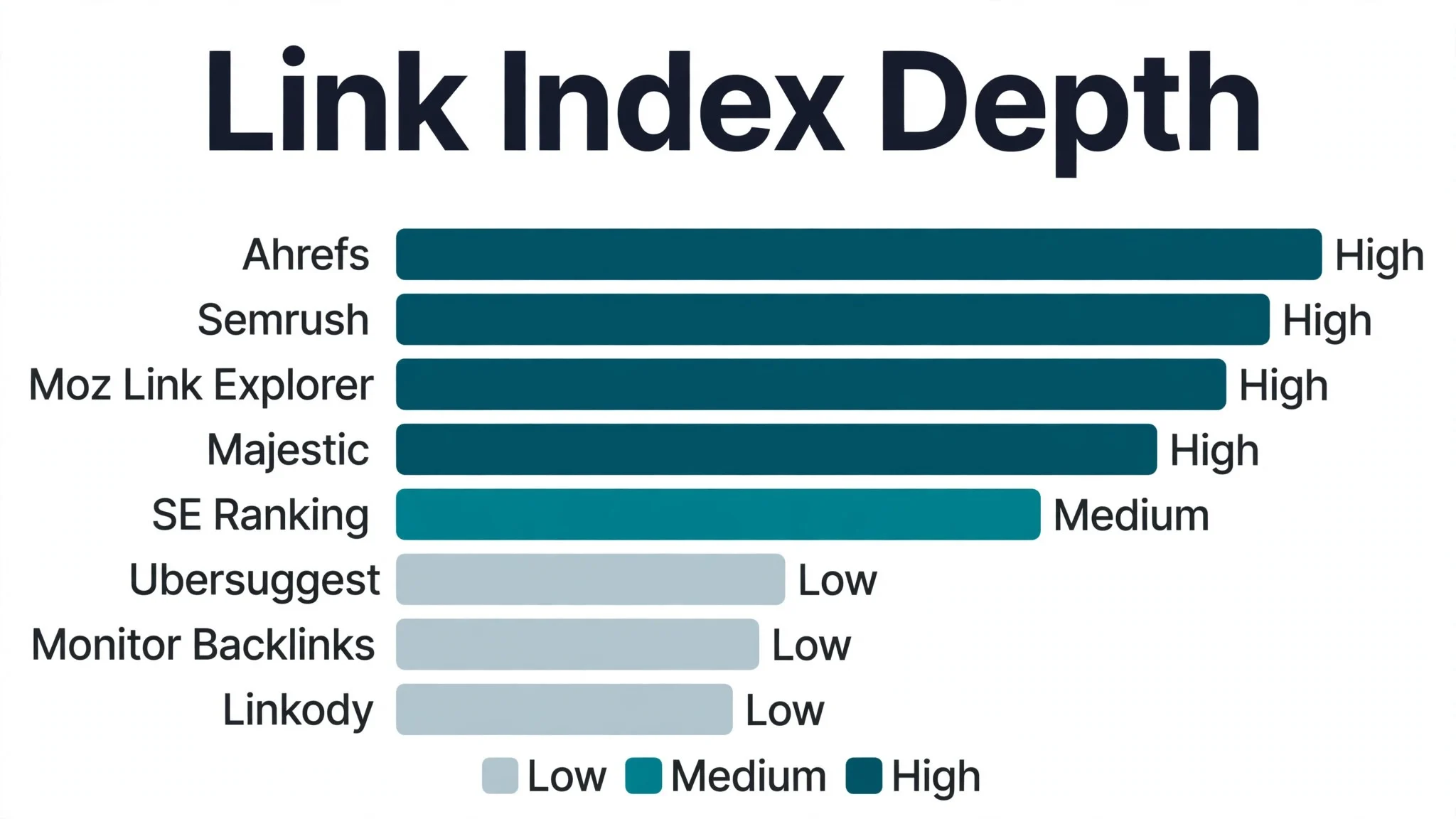
Index size is the first gap in this ranking, and it decides how much of your link profile you can actually see. Ahrefs and Semrush crawl the web constantly, so new links appear within days. Smaller indexes can take weeks to find the same link, and a link the tool never sees is a link you cannot act on.
Freshness matters more than raw size for a working SEO team, because a link gap is only useful while the rival still holds the link. Check the newest links to your own site in each tool and compare the dates with your memory. A tool that shows last month links as new is telling you its crawl is slow.
The honest test is a side-by-side count on your own domain, not the marketing number on the pricing page. Export the referring domains from two tools and compare the lists. The tool that finds the links you already know about, plus a few you missed, is the one to trust.
Small sites feel the index gap most, because a new domain earns few links and each one matters. A checker that misses half of a small profile gives a misleading picture of progress, while the same miss on a large site barely shows. If your site is young, index depth is worth paying for.
Five Link Building Mistakes That Waste Outreach
The first mistake is emailing sites that never link to anyone in your niche. A checker shows which domains link to your rivals, and those domains are the ones that might link to you. A cold list built from a search engine wastes most of its sends.
The second mistake is chasing quantity over quality. A hundred links from thin directories move a ranking less than five links from real sites in your field. Check the Trust Flow or spam score before sending, and drop any domain that looks built for links alone.
The third mistake is ignoring lost links. A strong link that disappears silently costs the ranking it once gave, and a team that never checks loses ground without knowing why. Set a weekly lost-link alert, and reclaim the good ones with a polite email to the site owner.
The fourth mistake is using the same anchor text everywhere. A profile with every link carrying the exact keyword looks manipulated, and Google treats it that way. Vary the anchors naturally, and let brand and URL anchors carry most of the weight.
How to Read a Backlink Report Without Getting Fooled
A backlink report looks simple on the surface, but three checks decide whether it is real. The first is the referring domain count, because ten links from one site count as one vote, not ten. A profile with a thousand links from fifty domains is weaker than a profile with three hundred links from two hundred domains.
The second check is the anchor mix. A natural profile has brand anchors, URL anchors, and generic phrases beside the keyword anchors. A profile where every anchor carries the money keyword is a sign of manipulation, whether yours or a rival.
The third check is the link context. A link inside a relevant article passes far more value than a link in a footer or a sidebar, and a checker that shows the linking page helps you judge it. Open the top ten linking pages and read them before deciding which links to chase.
The fourth check is the link velocity. A profile that gains fifty links in a week after gaining two a month looks bought, and Google notices the spike. Steady growth from real outreach beats a sudden burst every time, so spread the outreach across the month and let the links arrive naturally.
A Four-Week Link Audit Plan for a Small Site
Week one is the baseline, and it should be honest about the current profile. Export every referring domain, flag the spammy ones, and note the strongest ten links. A baseline built from real data beats a baseline built from hope every time.
Week two is the gap. Run the link gap against your top two rivals and list the domains that link to both of them but not to you. Those domains already link to your topic, which makes them the warmest outreach targets you will find.
Weeks three and four are the outreach and the check. Send personalised pitches to the gap domains, reclaim any lost links, and disavow the worst spam. A monthly audit that runs every month compounds, and the rankings follow the links.
Week four is the review, and it should be honest about what worked. Count the outreach emails sent, the replies received, and the links earned, then write down the lesson for next month. A review that measures the work keeps the next audit sharper.

Best Pick by Job
No single backlink checker fits every site, so each common SEO situation below is matched to the tool that scored highest for that job. The best backlink checkers for a solo blogger look different from the right pick for an agency running audits, and the table below makes that split clear.
| Job | Best pick | Why it wins |
|---|---|---|
| SEOs needing the deepest link data | Ahrefs | Huge live link index with fast crawls |
| SEOs wanting links plus full SEO suite | Semrush | Backlink tools inside a full marketing suite |
| SEOs trusting domain authority scores | Moz Link Explorer | Domain Authority with spam scoring |
| SEOs studying link quality deeply | Majestic | Trust Flow and Citation Flow analysis |
| Small teams wanting strong value | SE Ranking | Backlink checker with rank tracking at fair prices |
| Beginners checking backlinks cheaply | Ubersuggest | Simple backlink overview with keyword ideas |
| Site owners watching link changes | Monitor Backlinks | Alerts for new and lost backlinks |
| Small sites tracking links simply | Linkody | Simple link tracking with disavow tools |
If your situation does not match a row exactly, take the closest one and read that review first, starting with Ahrefs when it fits. The gap between neighbouring tools is smaller than the gap between a site that audits links monthly and one that never looks, so habit matters more than a few points on a scorecard.
Frequently Asked Questions
Site owners ask the same questions before every backlink checker change, so we answered the most common ones here.
How many backlinks does a small site need?
A small site needs links from real sites in its niche, not a target number. Fifty links from relevant domains can outrank five hundred from directories, because relevance and trust matter more than count. Build links from sites your readers already trust, and let the number follow.
Can I check backlinks for free?
You can check backlinks for free with Ubersuggest and the free tiers of the bigger tools, though the free views limit the number of domains and rows. A free check suits a quick audit of one site. A team running monthly outreach needs a paid plan for the full export.
How often should I audit my backlinks?
Audit your backlinks monthly, with a quick lost-link check every week. A monthly audit catches new spam and new opportunities while they are fresh, and a weekly alert catches a lost strong link before the ranking slips. Check the vendor site for current pricing before you pay for the tool that runs the audit.
Do backlinks still matter in 2026?
Backlinks still matter in 2026, because they remain one of the strongest signals that other sites trust your content. Content quality decides whether a page deserves to rank, and links decide how much Google trusts that judgment. A page needs both, and the links are the part a checker measures.
What happens to my data if I switch checkers later?
Every tool in this ranking exports link data to common formats, so a switch is possible but never painless. Saved projects and alert rules do not transfer, and the team must rebuild them in the new tool. Trial Ahrefs properly now instead of staying with a checker that no longer fits the way the team works.
Ahrefs Leads, and Your Next Link Audit Is the Real Test
A site owner can settle this in a trial by timing days to a first audit, counting the gap domains found in the first month, and measuring the links earned in the first quarter. The best backlink checkers prove themselves on the days to a first report, the share of gap domains that reply, and the referring domains gained in three months, and a four week trial with your real site will show all three. Ahrefs wins our ranking on the combined score, but the right tool for your site is the one your team audits with every month without being asked.
Run the trial on your real domain with your real rivals and your real outreach list, and judge the tool on the links found rather than the demo. If the gap report lists domains worth emailing and the fresh links appear fast, the system is working. If the index misses your newest links and the reports confuse you, the tool is fighting you rather than helping you. Pick the tool that makes link work feel easy, protect the monthly habit, and let the rankings pay for the subscription many times over.