


An agency that sends a client campaign to a dirty list is gambling with the client domain. Bounces climb, the sender reputation falls, and the next campaign lands in spam before a single subscriber has read it. A list that looked fine six months ago is full of dead addresses, typos, and spam traps today, and nobody notices until the deliverability report turns red. The best email verification tools for agencies clean that list before the send, so a campaign reaches real inboxes and the client domain stays safe. ZeroBounce leads this ranking on the combined score, with NeverBounce close behind for agencies that want fast bulk checks.
We judged each tool on real agency work rather than a feature list. That meant a client list of 50,000 addresses, a new lead list of 5,000, and a re-engagement campaign for a lapsed segment. We tracked how fast a list was checked, how accurate the results looked, and how much time the weekly list routine actually took. We also checked a known test list with good, bad, and risky addresses mixed in, so the accuracy scores rest on measured results rather than vendor claims.
ZeroBounce earns the top spot on accuracy, NeverBounce on bulk speed, and every tool after them on a strength of its own. Some are full verification platforms built for agencies that clean lists every week. Others are lighter tools that suit an agency fixing one list at a time. The right pick depends on your list size, your client count, and how much of the hygiene work you want the software to carry.
ZeroBounce tops the combined score, yet an agency that mostly verifies new leads should let the best pick by job table near the end carry equal weight. A tool that ranks fourth overall can still be the right answer for a small studio, while the overall winner can be too much for a team that only needs a monthly clean.
In this article
- The 8 Tools at a Glance
- Why the Best Email Verification Tools for Agencies Pay for Themselves
- How We Put Each Verification Tool Through Its Paces
- The 8 Tools in Detail
- Accuracy, Speed, and the Checks That Keep a List Clean
- Five List Hygiene Mistakes That Hurt Agency Deliverability
- A Four Week Plan to Clean a Client List
- What to Check in the Credit Model Before You Commit
- Best Pick by Job
- Frequently Asked Questions
- Why ZeroBounce Leads for Most Agencies
The 8 Tools at a Glance
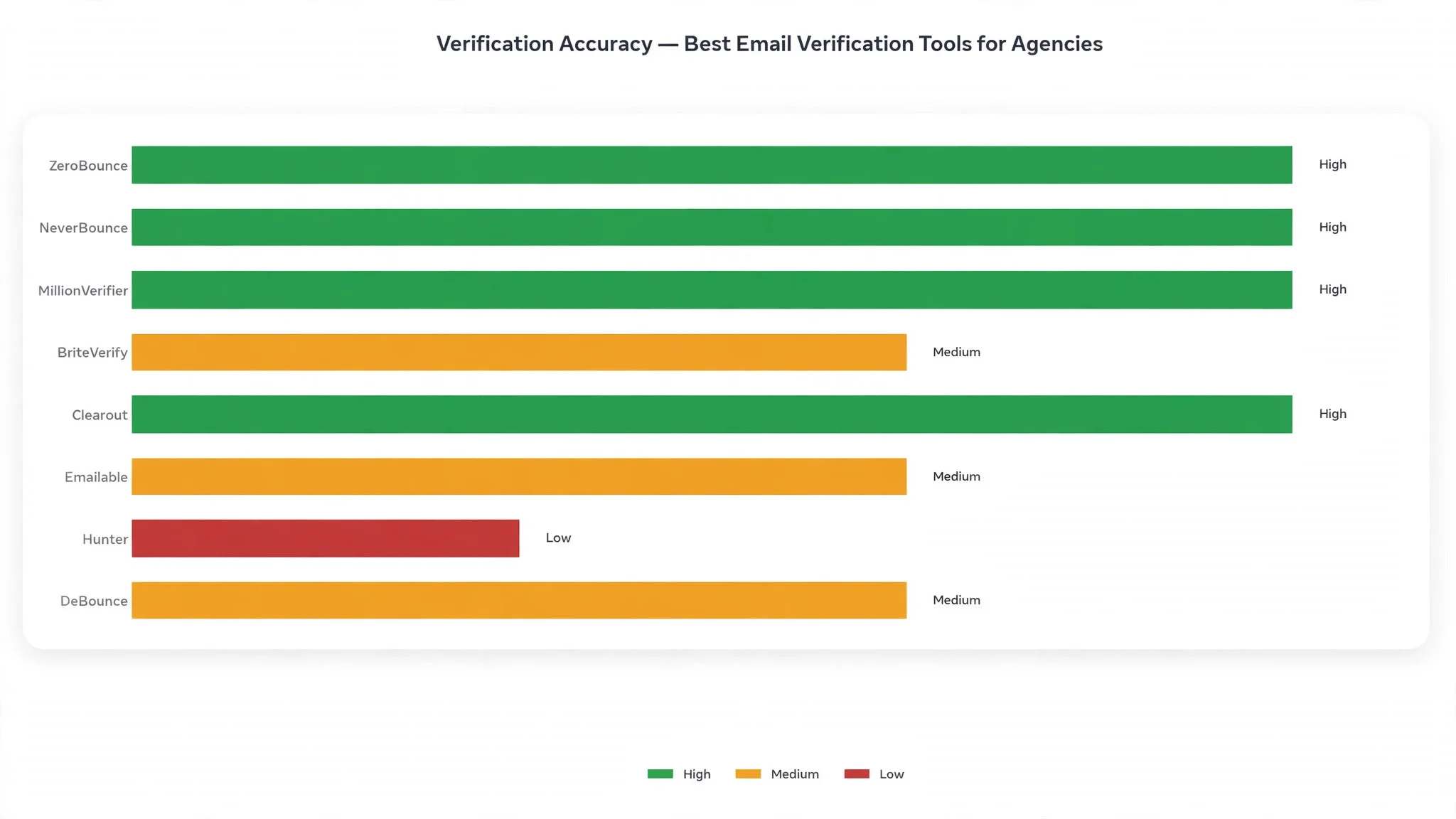
The table below puts one row per tool, with the price shape, the natural fit, and the strength that put ZeroBounce first. The best email verification tools for agencies are not always the most powerful, and the table shows why. ZeroBounce leads on accuracy, while MillionVerifier wins for agencies that want the lowest cost per check.
| Tool | Starting price | Best for | Standout strength |
|---|---|---|---|
| ZeroBounce | Free plan; paid plans on the vendor site | Agencies that need the highest accuracy | Deep checks with spam trap detection |
| NeverBounce | Pricing on the vendor site | Agencies cleaning large lists fast | Fast bulk verification with clean API |
| MillionVerifier | Pricing on the vendor site | Agencies watching the cost per check | Low prices with solid accuracy |
| BriteVerify | Pricing on the vendor site | Agencies verifying at the point of capture | Real-time checks with simple integration |
| Clearout | Free plan; paid plans on the vendor site | Agencies that want credits that roll over | Flexible credits with business checks |
| Emailable | Free plan; paid plans on the vendor site | Agencies that want simple bulk cleaning | Easy bulk uploads with clear results |
| Hunter | Free plan; paid plans on the vendor site | Agencies finding and verifying leads | Lead finding with built-in verification |
| DeBounce | Pricing on the vendor site | Agencies that want simple pay-as-you-go | Simple pricing with no monthly lock-in |
Narrow the table to ZeroBounce and NeverBounce, then read those two reviews to see which verification routine fits your agency. A tool that scores High on accuracy only helps if the results are easy to act on, and a tool that scores High on speed only helps if the checks are trustworthy. Fit to your list routine matters more than a long feature list, and the best email verification tools for agencies prove that fit in the first clean.
Why the Best Email Verification Tools for Agencies Pay for Themselves
A verification tool pays for itself in the same place, which is the campaign that reaches the inbox. A list with ten percent bad addresses loses a tenth of its sends to bounces, and the sender reputation damage costs far more than the verification, because the next campaign lands in spam for everyone. A tool that removes the bad addresses before the send hands that reach back, and the saving repeats with every campaign. The best email verification tools for agencies earn their keep here first, before any other feature matters.
The second reason is fewer blocked domains. Most agency losses are not dramatic. A client domain gets flagged after one bad send, the next three campaigns go to spam, and nobody knows why until the client complains. A platform that checks every list before it goes out catches these gaps before the domain is hurt.
Speed of response is the third reason. When a client asks whether a list is safe to send, an agency with a clean verification report answers in seconds. An agency working from guesswork has to argue the point, and the client is already doubting the campaign.
The fourth reason is evidence for the retainer. A tool that records every verification, every bounce rate, and every deliverability gain gives an agency real numbers for the next pitch. Guessing that lists are clean is very different from showing a report that proves it, and that proof is what wins the next contract.
The final reason is calmer teams. People do better work when the list is checked, the bounces are explained, and the send goes out without a last-minute panic. A clear verification report with a next step beats a pile of sticky notes, and the tools in this ranking all help a small team keep the workload honest.
How We Put Each Verification Tool Through Its Paces
We tested each verification tool against the same five measures, using a client list of 50,000, a new lead list of 5,000, and a re-engagement segment. Each tool ran the same workload for two weeks, so ZeroBounce and the rest compare like with like.
- Verification accuracy, judged by how well the results matched a known test list.
- Bulk check speed, measured by how fast 50,000 addresses were checked.
- Real-time checks, scored on whether a form could verify an address as it was typed.
- Result clarity, timed from a finished check to a list the team could act on.
- Daily usability, judged by how long the weekly list routine took and how often the team needed help.
Each measure carried equal weight except verification accuracy, which counted double, because a verification tool that calls bad addresses good is not doing its job. Scores run out of 100, and the order below follows the combined total, led by ZeroBounce on accuracy. Where two tools tied, we broke the tie on result clarity, since a careful tool protects the agency from lists nobody can act on.
We also checked the API workflow, because agency work moves fast. The best tools in this ranking let a developer verify addresses inside the agency system, while the weakest need a manual upload for anything beyond a file.
The 8 Tools in Detail
Each review below follows the same pattern, and every tool is judged on the same ground. We note what each tool does best, where it falls short, and the agency it suits best, with verification accuracy carrying the most weight.
1. ZeroBounce
ZeroBounce is the accuracy leader in this ranking, and it leads because it checks deeper than the rest. Syntax, domain, mailbox, spam trap, and abuse checks run on every address, and the scoring explains why an address is risky instead of just flagging it. For an agency that protects client domains, it is the natural standard.
The trade off is price shape. ZeroBounce is built for agencies with real list volume, so a tiny studio with one small list may find it dear. A team that invests in the platform gets a system that grows with it, but one cleaning a single list should start with the free credits.
In the trial, verify one client list and check the risky addresses by hand. Time how long the check takes, and ask whether the scoring explained the results clearly. A fast check and a report the team grasps mean the platform can carry your agency.
Our verdict. The most accurate verification here, and the best all rounder for agencies.
2. NeverBounce
NeverBounce is the bulk speed pick, and it earns second place by cleaning large lists fast. Fifty thousand addresses check in minutes, the API fits neatly into agency systems, and the results stay consistent across lists. The dashboard is clean and the pricing is simple.
The trade off is depth. NeverBounce is built for speed first, so an agency that needs the deepest spam trap detection may find ZeroBounce sharper. For an agency that cleans large lists every week, that speed is the reason to choose it.
In the trial, verify one large list and time the whole job. Watch whether the results matched your expectations, and whether the API integration was simple. Large lists verified on time with a simple API.
Our verdict. The fastest bulk verification here, ideal for agencies with big lists.
3. MillionVerifier
MillionVerifier is the value pick, and it earns third place with low prices and solid accuracy. The checks cover the essentials well, the bulk uploads are simple, and the cost per address stays low even on large lists. The free credits cover a real trial.
The trade off is the extras. MillionVerifier is built for price first, so an agency that needs deep scoring or abuse checks may find it lighter than the leaders. For an agency that watches every credit, that trade is worth making.
In the trial, verify one list and compare the cost with the leaders. Ask whether the accuracy held up, and whether the results were easy to act on. Accuracy held up at a lower cost than the leaders.
Our verdict. The best value per check here, ideal for agencies watching costs.
4. BriteVerify
BriteVerify is the real-time pick, and it suits agencies that verify at the point of capture. A form can check an address as the visitor types it, so bad addresses never enter the list at all. The integration is simple and the results arrive instantly.
The trade off is bulk depth. BriteVerify is built for real-time checks first, so an agency that needs deep bulk analysis may find it lighter than the leaders. For an agency whose lists grow through forms, that focus is exactly right.
In the trial, connect one form and test it with ten addresses, good and bad. See if the bad ones were caught instantly, and if the good ones passed without friction. Bad addresses got caught instantly and good ones passed smoothly.
Our verdict. The best real-time verification here, ideal for agencies that capture leads live.
5. Clearout
Clearout is the flexible credits pick, and it earns its place with credits that roll over and business checks. The verification covers the essentials well, the business email checks help B2B agencies, and the credits never expire in a rush. The interface stays friendly.
The trade off is brand depth. Clearout is a solid all rounder, so an agency that needs the deepest accuracy may find ZeroBounce sharper. For an agency that verifies in bursts rather than every week, the rolling credits are the reason to choose it.
In the trial, verify one list and check the business addresses separately. Ask whether the credits lasted, and whether the results read clearly. Clearout stretched credits well and results read clearly.
Our verdict. The most flexible credits here, ideal for agencies that verify in bursts.
6. Emailable
Emailable is the simple bulk pick, and it suits agencies that want easy bulk cleaning. Upload a file, watch the progress, and download a clean list with clear categories, all without a manual. The free credits cover a real trial.
The trade off is the extras. Emailable is built for simplicity first, so an agency that needs an API or deep scoring may find it lighter than the leaders. For an agency that cleans lists by hand each week, that simplicity is exactly right.
In the trial, upload one list and check the categories. Ask whether the risky addresses were explained, and whether the download was simple. Emailable explained risky addresses and downloaded the list simply.
Our verdict. The simplest bulk cleaning here, ideal for agencies that clean by hand.
7. Hunter
Hunter is the lead finding pick, and it earns its place by joining lead discovery with verification. An agency can find addresses for a target company, verify them in the same place, and build an outreach list without a second tool. The domain search is the best in this ranking.
The trade off is verification depth. Hunter is built for finding first, so an agency that needs the deepest bulk checks may find it lighter than the specialists. For an agency that builds lead lists from scratch, that combination is the reason to choose it.
In the trial, find and verify twenty addresses for one target company. Watch whether the addresses were real, and whether the verification caught the bad ones. Twenty addresses checked out and bad ones got caught.
Our verdict. The best find plus verify here, ideal for agencies building lead lists.
8. DeBounce
DeBounce is the pay-as-you-go pick, and it rounds out the ranking for agencies that want simple pricing with no monthly lock-in. Credits are bought as needed, the checks cover the essentials, and the API is straightforward. The setup stays quick.
The trade off is depth. DeBounce is lighter on advanced scoring than the leaders, so a growing agency will outgrow it. For a small agency that verifies occasionally, that lightness is a strength, because the team pays only for what it uses.
In the trial, verify one list with a small credit pack and check the results. Ask whether the accuracy held up, and whether the pricing stayed simple. A small credit pack verified the list cleanly.
Our verdict. The simplest pay-as-you-go here, ideal for small agencies that verify occasionally.
Accuracy, Speed, and the Checks That Keep a List Clean
A verification tool judges an address in layers, and the first is syntax. A typo in the domain, a missing @ sign, and a disposable address all fail fast, and a good tool catches them in seconds. The best email verification tools for agencies make these layers visible, because the agency needs to know why an address failed, not just that it did.
The second layer is the mailbox check. A tool that pings the mail server learns whether the mailbox exists, whether it accepts mail, and whether it is a catch-all that accepts everything. A catch-all result needs a human decision, because the tool cannot prove the address is real, and a careful agency treats those as risky rather than safe.
The third layer is the trap check. Spam traps are addresses that exist only to catch senders who buy lists, and sending to one can damage a domain for months. A tool that flags traps before the send protects the client domain, and that protection is worth more than any other feature.
The fourth layer is the score. A good tool does not just say valid or invalid, it explains the risk in plain language, so the agency can decide what to do with the grey area. A score that separates the clearly safe from the clearly bad saves the team from guessing, and the guessing is where most deliverability mistakes happen. Read the score definitions during the trial, because a score nobody understands is a score nobody uses.
Five List Hygiene Mistakes That Hurt Agency Deliverability
The first mistake is never cleaning a list. A list that was clean a year ago is dirty today, because people change jobs, abandon addresses, and close accounts. Clean every list before every send, not once a year.
The second mistake is trusting a purchased list. A list bought from a broker is full of traps and dead addresses, and no verification tool can make it safe. Build lists from real opt-ins, and verify them anyway.
The third mistake is ignoring the risky category. A verification result of “risky” is not a green light, and an agency that sends to risky addresses anyway is gambling with the client domain. Treat risky as no, unless the client confirms the address is real.
The fourth mistake is skipping the re-engagement check. A segment that has not opened in a year is a segment full of dead addresses, and sending to it hurts deliverability for the active subscribers too. Clean the lapsed segment first, then send to the engaged.
The fifth mistake is measuring opens instead of inbox placement. An open rate tells the agency nothing about the spam folder, while an inbox placement test shows where the mail actually landed. Test placement before judging a campaign.
A Four Week Plan to Clean a Client List
Week one is the audit, and it should be honest. Export the full list, check the size, and run a verification on a sample to see how dirty it really is. A honest audit beats a hopeful guess every time, because the bounce rate will tell the truth anyway.
Week two is the first clean. Verify the full list, remove the invalid and trap addresses, and segment the risky ones for a separate decision. Check the results the same week, and fix anything that looks wrong while the list is still small. A clean first list builds the habit that carries the whole routine.
Week three is the re-engagement. Send a short check-in to the lapsed segment, remove the ones that bounce, and keep the ones that reply. A re-engagement habit that runs every quarter compounds, and the list stays healthy.
Week four is the routine. Set a weekly verification slot, a shared results document, and a monthly deliverability report that shows every list and every bounce rate. A hygiene habit that runs every week compounds, and the client sees the value in the numbers.
After the first month, review the routine itself. Check which lists decay fastest, which clients send the dirtiest data, and whether the risky segment decisions were right. A routine that is reviewed monthly stays honest, while one that runs on autopilot drifts until a bad send reminds the team it exists.

What to Check in the Credit Model Before You Commit
A verification credit model looks simple on the surface, but three checks decide whether it is fair. The first is expiry. Credits that expire at the end of the month punish an agency that verifies in bursts, while credits that roll over reward it, so ask how long credits last before buying. A vendor that lets credits roll over is telling you it wants the agency to stay.
The second check is the duplicate rule. A tool that charges for every address, even the ones already verified, wastes credits on the same list twice, while one that only charges for new checks saves money every week. Ask whether re-checks cost credits, because that answer changes the bill.
The third check is the refund policy. A tool that refunds credits for unknown results is fairer than one that charges for every address regardless of the outcome. Read that clause before signing, because a vendor that charges for unknowns is charging for work it did not finish.
Best Pick by Job
No single verification tool fits every agency, so each common situation below is matched to the tool that scored highest for that job. A large agency looks different from a small studio, and the table below makes that split clear.
| Job | Best pick | Why it wins |
|---|---|---|
| Needs the highest accuracy | ZeroBounce | Deep checks with spam trap detection |
| Cleans large lists fast | NeverBounce | Fast bulk verification with clean API |
| Watches the cost per check | MillionVerifier | Low prices with solid accuracy |
| Verifies at the point of capture | BriteVerify | Real-time checks with simple integration |
| Verifies in bursts | Clearout | Flexible credits with business checks |
| Wants simple bulk cleaning | Emailable | Easy bulk uploads with clear results |
| Finds and verifies leads | Hunter | Lead finding with built-in verification |
| Verifies occasionally | DeBounce | Simple pricing with no monthly lock-in |
If your situation does not match a row exactly, take the closest one and read that review first, starting with ZeroBounce when it fits. The gap between neighbouring tools is smaller than the gap between a list that is clean and one that gets the client domain flagged, so habit matters more than a few points on a scorecard.
Frequently Asked Questions
Agency teams ask the same questions before every verification tool change, so we answered the most common ones here. The best email verification tools for agencies all handle the basics, and the answers below focus on the choices that actually change the outcome.
How much should an agency pay for email verification?
Most tools in this ranking charge per verification or per month, so an agency pays for the credits it uses plus any plan fee. Free credits cover small trials well, but the accuracy and trap detection that protect client domains usually sit on paid tiers. Check the vendor site for current pricing and confirm the total cost for your monthly volume before you pay, because per-check fees add up fast.
Can one tool handle bulk cleaning, real-time checks, and lead finding together?
It can handle all three, and most agencies prefer one system for the whole job. Bulk cleaning needs file uploads, real-time checks need an API, and lead finding needs a domain search, and the leaders cover all three well. Some agencies still pair a bulk specialist with a separate lead tool, which works fine when the list data stays in sync.
How long does it take to clean a client list?
A focused agency cleans a list of 50,000 addresses in a day if the file is ready. The delay usually comes from messy exports and undecided risky addresses, not from the tool. Export cleanly, verify the full list, and decide the risky segment the same day, because a list that waits is a list that decays.
Do these tools work for an agency with only one client?
They work, but the payoff comes from the weekly habit, not the headcount. An agency with one client still needs clean lists, safe sends, and a clear deliverability report. Start with the simplest tool that covers bulk cleaning, then move up when the client count grows.
What happens to our verification history if we switch tools later?
Every tool in this ranking exports verification results and lists to common formats, so a switch is possible but never painless. API integrations and alert rules do not transfer, and the team must rebuild them in the new tool. A switch is never painless, which is why an agency should trial ZeroBounce properly now instead of staying with a tool that no longer fits the way the team works.
Why ZeroBounce Leads for Most Agencies
An agency can settle this in a trial by timing days to a clean list, counting the bad addresses removed, and measuring deliverability in the first month. The best email verification tools for agencies prove themselves on the days to a clean list, the share of bad addresses caught before the send, and the deliverability gain found in the first month, and a four week trial with your real lists will show all three. ZeroBounce wins our ranking on the combined score, but the right tool for your agency is the one your team runs every week without being asked.
Run the trial on one real client list with your real addresses and your real campaign, and judge the tool on the first result rather than the demo. If the list cleans in a day and the bounce rate drops in the first send, the system is working. If the setup stalls and the report confuses the team, the tool is fighting you rather than helping you. Pick the tool that makes list hygiene feel easy, protect the weekly cleaning habit, and let the deliverability pay for the subscription many times over.