

An interview host can spend three hours cutting ums and cross-talk out of a waveform, or delete a sentence from a transcript and watch the audio follow. The waveform route gives total control, and for a sound designer it is still the right tool. The transcript route gives speed, and for a host who records two interviews a week, speed is the difference between publishing on schedule and publishing late. That is the choice the best podcast editing tools for interview hosts has to settle, and the 10 tools below settle it in 10 different ways.
That trade sits at the center of the this shortlist. Remote recording quality and transcript editing have become the two halves of the interview workflow, and the best tool for a show depends on which half costs the host more time. A show with remote guests loses episodes to bad connections, while a show with long interviews loses hours to editing.
We compared ten tools on the details that decide an interview show. Local recording quality, transcript editing, filler removal, separate tracks per guest, and the true monthly cost at real episode volume all matter more than a long feature list. Prices below come from vendor pages and recent comparisons checked in November 2026, priced for the best podcast editing tools for interview hosts at real volumes.
In this article
- The 10 Tools at a Glance
- Best Pick by Job
- How the best podcast editing tools for interview hosts Cut Editing Time in Half
- The 10 Tools in Detail
- Monthly Cost at Three Publishing Volumes
- Interview Editing Mistakes That Hurt a Show
- Your Interview Episode Workflow in Eight Steps
- Frequently Asked Questions
- The Pick for Most Interview Hosts, and the Runner-Up
The 10 Tools at a Glance
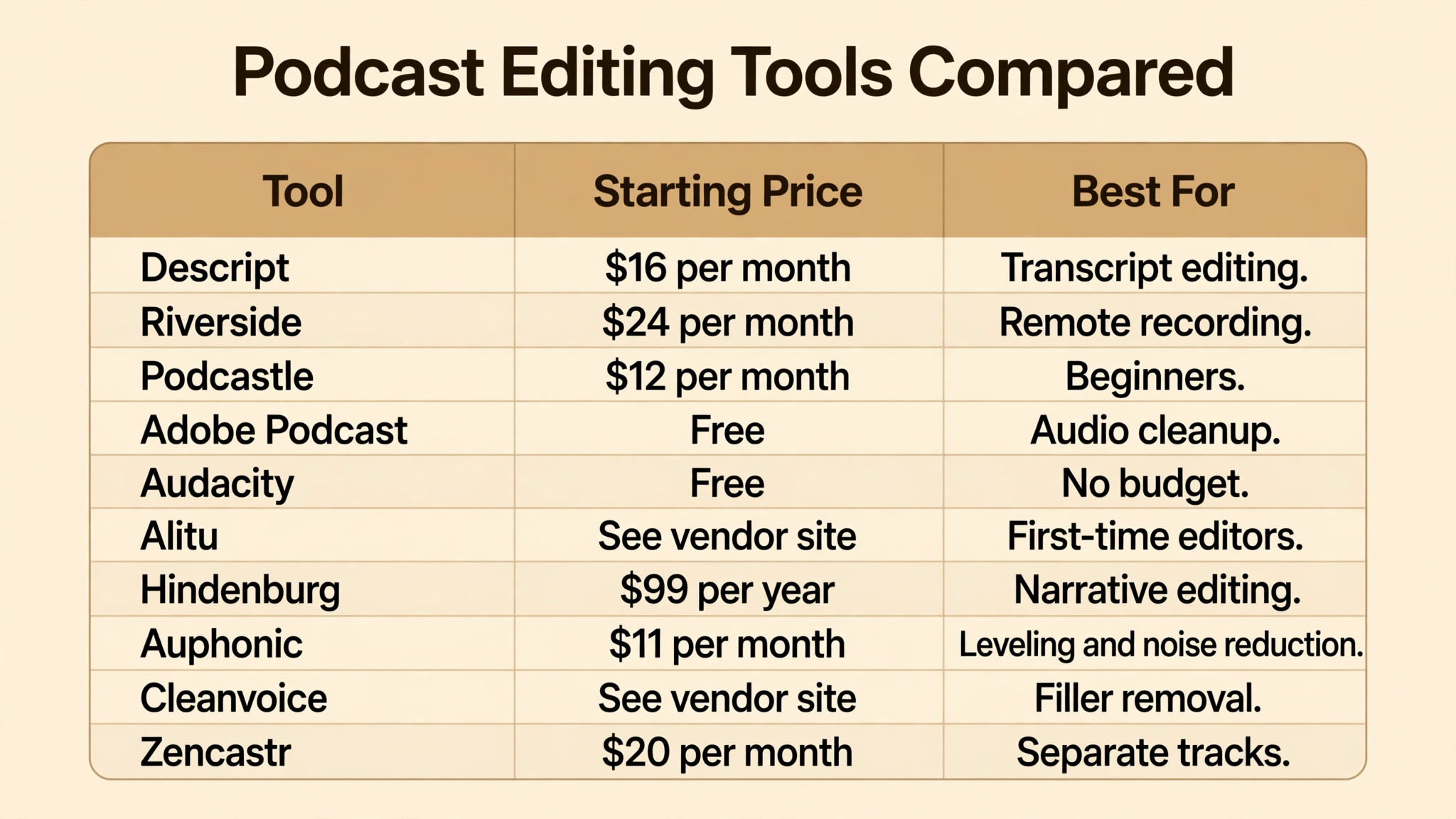
The table below lines up all ten tools on starting price and the interview job each one handles best. The best podcast editing tools for interview hosts ranges from free to about 24 dollars a month, so the cheapest option depends on how many episodes you publish.
| Tool | Starting price | Best for | Standout strength |
|---|---|---|---|
| Descript | Free plan, Hobbyist from about 16 dollars a month billed yearly | Editing audio by editing text | Descript changed podcast editing by making the transcript the timeline. |
| Riverside | Free plan, Pro from about 24 dollars a month billed yearly | Remote interviews in studio quality | Riverside solves the biggest problem in interview podcasting, which is guests on bad connections. |
| Podcastle | Free plan, paid from about 11.99 dollars a month | Beginners who want one simple tool | Podcastle is the all-in-one pick for beginners, covering recording, editing, and publishing in a single simple interface. |
| Adobe Podcast | Free tier available, premium pricing on the vendor site | Automatic cleanup of noisy audio | Adobe Podcast offers AI-powered audio enhancement that rescues recordings made in echoey rooms or on weak microphones. |
| Audacity | Free, open source | Free editing with no subscription | Audacity remains the best free podcast editor, now in version 4, handling recording and basic editing with no cost at all. |
| Alitu | Pricing on the vendor site | Hosts who have never edited audio | Alitu is built for hosts who have never edited audio. |
| Hindenburg | About 99 dollars a year for the PRO subscription | Narrative and interview editing with loudness standards | Hindenburg is a professional audio editor built for spoken word, with loudness normalization and a workflow designed for interviews and narrative shows. |
| Auphonic | Free credits available, paid plans from about 11 dollars a month | Automatic leveling and noise reduction | Auphonic is a web-based audio post-production service that levels volume, removes noise, and applies loudness standards automatically. |
| Cleanvoice | Pricing on the vendor site | Filler and mouth sound removal | Cleanvoice focuses on the small sounds that make an interview feel unpolished, removing filler words, stutters, and mouth sounds automatically. |
| Zencastr | From about 20 dollars a month | Remote recording with separate tracks | Zencastr records remote guests locally with separate tracks per speaker, and it adds AI editing and publishing tools on top of the recording. |
Best Pick by Job
Interview shows split by their biggest bottleneck, and the bottleneck decides the tool. The best podcast editing tools for interview hosts has a clear winner for transcript editing, remote recording, and beginners alike.
| Job | Pick | Why it wins |
|---|---|---|
| Editing long interviews by transcript | Descript | Delete text and the audio follows, with filler removal built in. |
| Remote guests on bad connections | Riverside | Local recording keeps quality high no matter the internet. |
| Beginners who want one simple tool | Podcastle | All-in-one recording and editing with a gentle learning curve. |
| Free editing with no subscription | Audacity | Full audio editing free, with no monthly bill at all. |
| Studio-quality remote video | Riverside | 4K local video with separate tracks per guest. |
| Automatic cleanup of noisy audio | Adobe Podcast | AI enhancement that rescues echoey recordings. |
How the best podcast editing tools for interview hosts Cut Editing Time in Half
Transcript editing changed interview production more than any other feature in the last five years. A host who once scrubbed through a waveform to find a rambling answer can now search the transcript for the phrase, delete the paragraph, and move on. Filler word removal works the same way, clearing ums and repeated words in one click instead of dozens of small cuts.
Local recording changed the other half of the job. When each guest records on their own device in full quality, a dropped connection no longer ruins the episode, and the host stops apologizing for audio that sounds like a phone call. The difference is audible in the first minute, and listeners notice it even when they cannot name the cause.
The two halves work best together, which is why many hosts now use one tool to record and another to edit. That split costs two subscriptions, so the decision is whether the combined workflow saves more hours than the second bill costs. For a weekly show, it usually does.
The 10 Tools in Detail
Each tool below was judged on the job it does best, its real price, and the point where it stops being the right choice for the best podcast editing tools for interview hosts. The headline price and the true cost are often two different numbers for the best podcast editing tools for interview hosts, so read the detail before you shortlist.
1. Descript
Descript changed podcast editing by making the transcript the timeline. Delete a sentence in the text and the audio is cut, rearrange paragraphs and the episode rearranges, and filler word removal clears ums in one click. Studio Sound cleans up echoey recordings, and Overdub lets you fix a flubbed line with your own cloned voice. That said, aI credits deplete fast on longer episodes, and the remote recording quality is decent but not at Riverside level. For a buyer comparing the best podcast editing tools for interview hosts, that combination of price and capability is the first thing to weigh.
Pricing starts at Free plan, Hobbyist from about 16 dollars a month billed yearly. Editing audio by editing text is the job it handles best, and that is the lens to judge it through. Before paying for Descript, run it on a real project from start to finish, since the handoff points between steps are where most tools either earn their price or lose it.
Choose Descript when pick Descript if editing long interviews is your biggest time cost. Look elsewhere if skip it if remote recording quality matters more than editing speed.
2. Riverside
Riverside solves the biggest problem in interview podcasting, which is guests on bad connections. Each participant records locally in the browser at up to 4K video and 48kHz audio, then uploads automatically, so a glitchy call never ruins the recording. The Pro plan includes text-based editing and Magic Clips for social highlights. The trade is clear. The editing tools trail Descript for transcript-led work, and higher tiers are needed for real production volume.
Pricing starts at Free plan, Pro from about 24 dollars a month billed yearly. Remote interviews in studio quality is the job it handles best, and that is the lens to judge it through. Trial Riverside for a week on real work before any annual commitment, because a week of daily use exposes the friction that a sales demo never shows.
Riverside fits when pick Riverside if your guests are remote and recording quality is non-negotiable. It fits less well if skip it if you record in person and need deep editing more than remote capture.
3. Podcastle
Podcastle is the all-in-one pick for beginners, covering recording, editing, and publishing in a single simple interface. It records guests locally, cleans up audio automatically, and now works under the Async name in some markets. The low entry price makes it the cheapest paid option here. The editing depth is thinner than Descript, and advanced hosts will outgrow the toolset as their show gets more complex.
Pricing starts at Free plan, paid from about 11.99 dollars a month. Beginners who want one simple tool is the job it handles best, and that is the lens to judge it through. A trial week with Podcastle on your own data answers the fit question faster than any feature table, and the answer is usually obvious by day three.
Pick Podcastle if pick Podcastle if you are starting out and want one tool that does everything simply. Skip it if skip it if you need deep transcript editing or advanced production features.
4. Adobe Podcast
Adobe Podcast offers AI-powered audio enhancement that rescues recordings made in echoey rooms or on weak microphones. The Enhance Speech feature is the strongest free cleanup tool in this category, and the web-based studio needs no installation. That said, the full editing workflow is thinner than Descript, and premium pricing is not published clearly, so budgeting takes a visit to the vendor site.
Pricing starts at Free tier available, premium pricing on the vendor site. Automatic cleanup of noisy audio is the job it handles best, and that is the lens to judge it through. Before paying for Adobe Podcast, run it on a real project from start to finish, since the handoff points between steps are where most tools either earn their price or lose it.
Choose Adobe Podcast when pick Adobe Podcast if your recordings need rescue and you want the best free cleanup. Look elsewhere if skip it if you need a complete editing and publishing workflow in one tool.
5. Audacity
Audacity remains the best free podcast editor, now in version 4, handling recording and basic editing with no cost at all. It is the tool most hosts learn first, and it covers multi-track editing, noise reduction, and leveling without a monthly bill. The trade is clear. It has no transcript editing, no AI cleanup, and no remote recording, so the workflow is entirely manual.
Pricing starts at Free, open source. Free editing with no subscription is the job it handles best, and that is the lens to judge it through. Trial Audacity for a week on real work before any annual commitment, because a week of daily use exposes the friction that a sales demo never shows.
Audacity fits when pick Audacity if your budget is zero and you edit by hand. It fits less well if skip it if you want transcript editing or remote guest recording.
6. Alitu
Alitu is built for hosts who have never edited audio. It automates noise removal and leveling, assembles the episode from your recordings, and publishes directly to your host. The guided workflow means a first episode can ship without learning a digital audio workstation. Pricing is not published on the vendor site, and the automation means less control for hosts who want to shape every cut.
Pricing for Alitu is listed on the vendor site, so confirm the current figure there before you commit. Hosts who have never edited audio is the job it handles best, and that is the lens to judge it through. A trial week with Alitu on your own data answers the fit question faster than any feature table, and the answer is usually obvious by day three.
Pick Alitu if pick Alitu if you want the simplest path from recording to published episode. Skip it if skip it if you want hands-on control of the edit.
7. Hindenburg
Hindenburg is a professional audio editor built for spoken word, with loudness normalization and a workflow designed for interviews and narrative shows. It suits hosts who care about broadcast loudness standards and want a dedicated audio tool rather than a browser app. That said, there is no transcript editing and no remote recording, so it covers only the editing half of the workflow.
Pricing starts at About 99 dollars a year for the PRO subscription. Narrative and interview editing with loudness standards is the job it handles best, and that is the lens to judge it through. Before paying for Hindenburg, run it on a real project from start to finish, since the handoff points between steps are where most tools either earn their price or lose it.
Choose Hindenburg when pick Hindenburg if you want a professional audio editor with loudness standards built in. Look elsewhere if skip it if you need remote recording or transcript editing.
8. Auphonic
Auphonic is a web-based audio post-production service that levels volume, removes noise, and applies loudness standards automatically. It works as a finishing step after editing, and it integrates with most podcast hosts for a hands-off publishing flow. The trade is clear. It is a processing service rather than an editor, so you still need a separate tool to cut the episode.
Pricing starts at Free credits available, paid plans from about 11 dollars a month. Automatic leveling and noise reduction is the job it handles best, and that is the lens to judge it through. Trial Auphonic for a week on real work before any annual commitment, because a week of daily use exposes the friction that a sales demo never shows.
Auphonic fits when pick Auphonic if you want automatic leveling and loudness correction on every episode. It fits less well if skip it if you need a full editor and not just a finishing service.
9. Cleanvoice
Cleanvoice focuses on the small sounds that make an interview feel unpolished, removing filler words, stutters, and mouth sounds automatically. It works as a cleanup pass before or after the main edit, and it handles multiple languages. Pricing is not published clearly, and the tool covers cleanup only, so it pairs with an editor rather than replacing one.
Pricing for Cleanvoice is listed on the vendor site, so confirm the current figure there before you commit. Filler and mouth sound removal is the job it handles best, and that is the lens to judge it through. A trial week with Cleanvoice on your own data answers the fit question faster than any feature table, and the answer is usually obvious by day three.
Pick Cleanvoice if pick Cleanvoice if filler and mouth sounds are your main editing burden. Skip it if skip it if you need a complete recording and editing workflow.
10. Zencastr
Zencastr records remote guests locally with separate tracks per speaker, and it adds AI editing and publishing tools on top of the recording. It is a solid alternative to Riverside for hosts who want local recording without the higher price. That said, the editing tools are newer and less deep than Descript, and the brand is smaller than the category leaders.
Pricing starts at From about 20 dollars a month. Remote recording with separate tracks is the job it handles best, and that is the lens to judge it through. Before paying for Zencastr, run it on a real project from start to finish, since the handoff points between steps are where most tools either earn their price or lose it.
Choose Zencastr when pick Zencastr if you want local remote recording at a lower price than Riverside. Look elsewhere if skip it if you need the deepest transcript editing available.
Monthly Cost at Three Publishing Volumes
The table below prices a host publishing at three volumes, so you can see where free tools stop being enough. The best podcast editing tools for interview hosts shows its widest gap here, because transcription hours and recording hours scale differently.
| Publishing volume | Descript Hobbyist | Riverside Pro | Audacity |
|---|---|---|---|
| 2 episodes a month, 1 hour each | About 16 dollars a month | About 24 dollars a month | Free |
| 4 episodes a month, 1 hour each | About 16 dollars a month | About 24 dollars a month | Free |
| 8 episodes a month, 1 hour each | About 24 dollars a month | About 29 dollars a month | Free |
| Transcription hours included | 10 hours a month | Text editing included | Not included |
| Video recording included | Yes, 1080p exports | Yes, 4K local recording | No |
Interview Editing Mistakes That Hurt a Show
An interview episode fails in specific ways, and the editing tool cannot fix a recording that was captured badly. The best podcast editing tools for interview hosts handles post-production, but these five mistakes happen before and during the recording.
Recording guests over a compressed call. A guest recorded through a compressed video call will always sound distant, no matter how much AI cleanup you apply. Use a tool that records each guest locally, and the episode will sound like a studio session instead of a phone call.
Cutting the guest instead of the ramble. Aggressive editing can remove the pause that makes an answer land, or cut a guest off mid-thought. Edit for clarity, not for speed, and listen to the cut at full length before publishing.
Publishing without separate tracks. When host and guest share one audio track, a cough, a dog, or a doorbell becomes part of the episode forever. Record separate tracks for every speaker, and noise on one track never touches the other.
Skipping the show notes. Listeners decide whether to press play from the title and the show notes, not from the audio. Write a short summary with timestamps for the best moments, and the episode will earn more plays.
Ignoring the video cut. Most interview shows now publish a video version, and a host who records audio only loses the YouTube audience entirely. Record video even if you publish audio first, so the video cut is ready when you need it.

Your Interview Episode Workflow in Eight Steps
Work through these eight steps in order, and the best podcast editing tools for interview hosts setup will hold up when the first real week arrives.
- Send the guest a one-page brief with the topics, the recording link, and the audio tips.
- Test the guest microphone and connection five minutes before the recording starts.
- Record each speaker on a separate track with local recording enabled.
- Transcribe the episode and cut the transcript before touching the waveform.
- Remove filler words in one pass, then listen to the full cut for awkward edits.
- Apply noise cleanup and leveling, and check the result on earbuds and a car speaker.
- Write show notes with timestamps for the three best moments in the episode.
- Publish the audio and the video cut together, and share the best clip on social media.
Frequently Asked Questions
What is the best podcast editing tool for interview hosts?
Descript is the best starting point for most interview hosts, because editing audio by editing text is faster than any waveform workflow for long conversations. Riverside is the better pick when remote guests and recording quality matter more than editing speed. Many hosts use Riverside to record and Descript to edit, accepting two subscriptions for a faster workflow.
How much does podcast editing software cost per month?
Entry prices run from free for Audacity and Adobe Podcast to about 16 dollars a month for Descript Hobbyist and 24 dollars a month for Riverside Pro. A host publishing four episodes a month can run on a single 16 to 24 dollar subscription, while a host who needs both recording and editing may pay 40 to 50 dollars a month for two tools. That is the honest range for the best podcast editing tools for interview hosts, and the right number inside it depends on volume and audience size.
Can I edit a podcast by editing the transcript?
Yes, and Descript invented the workflow. The tool transcribes the recording, and deleting a sentence in the transcript removes the matching audio. Rearranging paragraphs rearranges the episode, and filler word removal clears ums in one click. Riverside and Podcastle now offer text-based editing too, though Descript remains the deepest implementation.
Do I need separate audio tracks for each guest?
Yes, for any interview show. Separate tracks mean a cough or a barking dog on the guest track never touches the host track, and the editor can balance levels per speaker instead of compromising on a single mixed file. Riverside, Podcastle, and Zencastr all record separate tracks by default.
Is Audacity still good for podcast editing in 2026?
Yes, Audacity remains the best free podcast editor, now in version 4, and it handles recording and basic editing with no cost at all. It lacks transcript editing, AI cleanup, and remote recording, so it suits hosts who edit by hand and record locally. For a host starting with no budget, it is the right first tool.
How do I record remote guests in studio quality?
Use a tool that records each participant locally on their own device, like Riverside or Zencastr, so the audio is captured in full quality and uploaded in the background. A compressed video call recording will always sound worse, no matter how much cleanup you apply afterward. Test the guest connection before the interview, and ask the guest to wear headphones.
The Pick for Most Interview Hosts, and the Runner-Up
For most interview hosts, Descript is the pick that saves the most hours. Transcript editing, filler removal, and Studio Sound cleanup compress a three-hour edit into under an hour, and the Hobbyist plan at about 16 dollars a month covers a weekly show. Start with the free plan, edit one real episode, and time the difference before paying.
Riverside is the runner-up, and it wins outright when remote guests are the heart of the show. Local recording in 4K with separate tracks means a guest on a bad connection still sounds like a studio guest, and that quality is worth more than editing speed for an interview show. If your guests are remote and non-technical, take Riverside first.
One habit that saves hosts real time is editing the transcript the same day as the recording. The conversation is still fresh, so the cuts are faster and more confident, and the episode ships while the topic is still current. Waiting a week turns a one-hour edit into a two-hour rediscovery of what was said.
Guest preparation deserves a line in the workflow too. A one-page brief with the topics, the recording link, and two audio tips prevents most of the problems that editing cannot fix. Guests who know the plan relax faster, and relaxed guests give better answers.
Clip creation is the other half of the publishing job now. A tool that turns the best minute of an interview into a captioned social clip saves a separate editing session, and the clip often brings more new listeners than the episode itself. Check the clip features on your plan before you commit.
Finally, keep a backup recording. A local backup on the host machine costs nothing and saves the episode when the cloud recording fails. The best interview is the one that survives a dropped connection, a crashed browser, and a guest who forgets to press record.
One habit that saves hosts real time is recording a short backup on a second device. A phone on the desk, recording the room, costs nothing and saves the episode when the main recording fails. The backup audio will not match the studio quality, but a rescued episode always beats a lost one, and the guest will never know the difference if the backup is only used for a few minutes.
Show notes deserve the same care as the edit. A listener decides whether to press play from the title and the first two lines of the notes, not from the audio quality. Write a short summary that names the guest, the topic, and the single most useful moment, then add timestamps for the three best answers. That structure turns a casual browser into a listener.
Guest audio quality is the one variable the host cannot fix in editing. A guest on a laptop microphone in an echoey kitchen will sound distant no matter how much cleanup you apply, so the pre-recording check matters more than the post-production. Send the guest two simple tips, wear headphones and sit close to the microphone, and the episode will sound better before a single cut is made.
Clip creation is now half the publishing job. A sixty-second clip of the best answer, captioned and shared on social media, often brings more new listeners than the episode itself. Choose the clip while the conversation is fresh, and cut it from the same transcript you edited, so the work you already did pays twice.
Finally, keep the episode archive organized from the first show. Raw recordings, edited masters, show notes, and clips should sit in one folder per episode with a consistent name, because the day you need an old answer for a new episode, a clean archive saves an hour of searching. The habit costs minutes and pays back for the life of the show.