

A founder can run payroll from a spreadsheet for the first five hires, checking tax tables by hand and hoping nothing changes. Another founder pays a small monthly fee and lets the software file the taxes, issue the W-2s, and remind the team about time off. Both founders pay their people, but only one of them spends a Friday afternoon on payroll math. That is the choice the best payroll tools for startups has to settle, and the 8 tools below settle it in 8 different ways.
That gap is the decision behind the this shortlist. Payroll is the one business process where a mistake costs real money and real trust, because a wrong paycheck or a missed tax filing is visible to every employee on the same day. The software choice is really a choice about how much of that risk you keep on your own desk.
We compared eight tools on the details that decide payroll for a young company. Published pricing at real headcounts, tax filing coverage, contractor handling, benefits administration, and how the cost grows from five people to fifty all matter more than a long feature list. Prices below come from vendor pages and recent comparisons checked in November 2026, priced for the best payroll tools for startups at real volumes.
In this article
- The 8 Tools at a Glance
- Best Pick by Job
- What the best payroll tools for startups Actually Cost at Real Headcounts
- The 8 Tools in Detail
- Monthly Payroll Cost at Three Team Sizes
- Payroll Mistakes That Cost Startups Money and Trust
- Your First Payroll Run in Eight Steps
- Frequently Asked Questions
- The Pick for Most Startups, and the Runner-Up
The 8 Tools at a Glance
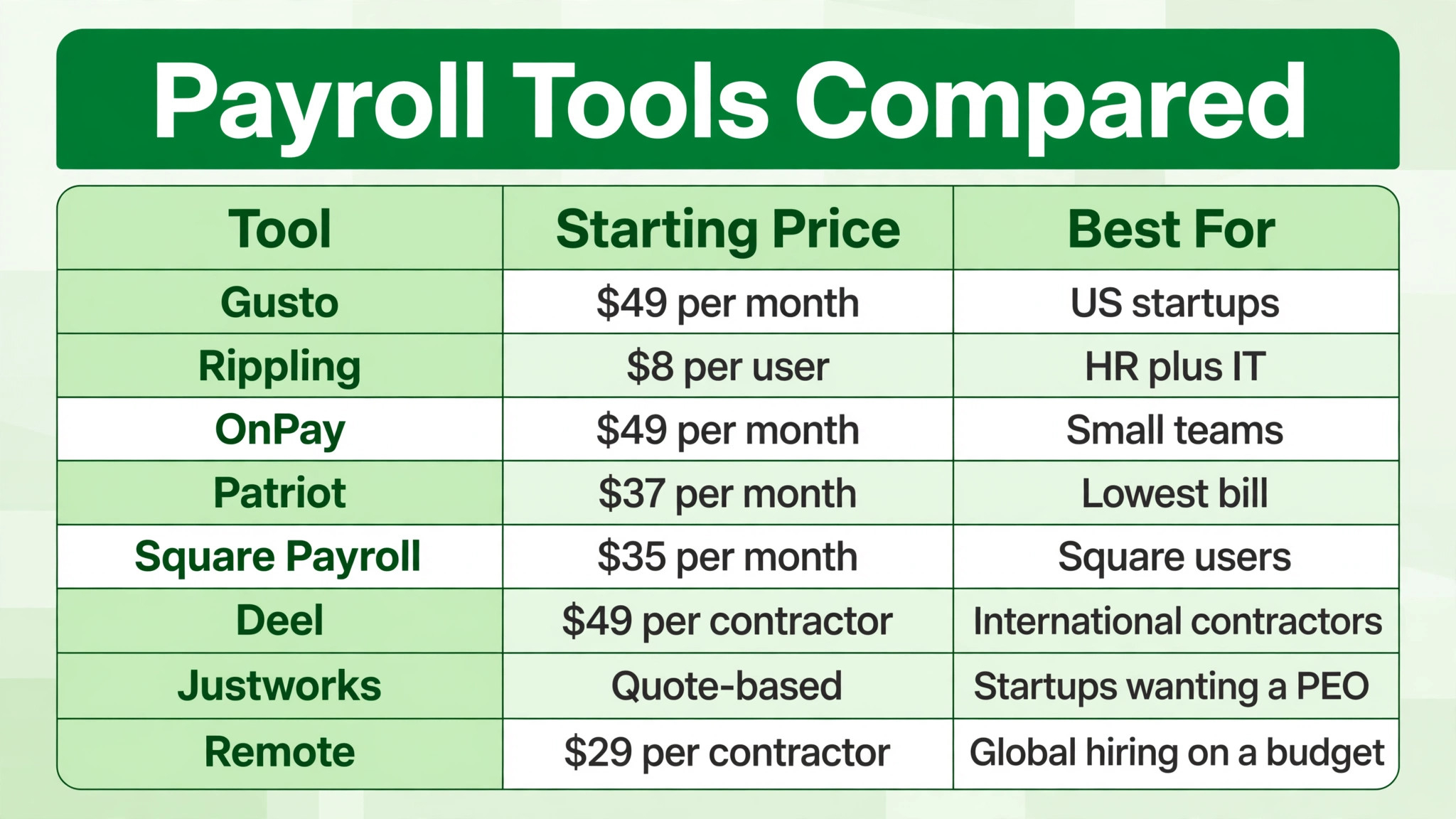
The table below lines up all eight tools on starting price and the payroll job each one handles best. The best payroll tools for startups ranges from about 35 dollars a month to quote-based enterprise pricing, so the cheapest option depends on headcount and location.
| Tool | Starting price | Best for | Standout strength |
|---|---|---|---|
| Gusto | Simple from 49 dollars a month plus 6 dollars per person | Most startups first payroll | Gusto is the default answer for US startups for a reason. |
| Rippling | From 8 dollars per user a month for the core, plus modules, quote-based | Payroll, HR, and IT in one system | Rippling treats payroll as one module in a larger employee system. |
| OnPay | From 49 dollars a month plus 6 dollars per worker | Small businesses that want payroll plus HR basics | OnPay covers full-service payroll with tax filing in all 50 states, plus HR basics like onboarding and time-off tracking. |
| Patriot | Full Service from 37 dollars a month plus 5 dollars per worker | Smallest honest monthly bill | Patriot Full Service is the cheapest full-service payroll on this list, at 37 dollars a month plus 5 dollars per worker, with tax filing included. |
| Square Payroll | From 35 dollars a month plus 6 dollars per person | Teams already running Square POS | Square Payroll is the pick for restaurants and shops already running Square point of sale, because tips and timecards sync automatically. |
| Deel | From 49 dollars per contractor a month, EOR from 599 dollars per employee a month | International contractors and global teams | Deel is the global-first payroll platform, with contractor management from 49 dollars per contractor a month and employer-of-record services for full-time hires abroad. |
| Justworks | Quote-based pricing on the vendor site | Startups that want a PEO | Justworks is a professional employer organization that handles payroll, benefits, and compliance through a co-employment model. |
| Remote | Contractor management from 29 dollars per contractor a month, EOR from 599 dollars per employee a month | Global hiring on a budget | Remote offers global contractor management from 29 dollars per contractor a month, which undercuts Deel, plus employer-of-record services for full-time international hires. |
Best Pick by Job
Payroll splits by stage and by where your team sits, and those two facts decide the tool. The best payroll tools for startups has a clear winner for US-only teams, global teams, and fast-growing companies alike.
| Job | Pick | Why it wins |
|---|---|---|
| US-only startup under 25 people | Gusto | Published pricing with full-service tax filing included. |
| Fast-growing startup consolidating HR and IT | Rippling | One employee record drives payroll, benefits, and devices. |
| Smallest honest monthly bill | Patriot | Lowest base fee with full-service tax filing. |
| Team already running Square POS | Square Payroll | Tips and timecards sync automatically from Square. |
| Mostly international contractors | Deel | Contractor management from 49 dollars per contractor a month. |
| Startup that wants a PEO | Justworks | Benefits and compliance handled through the PEO model. |
What the best payroll tools for startups Actually Cost at Real Headcounts
Payroll pricing looks simple on a vendor page and gets complicated the moment you count heads. A base fee plus a per-person charge means the same plan costs 79 dollars a month for five people and 349 dollars a month for fifty, and the jump between tiers can double the bill overnight. The honest way to compare is to price each tool at your headcount today and at the headcount you expect in a year.
Tax filing is the line that separates real payroll software from a calculator with a logo. Full-service filing means the vendor files federal, state, and local taxes on your behalf, issues W-2s and 1099s, and takes responsibility for the deadlines. Self-service plans look cheaper until the founder is the one filing, and a missed deadline costs more than a year of the price difference.
The other cost to model is the add-on stack. Benefits administration, time tracking, and multi-state payroll often sit behind a higher tier, so the entry price understates the real monthly bill. Price the tier you will actually need, not the tier the vendor advertises first.
The 8 Tools in Detail
Each tool below was judged on the job it does best, its real price, and the point where it stops being the right choice for the best payroll tools for startups. The headline price and the true cost are often two different numbers for the best payroll tools for startups, so read the detail before you shortlist.
1. Gusto
Gusto is the default answer for US startups for a reason. Pricing is public, signup is self-serve, and the Simple plan covers full-service payroll with automatic federal and state tax filing, W-2s and 1099s, direct deposit, and employee self-onboarding. A ten-person team pays 109 dollars a month, which is easy to budget. That said, simple is single-state, so multi-state startups need Plus at 80 dollars a month plus 12 dollars per person, and international payroll is an add-on. For a buyer comparing the best payroll tools for startups, that combination of price and capability is the first thing to weigh.
Pricing starts at Simple from 49 dollars a month plus 6 dollars per person. Most startups first payroll is the job it handles best, and that is the lens to judge it through. Before paying for Gusto, run it on a real project from start to finish, since the handoff points between steps are where most tools either earn their price or lose it.
Choose Gusto when pick Gusto if you are a US-only startup that wants payroll done right at a published price. Look elsewhere if skip it if your team is mostly international and you need a global-first platform.
2. Rippling
Rippling treats payroll as one module in a larger employee system. The same record that runs payroll also provisions laptops, manages app access, and administers benefits, so a new hire first day provisions itself. Payroll starts at about 35 dollars a month plus 12 dollars per employee, with unlimited runs and automatic tax filing. The trade is clear. The headline price understates the real cost, because the core platform, payroll, benefits, and IT modules stack to 20 to 50 dollars per user a month all-in, and the final number is a custom quote.
Pricing starts at From 8 dollars per user a month for the core, plus modules, quote-based. Payroll, HR, and IT in one system is the job it handles best, and that is the lens to judge it through. Trial Rippling for a week on real work before any annual commitment, because a week of daily use exposes the friction that a sales demo never shows.
Rippling fits when pick Rippling if you are growing fast and want HR, IT, and payroll on one record. It fits less well if skip it if you are under 25 people and the unified stack costs more than the admin it saves.
3. OnPay
OnPay covers full-service payroll with tax filing in all 50 states, plus HR basics like onboarding and time-off tracking. The price is honest and published, and the platform suits a startup that wants payroll done well without a large HR suite attached. The HR features are lighter than Gusto Plus, and the benefits administration is thinner than the PEO options.
Pricing starts at From 49 dollars a month plus 6 dollars per worker. Small businesses that want payroll plus HR basics is the job it handles best, and that is the lens to judge it through. A trial week with OnPay on your own data answers the fit question faster than any feature table, and the answer is usually obvious by day three.
Pick OnPay if pick OnPay if you want full-service payroll with straightforward pricing and light HR. Skip it if skip it if you need deep benefits administration or a unified IT stack.
4. Patriot
Patriot Full Service is the cheapest full-service payroll on this list, at 37 dollars a month plus 5 dollars per worker, with tax filing included. A ten-person team pays 87 dollars a month, which undercuts Gusto Simple while covering the same core filing work. That said, the interface is simpler and the HR extras are thinner, so a startup that wants onboarding, time tracking, and benefits in the same tool will need add-ons or a second product.
Pricing starts at Full Service from 37 dollars a month plus 5 dollars per worker. Smallest honest monthly bill is the job it handles best, and that is the lens to judge it through. Before paying for Patriot, run it on a real project from start to finish, since the handoff points between steps are where most tools either earn their price or lose it.
Choose Patriot when pick Patriot if the lowest honest monthly bill is your main criterion. Look elsewhere if skip it if you want a deeper HR suite alongside payroll.
5. Square Payroll
Square Payroll is the pick for restaurants and shops already running Square point of sale, because tips and timecards sync automatically. The payroll itself is full-service with tax filing, and the integration removes the manual step of moving hours from the till to the payroll run. The trade is clear. It is built around the Square ecosystem, so a startup that does not use Square POS gains little from the integration.
Pricing starts at From 35 dollars a month plus 6 dollars per person. Teams already running Square POS is the job it handles best, and that is the lens to judge it through. Trial Square Payroll for a week on real work before any annual commitment, because a week of daily use exposes the friction that a sales demo never shows.
Square Payroll fits when pick Square Payroll if your team already runs on Square and tips matter. It fits less well if skip it if you do not use Square and want a standalone payroll tool.
6. Deel
Deel is the global-first payroll platform, with contractor management from 49 dollars per contractor a month and employer-of-record services for full-time hires abroad. It handles local compliance, contracts, and payments in each country, which is work a US-first tool cannot do. US-only payroll is not its strength, and the per-contractor price adds up fast for a team with many international workers.
Pricing starts at From 49 dollars per contractor a month, EOR from 599 dollars per employee a month. International contractors and global teams is the job it handles best, and that is the lens to judge it through. A trial week with Deel on your own data answers the fit question faster than any feature table, and the answer is usually obvious by day three.
Pick Deel if pick Deel if much of your team sits outside the US. Skip it if skip it if your team is US-only and a domestic tool is cheaper.
7. Justworks
Justworks is a professional employer organization that handles payroll, benefits, and compliance through a co-employment model. A startup gets access to large-company health plans and a compliance team, which matters when benefits administration becomes a burden. That said, pricing is quote-based, so budgeting means a sales conversation, and the PEO model costs more than standalone payroll software.
Pricing for Justworks is quote-based, so the vendor site is the place to confirm the current figure. Startups that want a PEO is the job it handles best, and that is the lens to judge it through. Before paying for Justworks, run it on a real project from start to finish, since the handoff points between steps are where most tools either earn their price or lose it.
Choose Justworks when pick Justworks if benefits and compliance are your main payroll headache. Look elsewhere if skip it if you are under 25 people and standalone payroll covers your needs.
8. Remote
Remote offers global contractor management from 29 dollars per contractor a month, which undercuts Deel, plus employer-of-record services for full-time international hires. The platform covers contracts, compliance, and payments in each country, with a free HRIS for the core employee record. The trade is clear. The US payroll features are thinner than the domestic specialists, so a mixed team may need two systems.
Pricing starts at Contractor management from 29 dollars per contractor a month, EOR from 599 dollars per employee a month. Global hiring on a budget is the job it handles best, and that is the lens to judge it through. Trial Remote for a week on real work before any annual commitment, because a week of daily use exposes the friction that a sales demo never shows.
Remote fits when pick Remote if you hire internationally and want the lowest contractor price. It fits less well if skip it if your team is mostly US-based and a domestic tool fits better.
Monthly Payroll Cost at Three Team Sizes
The table below prices three tools at three headcounts, so the growth curve is visible before you commit. The best payroll tools for startups shows its widest gap here, because per-person pricing compounds as the team grows.
| Team size | Gusto Simple | Gusto Plus | Patriot Full Service |
|---|---|---|---|
| 5 employees | About 79 dollars a month | About 140 dollars a month | About 62 dollars a month |
| 10 employees | About 109 dollars a month | About 200 dollars a month | About 87 dollars a month |
| 25 employees | About 199 dollars a month | About 380 dollars a month | About 162 dollars a month |
| 50 employees | About 349 dollars a month | About 680 dollars a month | About 287 dollars a month |
| Tax filing included | Yes, full service | Yes, full service | Yes, full service |
| Contractor payments | Add-on, 120 plus countries | Add-on | Not included |
| Benefits administration | Plus tier and above | Premium tier | Add-on |
Payroll Mistakes That Cost Startups Money and Trust
Payroll errors are visible to every employee at once, which makes them the most expensive mistakes a startup can make. The best payroll tools for startups prevents most of them automatically, but these five errors still happen when the setup is rushed.
Choosing self-service to save twenty dollars. A self-service plan looks cheaper until the founder spends a Friday filing taxes by hand and misses a deadline. Full-service filing costs roughly 15 to 20 dollars more a month in base fee, and it is worth it for almost every startup.
Forgetting multi-state payroll. A remote hire in a second state needs tax filing in that state, and a single-state plan cannot do it. Check the state coverage before hiring remotely, not after the first paycheck is due.
Misclassifying contractors. Treating a contractor like an employee, or the reverse, creates tax and legal exposure that grows with every payment. Use the tool contractor classification features, and get advice before the first payment, not after an audit.
Ignoring the benefits deadline. Benefits enrollment has hard deadlines, and a missed one leaves an employee without coverage for a month. Set the enrollment reminders inside the payroll tool and confirm the employee completed them.
Paying late because approvals were manual. A payroll run that waits for a manual approval will eventually miss a payday. Automate the approval chain and set a calendar reminder two days before every run.
Hiring the first remote worker without checking state rules. A remote hire in a new state brings new tax registrations, new filing deadlines, and sometimes new benefits rules. Confirm the tool covers the state before the offer letter goes out, or the first paycheck will arrive late while the registration catches up.

Your First Payroll Run in Eight Steps
Work through these eight steps in order, and the best payroll tools for startups setup will hold up when the first real week arrives.
- Enter every employee with the correct tax state, pay rate, and start date.
- Confirm the tool files federal, state, and local taxes for every state you operate in.
- Set up direct deposit and run a test payment for one employee first.
- Add contractors separately with the correct classification and payment terms.
- Connect time tracking so hours flow into payroll without manual entry.
- Set benefits enrollment reminders and confirm each employee completes them.
- Schedule the payroll run two days before payday with an automatic approval chain.
- File the first W-2 and 1099 cycle early and confirm every employee received theirs.
Frequently Asked Questions
What is the best payroll tool for a startup with five employees?
Gusto Simple is the best pick for most US startups with five employees, at 49 dollars a month plus 6 dollars per person, which totals 79 dollars a month. It covers full-service payroll with automatic federal and state tax filing, W-2s and 1099s, direct deposit, and employee self-onboarding. Patriot Full Service is cheaper at 37 dollars a month plus 5 dollars per worker, and it suits a startup that wants the lowest honest bill.
How much does payroll software cost per month for a startup?
A startup with ten employees pays about 109 dollars a month on Gusto Simple, 87 dollars a month on Patriot Full Service, and 109 dollars a month on OnPay. The same team on Rippling costs substantially more once modules stack, because the 8 dollar per user headline covers only the core HR system. Budget 100 to 200 dollars a month for a ten-person US team on a published-price plan. That is the honest range for the best payroll tools for startups, and the right number inside it depends on volume and audience size.
Does Gusto or Rippling suit a startup better?
Gusto suits a US-only startup under 50 people that wants payroll and light HR at a published price, with signup that is self-serve and no sales call. Rippling suits a fast-growing startup that wants HR, IT, and payroll on one employee record, with devices and app access provisioned from the same profile. The price gap is large, so choose Rippling only when the unified stack saves real admin time.
Can payroll software handle international contractors?
Yes, and Deel is the specialist here, with contractor management from 49 dollars per contractor a month and employer-of-record services from 599 dollars per employee a month. Remote offers a similar service from 29 dollars per contractor a month. Gusto handles contractors in over 120 countries as an add-on, but a startup with a mostly international team should shortlist Deel or Remote first.
What is the difference between full-service and self-service payroll?
Full-service payroll means the vendor files your taxes, issues W-2s and 1099s, and takes responsibility for filing deadlines. Self-service means you file the taxes yourself using the software to calculate them. Full-service costs roughly 15 to 20 dollars more a month in base fee, and it is worth it for almost every startup, because a missed tax deadline costs more than the difference.
Do I need a PEO for my startup payroll?
A PEO like Justworks suits a startup that wants benefits and compliance handled through a co-employment model, with access to large-company health plans. It costs more than standalone payroll software, and the value shows when benefits administration becomes a real burden. Most startups under 25 people do fine with Gusto or Patriot, and move to a PEO when benefits become the main payroll headache.
The Pick for Most Startups, and the Runner-Up
For most US startups, Gusto is the pick that holds up from the first hire to the fiftieth. Published pricing, full-service tax filing, and a self-serve signup mean a founder can run payroll in an afternoon without a sales call. Start on Simple, and move to Plus when multi-state payroll or time tracking becomes necessary.
Rippling is the runner-up, and it wins outright when the startup is growing fast enough that HR, IT, and payroll need one employee record. A new hire whose laptop, app access, benefits, and payroll all provision from a single profile saves hours every week, and that saving is worth the higher price once the team passes 50 people. Below that size, Gusto is the better spend.
One detail worth checking before you choose is the cancellation policy. Some payroll vendors lock you into an annual contract, while Gusto and Patriot run month to month with no long commitment. A startup that might pivot, shrink, or change structure should avoid a contract that charges for a year of payroll it no longer needs.
Implementation time is another quiet differentiator. Gusto can be live in an afternoon for a small team, while Rippling and the PEO options need a guided setup that takes days or weeks. If your first payday is next Friday, that difference decides the shortlist before any feature comparison.
Contractor payments deserve a separate line in your comparison. Some tools charge per contractor paid each month, while others include a set number of contractors in the base price. A startup with ten contractors and five employees pays a very different bill depending on which rule applies.
Finally, keep the payroll records clean from day one. Every pay change, every bonus, and every contractor payment should sit in the same system with a date and a reason, because the first audit, the first tax question, and the first employee dispute all start with the same request, which is to show the records.
One decision that saves founders real money is running payroll on the same day every cycle. A fixed payday, with the run scheduled two days before, turns payroll from a monthly scramble into a routine that the team can plan around. Employees notice the consistency, and the founder stops spending the day before payday chasing approvals and fixing last-minute changes.
Time tracking is the add-on that pays for itself fastest. A team that tracks hours in the same tool as payroll never retypes a timesheet, and the payroll run pulls the hours directly without a manual step. The errors that creep in from retyping, a missed hour here and a wrong rate there, disappear, and the payroll run takes minutes instead of an afternoon.
Benefits enrollment is the deadline that catches startups by surprise. Open enrollment has a hard close, and an employee who misses it waits months for another chance. Set the reminder inside the payroll tool, send a second reminder a week before the close, and confirm each employee completed the enrollment. The cost of a missed enrollment is an unhappy employee and a compliance headache.
Contractor payments deserve a separate line in the monthly review. A contractor paid late will remember it longer than an employee paid late, because the contractor has no loyalty to the company beyond the next invoice. Pay contractors on the agreed date, keep the payment record in the same system as payroll, and the relationship stays professional.
Finally, keep a simple payroll calendar that the whole team can see. Paydays, tax filing dates, benefits deadlines, and review dates on one shared calendar mean no one is surprised by a date. The calendar costs an hour to build and saves a dozen urgent messages a year, which is a good trade for any founder.
One more detail worth checking is how the tool handles a pay correction. A wrong amount caught after the run needs a fix that reaches the employee quickly, without a second full payroll cycle. Ask each vendor how a correction works, and test it with a small amount during the trial, because the answer matters the first time a mistake happens.