


Retirement planning rewards people who start with a clear picture of where they stand. A good tool turns scattered accounts, rough guesses about spending, and vague ideas about a retirement date into one readable plan. The top 10 retirement tools in this guide do that job in different ways, from full brokerage platforms with planning built in to automated services that manage the portfolio for you. Fidelity leads the ranking on the combined score, while Vanguard wins for investors who want low costs above all else.
We tested each tool the way a real saver would use it. That meant opening an account view, entering income and savings, setting a target retirement age, and checking how the plan changes when the numbers move. We looked at whether the advice felt specific to the person using it or generic enough to fit anyone. The ranking weighs clarity of the plan, quality of the guidance, and how much work the tool does on its own.
Fidelity earns its place on planning depth, Vanguard on low-cost funds, and the rest on strengths of their own. Some are full brokerages where retirement is one part of a wider investing life. Others are focused planners that answer one question well, which is whether you are on track. The right pick depends on how much money you have saved, how much help you want, and whether you prefer to manage investments yourself.
Fidelity leads the combined score, yet a saver choosing between two close rivals will find the best pick by job table near the end clearer than the overall order. A tool that ranks fourth overall can still be the right answer for someone who wants everything automated, just as the overall winner can be wrong for someone who only needs a simple check on their progress. Read the whole guide, then match the tool to your situation, not to the rank.
In this article
- The 10 Tools at a Glance
- Why the Top 10 Retirement Tools Are Worth a Closer Look
- How We Put Each Retirement Tool Through Its Paces
- The 10 Tools in Detail
- How to Match the Tool to Your Savings Stage
- Mistakes That Quietly Shrink a Retirement Plan
- Best Pick by Job
- Frequently Asked Questions
- The Decision That Pays for Decades
The 10 Tools at a Glance
The table below puts one row per tool, with the price shape, the natural fit for a saver, and the strength that put Fidelity first. The top 10 retirement tools are not all built for the same person, and the table shows why. Fidelity leads on planning depth and research, while Betterment wins for savers who want the portfolio managed for them.
| Tool | Starting price | Best for | Standout strength |
|---|---|---|---|
| Fidelity | Free plan; paid plans on the vendor site | Savers who want deep planning and research | Planning tools with broad investment choice |
| Vanguard | Free plan; paid plans on the vendor site | Cost-conscious long-term investors | Low-cost funds and solid retirement guidance |
| Charles Schwab | Free plan; paid plans on the vendor site | Investors who want service plus planning | Strong support with wide account choice |
| Empower | Free plan; paid plans on the vendor site | People tracking many accounts in one place | Free dashboard with full net worth view |
| Betterment | Free plan; paid plans on the vendor site | Hands-off savers who want automation | Automated portfolios with goal tracking |
| Wealthfront | Free plan; paid plans on the vendor site | Savers who like automation and cash features | Automated investing with strong cash account |
| SoFi | Free plan; paid plans on the vendor site | Younger savers starting from a small base | Simple app with learning and banking built in |
| T. Rowe Price | Free plan; paid plans on the vendor site | Investors who value active fund management | Respected target-date funds and guidance |
| Merrill | Free plan; paid plans on the vendor site | Bank customers who want investing in one place | Tied-in banking with guided portfolios |
| E*TRADE | Free plan; paid plans on the vendor site | Self-directed investors who trade often | Flexible trading with planning calculators |
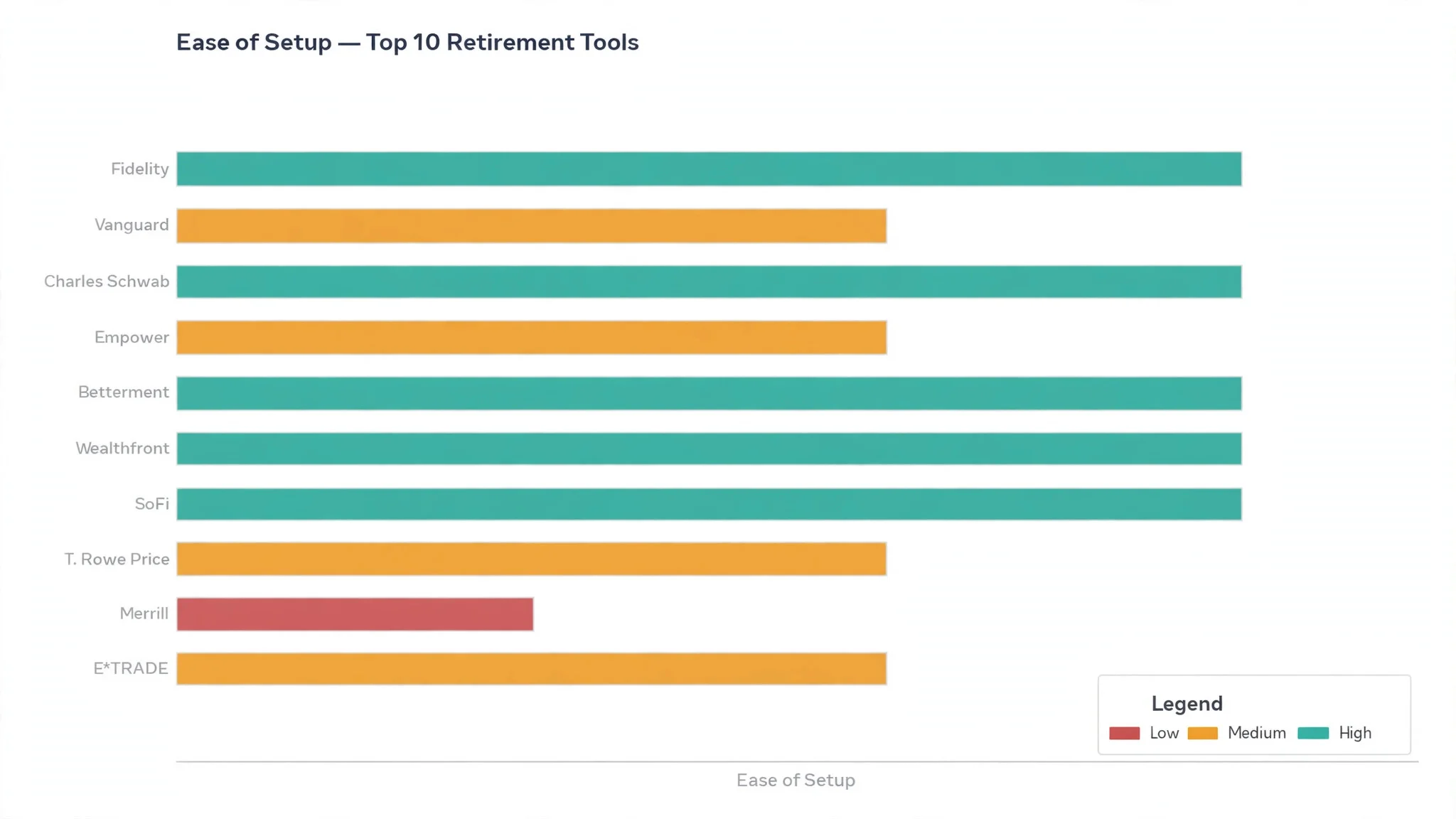
Fidelity and Vanguard are the two rows a saver should compare first, so read their reviews and see which saving habit fits your retirement plan. A tool that scores High on automation is only useful if you trust it enough to leave the portfolio alone, and a tool that scores High on planning is only useful if you open the plan more than once a year. Fit to your habits matters more than a long feature list.
Why the Top 10 Retirement Tools Are Worth a Closer Look
The top 10 retirement tools matter because most people guess at their retirement number instead of working it out. A saver who puts aside money each month without a target has no way to know whether the amount is enough. A planning tool replaces that guess with a number built from real income, real spending, and a real retirement date, and that number changes how people save.
The second reason is that small changes early beat big changes late. Raising a contribution by a small amount in your forties can matter more than a large catch-up in your late fifties, because the earlier money has more years to grow. A tool that shows this gap in plain figures gives a saver a reason to act now instead of next year.
A third reason is tax and account choice. The difference between a traditional account, a Roth account, and a taxable account can change what a saver keeps in retirement by a large amount over decades. The better tools in this ranking explain that choice in plain language and show how each account type fits the plan, instead of leaving the saver to work it out alone.
The fourth reason is that retirement plans drift. Markets move, salaries change, and life adds costs nobody planned for. A tool that updates the plan when the numbers change keeps the saver honest about where they stand. Without that check, a plan made five years ago can quietly go stale while the saver believes everything is on track.
The final reason is peace of mind. Retirement is a long horizon, and worry grows when the picture is unclear. A clear dashboard with a progress score, a projected monthly income, and a short list of next steps turns a vague fear into a manageable task. That clarity is what the tools in this ranking are really selling.
How We Put Each Retirement Tool Through Its Paces
We tested the top 10 retirement tools against the same five measures, using a saver aged forty-five with a mid-range salary, two existing accounts, and a target retirement age of sixty-five. Each tool ran the same saver profile, so Fidelity and the rest compare like with like.
- Planning depth, judged by how specific the retirement projection felt and whether it used real spending and income figures.
- Guidance quality, measured by whether the advice named concrete next steps instead of general tips.
- Ease of use, scored on how quickly a new saver could build a plan without help or training.
- Cost clarity, judged by how openly the tool showed fees and what the saver would actually pay.
- Ongoing tracking, measured by how well the tool kept the plan current as balances and goals changed.
Each measure carried equal weight except planning depth, which counted double, because a retirement tool that cannot show a believable projection is not doing its job. Scores run out of 100, and the order below follows the combined total, led by Fidelity on planning depth. Where two tools tied, we broke the tie on guidance quality, since specific advice is what turns a projection into action.
We also checked the mobile experience, because most savers check progress on a phone rather than a desktop. The best tools in this ranking let a saver see the plan, the progress score, and the next step in under a minute, while the weakest need a desktop for anything beyond a balance check.
The 10 Tools in Detail
Each review below follows the same pattern for Fidelity, and Vanguard is judged on the same ground. We note what each tool does best, where it falls short, and the saver it suits best, with planning depth carrying the most weight.
1. Fidelity
Fidelity is the deepest planning platform in this ranking, and it leads because its tools answer the questions savers actually ask. The top 10 retirement tools need that depth first, and Fidelity delivers it with income projections, a retirement score, and calculators that test what happens if you retire earlier or save more. The fund and account choice is wide, so a saver rarely outgrows the platform.
The trade off is that the breadth can overwhelm a beginner. There are many menus, many fund choices, and many reports, and a first-time saver may need an hour to find the planning view that matters. Support is strong, with phone help and local branches in many areas, which softens that learning curve for people who ask for guidance.
In the trial, we built a plan with a target age of sixty-five, then moved the date five years earlier to see how the projection changed. The tool showed the income gap clearly and suggested a higher monthly contribution to close it. If you want one place that handles planning, investing, and advice together, this is the strongest pick here.
Our verdict. The deepest planning here, and the best all rounder for most savers.
2. Vanguard
Vanguard is the low-cost specialist, and it earns second place by keeping fees down over decades. Its index funds and target-date funds are among the cheapest ways to hold a diversified retirement portfolio, and the planning tools give a clear read on whether you are on track. For a saver who believes costs matter more than features, it is hard to beat.
The trade off is a plainer experience. The website and app feel dated next to Fidelity, and the planning tools cover the basics without the depth of the leader. Customer service is solid but can be slower at busy times, so a saver who wants quick answers may notice the difference.
In the trial, we opened a target-date fund view and checked the projected income at sixty-five, then compared the fee figure with the same holding elsewhere. The saving was small each year but large over thirty years. If low cost is your first filter, this is the pick that rewards patience.
Our verdict. The cheapest long-term route here, ideal for patient index investors.
3. Charles Schwab
Charles Schwab is the service-first brokerage, and it earns third place by pairing solid planning with help that is easy to reach. Its retirement calculators are clear, its account choice covers the main retirement types, and its support team answers the phone around the clock. Savers who want a human to talk to will feel at home here.
The trade off is that the planning tools are good rather than great. They cover the standard questions well but go less deep than Fidelity on income scenarios and withdrawal planning. The fund range is wide, though the best low-cost options need a little digging to find among the larger menu.
In the trial, we called support with a question about contribution limits and got a clear answer in minutes. We then built a basic plan and checked the projected income figure. If you value being able to reach a person quickly, this is a strong choice.
Our verdict. The best human support here, ideal for savers who want help on call.
4. Empower
Empower is the dashboard specialist, and it earns its place by showing the whole financial picture in one free view. It links bank accounts, investment accounts, and debts, then shows net worth, spending, and retirement progress together. That single view is genuinely useful for a saver with accounts spread across several firms.
The trade off is that the free dashboard comes with sales calls. Empower offers paid wealth management, and users of the free tools should expect to hear about it. The planning features are strong for tracking, but the advice side is thinner than the brokerages above unless you pay for the managed service.
In the trial, we linked three accounts and watched the retirement projection update as balances changed. The picture was clear and the progress score moved sensibly with each change. If your accounts live in several places, this is the best free way to see them together.
Our verdict. The best free overview here, ideal for savers with scattered accounts.
5. Betterment
Betterment is the automation specialist, and it suits savers who want the portfolio managed without daily decisions. You set a goal and a retirement date, and it builds a diversified portfolio, rebalances it, and adjusts the mix as retirement nears. The goal tracking shows progress in plain terms, which keeps saving on track.
The trade off is control. A saver who wants to pick individual funds or hold a specific stock will feel boxed in, because the portfolios are built from a set menu. The management fee is modest but real, and over decades it adds up next to a do-it-yourself index portfolio.
In the trial, we set a retirement goal and watched the tool suggest a monthly deposit to reach it, then checked how the portfolio mix shifted when we moved the date earlier. The guidance was clear and the interface stayed simple. If you want to set a goal and let the tool do the work, this is the pick.
Our verdict. The smoothest automation here, ideal for hands-off savers.
6. Wealthfront
Wealthfront is the automation-first platform with a strong cash side, and it fits savers who like technology to handle the details. Its retirement planning builds a goal-based portfolio, handles rebalancing and tax-loss harvesting where available, and pairs investing with a cash account that pays a competitive yield. The whole experience feels modern and fast.
The trade off is the lack of human advice at the standard level. There is no phone line for planning questions, so a saver with a tricky tax or withdrawal question must rely on the help centre. The planning is also goal-based rather than deeply scenario-driven, so complex situations may need a separate adviser.
In the trial, we built a retirement goal, linked an outside account, and checked the projected outcome under different contribution levels. The numbers updated quickly and the cash account sat beside the investing view. If you like a clean automated setup, this is a strong option.
Our verdict. The cleanest automated setup here, ideal for tech-comfortable savers.
7. SoFi
SoFi is the friendly starting point, and it suits younger savers building their first retirement habit. The app is simple, the learning content is genuinely readable, and banking, investing, and retirement accounts sit in one place. A saver starting from a small base can open an account and begin without feeling lost.
The trade off is depth. The planning tools cover the basics but do not go far on income scenarios, withdrawal strategy, or tax planning. Serious investors with larger balances will outgrow it, and the fund choice is narrower than the big brokerages above.
In the trial, we opened a retirement account, set a monthly contribution, and read the built-in guides on contribution limits. Everything took minutes and nothing felt intimidating. If you are starting out and want a gentle first step, this is the right door.
Our verdict. The easiest first step here, ideal for new savers.
8. T. Rowe Price
T. Rowe Price is the active management house, and it earns its place on the strength of its target-date funds and research. Its retirement funds are widely used in workplace plans, and the planning tools give a steady read on progress with guidance that reflects decades of fund management experience. Savers who trust active management will find a lot to like.
The trade off is cost and a narrower platform. Expense ratios run higher than index rivals, and the brokerage side is thinner than Fidelity or Schwab, so a saver who wants to hold many different investments may feel limited. The website is functional rather than polished.
In the trial, we reviewed a target-date fund holding, checked its glide path toward retirement, and read the planning guidance on withdrawal order. The material was careful and well written. If you want a respected active manager running the fund, this is the pick.
Our verdict. The strongest active funds here, ideal for target-date investors.
9. Merrill
Merrill is the bank-tied option, and it suits savers who already bank with Bank of America and want investing in the same place. Guided portfolios handle the investment decisions, the banking link makes moving money simple, and the rewards programme can add value for customers who hold balances across both sides. For a loyal bank customer, the convenience is real.
The trade off is that the best features reward larger balances, and the guided portfolios carry fees that beat a do-it-yourself index approach. The self-directed side is capable but not as deep on planning as the leaders, so a saver who wants the richest calculators should look higher in this ranking.
In the trial, we opened a guided portfolio view, checked the projected retirement income, and moved money from the linked bank account. The transfer was instant and the combined view was tidy. If your banking already lives here, this is a convenient fit.
Our verdict. The most convenient bank pairing here, ideal for existing bank customers.
10. E*TRADE
E*TRADE is the self-directed trading platform, and it rounds out the ranking for investors who like to manage their own retirement accounts actively. Its trading tools are strong, the research is solid, and the retirement calculators cover the standard questions well enough for a confident investor. The mobile app is fast and reliable.
The trade off is planning depth. E*TRADE is built for trading first, so the retirement guidance is lighter than Fidelity or Vanguard, and a saver who wants deep income scenarios will need to look elsewhere. Support is good, but the platform assumes the user knows what they are doing.
In the trial, we built a basic retirement projection, then checked the research on a fund we were considering. Both worked well, though the projection stayed at a high level. If you trade your own accounts and want solid tools, this is a capable choice.
Our verdict. The strongest self-directed trading here, ideal for active investors.
How to Match the Tool to Your Savings Stage
A saver in their thirties needs a different tool from a saver in their late fifties. Early on, the job is building the habit and keeping costs low, so a simple automated service or a low-cost index platform does the most good. The plan at that stage is mostly about the monthly contribution and the habit of raising it when pay rises.
In the middle years, the questions get harder. A saver may hold several old workplace accounts, a growing mortgage, and children nearing college age. Here a dashboard that gathers every account in one view earns its keep, and a planning tool that tests different retirement dates becomes more valuable than a simple progress bar.
Near retirement, the job changes again. The question is no longer how much to save but how to turn savings into income without running out. Withdrawal order, tax timing, and healthcare costs matter more than fund choice. At this stage the deeper planning platforms in this ranking pull ahead, because they model income rather than just growth.
The practical move is to pick for the stage you are in now, not the stage you will reach in twenty years. A tool can be changed later, and most of these platforms allow transfers without selling everything. Choose the one that answers your current questions clearly, and revisit the choice when your situation changes.
Mistakes That Quietly Shrink a Retirement Plan
The most common mistake is saving without a target. A saver who puts aside a round number each month feels responsible, but the amount may be far below what the goal needs. A planning tool fixes this in minutes by turning a retirement date and a spending figure into a monthly target. Check that target once a year and the plan stays honest.
The second mistake is ignoring fees. A fund that costs one percent a year instead of a tenth of a percent takes a large slice of growth over thirty years, and most savers never see the charge because it is taken quietly. The low-cost tools in this ranking exist for exactly this reason, and comparing the fee figure before choosing a fund is one of the highest-value habits a saver can build.
The third mistake is leaving old workplace accounts scattered and forgotten. Old accounts carry old fund choices and old fees, and they rarely match the current plan. Gathering them into one view, or consolidating them where the rules allow, makes the whole picture clearer and often cheaper. A dashboard tool makes the scattered state visible, which is the first step to fixing it.
The fourth mistake is treating the plan as finished. A retirement plan is a living document that should change when salary, family, or health changes. The savers who do best check their projection at least once a year and adjust the contribution by a small amount when life moves. That small annual habit beats a heroic catch-up later.

Best Pick by Job
A single winner does not fit every saver, so we matched each common situation to the tool that scored highest for that job. The top 10 retirement tools for a new saver look different from the right pick for someone near retirement, and the table below makes that split clear.
| Job | Best pick | Why it wins |
|---|---|---|
| Wants the deepest planning | Fidelity | Income scenarios with wide fund choice |
| Wants the lowest long-term cost | Vanguard | Cheap index funds with solid guidance |
| Wants a person to call | Charles Schwab | Strong support with clear calculators |
| Tracks accounts in many places | Empower | Free dashboard with full net worth view |
| Wants everything automated | Betterment | Goal portfolios with automatic rebalancing |
| Likes automation plus cash yield | Wealthfront | Automated investing beside a cash account |
| Just starting to save | SoFi | Simple app with readable learning content |
| Trusts active fund management | T. Rowe Price | Respected target-date funds and guidance |
| Banks and invests in one place | Merrill | Linked banking with guided portfolios |
| Trades their own accounts | E*TRADE | Fast trading with solid research |
If your situation does not match a row exactly, take the closest one and read that review first, starting with Fidelity when it fits. The gap between neighbouring tools is smaller than the gap between a plan you check yearly and one you never open, so the habit matters more than a few points on a scorecard.
Frequently Asked Questions
Savers ask the same questions before choosing a retirement tool, so we answered the most common ones here. The top 10 retirement tools answer these in their help centres, but the plain answers below are faster to judge a tool against.
How much money do I need to start using a retirement planning tool?
Most tools in this ranking cost nothing to open and explore, and several offer a free planning view before you move any money. A saver can build a projection with a small balance or even none, because the plan is built from income and goals rather than the account size. Start with the free view, check the projection, and only move money once the tool feels right.
Should I pick an automated service or manage the investments myself?
It depends on how much time you want to spend and how much control you want. An automated service suits a saver who wants the portfolio handled and the goal tracked without daily decisions. Managing it yourself suits a saver who enjoys choosing funds and is willing to rebalance each year. Both routes can work, and the deciding factor is whether you will actually keep up the work.
What is a target-date fund and is it a good default?
A target-date fund holds a mix of shares and bonds that shifts toward bonds as the target year nears, so it grows more cautious as retirement approaches. It is a good default for a saver who wants one holding that handles the mix automatically. Check the fee and the glide path, because funds with the same target year can hold quite different mixes.
How often should I check my retirement plan?
Once a year is enough for most savers, with an extra check after a big life change such as a new job, a house move, or a new child. Checking weekly adds worry without adding information, because retirement is a decades-long project. Use the annual check to update income, spending, and the retirement date, then adjust the contribution if the projection moved.
Can I move my retirement accounts to a different tool later?
Yes, in most cases a retirement account can transfer to another provider without selling the holdings or paying tax, as long as the transfer is done directly between providers. The process usually takes a couple of weeks and the receiving provider guides it. That freedom means the first choice is not permanent, so pick the best fit now and switch later if your needs change.
The Decision That Pays for Decades
The decision comes down to one habit, which is checking a real projection at least once a year. The top 10 retirement tools prove themselves on whether the plan is clear, whether the advice names a next step, and whether the saver actually opens the tool again. Fidelity wins our ranking on the combined score, but the right tool for you is the one whose plan you understand and whose next step you will take.
Run a trial with your real numbers, not a demo profile, and judge the tool on the projection it gives you. If the income figure feels believable and the next step is clear, the tool is working. If the projection feels vague or the advice reads like a generic tip sheet, try the next tool on the list. Pick the platform that makes the truth easy to see, set the contribution the plan asks for, and let the years do the rest.