

An agency’s clients do not pay for traffic, they pay for leads. A website that gets ten thousand visitors and captures twenty emails is a failure, while a site that gets a thousand visitors and captures a hundred is a success. The best lead capture tools for agencies in this guide turn that traffic into names, emails and phone numbers, with forms, popups and landing pages that visitors actually complete. OptinMonster leads the ranking on targeting and testing, while HubSpot wins for agencies that want capture tied to a full CRM.
We tested each tool the way a working agency would, by building capture forms for real client sites and measuring what happened. We checked how many visitors completed each form, how precisely the targeting worked, how the leads flowed into the CRM, and whether the forms looked good on a phone. A tool that scored well had to lift conversions without annoying the visitors it was trying to convert.
OptinMonster earns its place on targeting, Leadpages on landing pages, and the rest on strengths of their own. Some are dedicated capture platforms with popups, bars and exit intent. Others are landing page builders or full marketing platforms where capture is one part of a bigger system. The right pick depends on whether the agency needs a capture layer on client sites or a full funnel for each client.
OptinMonster leads the combined score, yet an agency judging it against one client funnel will find the best pick by job table near the end more useful than the overall order. A tool that ranks tenth overall can still be the right answer for an agency that needs conversational forms, just as the overall winner can be wrong for a team that builds landing pages all day. Read the whole guide, then match the tool to the client work, not to the rank.
In this article
- The 15 Tools at a Glance
- Why the Best Lead Capture Tools for Agencies Decide Client Retention
- How We Put Each Capture Tool Through Its Paces
- The 15 Tools in Detail
- The Offer That Makes Visitors Convert
- Mistakes That Waste an Agency’s Traffic
- Best Pick by Job
- Frequently Asked Questions
- The Final Call for Agencies That Need More Leads
The 15 Tools at a Glance
The table below puts one row per tool, with the price shape, the natural fit for a buyer, and the strength that put OptinMonster first. The best lead capture tools for agencies are not always the ones with the most templates, and the table shows why. OptinMonster leads on targeting, while Typeform wins for agencies whose forms need to feel like a conversation.
| Tool | Starting price | Best for | Standout strength |
|---|---|---|---|
| OptinMonster | Pricing on the vendor site | Agencies that test everything | Precise targeting with A/B testing |
| Leadpages | Pricing on the vendor site | Agencies that build pages fast | Quick landing pages with forms |
| Unbounce | Pricing on the vendor site | Agencies that optimise conversions | Landing pages with AI and testing |
| Typeform | Free plan; paid plans on the vendor site | Agencies that want friendly forms | Conversational forms people finish |
| HubSpot | Free plan; paid plans on the vendor site | Agencies that want capture plus CRM | Forms tied to a full CRM |
| Sumo | Free plan; paid plans on the vendor site | Agencies that want simple popups | Free tools with easy setup |
| Sleeknote | Pricing on the vendor site | Agencies that want elegant popups | Beautiful popups with smart triggers |
| Poptin | Free plan; paid plans on the vendor site | Agencies on a budget | Free tier with popups and forms |
| ConvertBox | Pricing on the vendor site | Agencies that segment visitors | On-site messages with smart targeting |
| Hello Bar | Free plan; paid plans on the vendor site | Agencies that want simple bars | Top bars and popups that convert |
| Justuno | Pricing on the vendor site | Agencies that run promotions | Promotions with AI targeting |
| Privy | Free plan; paid plans on the vendor site | Agencies with ecommerce clients | Popups and email for online stores |
| Wishpond | Pricing on the vendor site | Agencies that run contests | Contests and landing pages together |
| Instapage | Pricing on the vendor site | Agencies that build pages at scale | Landing pages with collaboration |
| Landbot | Free plan; paid plans on the vendor site | Agencies that want chat-style capture | Chatbots that collect leads |
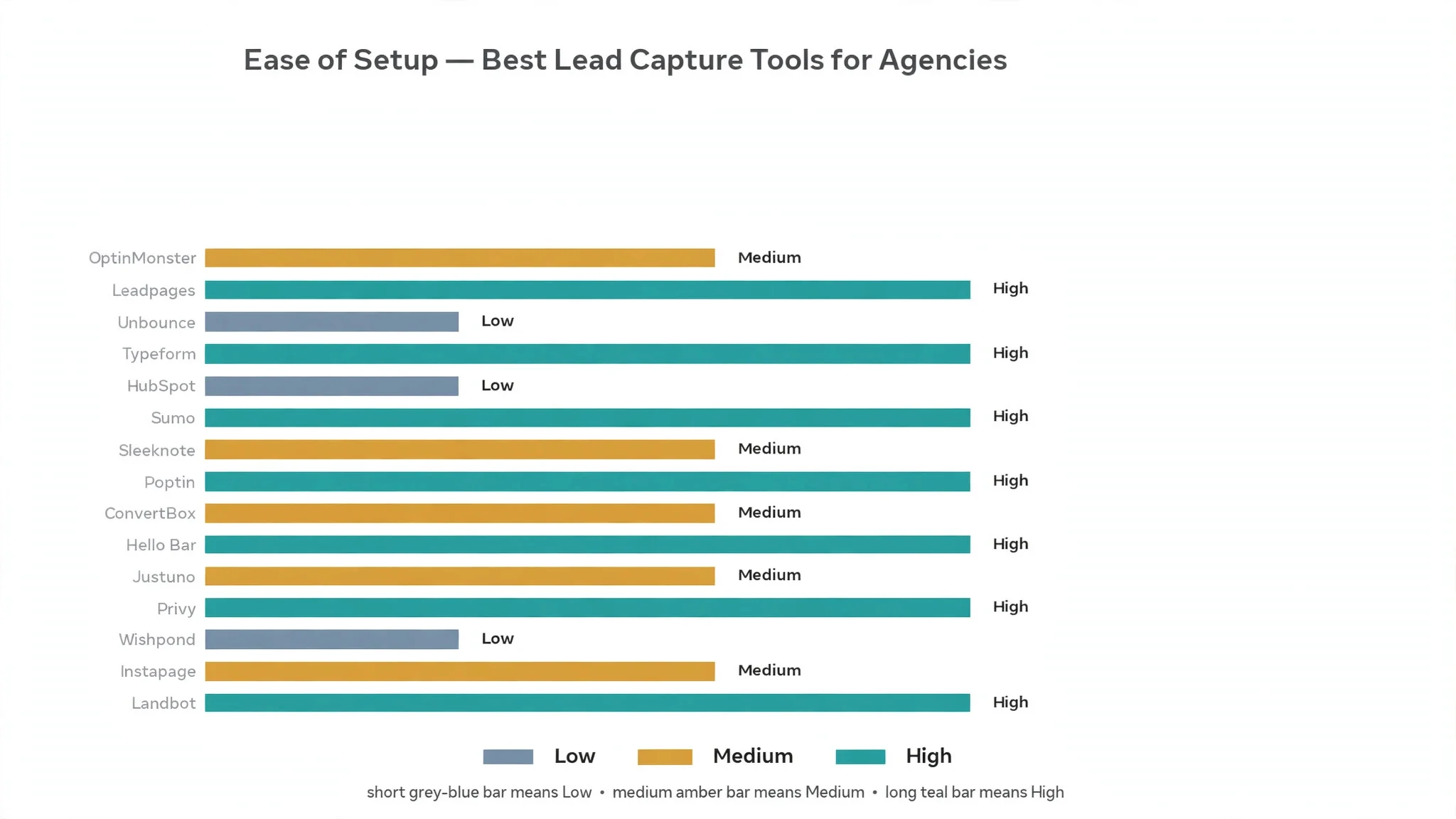
OptinMonster and Leadpages sit at the top of the table, so read their reviews and see which capture habit fits your client funnels. A tool that scores High on targeting is only useful if the forms it shows look good, and a tool that scores High on templates is only useful if the leads it captures flow into the CRM cleanly. Fit to the agency’s client work matters more than a long feature list.
Why the Best Lead Capture Tools for Agencies Decide Client Retention
The first reason is that clients judge agencies on leads, not traffic. A report showing ten thousand visits means little to a client who received twenty enquiries, while a report showing a hundred captured leads is a renewal conversation. The best lead capture tools for agencies make that number the headline, because it is the number that keeps clients paying.
The second reason is that most websites waste their traffic. A visitor who reads a blog post and leaves without leaving an email is gone forever, while a visitor who sees a well-timed offer will often convert. Capture tools recover those visitors with forms that appear at the right moment, with the right offer, instead of interrupting them at the wrong one.
The third reason is that agencies manage many clients at once. A tool that works across dozens of client sites, with separate campaigns, reports and permissions for each, saves the agency hours every week. A tool that only works well on one site will cost the agency time on every other client.
The fourth reason is testing. A form that converts at two percent and a form that converts at four percent look identical, and only testing reveals the difference. The capture tools in this ranking run A/B tests on headlines, offers and designs, so the agency can prove the improvement to the client with numbers.
The final reason is that capture is the start of the funnel, not the end. A captured lead needs a welcome email, a follow-up sequence and a handoff to sales, and the tools that connect capture to the CRM make that handoff automatic. An agency that captures well but follows up badly still loses the client.
How We Put Each Capture Tool Through Its Paces
We tested the best lead capture tools for agencies against the same five measures, using the same client-style websites and the same offers. Each tool built the same popup, form and landing page, so OptinMonster and the rest compare like with like.
- Conversion rate, judged by the share of visitors who completed each form, measured on the same traffic and the same offer.
- Targeting precision, measured by how accurately the tool showed the right form to the right visitor at the right moment.
- Design quality, scored on whether the forms looked professional on desktop and phone, and how much the agency could customise them.
- CRM and email flow, judged by how cleanly captured leads reached the CRM or email platform, with the right tags and fields.
- Multi-client handling, measured by how easily the agency could manage many client sites, campaigns and reports from one account.
Each measure carried equal weight except conversion rate, which counted double, because a capture tool that does not convert is not doing its job. Scores run out of 100, and the order below follows the combined total, led by OptinMonster on conversion rate. Where two tools tied, we broke the tie on targeting precision, since the right offer at the wrong moment is still a lost lead.
We also checked the mobile experience, because most traffic now arrives on phones. The best tools in this ranking show forms that fit a small screen and are easy to complete with a thumb, while the weakest show desktop popups squeezed onto a phone.
The 15 Tools in Detail
Each review below follows the same pattern for OptinMonster, and every other tool is judged on the same ground. We note what each tool does best, where it falls short, and the buyer it suits best, with conversion rate carrying the most weight.
1. OptinMonster
OptinMonster is the targeting specialist in this ranking, and it leads because it shows the right form to the right visitor at the right moment. The template library is large, and the analytics show exactly what each campaign earns.
The trade off is price and learning curve. OptinMonster is a premium tool, and the targeting options take time to master. A small agency with one client may find it heavy. For an agency managing many client sites, the targeting and testing pay for themselves quickly.
In the trial, build one exit-intent popup and one scroll-triggered form for the same offer, then test them against each other for a week. If the winner is clear, the testing is doing real work.
Our verdict. The strongest targeting and testing here, and the best all rounder for agencies that optimise.
2. Leadpages
Leadpages is the fast-page pick, and it earns second place by letting an agency build a landing page with a form in minutes. It suits agencies that need a page live today rather than next week.
The trade off is depth. The targeting and testing are lighter than OptinMonster’s, and the platform is built for pages rather than on-site popups. An agency that needs complex exit-intent rules will want another tool beside it. For fast landing pages, few tools match it.
In the trial, build one landing page for a client offer and check the conversion rate against the client’s current page. If the page converts better and took an hour, the speed is real.
Our verdict. The fastest landing pages here, ideal for agencies that build pages often.
3. Unbounce
Unbounce is the conversion-optimisation pick, and it suits agencies that test landing pages seriously. It is the tool for an agency that wants to prove, with numbers, that the new page beats the old one.
The trade off is price, which sits above the simpler page builders, and the learning curve is real. A small agency building one page a month will find it heavy. For an agency that optimises pages for many clients, the testing depth is the point.
In the trial, build two variants of one client page and run them against each other for a week. If the test produces a real improvement, the platform is earning its price.
Our verdict. The best landing page testing here, ideal for agencies that optimise conversions.
4. Typeform
Typeform is the conversational pick, and it fits agencies whose forms need to feel like a chat, not a chore. It suits lead qualification, surveys and signup flows where the experience decides the completion rate.
The trade off is that it is a form tool, not a popup platform, so it does not do exit intent or on-site targeting. An agency that needs popups will pair it with another tool. For forms that people actually finish, the conversational design is the point.
In the trial, rebuild one long client form as a Typeform and compare the completion rate with the old form. If more visitors finish, the conversation is working.
Our verdict. The friendliest forms here, ideal for agencies that qualify leads with questions.
5. HubSpot
HubSpot is the CRM pick, and it earns its place by tying capture directly to a full customer platform. The free tier covers the basics, which makes a proper trial easy.
The trade off is that the full power sits on paid tiers, and the platform is bigger than a capture tool alone. An agency that only needs popups will find it heavy. For an agency that wants capture, CRM and email in one system, the integration is the point.
In the trial, build one form and follow the lead from submission to the first follow-up email. If the flow is clean, the platform is doing the handoff work for the agency.
Our verdict. The best capture-plus-CRM here, ideal for agencies that manage the whole funnel.
6. Sumo
Sumo is the simple pick, and it suits agencies that want popups and bars without a big setup. It is easy to install on a client site, which suits an agency that needs something live in an afternoon.
The trade off is depth. The targeting and testing are lighter than the leaders, and the design options are simpler. An agency that optimises hard will outgrow it. For a quick capture layer on a small client site, the simplicity is the point.
In the trial, install it on a test site and build one popup with a clear offer. If the popup converts and the client is happy, the tool is doing its job.
Our verdict. The simplest free capture here, ideal for quick setups on small sites.
7. Sleeknote
Sleeknote is the elegant-popup pick, and it suits agencies whose clients care about design. It suits premium brands where an ugly popup would damage the site’s look.
The trade off is price, which reflects the design quality, and the platform is focused on popups rather than landing pages. An agency that needs pages as well will use a second tool. For popups that look like they belong on the site, few tools match it.
In the trial, build one popup for a premium client and check whether it feels like part of the site. If the popup converts without cheapening the brand, the design is earning its price.
Our verdict. The most elegant popups here, ideal for premium client sites.
8. Poptin
Poptin is the budget pick, and it earns its place with a free tier that covers popups, forms and basic targeting. It suits agencies with small clients who need capture without a large subscription.
The trade off is that the advanced targeting and testing are lighter than the leaders, and the support is thinner. An agency managing many large clients will want more. For a small client on a tight budget, the free start is the point.
In the trial, build one popup on the free tier and check the conversion rate after a week. If the popup wins, the free tier is a genuine way in.
Our verdict. The best free capture start here, ideal for agencies with small-budget clients.
9. ConvertBox
ConvertBox is the segmentation pick, and it suits agencies that show different messages to different visitors. The targeting is smart, and the one-time pricing model appeals to agencies that dislike subscriptions.
The trade off is that it is a messaging tool, not a full landing page platform, so agencies that build pages will pair it with another tool. The learning curve is moderate. For an agency that segments visitors carefully, the smart messages are the point.
In the trial, set up two messages for the same offer, one for new visitors and one for returning ones, and compare the conversion rates. If the split works, the segmentation is doing real work.
Our verdict. The best visitor segmentation here, ideal for agencies that personalise on-site messages.
10. Hello Bar
Hello Bar is the simple-bar pick, and it fits agencies that want a top bar or a simple popup that just works. It suits a client site that needs one clear capture element without complexity.
The trade off is depth. The targeting and testing are basic, and the design options are limited. An agency that optimises hard will want more. For a simple, fast capture bar, the ease is the point.
In the trial, add one top bar with a lead magnet to a client site and check the conversion rate after a week. If the numbers are healthy, the simplicity is working.
Our verdict. The simplest capture bar here, ideal for quick announcements and lead magnets.
11. Justuno
Justuno is the promotions pick, and it suits agencies that run sales, discounts and seasonal campaigns. It suits ecommerce clients where a well-timed discount decides the sale.
The trade off is that it is promotion-focused, so an agency that needs quiet lead capture will find the style too salesy. The price reflects the promotion features. For an agency running campaigns for ecommerce clients, the promotion tools are the point.
In the trial, run one promotion for a client sale and check the conversion rate against a plain popup. If the promotion outperforms, the tool is earning its place.
Our verdict. The best promotion capture here, ideal for agencies running sales campaigns.
12. Privy
Privy is the ecommerce pick, and it fits agencies with online store clients. The free plan covers small stores, which makes a trial easy.
The trade off is scope. Privy is built for ecommerce, so an agency with service clients will find less that fits. The landing page features are lighter than the dedicated builders. For an agency with store clients, the ecommerce focus is the point.
In the trial, set up one cart-saving popup and one welcome offer for a test store. If the numbers are healthy, the ecommerce design is working.
Our verdict. The best ecommerce capture here, ideal for agencies with online store clients.
13. Wishpond
Wishpond is the contest pick, and it suits agencies that run contests, sweepstakes and giveaways to grow lists. It suits clients who want fast list growth.
The trade off is that contests bring mixed-quality leads, and the platform is broader than a pure capture tool. An agency that needs quiet, high-intent capture will look elsewhere. For a client who wants a big list fast, the contest engine is the point.
In the trial, run one small contest and check how many leads it captured and how many opened the follow-up email. If the follow-up engagement is healthy, the contest is working.
Our verdict. The best contest capture here, ideal for agencies growing lists fast.
14. Instapage
Instapage is the scale pick, and it fits agencies that build landing pages for many clients at once. It suits an agency where landing pages are a core service.
The trade off is price, which is set for agencies and teams rather than solo users. A small agency building one page a month will find it expensive. For an agency where pages are the product, the collaboration and scale are the point.
In the trial, build one page with the client reviewing inside the tool, and check whether the collaboration saved a round of emails. If the workflow feels smooth, the platform is doing its job.
Our verdict. The best agency-scale pages here, ideal for teams that build pages constantly.
15. Landbot
Landbot is the chatbot pick, and it suits agencies that capture leads through conversation. It suits clients whose visitors prefer chatting to filling in a form.
The trade off is that a chatbot is not right for every visitor, and some people still prefer a simple form. The setup takes more thought than a popup. For a client whose audience likes to chat, the conversational capture is the point.
In the trial, build one chatbot flow for a client offer and compare its completion rate with the client’s existing form. If the chatbot converts more and qualifies better, the conversation is working.
Our verdict. The best chat-style capture here, ideal for agencies whose clients’ visitors like to chat.
The Offer That Makes Visitors Convert
The first rule is that the offer must be worth an email address. A generic newsletter signup converts poorly, while a specific lead magnet, like a checklist, a template or a discount, converts far better. The best lead capture tools for agencies make the offer the hero, because the form is only as strong as the reason to complete it.
The second rule is timing. A popup that appears the second a visitor arrives gets closed, while one that appears after the visitor has read half the page gets completed. Test the timing on every client site, and let the data decide whether the trigger is scroll depth, time on page or exit intent.
The third rule is fewer fields. Every extra field cuts the completion rate, so ask only for what the follow-up actually needs. A name and an email will convert far better than a form asking for a phone number, a company size and a budget. Collect the rest later, after the lead is warm.
The fourth rule is mobile first. Most visitors arrive on a phone, and a form that is hard to complete with a thumb will fail no matter how good the offer is. Test every form on a real phone, check the keyboard behaviour, and make the submit button easy to reach.
The fifth rule is the thank-you page. The moment after a visitor converts is the best time to ask for the next step, whether it is booking a call, sharing the offer or following the client on social media. A thank-you page that does nothing wastes the warmest moment in the funnel.

Mistakes That Waste an Agency’s Traffic
The first mistake is showing the same popup to everyone. A returning visitor, a first-time reader and a buyer ready to purchase need different messages, and a generic popup serves none of them well. Use the targeting rules to show each visitor the offer that fits them.
The second mistake is interrupting too early. A popup that fires before the visitor has read anything feels like an ambush, and the visitor leaves. Let the visitor engage first, then offer the capture at the moment they are most likely to say yes.
The third mistake is never testing. A headline, an offer and a button colour can each move the conversion rate by a point or more, and an agency that never tests is leaving leads on the table. Run one test per client per month, and the gains compound.
The fourth mistake is capturing leads and never following up. A lead that sits in the CRM for a week without a welcome email is a lead that forgets the brand. Connect the capture to an automatic welcome sequence, and check that it actually sends.
The fifth mistake is reporting traffic instead of leads. A client who sees a traffic chart will ask where the leads are, while a client who sees a lead report will renew. Report the captured leads, the cost per lead and the conversion rate, and the value of the work becomes obvious.
Best Pick by Job
No single capture tool fits every agency, so each common lead situation below is matched to the tool that scored highest for that job. The best lead capture tools for agencies for a testing-heavy agency look different from the right pick for a team that builds pages, and the table below makes that split clear.
| Job | Best pick | Why it wins |
|---|---|---|
| Tests and targets everything | OptinMonster | Precise targeting with A/B testing |
| Builds landing pages fast | Leadpages | Quick landing pages with forms |
| Optimises pages with data | Unbounce | Landing pages with AI and testing |
| Wants forms people finish | Typeform | Conversational forms people finish |
| Needs capture tied to a CRM | HubSpot | Forms tied to a full CRM |
| Needs a quick free capture layer | Sumo | Free tools with easy setup |
| Wants popups that look premium | Sleeknote | Beautiful popups with smart triggers |
| Works with small-budget clients | Poptin | Free tier with popups and forms |
| Segments visitors carefully | ConvertBox | On-site messages with smart targeting |
| Needs a simple bar or popup | Hello Bar | Top bars and popups that convert |
| Runs sales and promotions | Justuno | Promotions with AI targeting |
| Works with ecommerce clients | Privy | Popups and email for online stores |
| Grows lists with contests | Wishpond | Contests and landing pages together |
| Builds pages for many clients | Instapage | Landing pages with collaboration |
| Captures leads through chat | Landbot | Chatbots that collect leads |
If your situation does not match a row exactly, take the closest one and read that review first, starting with OptinMonster when it fits. The gap between neighbouring tools is smaller than the gap between an agency that captures leads and one that watches traffic leave, so the capture habit matters more than a few points on a scorecard.
Frequently Asked Questions
Agencies ask the same questions before every capture tool change, so we answered the most common ones here. The best lead capture tools for agencies answer these in their help centres, but the plain answers below are faster to judge a tool against.
How many fields should a lead capture form have?
As few as possible, usually a name and an email to start. A form that asks for a phone number, a company size and a budget on the first visit will convert far worse than a simple two-field form.
Will popups annoy visitors and hurt the site?
They will if they appear too early, too often, or with a weak offer. Test the timing, limit the frequency, and the data will show whether visitors mind.
How do I prove the capture tool is working to a client?
Report the numbers that matter, which are the captured leads, the conversion rate and the cost per lead. A client who sees leads growing month after month will renew, while a client who only sees traffic charts will ask questions.
Should the form live on the site or on a landing page?
Both have a place. Use on-site capture for the general audience and landing pages for campaigns, and let the conversion data decide where the budget goes.
What happens to leads after they are captured?
They should flow into the CRM or email platform automatically, with the right tags and the source recorded, then receive a welcome email within minutes. Check the flow in the trial, because a capture tool that does not hand off cleanly creates more work than it saves.
The Final Call for Agencies That Need More Leads
An agency can settle this in a trial by measuring the conversion rate on the same traffic, testing whether the right offer appears at the right moment, and following leads into the CRM to see if the flow stays clean. The best lead capture tools for agencies prove themselves on the conversion rate against the same traffic, the targeting that shows the right offer at the right moment, and the clean flow of leads into the CRM, and a two week trial on a real client site will show all three. OptinMonster wins our ranking on the combined score, but the right tool for an agency is the one that lifts conversions on every client site it touches.
Build the forms on a real client site, test them against the current setup, and judge the tool on the leads it captures rather than the demo. If the conversion rate rises, the targeting holds, and the leads flow cleanly into the CRM, the tool will pay for itself across the client base. If the forms annoy visitors or the leads arrive untagged, no feature list will save it. Pick the tool that turns traffic into names, protect the testing habit, and let the lead count do the talking with every client.