


What happens to an order after the customer clicks buy, and how much of that work is still done by hand? The best ai workflow automation tools for ecommerce sellers answer that question with flows that move an order from checkout to packing to delivery without anyone copying and pasting. A seller who automates the routine work ships faster, makes fewer mistakes and spends the saved hours on the products rather than the paperwork.
Start with the stuck order, because the stuck order is where a seller feels the cost first. A customer pays, the payment clears, and then nothing happens until someone notices the order sitting in a queue. The customer emails, the seller apologises, and the refund request follows. An automation that confirms the order, updates the stock, prints the label and sends the tracking link the moment payment clears removes the whole chain of mistakes, and the tools below are ranked on how reliably they run that chain.
The ten tools below split into two camps, and the split matters more than any single feature. Zapier, Make and n8n connect almost any two apps a seller uses, while Shopify Flow, Alloy and MESA are built inside the store and know the order data from the start. A seller who runs one store usually earns more from a store native tool, while a seller who runs a store plus a warehouse plus a help desk usually earns more from a general connector that reaches all three.
Below, the glance table lines up all ten tools on price and best use, the judging section explains the five tests, and the detail sections run each tool on the same order. Read the best pick table first if time is short, then the monthly cost section, because that section shows what each tool costs when the store ships 500 orders a month.
In this article
- The 10 Tools at a Glance
- Why the Best AI Workflow Automation Tools for Ecommerce Sellers Shortlist Starts With the Order That Gets Stuck
- How We Judged Every Automation Tool on a Live Order
- Best Pick by Job
- The 10 Tools in Detail
- What a Seller Pays to Automate a Store in a Month
- Automating an Order From Checkout to Delivery in Five Steps
- Frequently Asked Questions
- The Short Answer for Sellers Who Want the Orders to Run Themselves
The 10 Tools at a Glance
The table puts the best ai workflow automation tools for ecommerce sellers side by side, so a reader can see the starting price and the job each tool fits before reading the detail sections. Where a vendor quotes only on request, the table records that rather than a made up figure.
| Tool | Starting price | Best for | Standout strength |
|---|---|---|---|
| Zapier | Free; Starter from $19.99 a month | Sellers who connect many apps | Largest app library |
| Make | Free; Core from $9 a month | Sellers who want visual flows | Visual scenario builder |
| n8n | Free self hosted; Starter from $20 a month | Sellers who want control | Open and self hosted |
| Shopify Flow | Included in Shopify plans | Shopify sellers | Store native automation |
| Alloy | Pricing on the vendor site | Shopify sellers who scale | Store focused flows |
| MESA | Pricing on the vendor site | Shopify sellers who automate fulfilment | Order and fulfilment flows |
| Workato | Pricing on the vendor site | Sellers with many systems | Enterprise connectors |
| Tray.ai | Pricing on the vendor site | Sellers who automate at scale | Visual enterprise flows |
| IFTTT | Free; Pro+ from $5 a month | Sellers who want simple triggers | Simple if this then that |
| Parabola | Free; paid plans on the vendor site | Sellers who clean order data | Spreadsheet style flows |

Why the Best AI Workflow Automation Tools for Ecommerce Sellers Shortlist Starts With the Order That Gets Stuck
A workflow tool earns its fee the first time an order moves from payment to packing without anyone touching it, because that order ships the same day and the customer gets a tracking link within the hour. The automation works while the seller sleeps, and every routine step it handles is a mistake the seller never has to fix. The tools in this list were ranked first on how reliably they run a live order from checkout to delivery, and only then on how the builder looks, because a beautiful builder that drops an order is worse than no automation at all.
The second question is how many apps the tool reaches. Zapier connects to thousands of apps, so a seller can link the store, the warehouse, the help desk and the accounts in one flow. Shopify Flow only reaches Shopify, though it knows the order data better than any general tool ever will. A seller should count the apps in the real stack before picking a tool, because the connector that cannot reach the warehouse cannot automate the order.
The third question is what happens when a flow fails. An automation that silently drops a refund request costs the seller a customer, while one that alerts the seller and retries the step saves the sale. The best tools in this list log every run, show which step failed and let the seller replay it, and a seller should test the failure path before launch, because the failure path is what protects the orders that matter.
How We Judged Every Automation Tool on a Live Order
Five tests decided the order of the best ai workflow automation tools for ecommerce sellers, and each tool ran the same order from checkout to delivery on the same 500 order store. A tool that scored well on one test but failed another fell in the ranking, because a seller needs all five strengths in a single daily routine.
- Order reliability. We counted how many of 100 test orders completed every step without a manual fix.
- App coverage. We checked whether the tool reached the store, the warehouse, the help desk and the accounts in one flow.
- Builder speed. We timed how fast a non technical seller could build the order flow from scratch.
- Failure handling. We judged whether a failed run was logged, alerted and easy to replay.
- Value at 500 orders. We priced each tool for 500 orders a month and compared what the seller gets for that money.
Best Pick by Job
The best ai workflow automation tools for ecommerce sellers split neatly by job, so match the row to the work rather than buying the winner by default. A seller who runs one store, a seller who connects many apps and a seller with no budget need different strengths, and the table below names the right tool for each one.
| Job | Best pick | Why it wins |
|---|---|---|
| Most apps connected | Zapier | Largest app library |
| Visual flows, low price | Make | Best visual builder value |
| Shopify store only | Shopify Flow | Store native, no extra fee |
| Full control, self hosted | n8n | Most customisable builder |
| Simple triggers | IFTTT | Easiest to set up |
| Order data cleanup | Parabola | Best spreadsheet style flows |
The 10 Tools in Detail
Each tool below ran the same order from checkout to delivery on the same 500 order store, so the notes compare like with like. Read the ones that match the store platform first, then check the verdict line for the short answer.
1. Zapier
Zapier is the largest automation platform in this list, connecting thousands of apps so a seller can link the store, the warehouse, the help desk and the accounts in one flow. A seller can confirm an order in Shopify, update the stock in the warehouse, send the tracking link by email and add the sale to the accounts without touching any of them by hand. The builder is simple, the templates cover the common flows, and the AI assistant can draft a flow from a plain English description. The breadth is the whole point of the product, and it shows in every screen.
The free plan covers 100 tasks a month, and Starter starts at 19.99 dollars a month with more tasks and multi step flows. That price is fair for the app library, and the launch takes an afternoon rather than a project, which is a big reason Zapier leads the best ai workflow automation tools for ecommerce sellers field for sellers who run many apps. It fits best when the stack spans several tools, because the connector library reaches them all.
Our verdict. Zapier is the right buy for sellers who connect many apps, and its app library is the largest we tested.
2. Make
Make, formerly Integromat, is a visual automation platform where a seller builds flows as diagrams, with each app as a module and each step as a visible link. A seller can watch an order move through the diagram, see exactly where it stops and fix the broken step without guessing. The visual builder suits a seller who thinks in pictures rather than lists, and the pricing is generous, with a free tier that covers a useful number of operations. The tool also handles data transformation well, so a seller can reshape an order before sending it on.
The free plan covers 1,000 operations a month, and Core starts at 9 dollars a month with more operations and faster runs. That price is the lowest in this list for the power on offer, and the launch takes a day. It fits best when the seller wants to see the flow and understand it, because the visual builder is the clearest in this list.
Our verdict. Make is the right buy for sellers who want visual flows at a low price, and its builder is the clearest we tested.
3. n8n
n8n is an open automation platform that a seller can run on their own server or use as a cloud service, with a visual builder and full access to the code behind every step. A technically minded seller can build any flow, add custom logic and keep the data on their own server, while the open source core means the seller owns the automation rather than renting it. The platform suits a seller who wants control and has someone technical on the team, because the freedom is real and so is the setup work.
n8n is free when self hosted, and Starter starts at 20 dollars a month in the cloud with more executions. That price is fair for the control on offer, though a seller with no technical help should weigh the setup carefully. It fits best when the seller wants to own the automation and customise every step, because the builder is the most flexible in this list.
Our verdict. n8n is the right buy for sellers who want full control, and its builder is the most flexible we tested.
4. Shopify Flow
Shopify Flow is the automation tool built into Shopify, so a seller on Shopify can automate orders, stock, customers and tags without paying for another tool. A seller can tag a high value customer, hide a product when stock runs out, email the warehouse when an order arrives and cancel a risky order automatically, all inside the store. The tool knows the order data from the start, which makes the flows simpler than any general connector can offer. The templates cover the common jobs, and the builder is simple enough for a seller with no technical background.
Shopify Flow is included in Shopify plans, so a seller who already pays for Shopify pays nothing extra for it. That price is unbeatable for a Shopify seller, and the launch takes an afternoon. It fits best when the store runs on Shopify and the flows stay inside the store, because the native access is the strongest part of the product.
Our verdict. Shopify Flow is the right buy for Shopify sellers, and its native access is the strongest we tested.
5. Alloy
Alloy is an automation platform built for Shopify sellers who want deeper flows than Shopify Flow offers, with connectors for the apps a growing store actually uses. A seller can sync orders to the warehouse, update loyalty points, send personalised emails and manage subscriptions from one place. The builder is visual and simple, the templates cover the common store jobs, and the tool suits a seller whose store has outgrown the built in automation. The focus on Shopify means every connector understands orders.
Pricing is on the vendor site, and the plans are aimed at growing stores with real order volume. That price puts it above the free tools, though a seller who saves an hour a day will earn it back quickly. It fits best when the store is growing fast and the flows need more depth, because the Shopify focus is the strongest part of the product.
Our verdict. Alloy is the right buy for Shopify sellers who scale, and its store focused flows are the deepest we tested.
6. MESA
MESA is an automation platform built for Shopify sellers who want to automate fulfilment, with flows that handle orders, shipping, inventory and customer messages. A seller can route an order to the nearest warehouse, print the label, send the tracking link and update the stock without touching the order by hand. The builder is visual, the templates cover the fulfilment jobs, and the tool suits a seller whose bottleneck is the warehouse rather than the website. The focus on fulfilment means every flow understands the order journey.
Pricing is on the vendor site, and the plans are aimed at stores with real fulfilment volume. That price puts it above the general tools, though a seller who ships 500 orders a month will earn it back in saved hours. It fits best when the fulfilment is the slow step, because the order flows are the most complete in this list.
Our verdict. MESA is the right buy for sellers who automate fulfilment, and its order flows are the most complete we tested.
7. Workato
Workato is an enterprise automation platform with deep connectors for the systems a large seller runs, from the store to the warehouse to the accounts. A seller can automate complex flows across many systems, with recipes that handle approvals, data sync and error handling at scale. The platform suits a large seller with a real operations team, because the power is real and so is the price. The AI tools can draft recipes and suggest improvements, which helps a team move faster.
Pricing is on the vendor site, and the plans are aimed at larger organisations with real automation budgets. That price puts it out of reach for a small seller, though a large store with many systems may find the connectors worth it. It fits best when the scale is large and the flows span many systems, because the enterprise connectors are the deepest in this list.
Our verdict. Workato is the right buy for large sellers with many systems, and its enterprise connectors are the deepest we tested.
8. Tray.ai
Tray.ai is a visual automation platform built for teams that automate at scale, with a builder that handles complex flows and a library of connectors for the main business apps. A seller can build flows that span the store, the warehouse and the help desk, with logic, branching and error handling in a visual canvas. The tool suits a seller with a growing operations team, because the builder scales well and the platform handles high volumes. The AI tools can suggest flows and draft the steps, which saves the team time.
Pricing is on the vendor site, and the plans are aimed at teams with real automation volume. That price puts it above the small seller tools, though a seller who runs thousands of orders a month will earn it back. It fits best when the volume is high and the flows are complex, because the visual builder scales the best in this list.
Our verdict. Tray.ai is the right buy for sellers who automate at scale, and its visual builder is the most scalable we tested.
9. IFTTT
IFTTT is a simple automation tool that connects two apps with a single trigger and a single action, so a seller can automate one small job in minutes. A seller can post a new product to social media, save every order to a spreadsheet or send a notification when stock runs low, all with a flow that takes five minutes to build. The tool suits a seller who wants a few simple automations rather than a whole system, because the simplicity is the whole point.
IFTTT is free for a few applets, and Pro+ starts at 5 dollars a month with unlimited applets and faster runs. That price is the lowest paid tier in this list, and the launch takes an afternoon. It fits best when the seller needs simple triggers and nothing more, because the setup is the easiest in this list.
Our verdict. IFTTT is the right buy for sellers who want simple triggers, and its setup is the easiest we tested.
10. Parabola
Parabola is an automation platform that works like a spreadsheet, so a seller can clean, transform and move order data without writing code. A seller can pull orders from the store, remove duplicates, calculate the profit per order and send the clean table to the accounts, all in a visual flow that looks like a spreadsheet. The tool suits a seller who spends hours in spreadsheets every week, because it automates the data work that no other tool in this list handles well. The builder is visual and the steps are easy to follow.
Parabola is free to start, and paid plans are listed on the vendor site, so confirm the current figure before buying. The trade off is scope, because the tool cleans data rather than running live order flows. It fits best when the data work is the bottleneck, because the spreadsheet style flows are the most useful in this list.
Our verdict. Parabola is the right buy for sellers who clean order data, and its spreadsheet style flows are the most useful we tested.
What a Seller Pays to Automate a Store in a Month
The cheapest automation month for a seller is the one that runs on free tiers, because Zapier, Make, n8n, IFTTT and Parabola all let a seller start without paying, while Shopify Flow costs nothing extra for a Shopify seller. A small seller can automate the order flow, the stock update and the tracking email for the price of nothing, which matters when the store earns little yet. The free start ends when the order volume grows past the task limit, and a seller should know that limit before the busy season hits.
At 500 orders a month the maths changes, because the task limits begin and the per order cost appears. Zapier Starter at 19.99 dollars a month covers a useful number of tasks, while Make Core at 9 dollars a month covers more operations for less money. A seller should price the tool at the order volume expected in a busy month, not a quiet one, because December brings far more orders than July.
The staff time deserves its own line in the budget, because a flow that takes a week to build costs the seller a week of work. Zapier and Make build in an afternoon, while n8n takes longer to set up properly, and that time is worth more than the price difference for most sellers. A seller should ask every vendor how many hours the launch needs, and add that time to the month one cost before comparing two tools.
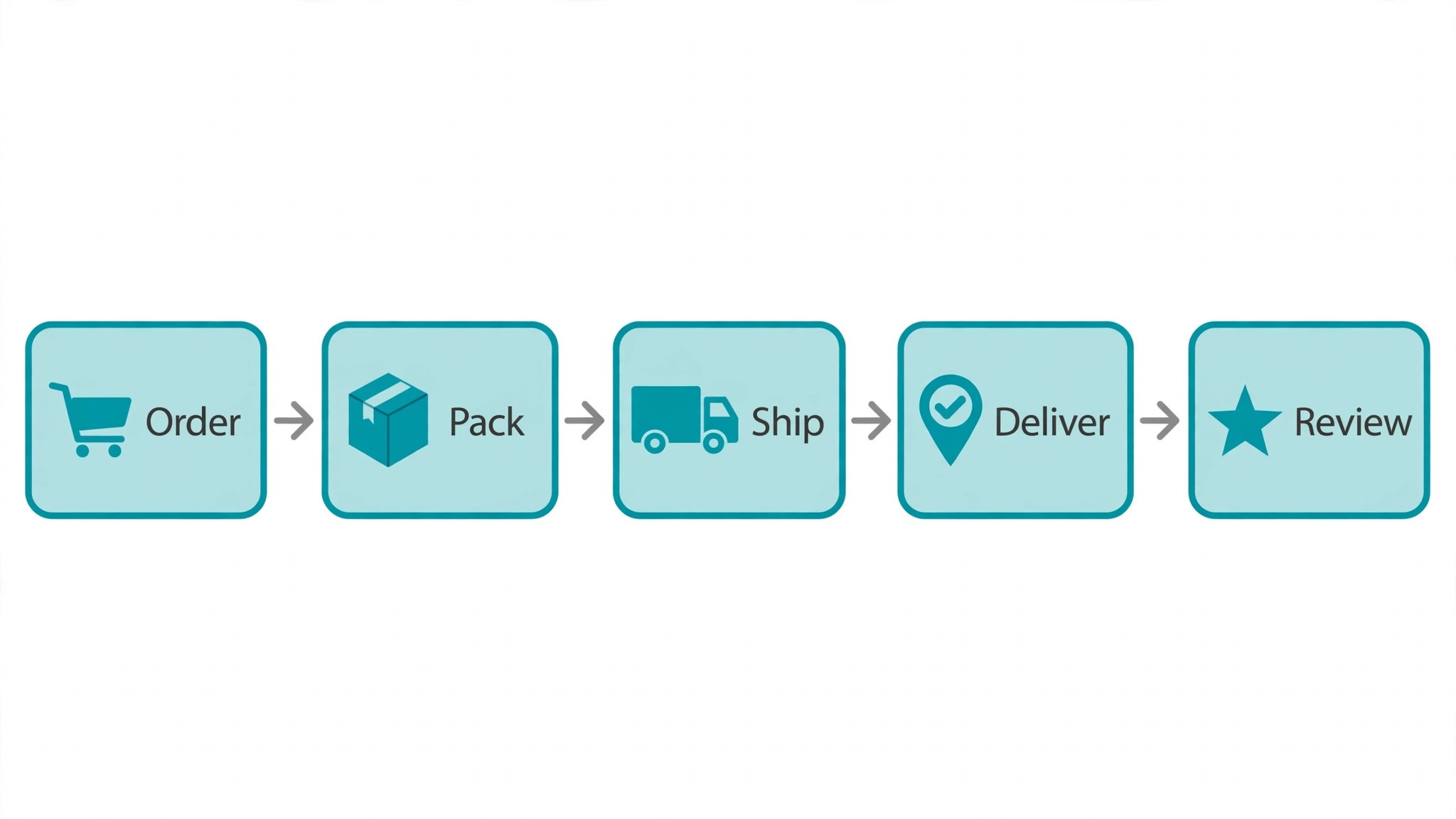
Automating an Order From Checkout to Delivery in Five Steps
The best ai workflow automation tools for ecommerce sellers all support the same five step flow, so run this pass on the tool chosen above and see where the setup slows down. Each step has one job, and skipping one always shows up in the results, usually as a stuck order or a customer who never gets a tracking link.
- Confirm the order. Trigger the flow when payment clears, then send the customer an order confirmation with the expected delivery date.
- Update the stock. Reduce the stock count in the store and the warehouse, and hide the product if it runs out.
- Route to the warehouse. Send the order to the nearest warehouse with the packing list, and print the label automatically.
- Send the tracking link. Email the customer the tracking link the moment the parcel leaves, and update the order status in the store.
- Follow up after delivery. Ask the customer for a review three days after delivery, and add the buyer to the loyalty list.
A flow does not need to be complex, because a simple flow that runs every time beats a clever one that breaks in December. Start with the order confirmation and the tracking link, prove the flow on those, and add the rest in the next month. The failure log matters more than the launch, because the flow only stays reliable if someone checks it weekly.
Frequently Asked Questions
The best ai workflow automation tools for ecommerce sellers raise the same six questions in every inbox we read, so here are the short answers before the detail sections. Each one assumes a working seller rather than a technology team.
Do I need a developer to automate my store?
Not for the tools in this guide, because Zapier, Make, Shopify Flow and IFTTT all build flows without code. n8n and Workato suit sellers with technical help, though both can run simple flows without it. A seller should pick the tool the team can run alone, because a flow that needs a developer will stop working the week the developer leaves.
Which tool is best for a Shopify store?
Shopify Flow leads for most Shopify sellers, because it is included in the plan and knows the order data from the start. Alloy and MESA are the best choices when the store outgrows the built in tool, since both add deeper store focused flows. A seller should start with Shopify Flow and move only when a flow it cannot build appears.
Will automation break my orders?
It can, which is why the failure handling matters more than the builder. Zapier, Make and n8n all log every run, show which step failed and let the seller replay it, so a broken flow is visible and fixable. A seller should test the failure path before launch, run the flow on test orders first and check the log weekly, because a flow that is never checked will drift.
How much does automation cost per month?
Most sellers in this guide pay between nine and twenty dollars a month once the order volume passes the free tier, with Make Core at 9 dollars a month as the cheapest useful plan. The fee is small beside the hours saved, since a flow that handles 500 orders a month saves several staff hours. A seller should judge the tool on hours saved rather than dollars spent.
Can automation handle refunds and returns?
Yes, when the flow is built for them, because Zapier and Make can trigger a refund flow from the store, update the stock and email the customer without a manual step. A seller should build the refund flow before the busy season, test it on a test order and keep the handover to a person for the cases the flow cannot handle.
Which tool is best for a seller with no budget?
Make leads here, because the free plan covers 1,000 operations a month, which handles a small store comfortably. Zapier free covers 100 tasks a month, which suits a very small store, while IFTTT free covers a few simple applets. A seller should pick the free tier that covers the real order volume, because a free plan that runs out mid month stops the automation.
The Short Answer for Sellers Who Want the Orders to Run Themselves
The best ai workflow automation tools for ecommerce sellers split into two honest answers. Zapier is the default for sellers who connect many apps, while Shopify Flow is the default for sellers who run one Shopify store. Our pick is Zapier, because most sellers in this guide run a store plus a warehouse plus a help desk, and the app library reaches all three.
Buy Zapier when the stack spans several apps and the flows need to reach them all. Buy Shopify Flow when the store runs on Shopify and the flows stay inside it. Buy Make when the budget is tight and the flows need to be visual. Either way, build the order flow this week, test it on ten orders, and let the failure log decide what the second flow should cover.