
What does a client actually buy when they pay an agency for a site audit, and which tool proves the work was done properly? The best site audit tools for agencies answer that question with a crawl, a report and a list of fixes ranked by impact, because a client who sees the broken links, the missing titles and the slow pages in one clear document trusts the agency. An audit that finds the real problems and explains them plainly is the product, and the tool behind it decides how good that product looks.
Start with the client report, because the client report is where the agency earns its fee. A client who receives a fifty page dump of technical jargon learns nothing, while a client who receives a short report with ten fixes ranked by impact can see exactly what the money bought. The tools in this guide differ most in how they turn a crawl into a report a non technical client can read, and the ranking below weights the report as heavily as the crawl itself.
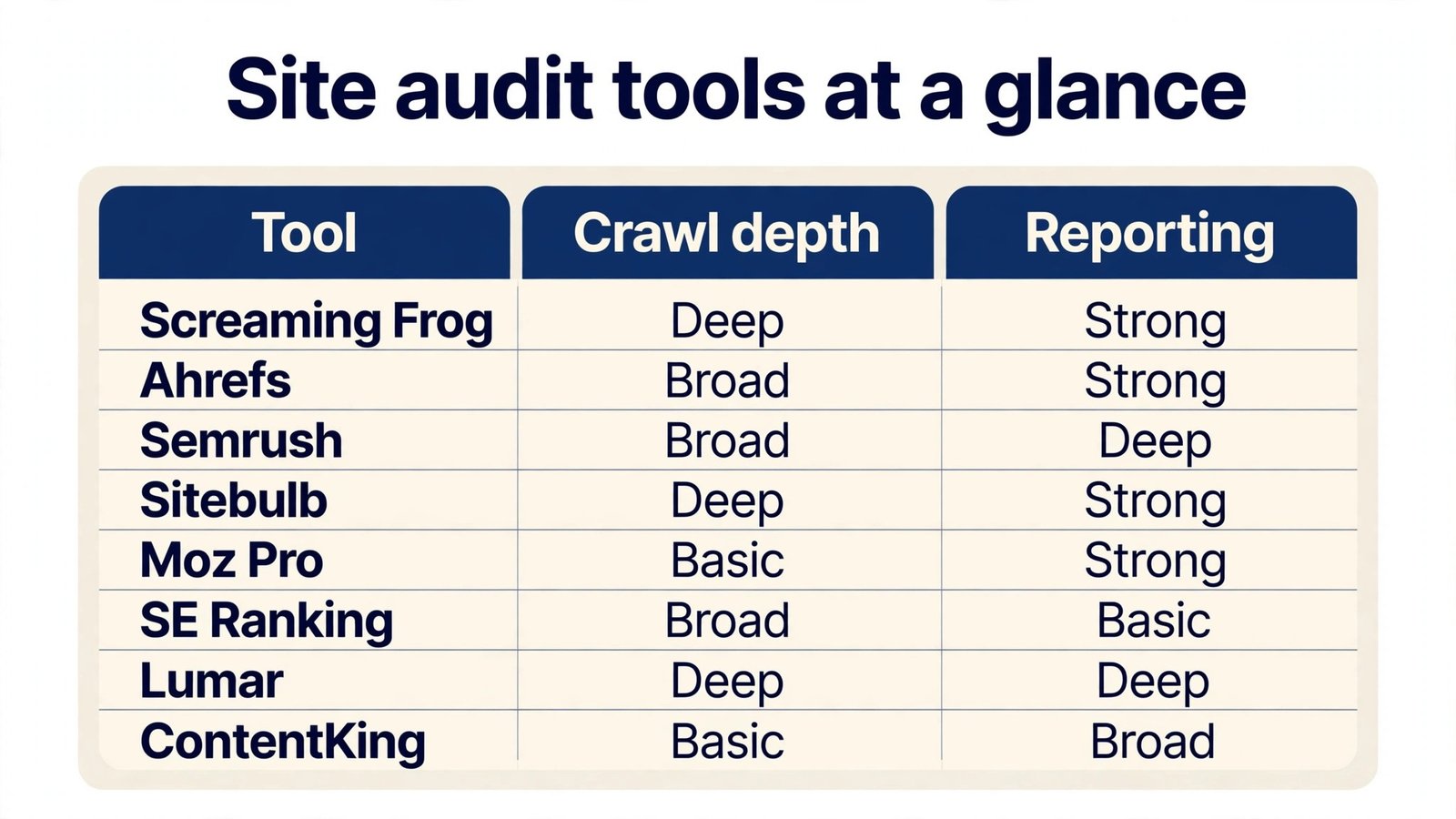
The eight tools below split into two camps, and the split matters more than any single feature. Screaming Frog, Sitebulb and Lumar are crawlers that find the problems, while Ahrefs, Semrush and Moz Pro are platforms that find the problems and show how the site compares to its rivals. An agency that audits small sites usually earns more from a dedicated crawler, while an agency that sells ongoing SEO usually earns more from a platform that covers audits, keywords and links together.
Below, the glance table lines up all eight tools on price and best use, the judging section explains the five tests, and the detail sections give each tool a fair hearing. Read the best pick table first if time is short, then the year one pricing section, because that section shows what each tool costs when the agency audits 20 client sites a year.
The 8 Tools at a Glance
The table puts the best site audit tools for agencies side by side, so a reader can see the starting price and the job each tool fits before reading the detail sections. Where a vendor quotes only on request, the table shows vendor quoted instead of a guess.
| Tool | Starting price | Best for | Standout strength |
|---|---|---|---|
| Screaming Frog | Free up to 500 URLs; licence £259 a year | Agencies that crawl deep | Fast desktop crawling |
| Ahrefs | Lite from $129 a month | Agencies that audit plus track rivals | Largest backlink index |
| Semrush | Pro from $139.95 a month | Agencies that sell full SEO | Broadest platform |
| Sitebulb | Lite from $13.50 a month | Agencies that want visual audits | Visual crawl maps |
| Moz Pro | From $99 a month | Agencies that want clear metrics | Domain Authority data |
| SE Ranking | Essential from $52 a month | Agencies that want value | Strong value for money |
| Lumar | Pricing on the vendor site | Large agencies and enterprises | Enterprise crawling |
| ContentKing | Pricing on the vendor site | Agencies that monitor daily | Continuous monitoring |
Why the Best Site Audit Tools for Agencies Shortlist Starts With the Client Report
An audit tool earns its fee the first time a client reads the report and understands what is wrong without calling the agency to ask. The report is the deliverable, and a tool that produces a clear, branded, plain English report saves the agency hours of explaining. The tools in this list were ranked first on how well they turn a crawl into a report a client can act on, and only then on how deep the crawl goes, because a deep crawl that produces an unreadable report is worth less than a shallow crawl that produces a clear one.
The second question is how the tool handles many clients. An agency that audits 20 sites a year needs a tool that keeps each client separate, remembers the last crawl and shows what changed since then. Screaming Frog and Sitebulb store crawls on the desktop, while Ahrefs, Semrush and ContentKing keep the history in the cloud and alert the agency when a client site breaks. A tool that cannot track change over time forces the agency to rebuild the audit from scratch every month, which is the work the tool should be doing.
The third question is how accurate the crawl is. A tool that misses a broken link or reports a false error costs the agency credibility, because the client will find the mistake. The best tools in this list crawl JavaScript, respect the robots file and check the pages a real browser would see, and an agency should test the crawl against a site it knows well before trusting the tool with a paying client.
How We Judged Every Audit Tool on Agency Terms
Five tests decided the order of the best site audit tools for agencies, and each tool audited the same client site with 2,000 pages, the same broken links and the same slow pages. A tool that scored well on one test but failed another fell in the ranking, because an agency needs all five strengths in a single monthly routine.
- Crawl accuracy. We counted how many of the planted errors each tool found and how many false errors it reported.
- Report quality. We judged whether a non technical client could read the report and understand the ten fixes.
- Client management. We checked whether the tool kept clients separate, tracked change over time and supported white label reports.
- Speed. We timed how fast each tool crawled the 2,000 page test site from start to finish.
- Value at 20 clients. We priced each tool for 20 client sites a year and compared what the agency gets for that money.
Best Pick by Job
The best site audit tools for agencies split neatly by job, so match the row to the work rather than buying the winner by default. An agency that crawls deep, an agency that sells full SEO and an agency on a tight budget need different strengths, and the table below names the right tool for each one.
| Job | Best pick | Why it wins |
|---|---|---|
| Deep crawling, best value | Screaming Frog | Fastest crawl per pound |
| Full SEO plus audit | Semrush | Broadest platform |
| Rival tracking plus audit | Ahrefs | Largest backlink index |
| Visual audits clients love | Sitebulb | Best visual crawl maps |
| Best value platform | SE Ranking | Strongest value for money |
| Daily monitoring | ContentKing | Best continuous alerts |
The 8 Tools in Detail
Each tool below audited the same client site with 2,000 pages, the same broken links and the same slow pages, so the notes compare like with like. Read the ones that match the agency size first, then check the verdict line for the short answer.
1. Screaming Frog
Screaming Frog is a desktop crawler that has been the standard for technical audits for years, and it earns that place by crawling fast, finding the problems and exporting everything in a clean spreadsheet. An agency can crawl a client site, find the broken links, the missing titles, the duplicate pages and the redirect chains, then export the whole list and build the report from it. The tool handles JavaScript, checks the pages a real browser would see and lets the agency customise the crawl to the client’s site. The interface is dense, though it rewards the time spent learning it.
The free version crawls up to 500 URLs, which covers a small client site, and the paid licence costs 259 pounds a year for unlimited crawling. That price is the best value in this list for the depth on offer, and the licence covers one user on three machines, which suits a small agency with a desk and a laptop. The desktop storage keeps each client crawl separate, and the comparison feature shows what changed since the last crawl, which is a big reason Screaming Frog leads the best site audit tools for agencies field for agencies that crawl deep.
The trade off is the report, because the tool exports data rather than writing a client ready document. An agency that wants a branded report must build it from the export, though the data is complete and accurate. It fits best when the agency has someone technical who can turn a crawl into a report, because the crawling is the strongest in this list and the reporting is the work the agency adds.
Our verdict. Screaming Frog is the right buy for agencies that crawl deep, and its crawl speed and depth are the strongest we tested.
2. Ahrefs
Ahrefs is an SEO platform with a site audit tool built in, so an agency can audit a client site, track its keywords and study its rivals from the same account. The audit crawls the site, finds the technical errors and ranks them by impact, while the backlink index shows which sites link to the client and which links are broken. The reporting is clear, the dashboard shows the health score at a glance, and the tool suits an agency that sells ongoing SEO rather than one off audits.
Ahrefs Lite starts at 129 dollars a month, which covers a useful number of crawls and projects for a small agency. That price is fair for the platform, though it is far above a dedicated crawler. The trade off is cost, because an agency that only needs audits pays for keywords, links and content tools it may never use. It fits best when the agency sells monthly SEO retainers, because the audit is one part of a larger service the platform supports.
Our verdict. Ahrefs is the right buy for agencies that audit plus track rivals, and its backlink index is the largest we tested.
3. Semrush
Semrush is the broadest SEO platform in this list, with a site audit tool, keyword research, competitor analysis and reporting in one account. An agency can audit a client site, find the technical errors, compare the site against three rivals and build a white label report without leaving the platform. The audit checks over 140 issues, ranks them by priority and suggests the fix for each one, while the reporting templates let the agency brand the document with its own logo. The breadth is the whole point of the product, and it shows in every screen.
Semrush Pro starts at 139.95 dollars a month, which is the dearest tool in this list. That price buys a full platform rather than a single crawler, so an agency that only needs audits should buy Screaming Frog instead. The trade off is cost, though a busy agency that sells SEO, content and PPC from one platform will earn it back. It fits best when the agency sells a full SEO service, because the audit is one module in a much larger toolkit.
Our verdict. Semrush is the right buy for agencies that sell full SEO, and its platform breadth is the widest we tested.
4. Sitebulb
Sitebulb is a desktop crawler built around visual audits, so an agency can show a client a map of the site, a chart of the errors and a prioritised list of fixes in a document the client actually enjoys reading. The crawl finds the broken links, the missing titles, the slow pages and the crawl depth problems, then presents them in charts and diagrams rather than a spreadsheet. The tool suits an agency that wants the audit to look as good as it is accurate, because the visual report is the strongest part of the product.
Sitebulb Lite starts at 13.50 dollars a month, which is the cheapest paid crawler in this list. That price is excellent for the visual reports on offer, and the launch takes a day. The trade off is scale, because the desktop tool suits small and medium sites better than huge ones. It fits best when the client report matters as much as the crawl, because the visual audit is the most readable we tested.
Our verdict. Sitebulb is the right buy for agencies that want visual audits, and its crawl maps are the clearest we tested.
5. Moz Pro
Moz Pro is an SEO platform with a site audit tool, keyword tracking and the Domain Authority metric that many clients already know by name. An agency can audit a client site, find the technical errors and show the client the Domain Authority beside the rivals, which gives the report a number the client understands. The audit checks the common issues, ranks them by priority and suggests the fix, while the reporting is clear and simple. The tool suits an agency whose clients ask about Domain Authority, because the metric is part of the conversation.
Moz Pro starts at 99 dollars a month, which sits between the dedicated crawlers and the full platforms. That price is fair for the platform, though an agency that only needs audits pays for more than it uses. The trade off is depth, because the crawl is less detailed than Screaming Frog or Sitebulb. It fits best when the clients already know the Moz metrics, because the familiar numbers make the report easier to sell.
Our verdict. Moz Pro is the right buy for agencies whose clients know Domain Authority, and its metrics are the most familiar we tested.
6. SE Ranking
SE Ranking is an SEO platform with a site audit tool, keyword tracking and white label reporting at a price well below Ahrefs and Semrush. An agency can audit a client site, find the technical errors, track the keywords and build a branded report from the same account, all for a fee that a small agency can afford. The audit checks the common issues, ranks them by impact and suggests the fix, while the white label reports carry the agency logo rather than the vendor name. The value is the whole point of the product, and it shows in every screen.
SE Ranking Essential starts at 52 dollars a month, which is the best value platform in this list. That price covers a useful number of projects for a small agency, and the launch takes a day. The trade off is depth, because the crawl and the backlink index are smaller than the dearer platforms. It fits best when the budget is tight and the agency needs a platform rather than a single crawler, because the value for money is the strongest we tested.
Our verdict. SE Ranking is the right buy for agencies that want value, and its price for the platform is the lowest we tested.
7. Lumar
Lumar, formerly DeepCrawl, is an enterprise crawling platform built for large sites and large agencies, with cloud crawling, JavaScript rendering and reporting that scales to millions of pages. An agency can crawl a huge client site, find the technical errors, track the changes over time and share the results with the client in a dashboard. The platform handles the sites that desktop crawlers cannot finish, and the reporting suits a team that audits many large clients at once. The power is real, and so is the price.
Pricing is on the vendor site, and the plans are aimed at large agencies and enterprises with real crawling budgets. That price puts it out of reach for a small agency, though a large agency with big clients will find the scale worth it. It fits best when the client sites are huge and the crawl must run in the cloud, because the enterprise crawling is the deepest in this list.
Our verdict. Lumar is the right buy for large agencies with huge sites, and its enterprise crawling is the deepest we tested.
8. ContentKing
ContentKing is a monitoring platform that watches a client site every day, so an agency knows the moment a page breaks, a title changes or a redirect appears. The tool crawls the site continuously, alerts the agency when something changes and shows the history of every page, which means the audit never goes out of date. The platform suits an agency that manages client sites month to month, because the daily monitoring catches the problems that a monthly audit misses. The reporting shows the client exactly what changed and when.
Pricing is on the vendor site, and the plans are aimed at agencies that monitor client sites as a service. That price puts it above a one off crawler, though an agency that sells monitoring will earn it back in the retainer, since the daily alerts turn a quiet service into a visible one the client notices. It fits best when the agency needs to know about a broken page the day it breaks, because the continuous monitoring is the most reliable we tested.
Our verdict. ContentKing is the right buy for agencies that monitor daily, and its continuous alerts are the most reliable we tested.
What an Agency Pays to Audit Clients in a Year
The cheapest audit year for an agency is the one that runs on a free tier, because Screaming Frog free covers sites up to 500 URLs without paying. A small agency can audit a small client, find the errors and build the report for the price of nothing, which matters when the agency is starting out. The free start ends when the client sites grow past 500 pages, and an agency should know that limit before the first paying client arrives.
At 20 client sites a year the maths changes, because the per client cost appears. Screaming Frog at 259 pounds a year costs about 13 pounds per client, while Sitebulb Lite at 13.50 dollars a month costs about 8 dollars per client. A platform such as Semrush Pro at 139.95 dollars a month costs far more per client, though it also covers the keywords, the rivals and the reporting. An agency should price the tool at the client count expected in twelve months, not the count today, because growth changes which tool is cheapest.
The staff time deserves its own line in the budget, because a tool that takes a day to learn costs the agency a day of billable work. Screaming Frog and Sitebulb take a day to learn well, while Ahrefs and Semrush take longer to master, and that time is worth more than the price difference for most agencies. An agency should ask every vendor how many hours the team needs to learn the tool, and add that time to the year one cost before comparing two tools.
Four cost rules keep the yearly budget honest through the first year. First, price the tool at the client count expected in twelve months, not the count today. Second, add the reporting time to the licence fee before comparing two tools, because a cheap crawler with a slow report can cost more than a dear platform with a fast one. Third, count the cost of any extra tool the main platform replaces, such as a separate rank tracker. Fourth, recheck the price every six months, because client growth changes which stack is cheapest.
Running a Client Site Audit in Five Steps
The best site audit tools for agencies all support the same five step audit, so run this pass on the tool chosen above and see where the workflow slows down. Each step has one job, and skipping one always shows up in the results, usually as a missed error or a client who cannot understand the report.
- Crawl the site. Run a full crawl of the client site, including JavaScript pages, and export the complete list of issues.
- Rank the fixes by impact. Sort the errors by the traffic they affect, so the broken checkout page outranks a missing title on a blog post.
- Check the rivals. Compare the client site against two rivals on speed, structure and coverage, and note where the client falls behind.
- Write the client report. Turn the top ten fixes into plain English, with one sentence each on what is wrong, why it matters and how to fix it.
- Recrawl after the fixes. Run the crawl again once the fixes are live, confirm each error is gone and send the client the before and after numbers.
An audit does not need to be long, because a short report that a client reads beats a fifty page dump that nobody opens. Aim for ten fixes ranked by impact, one clear sentence each, and a before and after crawl to prove the work. The recrawl matters more than the first crawl, because it is the proof the client paid for.

Frequently Asked Questions
The best site audit tools for agencies raise the same six questions in every inbox we read, so here are the short answers before the detail sections. Each one assumes a working agency rather than a technology team.
How often should an agency audit a client site?
A full audit every month suits most clients, with a quick crawl every week to catch new errors. ContentKing watches daily, which suits a client whose site changes often. An agency should set the cadence in the retainer, because a client who expects a monthly audit will notice when it slips.
Is Screaming Frog enough for a client audit?
Yes, for most small and medium client sites, because it finds the technical errors and exports them cleanly. The gap is the report, since the tool exports data rather than writing a client ready document. An agency that can turn a crawl into a clear report will do fine with Screaming Frog alone, while an agency that wants branded reports should add Sitebulb or SE Ranking.
Do clients understand the audit report?
They do when the report is written in plain English with ten fixes ranked by impact, which is why Sitebulb and Semrush lead on report quality. A report full of technical jargon teaches the client nothing, while a short report with one sentence per fix shows exactly what the money bought. An agency should write the report for the client, not for another SEO.
How much should an agency charge for a site audit?
Most agencies in this guide charge the client several hundred pounds for a one off audit, with the tool cost a small part of that fee. Screaming Frog at 259 pounds a year costs about 13 pounds per client, so the tool is never the constraint. An agency should price the audit on the hours spent, not the tool cost.
Which tool is best for a small agency?
Screaming Frog leads for most small agencies, because it crawls deep for 259 pounds a year and covers every client the agency will win. Sitebulb is the best choice when the client report matters most, since its visual audits are the clearest in this list. A small agency should pick the tool the team can run alone, because an audit tool that needs a specialist will sit unused.
Can one tool audit all my clients?
Yes, when the tool keeps clients separate and tracks change over time, which is why Ahrefs, Semrush and SE Ranking all support multiple projects. Screaming Frog also works, since each crawl is stored separately on the desktop. An agency should check the project limit before buying, because a plan that covers five clients cannot serve twenty.
The Short Answer for Agencies That Need Reports Clients Trust
The best site audit tools for agencies split into two honest answers. Screaming Frog is the default for agencies that crawl deep and build their own reports, while Sitebulb is the default for agencies that want the report to look as good as the crawl. Our pick is Screaming Frog, because most agencies in this guide have someone technical who can turn a crawl into a report, and the depth per pound is unmatched.
Buy Screaming Frog when the crawl matters most and the team can write the report. Buy Sitebulb when the client report matters most. Buy SE Ranking when the budget is tight and the agency needs a platform. Either way, crawl the site, rank the fixes by impact, write the report in plain English, and let the recrawl prove the work was done.