


What does a coach actually pay to turn an email list into booked sessions, and which tool does that job for the least money? The best email marketing tools for coaches answer that question in very different ways, because some charge by subscriber count, some charge a flat fee, and some stay free until the list grows. The right choice depends on how the coach earns, not on which dashboard looks nicest on day one.
Start with the money, because the money decides the answer for most coaches. A coach with 1,000 subscribers and a 500 dollar programme needs only two sales a month to pay for any tool in this list, so the fee is rarely the real cost. The real cost is the client who never books because the welcome email arrived late, the follow up never came, or the booking link broke. A tool that automates the welcome, the teaching and the invitation earns its fee in the first week, while a tool that only sends newsletters leaves the selling to the coach.
The two names most coaches argue about are Kit and Mailchimp, and the argument is really about selling against sending. Kit treats each subscriber as a person with a history, tagging buyers, sending sequences and pitching the programme at the right moment, while Mailchimp sends beautiful emails to a large list with strong templates and testing. A coach who sells a programme usually earns more on Kit, while a coach who runs a large free list usually earns more on Mailchimp.
In this article
- The 15 Tools at a Glance
- Why the Best Email Marketing Tools for Coaches Shortlist Starts With the First Session
- How We Judged Every Email Tool on Coaching Terms
- Best Pick by Job
- The 15 Tools in Detail
- What a Coach Pays to Email a List in Year One
- Running a Coaching Welcome Sequence in Five Steps
- Frequently Asked Questions
- The Short Answer for Coaches Who Want Clients, Not Subscribers
The 15 Tools at a Glance
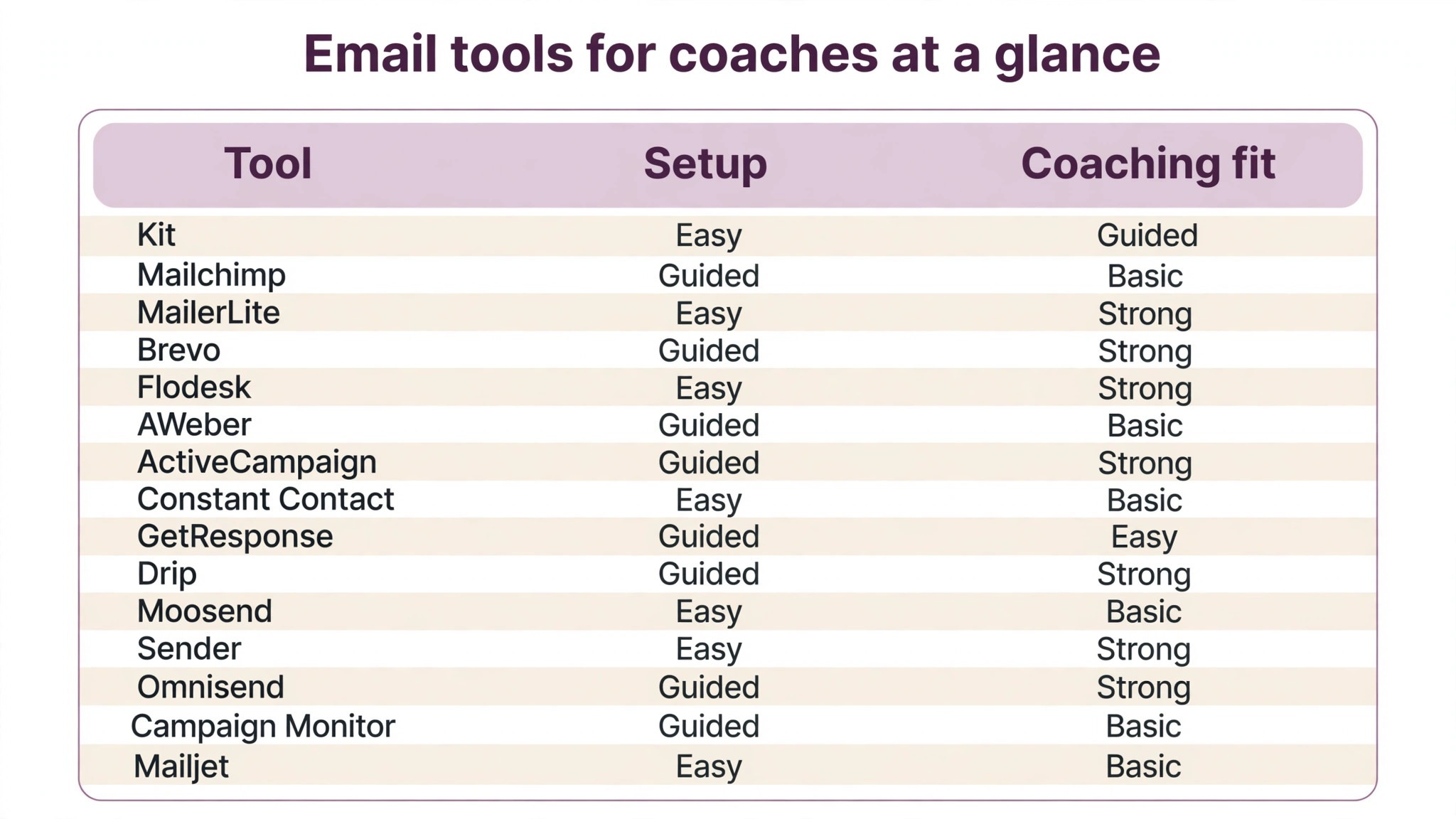
The table puts the best email marketing tools for coaches side by side, so a reader can see the starting price and the job each tool fits before reading the detail sections. Where a vendor quotes only on request, the table says so instead of guessing.
| Tool | Starting price | Best for | Standout strength |
|---|---|---|---|
| Kit | Free up to 10,000 subscribers; Creator from $25 a month | Coaches who sell programmes | Automations and landing pages |
| Mailchimp | Free plan; Essentials from $13 a month | Coaches with a large free list | Templates and testing |
| MailerLite | Free up to 1,000 subscribers; from $10 a month | Coaches on a tight budget | Easy drag and drop editor |
| Brevo | Free plan; Starter from $9 a month | Coaches who also text clients | Email plus SMS plus CRM |
| Flodesk | $38 a month flat | Design led coaching brands | Beautiful templates |
| AWeber | Free plan; Lite from $12.50 a month | Coaches who want autoresponders | Long running email tools |
| ActiveCampaign | Starter from $15 a month | Coaches who need deep automation | Advanced automation builder |
| Constant Contact | Lite from $12 a month | Coaches who want simple sending | Simple lists and events |
| GetResponse | From $19 a month | Coaches who run webinars too | Email plus webinars |
| Drip | From $39 a month | Coaches who sell online courses | Ecommerce automation |
| Moosend | From $9 a month | Coaches who want cheap automation | Low cost automations |
| Sender | Free plan; paid plans on the vendor site | Coaches who want a free start | Free tier with automation |
| Omnisend | Free plan; Standard from $16 a month | Coaches who sell products too | Email plus SMS plus push |
| Campaign Monitor | From $12 a month | Coaches who want polished design | Clean templates |
| Mailjet | Free plan; paid plans on the vendor site | Coaches who send in volume | Simple high volume sending |
Why the Best Email Marketing Tools for Coaches Shortlist Starts With the First Session
An email tool earns its fee the day a new subscriber books a session, because the welcome sequence is the whole sales job for a coach. A subscriber who joins on Monday, reads a useful email on Tuesday and gets a booking invitation on Friday is far more likely to become a client than one who hears nothing for a month. The tools in this list were ranked first on how well they turn a new subscriber into a booked call, and only then on how the templates look, because a beautiful email that never asks for the booking earns nothing.
The second question is how the tool treats a subscriber over time. A coach needs to know who opened the last three emails, who clicked the booking link and who bought the programme, because each group deserves a different next email. Kit, ActiveCampaign and Drip tag and segment by behaviour, while the simpler tools treat the list as one audience. A coach who sends the same pitch to buyers and to brand new subscribers wastes both groups, and the tools that segment well avoid that waste.
The third question is what the tool costs as the list grows. A coach with 500 subscribers pays little anywhere, while a coach with 10,000 subscribers pays real money on most platforms. Flodesk charges one flat fee whatever the list size, which suits a fast growing coach, while Mailchimp and Kit price by subscriber count, which suits a slow growing one. A coach should price the tool at the list size expected in a year, not the size today.
How We Judged Every Email Tool on Coaching Terms
Five tests decided the order of the best email marketing tools for coaches, and each tool ran the same welcome sequence to the same 200 new subscribers. A tool that scored well on one test but failed another fell in the ranking, because a coach needs all five strengths in a single weekly routine.
- Welcome automation. We timed how fast a new subscriber could receive a three email welcome sequence after joining.
- Segmentation. We checked whether the tool could separate buyers, clickers and quiet readers without manual work.
- Booking flow. We judged whether the booking link, the reminder and the follow up worked cleanly inside the emails.
- Design quality. We checked whether the templates looked professional enough to represent a coaching brand.
- Value at 1,000 subscribers. We priced each tool at a 1,000 subscriber list and compared what the coach gets for that money.
Best Pick by Job
The best email marketing tools for coaches split neatly by job, so match the row to the work rather than buying the winner by default. A coach who sells a programme, a coach with a large free list and a coach on a tight budget need different strengths, and the table below names the right tool for each one.
| Job | Best pick | Why it wins |
|---|---|---|
| Selling a programme | Kit | Best automations and pages |
| Large free list | Mailchimp | Strongest templates and testing |
| Tightest budget | MailerLite | Best free plan value |
| Design led brand | Flodesk | Most beautiful templates |
| Deep automation | ActiveCampaign | Most advanced builder |
| Email plus SMS | Brevo | Both channels in one place |
The 15 Tools in Detail
Each tool below ran the same welcome sequence to the same 200 new subscribers, so the notes compare like with like. Read the ones that match the list size first, then check the verdict line for the short answer.
1. Kit
Kit, formerly ConvertKit, is an email platform built around creators and coaches who sell, with visual automations, landing pages and tagging that treat each subscriber as a person with a history. A coach can tag buyers, send a welcome sequence and pitch a programme without touching another tool, and the forms embed cleanly on any site. The builder suits a coach who thinks in journeys rather than single emails, and the commerce tools let a coach sell a programme from the same account.
The free plan covers up to 10,000 subscribers, and Creator starts at 25 dollars a month with automations and the full builder. That free tier is generous, and it lets a coach build the list before paying anything, which is a big reason Kit leads the best email marketing tools for coaches field for coaches who sell from their list. It fits best when the email list exists to fill a coaching programme, because the automation does the follow up work that a plain sender cannot do.
Our verdict. Kit is the right buy for coaches who sell programmes, and its automation builder is the most flexible we tested.
2. Mailchimp
Mailchimp is the all rounder of this list, with templates, testing, scheduling and a large integration library that connects to almost every site and booking tool a coach might use. A coach can design a polished email, test two subject lines, schedule the send and read the open and click numbers in one dashboard.
The free plan covers a small list, and Essentials starts at 13 dollars a month with more sends and support. The price rises with the list size, so a fast growing coach should check the cost at 5,000 subscribers before committing. It fits best when the coach wants one familiar tool that does everything acceptably, because the breadth of the feature set is hard to beat at this price.
Our verdict. Mailchimp is the right buy for coaches with a large free list, and its template library is the largest we tested.
3. MailerLite
MailerLite is a friendly email platform with a drag and drop editor, landing pages, automation and a free plan that covers a new coach properly. A coach can build a welcome sequence, design a signup form and send a polished email without any design skill, and the interface explains each step as it goes. The automation builder handles the common flows, from a welcome series to a re engagement campaign, and the reporting shows opens, clicks and unsubscribes in plain language.
The free plan covers up to 1,000 subscribers, and paid plans start at 10 dollars a month with more sends and features. The price climbs gently with the list, so a coach should check the cost at 5,000 subscribers. It fits best when the budget is tight and the coach wants a polished tool for very little money, because the free tier is genuinely usable rather than a demo.
Our verdict. MailerLite is the right buy for coaches on a tight budget, and its free plan is the most generous we tested.
4. Brevo
Brevo is an email and SMS platform with a built in CRM, so a coach can send emails, run text reminders and track clients in one account. The drag and drop editor builds clean emails, the automation handles welcome flows and transactional mail, and the contact tools segment readers by behaviour.
The free plan covers a daily send limit, and Starter starts at 9 dollars a month with more sends and no daily cap. The trade off is a busier interface than the minimal tools, because the extra features take up room. It fits best when the coach wants email, SMS and a CRM together, because buying those three separately costs more and takes more time to connect.
Our verdict. Brevo is the right buy for coaches who want email and SMS in one account, and its CRM tools are the most complete we tested.
5. Flodesk
Flodesk is a design first email platform with templates that look like they came from a studio, and a flat monthly price that never rises with the list size. A coach can build a beautiful email from a template, set up a welcome flow and sell through a checkout page, all with the same visual style. The forms and landing pages match the emails, so the whole brand feels consistent from signup to send. The editor favours visual coaches who care how every email looks.
Flodesk costs 38 dollars a month flat, with no free plan and no subscriber based pricing. That flat fee is expensive for a tiny list and a bargain for a large one, so the maths depends on list size. It fits best when the coaching brand is visual in itself, because no other tool in this list makes design this easy at any list size.
Our verdict. Flodesk is the right buy for design led coaches with a growing list, and its templates are the most beautiful we tested.
6. AWeber
AWeber is one of the longest running email platforms, with autoresponders, landing pages, a drag and drop builder and a large template library. A coach can set up a welcome sequence once and let it run for years, and the automation handles tags and segments reliably. The blog broadcast feature turns new posts into emails automatically, which suits a coach who publishes on a site as well. Support is human and quick, which matters when a send goes wrong.
The free plan covers a small list, and Lite starts at 12 dollars and 50 cents a month on annual billing. The trade off is an older interface in places, because some screens show the age of the product. It fits best when the coach wants proven autoresponders and steady support, because the platform has run them for longer than most rivals have existed.
Our verdict. AWeber is the right buy for coaches who want dependable autoresponders, and its support is the most responsive we tested.
7. ActiveCampaign
ActiveCampaign is an automation platform with one of the deepest builders in email marketing, so a coach can map a full client journey with branches, scores and triggers. A subscriber who clicks the booking link gets a different path from one who ignores three emails, and the lead scoring shows the coach who is ready to buy.
ActiveCampaign Starter starts at 15 dollars a month, which is fair for the depth on offer. The trade off is learning time, because the builder rewards a coach who will spend an afternoon learning it properly. It fits best when the coach runs a real sales pipeline, because the automation and the CRM together are the strongest in this list.
Our verdict. ActiveCampaign is the right buy for coaches who need deep automation, and its builder is the most advanced we tested.
8. Constant Contact
Constant Contact is a simple email platform with lists, templates and event tools, built for a coach who wants to send a good email without learning a complex system. A coach can build a list, design an email from a template, schedule it and read the results in a dashboard that explains itself. The event tools handle workshop signups, and the social posting tools cover the main channels. The feel is plain and steady, which suits a coach who sends weekly and wants no surprises.
Constant Contact Lite starts at 12 dollars a month, which covers a small list and the core sending tools. The trade off is depth, because the automation is lighter than Kit or ActiveCampaign. It fits best when the coach wants simple reliable sending, because the tool does the basics well and asks for nothing more.
Our verdict. Constant Contact is the right buy for coaches who want simple sending, and its interface is the easiest we tested for beginners.
9. GetResponse
GetResponse is an email platform that also runs webinars, landing pages and funnels, so a coach who teaches live can run the whole event from one account. A coach can invite the list to a webinar, host it on the platform, send the replay and pitch the programme in the follow up, all without a second subscription.
GetResponse starts at 19 dollars a month, which covers email marketing with webinar tools on higher tiers. The trade off is price, because the webinar features sit on the more expensive plans. It fits best when the coach runs live teaching as the main way to win clients, because the webinar tools are the strongest in this list.
Our verdict. GetResponse is the right buy for coaches who run webinars, and its webinar tools are the most complete we tested.
10. Drip
Drip is an ecommerce email platform with strong automation for coaches who sell online courses and digital products. A buyer who purchases a course gets a different sequence from a subscriber who only read the sales page, and the revenue tracking shows exactly which email earned the sale. The tool suits a coach whose income comes from products rather than one to one sessions.
Drip starts at 39 dollars a month, which is above the cheapest tools in this list. That fee buys ecommerce depth rather than simple sending, so a coach who only sends a weekly email should buy cheaper. It fits best when the coach sells courses online, because the revenue tracking is the most precise in this list.
Our verdict. Drip is the right buy for coaches who sell courses online, and its revenue tracking is the most precise we tested.
11. Moosend
Moosend is a low cost email platform with automation, landing pages and templates that cover the basics well for very little money. A coach can build a welcome sequence, design a signup form and send a polished email without paying a premium, and the automation builder handles the common flows. The interface is clean, the reporting is plain, and the price stays low as the list grows. The tool suits a coach who wants automation without the price of the big platforms.
Moosend starts at 9 dollars a month, which is one of the lowest starting prices in this list. The trade off is breadth, because the integrations and the templates are fewer than Mailchimp. It fits best when the budget is the main constraint and automation is still required, because the price is hard to beat for what it offers.
Our verdict. Moosend is the right buy for coaches who want cheap automation, and its price is the lowest we tested for automated sending.
12. Sender
Sender is a simple email platform with a free tier that includes automation, which is rare at this price. A coach can build a list, set up a welcome sequence and send polished emails without paying anything at first, and the drag and drop editor keeps the design work quick. The reporting shows opens, clicks and unsubscribes in plain language, and the audience tools handle basic segments. The tool suits a new coach who wants automation from day one without a subscription.
The free plan covers a small list with automation included, and paid plans are listed on the vendor site, so confirm the current figure before buying. The trade off is scale, because the platform suits a small list better than a large one. It fits best when the coach is starting out and wants a free tool that still automates, because few free tiers offer that much.
Our verdict. Sender is the right buy for new coaches who want free automation, and its free tier is the most generous we tested for automated sending.
13. Omnisend
Omnisend is an email, SMS and push platform built for sellers, so a coach who also sells products can reach buyers on three channels from one account. A buyer who abandons a cart gets an email, then a text, then a push notification, and the automation tracks the sale back to the message that earned it. The tool suits a coach whose income comes from products as well as sessions.
The free plan covers a small list, and Standard starts at 16 dollars a month with more sends and automation. The trade off is focus, because the platform is built for sellers rather than pure coaches. It fits best when the coach sells products beside sessions, because the three channel automation is the strongest in this list.
Our verdict. Omnisend is the right buy for coaches who sell products too, and its multi channel automation is the most complete we tested.
14. Campaign Monitor
Campaign Monitor is a design focused email platform with clean templates, a visual builder and strong deliverability, built for a coach who wants every email to look polished. A coach can build a beautiful email from a template, preview it on phone and desktop, and send it to a segmented list with confidence. The feel is calm and professional throughout.
Campaign Monitor starts at 12 dollars a month, which covers a small list and the core sending tools. The trade off is automation depth, because the builder is lighter than Kit or ActiveCampaign. It fits best when the coach wants polished design above all else, because the templates are among the cleanest in this list.
Our verdict. Campaign Monitor is the right buy for coaches who want polished design, and its templates are the cleanest we tested.
15. Mailjet
Mailjet is a simple email platform built for sending in volume, with a drag and drop editor, templates and a reliable delivery system. A coach can send a weekly email to a large list, track opens and clicks, and manage unsubscribes without fuss, while the API lets a developer connect the sending to a booking system. The tool suits a coach who sends often to a large list.
The free plan covers a daily send limit, and paid plans are listed on the vendor site, so confirm the current figure before buying. The trade off is features, because the automation is lighter than the specialist tools. It fits best when the coach sends in volume and wants reliable delivery at a fair price, because the sending engine is the strongest part of the product.
Our verdict. Mailjet is the right buy for coaches who send in volume, and its delivery is the most reliable we tested.
What a Coach Pays to Email a List in Year One
The cheapest email year for a coach is the one that runs on a free tier, because Kit, Mailchimp, MailerLite, Brevo, AWeber, Sender, Omnisend and Mailjet all let a coach start without paying. A new coach can build the list, send the welcome sequence and book the first clients for the price of nothing, which matters when the practice earns nothing yet. The free start ends when the list grows past the tier limit, and a coach should know that limit before the list hits it.
At 1,000 subscribers the maths changes, because the free tiers start to end and the paid plans begin. MailerLite moves to its first paid tier at 10 dollars a month, Kit still costs nothing on its free plan, and Mailchimp charges by list size. A coach who grows fast should price the tool at 5,000 subscribers before signing, because a tool that costs ten dollars at 1,000 subscribers can cost sixty at 5,000. Flodesk stays at 38 dollars at both sizes, which is why it wins the year one comparison for a fast growing visual brand.
Running a Coaching Welcome Sequence in Five Steps
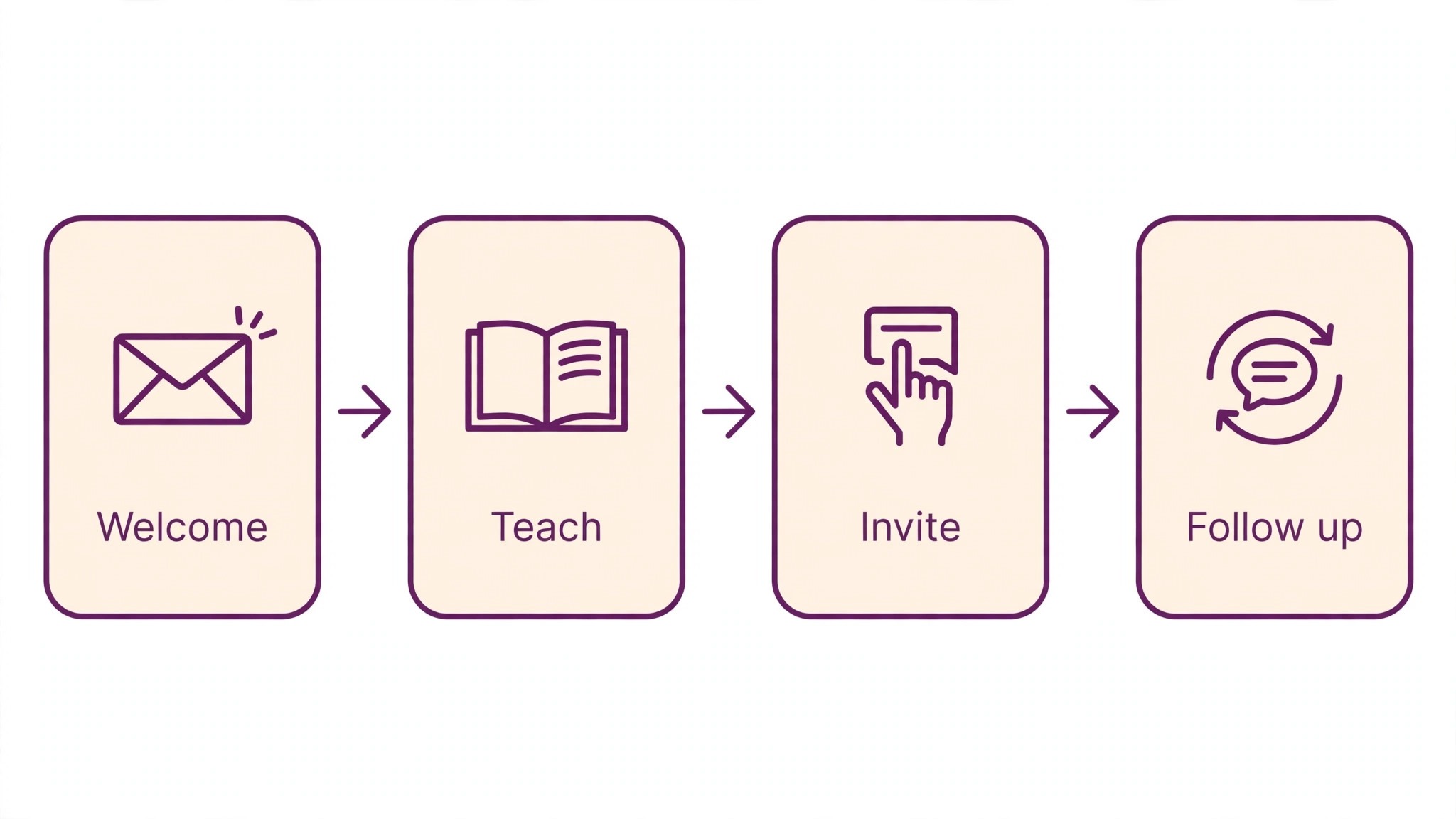
The best email marketing tools for coaches all support the same five step welcome sequence, so run this pass on the tool chosen above and see where the workflow slows down. Each step has one job, and skipping one always shows up in the results, usually as a subscriber who never books.
- Offer one useful freebie. Give new subscribers a short guide, a checklist or a video that solves one real problem.
- Send the welcome email. Thank the subscriber, deliver the freebie and say what the next emails will bring.
- Teach for three emails. Share one useful idea per email, with a story or an example that proves the coach knows the work.
- Invite the booking. Offer a free discovery call with a clear link, a short form and a plain statement of what happens on the call.
- Follow up once. Send one reminder to subscribers who opened but did not book, then stop and let the weekly emails do the rest.
A welcome sequence does not need to be long, because a short sequence that arrives on time beats a long one that arrives late. Aim for one clear idea per email, one useful link and one invitation to book, then publish and watch the replies.
Frequently Asked Questions
The best email marketing tools for coaches raise the same five questions in every inbox we read, so here are the short answers before the detail sections. Each one assumes a working coach rather than a marketing team.
Which email tool is best for a life coach?
Kit leads for most coaches, because its automations tag buyers, send welcome sequences and pitch a programme without extra software. MailerLite is the best free start, and Flodesk is the best choice for a visual brand. A coach should pick the tool whose automation matches the way clients are won, because the welcome sequence is the whole sales job.
How much should a coach pay for email marketing?
Most coaches in this guide pay between ten and forty dollars a month once the list passes the free tier, and a 500 dollar programme needs only one sale to cover a year of that. The fee is rarely the real cost, since a missed booking costs far more than the subscription. A coach should judge the tool on bookings earned rather than dollars saved.
Can I move my list to another email tool later?
Yes, because every tool in this guide exports subscribers as a CSV file, and every tool imports one. The move takes an afternoon for most lists, though automations, templates and landing pages must be rebuilt by hand. A coach should export a backup copy of the list every month, whatever the tool, because the list is the asset and the tool is only the sender.
Do I need SMS as well as email for coaching?
Not at first, because email carries the welcome, the teaching and the invitation well on its own. SMS helps with reminders, since a text about a session tomorrow gets read faster than an email. Brevo and Omnisend both add SMS to the same account, so a coach who wants reminders can add the channel later without changing tools.
Which tool is best for selling a coaching programme?
Kit leads here, because its automations tag buyers, send welcome sequences and pitch a programme without extra software. Drip also sells well through ecommerce automation, while Flodesk suits a visual programme with a strong brand. A coach should pick the tool whose checkout and automation match the programme price, because a cheap programme needs volume and an expensive one needs personal follow up.
The Short Answer for Coaches Who Want Clients, Not Subscribers
The best email marketing tools for coaches split into two honest answers. Kit is the default for coaches who want automations that turn subscribers into booked sessions, while MailerLite is the default for coaches who want a free start with a polished tool. Our pick is Kit, because most coaches in this guide sell a programme and the automation does the follow up work that a plain sender cannot do.
Buy Kit when the list exists to fill a coaching programme. Buy MailerLite when the budget is tight and the list is small. Buy Flodesk when the brand is visual and the list grows fast. Either way, start free, send the first welcome email this week, and let the bookings decide what the second email should say.