

What happens the week an auditor asks for proof that every AI system in the company was checked, and the team has the checks spread across spreadsheets, emails and memory? The top 10 ai risk management tools answer that question with a single register, because each one gathers risks, controls, evidence and sign offs into one place an auditor can actually read. A company that can show its work in an afternoon passes the audit, while a company that hunts through folders for a week fails it before the meeting starts.
The cost of a weak risk register is easy to count once the first incident lands. A model that makes a biased hiring decision, a chatbot that leaks customer data, or a vendor tool that nobody vetted can each cost a company far more than a year of software. The tools in this guide do not remove risk, and no honest vendor claims they do, but they make the risk visible, assigned and tracked, which is what boards and regulators actually ask for.
The ten tools below split into two camps, and the split matters more than any single feature. Drata, Vanta and LogicGate are built for teams that want compliance frameworks and AI governance in one workflow, while AuditBoard, MetricStream and RSA Archer are built for larger risk teams with deep audit programmes. A mid sized company that buys an enterprise platform pays enterprise money for reports nobody reads, while a company that buys a light tool for a heavy audit programme runs out of depth at the worst moment.
Below, the glance table lines up all ten tools on price and best use, the judging section explains the five tests, and the detail sections give each tool a fair hearing. Read the best pick table first if time is short, then the year one pricing section, because that section shows what each tool costs when the company tracks fifty AI systems instead of five.
In this article
- The 10 Tools at a Glance
- Why the Top 10 AI Risk Management Tools Shortlist Starts With the Audit Question
- How We Judged Every Risk Tool on Audit Readiness
- Best Pick by Job
- The 10 Tools in Detail
- What a Risk Programme Costs in Year One
- Running Your First AI Risk Review in Five Steps
- Frequently Asked Questions
- The Short Answer for Teams That Need Proof, Not Promises
The 10 Tools at a Glance
The table puts the top 10 ai risk management tools side by side, so a reader can see the starting price and the job each tool fits before reading the detail sections. Where a vendor quotes only on request, the table says so plainly rather than guessing a figure.
| Tool | Starting price | Best for | Standout strength |
|---|---|---|---|
| Drata | Pricing on the vendor site | Teams that want fast compliance | Automated evidence collection |
| Vanta | Pricing on the vendor site | Startups that need trust reports | Quick framework setup |
| LogicGate | Pricing on the vendor site | Teams that build custom workflows | Flexible risk workflows |
| AuditBoard | Pricing on the vendor site | Audit led risk teams | Audit and risk in one suite |
| OneTrust | Pricing on the vendor site | Teams that govern data and AI | Privacy plus AI governance |
| Resolver | Pricing on the vendor site | Teams that manage incidents | Incident and case tracking |
| MetricStream | Pricing on the vendor site | Large risk programmes | Deep GRC coverage |
| RSA Archer | Pricing on the vendor site | Enterprises with complex risk | Mature risk platform |
| ServiceNow | Pricing on the vendor site | Teams already on ServiceNow | GRC inside a known platform |
| Riskonnect | Pricing on the vendor site | Teams that manage claims too | Risk plus claims handling |
Why the Top 10 AI Risk Management Tools Shortlist Starts With the Audit Question
A risk tool earns its fee the day an auditor asks for evidence, because a register without proof is only a list of good intentions. The auditor wants to see the risk, the control, the test result and the sign off, all linked and dated, and a tool that stores those four things together turns a three week audit into a three day one. The tools in this list were ranked first on how well they tie evidence to risk, and only then on how the dashboards look, because a beautiful dashboard cannot pass an audit on its own.
The second question is how much of the work the tool does by itself. Drata and Vanta connect to the systems a company already runs and pull evidence automatically, which saves the team from chasing screenshots every quarter. LogicGate and AuditBoard lean more on workflows the team designs, which suits a company with unusual processes. A team with two people and fifty systems needs automation, while a team with twenty people and five systems can afford manual steps.
The third question is whether the tool understands AI risk as its own subject or treats it as another row in a generic register. OneTrust and Drata both carry AI governance features, from model inventories to bias checks, while the older GRC platforms handle AI risk through custom fields. A company whose main exposure is AI models should pick a tool that names those risks properly, because a generic register hides the very risks the board is asking about.
How We Judged Every Risk Tool on Audit Readiness
Five tests decided the order of the top 10 ai risk management tools, and each tool ran the same fictional audit of a company with twelve AI systems. A tool that scored well on one test but failed another fell in the ranking, because a risk team needs all five strengths in a single quarterly routine.
- Evidence linking. We checked whether each risk tied to its control, its test result and its sign off without manual work.
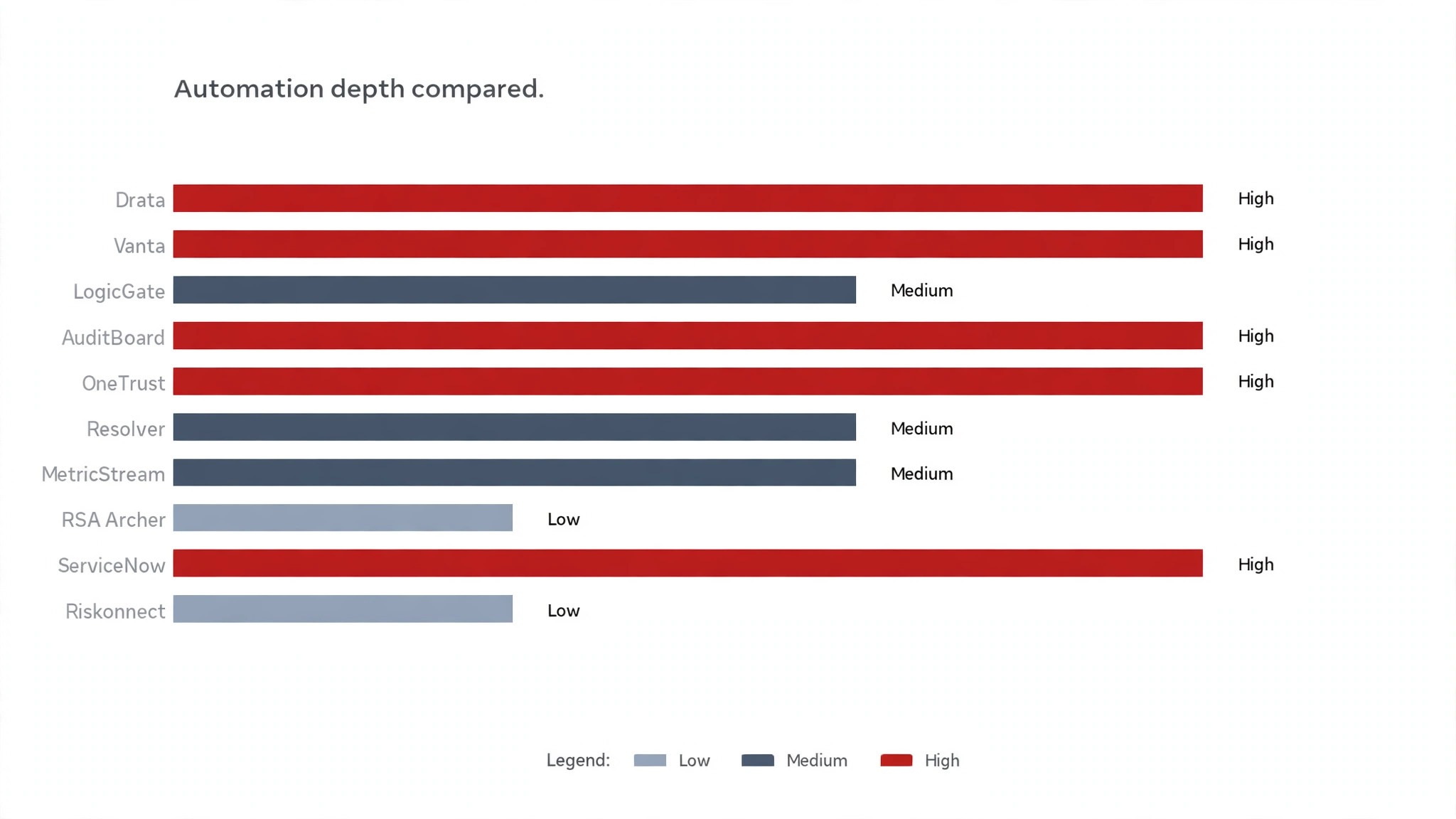
- Automation depth. We counted how many evidence checks ran by themselves through integrations rather than by hand.
- AI governance. We judged whether the tool carried model inventories, bias checks and vendor AI assessments as first class features.
- Reporting. We checked whether the board pack, the audit trail and the risk heat map came out clean and current.
- Value for a mid sized team. We priced each tool for a team of five and fifty tracked systems, and compared what the team gets for that money.
Best Pick by Job
The top 10 ai risk management tools split neatly by job, so match the row to the work rather than buying the winner by default. A startup that needs a trust report, an audit led team and a company already on ServiceNow need different strengths, and the table below names the right tool for each one.
| Job | Best pick | Why it wins |
|---|---|---|
| Fastest compliance setup | Drata | Best automated evidence |
| Startup trust reports | Vanta | Quickest framework start |
| Custom risk workflows | LogicGate | Most flexible builder |
| Audit led teams | AuditBoard | Audit and risk together |
| Data plus AI governance | OneTrust | Privacy and AI in one place |
| Already on ServiceNow | ServiceNow | GRC inside a known platform |
The 10 Tools in Detail
Each tool below ran the same fictional audit of a company with twelve AI systems, so the notes compare like with like. Read the ones that match the team size first, then check the verdict line for the short answer.
1. Drata
Drata is a compliance automation platform that connects to the systems a company already runs and pulls evidence for security and AI governance frameworks without manual chasing. A team can watch controls stay green in real time, see which checks failed overnight, and hand an auditor a live dashboard instead of a folder of screenshots. The AI governance module carries a model inventory, risk scoring and vendor assessments, which suits a company whose audit scope now includes its models. The setup is guided, and most teams see their first framework live within weeks.
A The plans scale by framework count and company size, which suits a growing team that adds standards over time. It fits best when the team is small and the evidence load is large, and that automation is why Drata leads the top 10 ai risk management tools field for teams that need proof without the chasing.
The integrations deserve a closer look, because they decide how much of the evidence arrives by itself. Drata connects to cloud providers, identity tools and code repositories, and each connection feeds controls that would otherwise need a screenshot every quarter. A team that already runs its stack on the big cloud platforms will see most checks turn green on day one, while a team with unusual in house systems should check the integration list before signing, because a missing connection means manual evidence for that system.
Our verdict. Drata is the right buy for teams that want compliance without the chasing, and its automated evidence is the strongest we tested.
2. Vanta
Vanta is a trust management platform that helps a startup prove its security and AI controls to customers and auditors quickly. The platform maps controls to frameworks such as SOC 2 and ISO 27001, runs automated checks against connected systems, and produces a trust report a buyer can read without a meeting. A small team can move from a blank account to a credible security story in weeks, and the questionnaire automation answers vendor security forms that used to take days.
A The plans scale by company size and framework count, which suits a startup that adds customers faster than it adds staff. It fits best when the goal is winning deals with proof of good controls, because the trust report is the feature buyers actually ask to see.
The questionnaire automation is the feature buyers notice first, because vendor security forms used to eat days of staff time. Vanta answers the standard questions from live control data, and a human reviews the rest before it goes out. A startup that answers ten security questionnaires a quarter saves real hours here, and the trust centre lets buyers read the security posture without booking a call, which shortens the sales cycle for the whole company.
Our verdict. Vanta is the right buy for startups that need trust fast, and its framework setup is the quickest we tested.
3. LogicGate
LogicGate is a risk workflow platform that lets a team design its own risk processes with a drag and drop builder, rather than forcing the team into a fixed template. A risk manager can build an AI risk assessment, a vendor review and an incident workflow that match the company exactly, and the reporting shows where each item sits. The platform suits a company whose risks do not fit a standard framework, because the builder bends to the process instead of the other way round.
A The plans scale by user count and workflow complexity, which suits a team that grows its risk programme gradually. It fits best when the company has unusual processes that a fixed platform cannot hold, because the builder is the whole point of the product.
The reporting tools reward a team that builds its workflows carefully, because every field in a workflow can appear in a report. A risk manager can show the board how many assessments finished late, which vendor reviews are overdue and where incidents cluster, all from live data. The trade off is the build time, since a workflow that takes a week to design properly will not pay off until the second or third cycle, so a team should start with one process and prove it before building five.
Our verdict. LogicGate is the right buy for teams that need custom workflows, and its builder is the most flexible we tested.
4. AuditBoard
AuditBoard is a connected risk suite that pairs audit management with risk management, so the same platform holds the audit plan, the risk register and the controls. An audit team can plan the year, run fieldwork, track findings and watch risks in one place, and the board reporting pulls from live data rather than a spreadsheet. The SOX and internal audit tools are mature, and the risk module links each risk to the audits that test it.
B The plans are aimed at teams with a real audit function, which puts the price above the lighter tools in this list. It fits best when audit leads the risk programme, because the audit tools are the strongest part of the suite.
The audit planning tools are where AuditBoard earns its keep for a larger team, because the annual plan, the resource schedule and the fieldwork all live in one place. An audit manager can see which audits are behind, which findings are open and which risks have no coverage, without opening a spreadsheet. The platform suits a team that runs dozens of audits a year, while a team that runs two audits a year will find much of the depth unused.
Our verdict. AuditBoard is the right buy for audit led teams, and its audit workflow is the most complete we tested.
5. OneTrust
OneTrust is a trust intelligence platform that covers privacy, data governance and AI governance in one place, so a team can track personal data, consent and AI models together. The AI governance module holds a model inventory, runs risk assessments and maps models to regulations, while the privacy tools handle data mapping and subject requests. A company that answers to several regulators will value the single register, because the same model can carry privacy and AI risks side by side.
B The plans are modular, which lets a team buy privacy first and add AI governance later. It fits best when data and AI risks overlap, because few tools in this list cover both subjects that well.
The regulatory mapping is the quiet strength of the platform, because a single model can carry obligations from several rules at once. A team can see which models fall under European AI rules, which hold personal data and which need a bias review, all from one register. That mapping saves a compliance officer from keeping three separate spreadsheets, and it makes the board pack shorter, since one page can show the whole obligation picture.
Our verdict. OneTrust is the right buy for teams that govern data and AI together, and its regulatory mapping is the most complete we tested.
6. Resolver
Resolver is a risk and incident management platform that tracks risks, incidents and investigations in one case system. A team can log an AI incident, assign it, investigate it and link the fix back to the risk it came from, which closes the loop that most registers leave open. The reporting shows incident trends and repeat causes, and the workflow tools suit a team that handles a steady flow of cases rather than a quarterly review.
C The plans scale by user count and module, which suits a team that starts with incidents and adds risk later. It fits best when the team spends its days on cases rather than frameworks, because the case tracking is the strongest part of the product.
The analytics reward a team that logs every incident honestly, because trends only appear when the data is complete. A manager can see which incident types repeat, which teams close cases slowly and which risks produce the most claims, then act on the pattern rather than the single case. The platform suits a team that treats incidents as data, while a team that only logs the serious cases will miss the pattern entirely.
Our verdict. Resolver is the right buy for teams that manage incidents daily, and its case tracking is the most thorough we tested.
7. MetricStream
MetricStream is a large GRC platform that covers risk, compliance, audit and third party management in depth, with workflows that suit a company with a mature risk programme. The risk module holds registers, assessments, controls and key indicators, and the reporting serves boards and regulators alike. A large team can run the whole programme in one system, and the integrations connect to the business systems that feed it.
C The plans are aimed at large programmes with enterprise budgets, which puts the price above the lighter tools in this list. It fits best when the risk programme is large and formal, because the depth is the product here.
Our verdict. MetricStream is the right buy for large risk programmes, and its GRC coverage is the deepest we tested.
8. RSA Archer
RSA Archer is a long running GRC platform that enterprises use to manage risk, compliance and audit across many business units. The platform is highly configurable, with a large library of use cases and a mature control framework, and it handles complex hierarchies that smaller tools cannot. A global company can run regional risk registers under one corporate view, and the reporting serves both local managers and the board.
C The plans are enterprise priced, and the implementation needs real effort from the team. It fits best when the company is large and the risk structure is complex, because the configurability is what enterprises pay for.
Our verdict. RSA Archer is the right buy for enterprises with complex risk, and its configurability is the most mature we tested.
9. ServiceNow
ServiceNow is a workflow platform whose GRC module brings risk, policy and compliance into a system many companies already run for IT service. A team that already uses ServiceNow can add risk registers, control testing and audit tasks without a new login, and the workflows reuse the same approvals and notifications. The integration with IT operations is the advantage, because risks tied to systems and incidents stay linked automatically.
D The GRC module is an add on to the platform, which suits a company already paying for ServiceNow. It fits best when the team already lives in ServiceNow, because adding a new platform for risk alone rarely pays off.
The approval workflows are the practical advantage for a company already on the platform, because risk sign offs reuse the same managers, groups and notifications as IT tickets. A control owner gets a task in the same queue as their other work, which means it gets done rather than sitting in an unfamiliar inbox. The trade off is licensing, since the GRC module adds cost on top of a platform the company already pays for, so the finance team should see the full figure.
Our verdict. ServiceNow is the right buy for teams already on the platform, and its IT integration is the tightest we tested.
10. Riskonnect
Riskonnect is a risk management platform that pairs traditional risk registers with claims handling, so a company can track a risk and the claims it produces in one place. The tools cover incident intake, claims, insurance and risk analytics, and the dashboards show the cost of risk alongside its likelihood. A team that manages insurance claims will value the combined view, because the claim history informs the risk score directly.
D The plans are aimed at mid sized and large teams with a real claims load. It fits best when claims are part of the risk job, because few tools in this list handle both sides.
Our verdict. Riskonnect is the right buy for teams that manage claims too, and its claims tools are the most complete we tested.
What a Risk Programme Costs in Year One
The cheapest risk programme in year one is the one the team actually uses, because a platform that sits empty costs the full fee and delivers nothing. Drata and Vanta both price on the vendor site, so a team should ask for a written quote that covers the frameworks, the user count and the number of tracked systems before signing. A quote that leaves out onboarding or extra frameworks is not a complete price, whatever the headline says.
At fifty tracked AI systems the maths changes, because some plans charge by system count and others by user count. A tool that prices by user stays cheap when the systems grow, while a tool that prices by system grows with the register. A team should price the platform at the system count expected in a year, not the count today, because AI adoption moves faster than most budgets assume.
The implementation cost deserves its own line in the budget, because enterprise platforms need weeks of setup while lighter tools go live in days. RSA Archer and MetricStream need a real project with staff time, while Drata and Vanta ship with guided setup. A team should ask every vendor how many staff hours the first framework needs, and add that time to the year one cost before comparing two tools.
Running Your First AI Risk Review in Five Steps
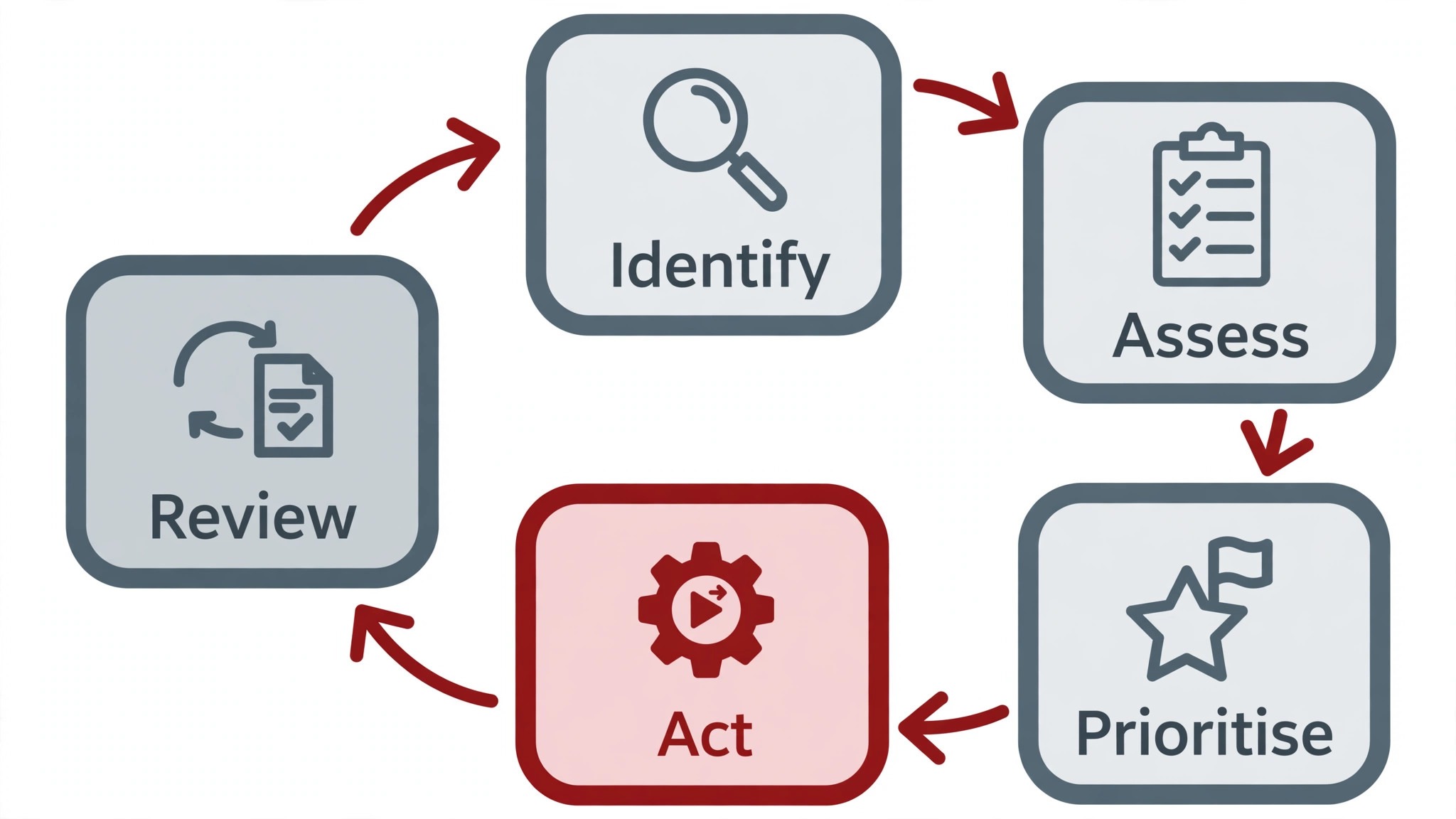
The top 10 ai risk management tools all support the same five step first review, so run this pass on the tool chosen above and see where the workflow slows down. Each step has one job, and skipping one always shows up in the results, usually as a risk with no owner or a control with no evidence.
- List the AI systems. Write down every model, vendor tool and internal system that touches decisions or data.
- Score each risk. Rate likelihood and impact for bias, data leakage, vendor failure and misuse, then rank the list.
- Assign an owner. Give every top risk a named person and a review date, because an unowned risk is an unmanaged one.
- Link the evidence. Attach the control, the test result and the sign off to each risk, so an auditor can follow the chain.
- Set the review cycle. Schedule the next review before the first one ends, and let the tool remind the owner when it falls due.
A first review does not need to cover everything, because a register with twelve honest risks beats a register with two hundred guesses. Start with the systems that touch customers or money, prove the workflow on those, and add the rest in the next cycle. The discipline of the review matters more than the size of the register.
Frequently Asked Questions
The top 10 ai risk management tools raise the same six questions in every inbox we read, so here are the short answers before the detail sections. Each one assumes a working risk team rather than a large consultancy.
Do small companies need AI risk management tools?
Yes, when they run AI systems that touch customers, money or personal data, because the risk exists whether or not a tool tracks it. A small team can start with Drata or Vanta on a single framework and grow from there. A company with no customer facing AI can wait, though the vendor tools it buys still deserve a basic assessment.
What is an AI model inventory?
It is a register of every AI model the company runs or buys, with its purpose, its data, its owner and its risk rating. OneTrust and Drata both carry one as a first class feature, while older GRC tools handle it through custom fields. An auditor will ask for it first, because a company cannot govern models it cannot list.
How long does it take to set up a risk tool?
Drata and Vanta typically go live in weeks with guided setup, while enterprise platforms such as RSA Archer and MetricStream need a longer project. The time depends on how many frameworks the team adopts and how clean the existing evidence is. A team should pilot one framework first, then add the rest once the workflow works.
Can these tools handle vendor AI risk?
Yes, because most tools in this guide carry vendor assessments that score a third party tool before the company buys it. Drata, Vanta and OneTrust all track vendor AI systems alongside internal ones. A team should assess a vendor tool before signing the contract, because the risk arrives with the purchase rather than after it.
What is the difference between GRC and AI governance?
GRC covers governance, risk and compliance across the whole company, while AI governance covers the risks of AI systems specifically, such as bias, transparency and model drift. OneTrust and Drata bridge both, while MetricStream and RSA Archer handle AI risk inside a broader GRC programme. A company whose main exposure is AI should pick a tool that names those risks properly.
How often should risks be reviewed?
Quarterly is the standard for most teams, with a faster review after any incident or major model change. The tool should remind owners when a review falls due, and the board should see the top risks at least twice a year. A register that nobody reviews is only a document, and a document does not manage risk.
The Short Answer for Teams That Need Proof, Not Promises
The top 10 ai risk management tools split into two honest answers. Drata is the default for teams that want fast compliance with automated evidence, while Vanta is the default for startups that need a trust report quickly. Our pick is Drata, because automated evidence is the feature that saves the most staff time in the first year.
Buy Drata when the team is small and the evidence load is large. Buy Vanta when the goal is winning deals with proof of good controls. Buy LogicGate when the processes are unusual and need a custom build. Either way, start with one framework, list the AI systems honestly, and let the first audit prove whether the register holds up.