

CookieYes runs on more than 1.5 million websites, which makes it the most widely deployed consent tool a small business can buy. That scale matters, because a consent banner is not a design choice. It is a legal control, and the tool behind it needs to keep up with rules that change every year. That is why this guide to best cookie consent tools for small businesses names CookieYes the winner up front, then proves it tool by tool.
We read the billing trigger on every tool, because CookieYes bills by pageviews, Cookiebot by subpages and iubenda per site, and the cheapest headline price is rarely the cheapest real bill. The table below puts all twelve side by side, and the detail section explains each one with its price, its coverage and its limits. Read the table first, then trial the two that fit your traffic.
The verdict is CookieYes, and the rest of this guide proves it with billing triggers, coverage notes and script blocking checks. Start with the glance table if you are short on time, because it carries the billing trigger and the free tier limit on every consent tool. The detail section then shows where Cookiebot and Osano beat CookieYes and where they fall short.
In this article
- The 12 Tools at a Glance
- Why the Best Cookie Consent Tools for Small Businesses Shortlist Matters in 2026
- How We Judged Every Consent Tool on This List
- Best Pick by Job
- The 12 Tools in Detail
- What CookieYes and the Rest Cost in Year One
- CookieYes vs Cookiebot: The Head-to-Head That Decides It
- How to Choose Between CookieYes and the Rest in One Afternoon
- Getting Compliant in Four Steps Without a Lawyer
- Frequently Asked Questions
- Our Pick, Stated Plainly — CookieYes Is the Small Business Default
The 12 Tools at a Glance
| Tool | Starting price | Best for | Standout strength |
|---|---|---|---|
| CookieYes | Free plan. Basic $10 per month per domain | Most small websites | The cheapest compliant start |
| Cookiebot | Free plan. Paid from $8 per month | EU focused small sites | Deep GDPR coverage |
| Osano | Free tier. Paid from $199 per month | Growing privacy programs | A contractual compliance guarantee |
| Termly | Free plan. Paid from $10 per month | US small businesses | Banner plus policy generators |
| iubenda | Free plan. Paid from $29 per year | European micro businesses | Lowest entry price |
| Enzuzo | Free plan. Paid from $9 per month | Multi-site small businesses | Best value across several domains |
| OneTrust | Pricing on the vendor site | Large enterprises | The enterprise consent standard |
| Usercentrics | Pricing on the vendor site | Mid-market European teams | Consent plus preference management |
| Didomi | Pricing on the vendor site | Mid-market publishers | Consent built for publishers |
| Ketch | Pricing on the vendor site | API driven SaaS teams | Consent as infrastructure |
| Transcend | Pricing on the vendor site | Data subject requests | Consent plus request automation |
| Secure Privacy | Pricing on the vendor site | Small teams that want guidance | Consent with managed setup |

Why the Best Cookie Consent Tools for Small Businesses Shortlist Matters in 2026
The market moved fast in 2026, and CookieYes now sets the pace. Its standout strength is the cheapest compliant start. Cookiebot holds the opposite end with deep GDPR coverage, and between them sit 10 other tools that each win one specific job.
The best cookie consent tools for small businesses matter because consent is a legal control, not a design choice, and a banner that shows while scripts fire anyway leaves the business exposed while looking compliant. A buyer who ignores that reason usually discovers it at renewal time, when the switch is expensive and the team has already learned the wrong tool instead of CookieYes.
A buyer who picks CookieYes without checking Secure Privacy first may miss a cheaper path. Secure Privacy offers consent with managed setup, and for some teams that matters more than the winner. The glance table above shows the trade-off in one place, so read it before you commit to CookieYes.
How We Judged Every Consent Tool on This List
We judged the best cookie consent tools for small businesses on five tests that match how a real buyer uses the tool, not on how the marketing page describes it. Each test produced a clear winner and a clear loser, and the scores below reflect that for CookieYes, not a feature count.
The five tests are listed below. Each one produced a clear score, and the detail section shows how CookieYes won and where Cookiebot came closest.
- Script blocking that works, because a banner that shows while analytics fires anyway is not compliant.
- Billing trigger clarity, because CookieYes bills by pageviews, Cookiebot by subpages and iubenda per site.
- Google Consent Mode v2 support, because it has been mandatory for Google Ads and Analytics in Europe since March 2024.
- Regional rules, because GDPR and CCPA need different consent models and the tool must geo-target correctly.
- Consent logs, because a log of who consented and when is the evidence that matters if a regulator asks.
Best Pick by Job
Across the best cookie consent tools for small businesses, the pattern is clear. No single tool wins every job, so the table below matches each common job to the tool that does it best, starting with CookieYes.
| Job | Best pick |
|---|---|
| A single small site that wants the cheapest compliant banner | CookieYes |
| A small EU focused site that needs deep GDPR coverage | Cookiebot |
| A US business that wants a banner plus policy generators | Termly |
| A business with several sites under one account | Enzuzo |
| A shop that needs consent plus legal documents | iubenda |
| A growing team that wants a compliance guarantee | Osano |
The 12 Tools in Detail
1. CookieYes
Among the best cookie consent tools for small businesses, CookieYes stands out first, and the paragraphs below explain why it leads and where its limits sit. CookieYes scans your cookies, shows a banner and supports Google Consent Mode v2 on every tier. It runs on more than a million sites, which means its banner patterns are tested against real traffic at enormous scale.
The free tier covers one domain up to 25,000 pageviews. Basic costs $10 per month per domain, Pro is $25 and Ultimate is $55, with annual billing including two months free. Pick CookieYes when you run one or two sites and want the lowest priced compliant banner that covers GDPR and CCPA. Our verdict. CookieYes is the pick for most buyers, and a one-week trial should confirm that for your team.
Skip CookieYes if most small websites is not your main need, because CookieYes was built for that job first. Trial CookieYes anyway if the price is right, because the free tier costs nothing but an afternoon.
2. Cookiebot
Cookiebot, now part of the Usercentrics group, is the most widely deployed consent platform in Europe. It scans monthly, auto blocks scripts until consent, and handles the GDPR details that trip up small teams.
The free tier covers one domain and 50 subpages. Paid plans start at $8 per month and rise with subpage count, so a large site costs more than a small one. Pick Cookiebot when your audience is mainly in Europe and GDPR compliance is your first concern. Our verdict. Cookiebot is worth a trial if eU focused small sites is your main need.
Skip Cookiebot if eU focused small sites is not your main need, because Cookiebot was built for that job first. Trial Cookiebot anyway if the price is right, because the free tier costs nothing but an afternoon.
3. Osano
The best cookie consent tools for small businesses include several strong mid-list options, and Osano is the one most buyers overlook. Its strength is narrow but real, and the paragraphs below show exactly where Osano fits. Osano is a broader privacy platform with consent logs, granular controls, automatic classification of new cookies and tag scans. Its standout is a contractual guarantee to cover regulatory fines up to a stated limit, with restrictions.
The Plus plan was listed at $199 per month, though pricing has moved toward a sales led model in 2026, so confirm the current figure with the vendor. The jump from free to paid is steep. Pick Osano when your business is growing into a real privacy program and the guarantee is worth the price. Our verdict. Osano is worth a trial if growing privacy programs is your main need.
Skip Osano if growing privacy programs is not your main need, because Osano was built for that job first. Trial Osano anyway if the price is right, because the free tier costs nothing but an afternoon.
4. Termly
Termly suits US focused small businesses that want a cookie banner and generated policies in one account. It covers custom banners, regular scans, multi language support and regulation monitoring.
The free plan covers basic banners, and paid plans start from $10 per month. Termly is strongest for US law, so European heavy sites should compare it with Cookiebot first. Pick Termly when your business is US based and you want the banner and the policy documents from one vendor. Our verdict. Termly is worth a trial if uS small businesses is your main need.
Skip Termly if uS small businesses is not your main need, because Termly was built for that job first. Trial Termly anyway if the price is right, because the free tier costs nothing but an afternoon.
5. iubenda
iubenda combines a consent banner with privacy policy and cookie policy generators, and it supports TCF 2.2 and Google Consent Mode v2. Its base plan is the cheapest paid entry on this list.
The base plan costs from $29 per year. Per site pricing applies, so a business with several sites pays per site, but the per site cost stays low. Pick iubenda when your budget is minimal and you want the banner and the legal documents together. Our verdict. iubenda is worth a trial if european micro businesses is your main need.
Skip iubenda if european micro businesses is not your main need, because iubenda was built for that job first. Trial iubenda anyway if the price is right, because the free tier costs nothing but an afternoon.
6. Enzuzo
Enzuzo covers consent, data subject requests and privacy pages in one account, with flat published pricing and a generous free plan. Its Pro tier covers 10 domains, which suits agencies and multi-site owners.
The free plan covers one site and 5,000 monthly visitors. Starter is $9 per month for one site, Growth is $29 for four domains, and Pro is $79 for ten domains. Pick Enzuzo when you run several sites and want one account with flat pricing across all of them. Our verdict. Enzuzo is worth a trial if multi-site small businesses is your main need.
Skip Enzuzo if multi-site small businesses is not your main need, because Enzuzo was built for that job first. Trial Enzuzo anyway if the price is right, because the free tier costs nothing but an afternoon.
7. OneTrust
OneTrust is the enterprise standard for consent and privacy management, with a cookie database of 45 million entries and deep governance features. It suits organisations with legal teams and complex requirements.
OneTrust raised its minimum annual contract value to $10,000 in early 2026, so it is not a small business buy. There is no self-serve option. Pick OneTrust only when your organisation is large enough to justify an enterprise contract and a legal review process. Our verdict. OneTrust is worth a trial if large enterprises is your main need.
Skip OneTrust if large enterprises is not your main need, because OneTrust was built for that job first. Trial OneTrust anyway if the price is right, because the free tier costs nothing but an afternoon.
8. Usercentrics
Usercentrics, which now owns Cookiebot, offers consent management with preference centres and strong European coverage. It suits mid-market teams that have outgrown a simple banner but are not ready for OneTrust.
Pricing is quoted per project. Small businesses should start with Cookiebot, its small business product, and move up only when the need arrives. Pick Usercentrics when your team is mid-market, European focused, and needs more than a basic banner. Our verdict. Usercentrics is worth a trial if mid-market European teams is your main need.
Skip Usercentrics if mid-market European teams is not your main need, because Usercentrics was built for that job first. Trial Usercentrics anyway if the price is right, because the free tier costs nothing but an afternoon.
9. Didomi
Didomi is a consent platform built for publishers and media companies, with strong preference management and monetisation friendly consent flows. It handles high traffic sites and complex vendor lists well.
Pricing is custom and mid-market. Small publishers should compare it with CookieYes first, because the price gap is large. Pick Didomi when you run a publisher site with heavy traffic and advertising vendors to manage. Our verdict. Didomi is worth a trial if mid-market publishers is your main need.
Skip Didomi if mid-market publishers is not your main need, because Didomi was built for that job first. Trial Didomi anyway if the price is right, because the free tier costs nothing but an afternoon.
10. Ketch
Ketch treats consent as infrastructure, with APIs and programmatic controls that suit SaaS teams. It handles GDPR, CCPA and Google Consent Mode v2, and it fits teams that want consent wired into their product rather than pasted on a site.
Pricing is quoted per project. It is a developer led buy, so expect an implementation conversation rather than a self-serve checkout. Pick Ketch when your team is technical and wants consent managed through APIs across a product. Our verdict. Ketch is worth a trial if aPI driven SaaS teams is your main need.
Skip Ketch if aPI driven SaaS teams is not your main need, because Ketch was built for that job first. Trial Ketch anyway if the price is right, because the free tier costs nothing but an afternoon.
11. Transcend
Transcend automates data subject requests alongside consent, which suits businesses that receive deletion and access requests regularly. It connects to your data systems and handles the workflow end to end.
Pricing is quoted per project and aimed at mid-market and larger teams. Small businesses with few requests will find it more than they need. Pick Transcend when data subject requests are a regular burden and you want them automated. Our verdict. Transcend is worth a trial if data subject requests is your main need.
Skip Transcend if data subject requests is not your main need, because Transcend was built for that job first. Trial Transcend anyway if the price is right, because the free tier costs nothing but an afternoon.
12. Secure Privacy
Secure Privacy offers consent management with a managed setup service, which suits small teams that want the banner configured for them rather than doing it alone. It covers GDPR and CCPA with regular scans.
Pricing is quoted per project. Ask for a fixed setup price before you commit, so the managed service does not become an open ended bill. Pick Secure Privacy when you want a person to set up your consent banner correctly the first time. Our verdict. Secure Privacy is worth a trial if small teams that want guidance is your main need.
Skip Secure Privacy if small teams that want guidance is not your main need, because Secure Privacy was built for that job first. Trial Secure Privacy anyway if the price is right, because the free tier costs nothing but an afternoon.
What CookieYes and the Rest Cost in Year One
The year-one picture is simple. CookieYes lists free plan. Basic $10 per month per domain. Cookiebot lists free plan. Paid from $8 per month. Secure Privacy lists pricing on the vendor site. Those three lines already separate the cheap start from the expensive one for CookieYes, and the rest of the table fills in the middle.
The hidden cost is the switch. Moving from Secure Privacy to CookieYes later means retraining the team and rebuilding the setup, so choose with a two-year horizon, not a one-month trial. CookieYes avoids that trap when you choose it with a two-year horizon, because a tool that looks cheap in month one and forces a migration in month nine was never cheap.
Stay on the free tier while CookieYes covers your real workload, and pay when a limit you actually hit blocks real work. That rule keeps the year-one bill for CookieYes honest, and it works for every tool on this list, including the ones with the biggest feature lists.
CookieYes vs Cookiebot: The Head-to-Head That Decides It
Price is where the two part ways. CookieYes lists free plan. Basic $10 per month per domain, while Cookiebot lists free plan. Paid from $8 per month. On a one-year horizon the difference between CookieYes and Cookiebot is real money, and it is the first number a buyer should compare, because a tool that costs twice as much must earn twice as much to justify itself.
The trial decides the shortlist. CookieYes wins on the cheapest compliant start, while Cookiebot wins on deep GDPR coverage. A buyer should trial CookieYes and Cookiebot on the same real task and compare the result, not the feature list, because two tools can look identical on paper and feel very different in daily use.
The best fit decides the winner. CookieYes suits most small websites, while Cookiebot suits eU focused small sites. Those two phrases describe different buyers, and the honest answer is to pick the one that describes your team, not the one with the higher score for CookieYes in this guide.
Our call is CookieYes for most buyers, and Cookiebot when eU focused small sites is the job that matters most. The rest of this guide proves that call tool by tool, and the detail section shows exactly where each rival beats CookieYes.
How to Choose Between CookieYes and the Rest in One Afternoon
Start with the glance table and circle three tools, with CookieYes first, Cookiebot second and Secure Privacy third. Three trials in one afternoon tell you more than a week of reading reviews, because the tool you enjoy opening, whether that is CookieYes or Cookiebot, is the tool your team will actually use.
Trial CookieYes and Cookiebot on the same real task. For CookieYes, that task is most small websites. For Cookiebot, it is eU focused small sites. Run the same job through both and write down the time each one took, because the stopwatch is more honest than any review of CookieYes, including this one.
Decide on price last, not first. A tool that saves an hour a week is worth far more than the difference between the cheapest and the dearest plan on this list, and the reason to pay for CookieYes is the cheapest compliant start. If the trial proves that for CookieYes, pay for it. If it does not, pick Secure Privacy and spend the saving elsewhere.
- Check the free tier of CookieYes against your real workload, not the demo workload.
- Price Cookiebot for the team size you will have in six months, not the team you have today.
- Confirm that Secure Privacy covers small teams that want guidance before you commit to the cheapest option.
- Read the renewal terms of CookieYes and Cookiebot, because a cheap first year can hide an expensive second one.
- Trial CookieYes and Cookiebot on the same task and compare the time each one takes.
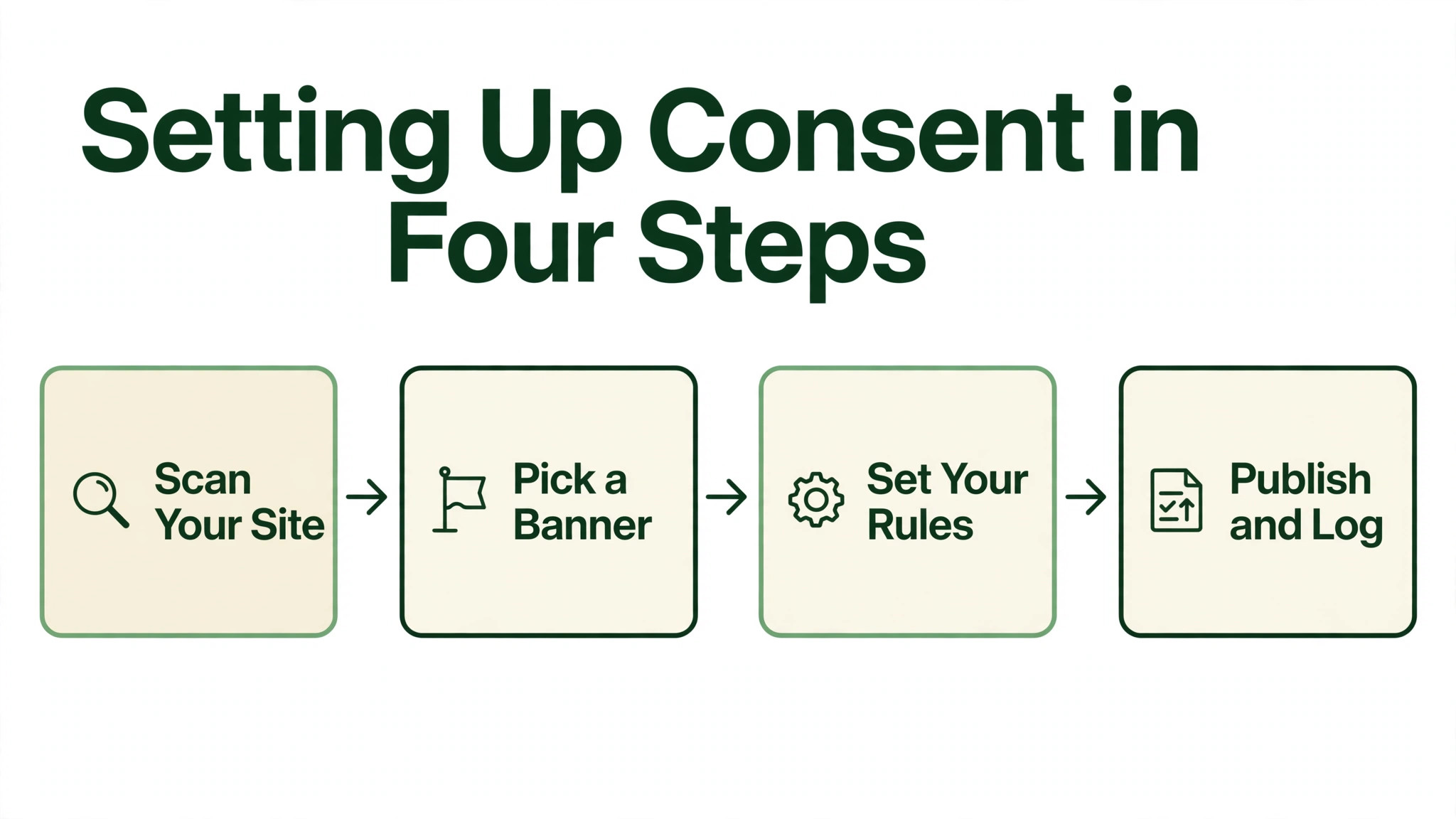
Getting Compliant in Four Steps Without a Lawyer
The best cookie consent tools for small businesses all share one trait. The setup is quick, but the habits around CookieYes decide whether the tool earns its keep, so the steps below cover the habits as well as the clicks.
- Scan Your Site. Run the first scan in CookieYes or Cookiebot and let it find every cookie and tracker, including the ones your plugins added without telling you.
- Pick a Banner. Choose a banner design that matches the site and states the choice plainly, with the reject option as visible as the accept button.
- Set Your Rules. Set the regions explicitly, so Europe sees an opt-in banner and California sees the notice its law requires.
- Publish and Log. Publish the banner and check that the consent log records each decision, because the log is the evidence if a regulator asks.
- Review Quarterly. Re-scan every quarter and check usage against the free tier limits, because a site that outgrows its tier can face overage fees.
The billing trigger is the detail that decides the real price, and it differs on every tool. CookieYes bills by pageviews, Cookiebot by subpages, iubenda per site, and Osano by program size. A small site with heavy traffic pays more on CookieYes than on Cookiebot, while a large site with light traffic pays the opposite. Price your actual traffic and your actual page count on two tools before you choose, because the headline price tells you almost nothing.
Consent rate optimisation is the hidden job after setup. A banner that everyone rejects is compliant but useless, because it blocks the analytics you need to run the business. Test banner wording, button placement and the number of choices you offer. A clear accept button and a plain explanation will lift acceptance without tricking anyone, and dark patterns that hide the reject button are now illegal in several jurisdictions. Optimise for clarity, not for coercion.
Script blocking is the feature that separates a real consent tool from a decorative banner. A banner that shows while Google Analytics fires anyway is not compliant, and it is the most common failure on small sites. During your trial, open your browser tools, reject consent, and check which scripts still load. If analytics still fires, the tool is not doing its job. Every tool on this list auto blocks, but verify it on your own site rather than trusting the marketing page.
Run the steps in order and CookieYes will do the heavy lifting while the checks above keep the launch from becoming a rescue job.
Frequently Asked Questions
Do small businesses really need a cookie consent tool?
Yes, if your site uses analytics, advertising or any third party script that sets cookies. GDPR applies to any business with visitors in Europe, and California law applies to businesses with visitors in that state, regardless of where you are based. A consent banner is the visible part, but the real job is blocking scripts until consent is given and keeping a log. A tool does both, while a hand coded banner usually does neither.
What is the cheapest cookie consent tool for a small site?
iubenda has the lowest paid entry at $29 per year, and Cookiebot starts at $8 per month with a free tier for one domain. CookieYes free covers one domain up to 25,000 pageviews, and its Basic plan is $10 per month. The cheapest choice depends on your traffic and your site count, because CookieYes bills by pageviews, Cookiebot by subpages and iubenda per site. Price your real traffic on two tools before you decide. That answer is the same across the best cookie consent tools for small businesses. The tool matters less than the habit, and the habit around CookieYes is what the rest of this guide is built to teach.
What is Google Consent Mode v2 and do I need it?
Google Consent Mode v2 is mandatory since March 2024 for any site using Google Ads or Google Analytics in Europe. It tells Google tags how to behave based on the consent a visitor gave. Every tool on this list supports it, and the certified ones include CookieYes, Cookiebot, Osano and Enzuzo. If your tool does not support it, your analytics and ads will underperform in Europe, so check this before you buy.
Can a consent tool replace legal advice?
No. A consent tool is not legal advice, and consent rules vary by regulation, from GDPR to CCPA and CPRA. The tool handles the banner, the blocking and the log, but your business still needs to decide which laws apply to you and what your policies must say. For a regulated industry or a large audience, a short review with a privacy lawyer is worth far more than a premium tool tier.
How long does it take to set up a cookie consent banner?
Most small businesses finish in under an hour. The steps are the same on every tool. Scan the site, pick a banner design, set the rules for each region, and publish. The scan finds your cookies, the banner collects consent, and the log records it. The part that takes longer is the policy pages, which is why tools like Termly and iubenda bundle generated policies with the banner.
What happens if I ignore cookie consent rules?
Regulators can fine businesses that track visitors without consent, and the fines are real even for small companies. Beyond fines, browsers and ad platforms increasingly punish sites that do not respect consent signals, which hurts your analytics and your ad revenue. A $10 a month tool is cheap insurance against both problems, and the setup takes less time than fixing a complaint afterwards.
Our Pick, Stated Plainly — CookieYes Is the Small Business Default
If you buy one tool from this best cookie consent tools for small businesses list, buy CookieYes. It is the pick that fits the most buyers, and CookieYes holds that spot at the fairest price, with the fewest regrets after six months.
The runner-up is Cookiebot, and it wins when deep GDPR coverage matters more than the winner. Everyone else should start with CookieYes and trial the runner-up only if a specific need in this guide points there.