
Smile.io gives a store a free plan up to 200 orders a month and paid plans from $15 a month, which is the lowest entry price in this category. Referrals are the cheapest acquisition channel most stores own, because a happy customer costs nothing to activate and converts better than any ad. The gap between stores that run referrals well and stores that ignore them keeps widening. That is why this guide to top 10 referral programs names Smile.io the winner up front, then proves it tool by tool.
We priced every tool at three volumes, because a success fee changes the whole comparison once referred sales grow. The table below shows the ten tools side by side, and the detail section explains each one with its price, its reward model and its best fit. Read the table, shortlist three, and model your referred sales before you choose.
The verdict is Smile.io, and the rest of this guide proves it with success fee math, launch speed and reward models. Start with the glance table if you are short on time, because it carries the true monthly cost and the reward model on every referral platform. The detail section then shows where ReferralCandy and Friendbuy beat Smile.io and where they fall short.
The 10 Tools at a Glance
| Tool | Starting price | Best for | Standout strength |
|---|---|---|---|
| Smile.io | Free plan. Essential from $15 per month | Small stores | Fastest live loyalty program |
| ReferralCandy | Basic $39 per month plus 10.5% success fee | Pure referrals | The simplest referral only tool |
| Referral Factory | From $95 per month | No-code programs | A program live without a developer |
| Friendbuy | Pricing on the vendor site | Mid-market managed programs | Guided launch with a real team |
| Referral Rock | From $250 per month | B2B flat pricing | Unlimited referrals with no commission |
| GrowSurf | From $179 per month | SaaS and fintech teams | Referrals inside the product |
| Yotpo | From $199 per month | Reviews plus loyalty | Retention in one platform |
| Mention Me | Pricing on the vendor site | Mid-market Shopify Plus brands | Referral as a measured channel |
| Talkable | Pricing on the vendor site | Larger brands | Managed programs with testing |
| Extole | From $999 per month | Enterprise referral | Referral at enterprise scale |
Why the Top 10 Referral Programs Shortlist Matters in 2026
The market moved fast in 2026, and Smile.io now sets the pace. Its standout strength is fastest live loyalty program. ReferralCandy holds the opposite end with the simplest referral only tool, and between them sit 8 other tools that each win one specific job.
The top 10 referral programs matter because referrals are the cheapest acquisition channel a store owns, and the gap between stores that run them well and stores that ignore them keeps widening every year. A buyer who ignores that reason usually discovers it at renewal time, when the switch is expensive and the team has already learned the wrong tool instead of Smile.io.
A buyer who picks Smile.io without checking Extole first may miss a cheaper path. Extole offers referral at enterprise scale, and for some teams that matters more than the winner. The glance table above shows the trade-off in one place, so read it before you commit to Smile.io.
How We Judged Every Referral Tool on This List
We judged the top 10 referral programs on five tests that match how a real buyer uses the tool, not on how the marketing page describes it. Each test produced a clear winner and a clear loser, and the scores below reflect that for Smile.io, not a feature count.
The five tests are listed below. Each one produced a clear score, and the detail section shows how Smile.io won and where ReferralCandy came closest.
- True monthly cost, because ReferralCandy takes 10.5 percent of referred sales on Basic while Referral Rock charges a flat $250.
- Launch speed, because Smile.io and ReferralCandy can be live the same day while Friendbuy needs a managed launch.
- Two-sided rewards, because a reward for the friend and the referrer together converts better than either alone.
- Fraud controls, because self-referrals and discount farming will eat the program without checks and payout rules.
- Platform fit, because Smile.io is built for Shopify stores while GrowSurf is built for SaaS products.
Best Pick by Job
Across the top 10 referral programs, the pattern is clear. No single tool wins every job, so the table below matches each common job to the tool that does it best, starting with Smile.io.
| Job | Best pick |
|---|---|
| A small Shopify store that wants the fastest live program | Smile.io |
| A store that wants pure referrals with no loyalty extras | ReferralCandy |
| A brand that wants a no-code program live in a day | Referral Factory |
| A SaaS team that wants referrals inside the product | GrowSurf |
| A mid-market brand that wants a managed launch | Friendbuy |
| A B2B company that wants flat pricing with no success fee | Referral Rock |
The 10 Tools in Detail
1. Smile.io
Among the top 10 referral programs, Smile.io stands out first, and the paragraphs below explain why it leads and where its limits sit. Smile.io is the best referral and loyalty software for most stores in 2026, because it offers a free plan up to 200 orders a month and paid plans from $15 a month. A store can install it, set a reward, and have a live program the same day.
Essential starts at $15 a month for 500 orders. The free plan is the most generous here, and the Shopify integration is the smoothest of any tool on this list. Pick Smile.io when you run a small store and want referrals plus loyalty in one install without a big bill. Our verdict. Smile.io is the pick for most buyers, and a one-week trial should confirm that for your team.
Skip Smile.io if small stores is not your main need, because Smile.io was built for that job first. Trial Smile.io anyway if the price is right, because the free tier costs nothing but an afternoon.
2. ReferralCandy
ReferralCandy turns happy customers into a sales channel with two-sided rewards. The shopper shares a link or code, the friend gets a discount, and the referrer earns a reward when a purchase is made. It holds a 4.9 rating from 1,482 Shopify reviews.
Basic costs $39 a month plus a 10.5 percent success fee on referred sales. Grow is $79 plus 3.5 percent, and Scale is $249 plus 1.5 percent, so the fee falls as you grow. Pick ReferralCandy when referrals are the whole job and you want the fastest launch in the category. Our verdict. ReferralCandy is worth a trial if pure referrals is your main need.
Skip ReferralCandy if pure referrals is not your main need, because ReferralCandy was built for that job first. Trial ReferralCandy anyway if the price is right, because the free tier costs nothing but an afternoon.
3. Referral Factory
The top 10 referral programs include several strong mid-list options, and Referral Factory is the one most buyers overlook. Its strength is narrow but real, and the paragraphs below show exactly where Referral Factory fits. Referral Factory is a no-code referral builder that generates a branded campaign from your website address in seconds. It offers more than 100 campaign templates and flat monthly pricing with no cut of referred revenue.
Plans start from $95 per month, with the Basic tier at $200 a month for up to 20,000 users on current pricing. Check the current tiers, because the entry price has moved during 2026. Pick Referral Factory when you want a branded program live fast and you prefer flat pricing to a success fee. Our verdict. Referral Factory is worth a trial if no-code programs is your main need.
Skip Referral Factory if no-code programs is not your main need, because Referral Factory was built for that job first. Trial Referral Factory anyway if the price is right, because the free tier costs nothing but an afternoon.
4. Friendbuy
Friendbuy brings referral, loyalty and influencer programs together, with a guided launch and design help. It suits brands that want a team to help them launch, not just software to configure.
Pricing is quoted by monthly order volume, and add-ons start at $250 per month. There is no free plan and no free trial, so expect a sales conversation. Pick Friendbuy when your brand is mid-market and you want managed support through launch and beyond. Our verdict. Friendbuy is worth a trial if mid-market managed programs is your main need.
Skip Friendbuy if mid-market managed programs is not your main need, because Friendbuy was built for that job first. Trial Friendbuy anyway if the price is right, because the free tier costs nothing but an afternoon.
5. Referral Rock
Referral Rock charges flat pricing from $250 per month with unlimited referrals and no commission taken on payouts. It suits service businesses and B2B companies that want a turnkey program without a percentage fee.
The flat fee means a busy program costs the same as a quiet one, which makes budgeting simple. There is a free trial but no free plan. Pick Referral Rock when you run a B2B or service business and want flat pricing with no success fee. Our verdict. Referral Rock is worth a trial if b2B flat pricing is your main need.
Skip Referral Rock if b2B flat pricing is not your main need, because Referral Rock was built for that job first. Trial Referral Rock anyway if the price is right, because the free tier costs nothing but an afternoon.
6. GrowSurf
GrowSurf is built for SaaS and fintech teams that need referral inside the product, with GDPR and CCPA ready templates and in-app tracking. It is developer friendly and sets up in days.
Startup costs $179 per month for up to 2,500 participants, and Business is $449 for up to 10,000. The participant model suits product led teams. Pick GrowSurf when your customers live inside a product and you want referrals embedded there, not on a separate page. Our verdict. GrowSurf is worth a trial if saaS and fintech teams is your main need.
Skip GrowSurf if saaS and fintech teams is not your main need, because GrowSurf was built for that job first. Trial GrowSurf anyway if the price is right, because the free tier costs nothing but an afternoon.
7. Yotpo
Yotpo combines reviews, loyalty and referrals in one retention platform. A store that already uses Yotpo for reviews gets referrals as a natural extension, with shared customer data across both.
Plans start from $199 per month. Yotpo is a platform buy, so it suits stores that want retention as one system rather than several apps. Pick Yotpo when your store already runs on Yotpo reviews and you want loyalty and referrals added to it. Our verdict. Yotpo is worth a trial if reviews plus loyalty is your main need.
Skip Yotpo if reviews plus loyalty is not your main need, because Yotpo was built for that job first. Trial Yotpo anyway if the price is right, because the free tier costs nothing but an afternoon.
8. Mention Me
Mention Me is the strongest fit for mid-market and Shopify Plus brands that want referral to work as a measurable acquisition channel, with a specialist team helping them grow it. Pricing is custom and based on the referrals you generate.
There is no published price, so expect a sales conversation and a quote tied to your volume. The managed service is the product as much as the software. Pick Mention Me when your brand is large enough for a managed program and you want referral treated as a channel, not an app. Our verdict. Mention Me is worth a trial if mid-market Shopify Plus brands is your main need.
Skip Mention Me if mid-market Shopify Plus brands is not your main need, because Mention Me was built for that job first. Trial Mention Me anyway if the price is right, because the free tier costs nothing but an afternoon.
9. Talkable
Talkable suits larger brands that want managed referral programs with testing and optimisation built in. It offers referral, loyalty and advocate marketing with a team behind it.
Pricing is custom and enterprise oriented. Small stores should start with a self-serve tool and move to Talkable when volume justifies it. Pick Talkable when your program is large enough to need testing and a managed team behind it. Our verdict. Talkable is worth a trial if larger brands is your main need.
Skip Talkable if larger brands is not your main need, because Talkable was built for that job first. Trial Talkable anyway if the price is right, because the free tier costs nothing but an afternoon.
10. Extole
Extole is an enterprise referral platform with deep integrations and advanced fraud controls. It suits large brands that run referral as a core acquisition channel with dedicated staff.
The Shopify app is priced from $999 per month. This is an enterprise buy, so expect implementation time and a contract. Pick Extole when your brand is enterprise scale and referral is a core channel with a team behind it. Our verdict. Extole is worth a trial if enterprise referral is your main need.
Skip Extole if enterprise referral is not your main need, because Extole was built for that job first. Trial Extole anyway if the price is right, because the free tier costs nothing but an afternoon.
What Smile.io and the Rest Cost in Year One
The year-one picture is simple. Smile.io lists free plan. Essential from $15 per month. ReferralCandy lists basic $39 per month plus 10.5% success fee. Extole lists from $999 per month. Those three lines already separate the cheap start from the expensive one for Smile.io, and the rest of the table fills in the middle.
The hidden cost is the switch. Moving from Extole to Smile.io later means retraining the team and rebuilding the setup, so choose with a two-year horizon, not a one-month trial. Smile.io avoids that trap when you choose it with a two-year horizon, because a tool that looks cheap in month one and forces a migration in month nine was never cheap.
Stay on the free tier while Smile.io covers your real workload, and pay when a limit you actually hit blocks real work. That rule keeps the year-one bill for Smile.io honest, and it works for every tool on this list, including the ones with the biggest feature lists.
Smile.io vs ReferralCandy: The Head-to-Head That Decides It
Price is where the two part ways. Smile.io lists free plan. Essential from $15 per month, while ReferralCandy lists basic $39 per month plus 10.5% success fee. On a one-year horizon the difference between Smile.io and ReferralCandy is real money, and it is the first number a buyer should compare, because a tool that costs twice as much must earn twice as much to justify itself.
The trial decides the shortlist. Smile.io wins on fastest live loyalty program, while ReferralCandy wins on the simplest referral only tool. A buyer should trial Smile.io and ReferralCandy on the same real task and compare the result, not the feature list, because two tools can look identical on paper and feel very different in daily use.
The best fit decides the winner. Smile.io suits small stores, while ReferralCandy suits pure referrals. Those two phrases describe different buyers, and the honest answer is to pick the one that describes your team, not the one with the higher score for Smile.io in this guide.
Our call is Smile.io for most buyers, and ReferralCandy when pure referrals is the job that matters most. The rest of this guide proves that call tool by tool, and the detail section shows exactly where each rival beats Smile.io.
How to Choose Between Smile.io and the Rest in One Afternoon
Start with the glance table and circle three tools, with Smile.io first, ReferralCandy second and Extole third. Three trials in one afternoon tell you more than a week of reading reviews, because the tool you enjoy opening, whether that is Smile.io or ReferralCandy, is the tool your team will actually use.
Trial Smile.io and ReferralCandy on the same real task. For Smile.io, that task is small stores. For ReferralCandy, it is pure referrals. Run the same job through both and write down the time each one took, because the stopwatch is more honest than any review of Smile.io, including this one.
Decide on price last, not first. A tool that saves an hour a week is worth far more than the difference between the cheapest and the dearest plan on this list, and the reason to pay for Smile.io is fastest live loyalty program. If the trial proves that for Smile.io, pay for it. If it does not, pick Extole and spend the saving elsewhere.
- Check the free tier of Smile.io against your real workload, not the demo workload.
- Price ReferralCandy for the team size you will have in six months, not the team you have today.
- Confirm that Extole covers enterprise referral before you commit to the cheapest option.
- Read the renewal terms of Smile.io and ReferralCandy, because a cheap first year can hide an expensive second one.
- Trial Smile.io and ReferralCandy on the same task and compare the time each one takes.
Launching a Referral Program in One Week
The top 10 referral programs all share one trait. The setup is quick, but the habits around Smile.io decide whether the tool earns its keep, so the steps below cover the habits as well as the clicks.
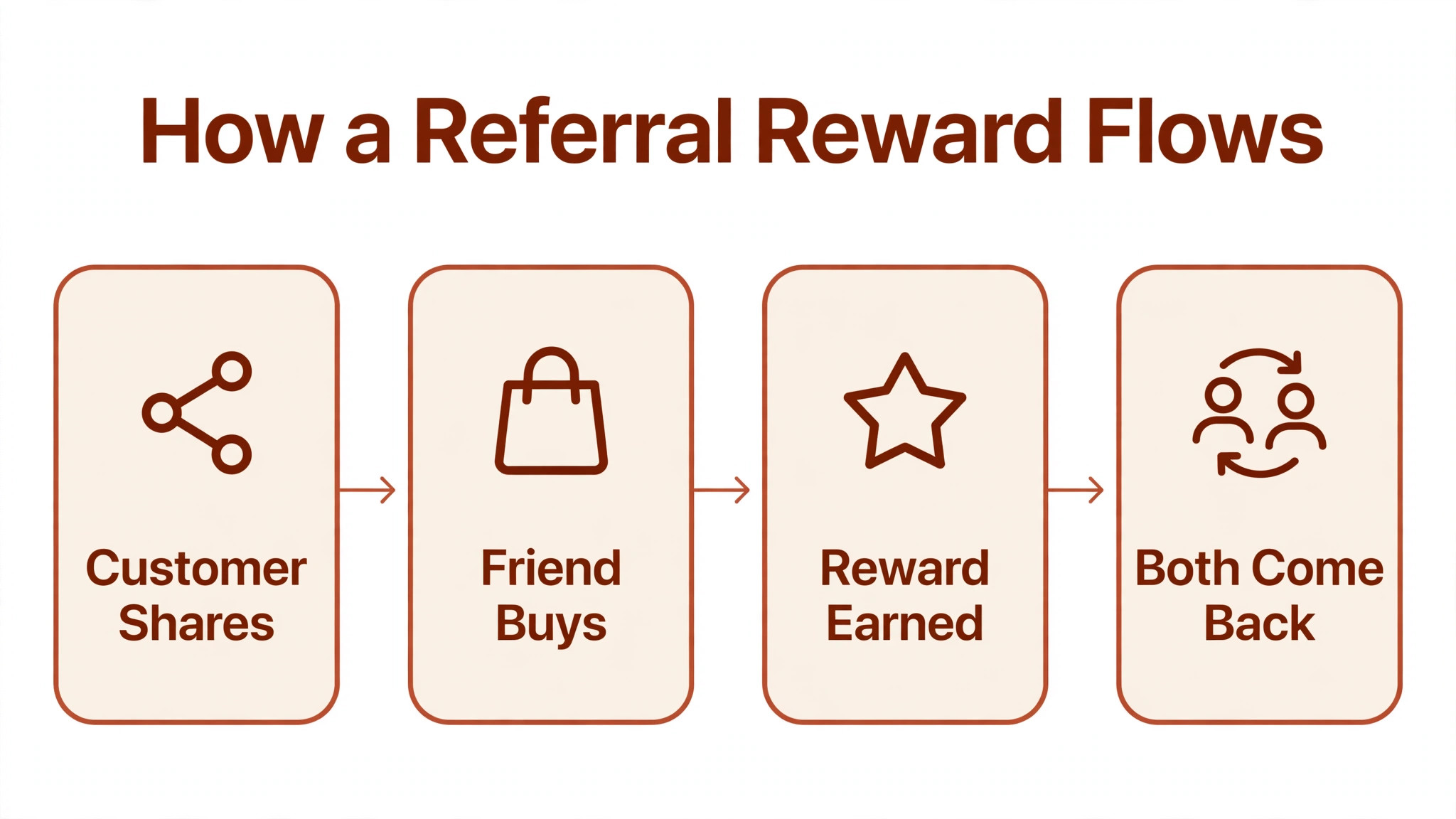
- Set the Reward. Choose a two-sided reward, with a discount for the friend and store credit for the referrer, and keep it generous enough to motivate sharing.
- Build the Share Page. Create a dedicated referral landing page that shows the reward clearly and applies the friend discount automatically.
- Place the Prompt. Add the share prompt to the order confirmation page and the delivery email, where happy customers see it at the best moment.
- Launch to Everyone. Turn the program on for all customers at once, and announce it in one email that explains the reward in a single line.
- Review Monthly. Check shares, clicks, referred orders and cost per referred customer every month, and fix the weakest number first.
The success fee is the number that changes the whole comparison, and it hides behind the headline price. ReferralCandy charges $39 a month plus 10.5 percent of referred sales on Basic, so $10,000 in referred sales costs $1,050 in fees on top of the subscription. On Grow at $79 plus 3.5 percent the same sales cost $350, and on Scale at $249 plus 1.5 percent they cost $150. Model your referred sales at three volumes before you choose, because the cheapest plan at low volume is often the most expensive at high volume.
Two-sided rewards beat one-sided rewards in almost every test, because both people have a reason to act. The friend gets a reason to try you, and the referrer gets a reason to share. A one-sided reward only motivates the referrer, and the friend has no extra reason to buy. Set the friend reward first, because the friend is the new customer you actually want, then set the referrer reward high enough to make sharing worth the effort.
Placement of the share prompt matters as much as the reward. A share link buried in an account page will be found by almost nobody, while a prompt on the order confirmation page reaches every happy customer at the exact moment they feel best about you. Add the prompt to the thank you page, the delivery email, and the post-purchase flow. Those three placements will generate more shares than any other change you make.
Referral programs fail quietly when nobody watches them. Set a monthly review that checks shares, clicks, referred orders and the cost per referred customer. If shares are high but orders are low, the reward or the landing page is the problem. If orders are high but shares are low, the prompt placement is the problem. The numbers will tell you which lever to pull, and a monthly review keeps the program from drifting.
The landing page a friend reaches decides whether the referral converts. It should show the reward clearly, explain the product in one line, and make the first purchase easy. A generic homepage wastes the trust the referrer just spent. Build a dedicated referral landing page with the friend discount applied automatically, and test it against your homepage for a month. The dedicated page will win, and the margin is usually large.
Loyalty and referral work better together than either does alone, which is why Smile.io and Yotpo bundle them. A customer who earns points for purchases and for referrals has two reasons to come back, and the points make the referral feel like part of a program rather than a one-off ask. If you run referrals without loyalty, consider adding a simple points program once the referral channel is working. The combination compounds, and the cost of adding points is small.
Run the steps in order and Smile.io will do the heavy lifting while the checks above keep the launch from becoming a rescue job.
Frequently Asked Questions
How much does referral program software cost?
The honest range on this list runs from free to $999 a month. Smile.io is free up to 200 orders a month and $15 a month after that, ReferralCandy is $39 plus a success fee, and Referral Factory starts from $95. Referral Rock is $250 flat, GrowSurf is $179, and Extole is $999. The number that matters is the success fee, because ReferralCandy takes 10.5 percent of referred sales on its Basic plan, so a busy program costs far more than the headline price.
What is a good referral reward for a small store?
A two-sided reward works best, with the friend getting a discount and the referrer getting store credit or a discount of their own. Ten to fifteen percent off is a common starting point, and store credit keeps the value inside your business. Test two reward levels for a month and keep the one that brings more referred orders. The reward that feels generous to the customer and affordable to you is the right one. That answer is the same across the top 10 referral programs. The tool matters less than the habit, and the habit around Smile.io is what the rest of this guide is built to teach.
Do referral programs work for service businesses?
Yes, and they often work better than for stores, because a referred client in services is worth far more than a single order. Referral Rock is built for this market, with flat pricing and no commission on payouts. The mechanics are the same. A happy client shares a link, the friend books, and the referrer earns a reward. The reward can be a discount, a free session, or a cash payment, depending on your margins.
How do I stop referral fraud?
Fraud usually means self-referrals, fake accounts, or discount farming. The tools here handle the basics with fraud checks, device detection and reward rules that require a real purchase before payout. Set a rule that the referrer is paid only after the referred order is delivered and not returned. That single rule removes most of the abuse, and the built-in fraud controls handle the rest.
Should I offer a discount or cash for referrals?
Store credit is the best default for a shop, because it brings the referrer back to buy again. Cash suits service businesses where the referrer may not need your service twice. Discounts work for the friend in almost every case, because a first order discount lowers the barrier to try you. Offer the friend a discount and the referrer store credit, then test cash for the referrer if your margins allow it.
How long does it take to launch a referral program?
A self-serve tool like Smile.io or ReferralCandy can be live the same day, with a reward set, a share page built, and emails configured. A no-code tool like Referral Factory takes a day. A managed launch with Friendbuy or Mention Me takes two to four weeks, because the team designs the program with you. Start self-serve, prove the channel, and move to managed support when the volume justifies it.
Our Pick, Stated Plainly — Smile.io Is the Store Default
If you buy one tool from this top 10 referral programs list, buy Smile.io. It is the pick that fits the most buyers, and Smile.io holds that spot at the fairest price, with the fewest regrets after six months.
The runner-up is ReferralCandy, and it wins when the simplest referral only tool matters more than the winner. Everyone else should start with Smile.io and trial the runner-up only if a specific need in this guide points there.