
How much does expense tracking actually cost a contractor. That is the first question every tradesperson asks, and best expense trackers for contractors answers it with a spread from zero to about 25 dollars a month for a five-person crew. The cheapest real system is free, the most common team price is 15 to 25 dollars a month, and the dearest option is a quote-only platform that costs more than the fuel it tracks. The right price depends on how many people are on the crew and whether mileage matters.
An expense tracker for a contractor does a different job from a tracker built for office workers. The miles between sites are the biggest deduction, the receipts come from a hardware store rather than a restaurant, and the crew submits expenses from a phone on a job site. A tool built for an office will miss the mileage, and a tool built for drivers will miss the receipts.
This guide compares fifteen tools on the numbers that decide the purchase. We look at the free tier, the per-user price, the mileage tracking and the limits that only appear after launch. Every price below is the published starting figure, and those figures move, so confirm the current number on the vendor site before you put a crew on it.
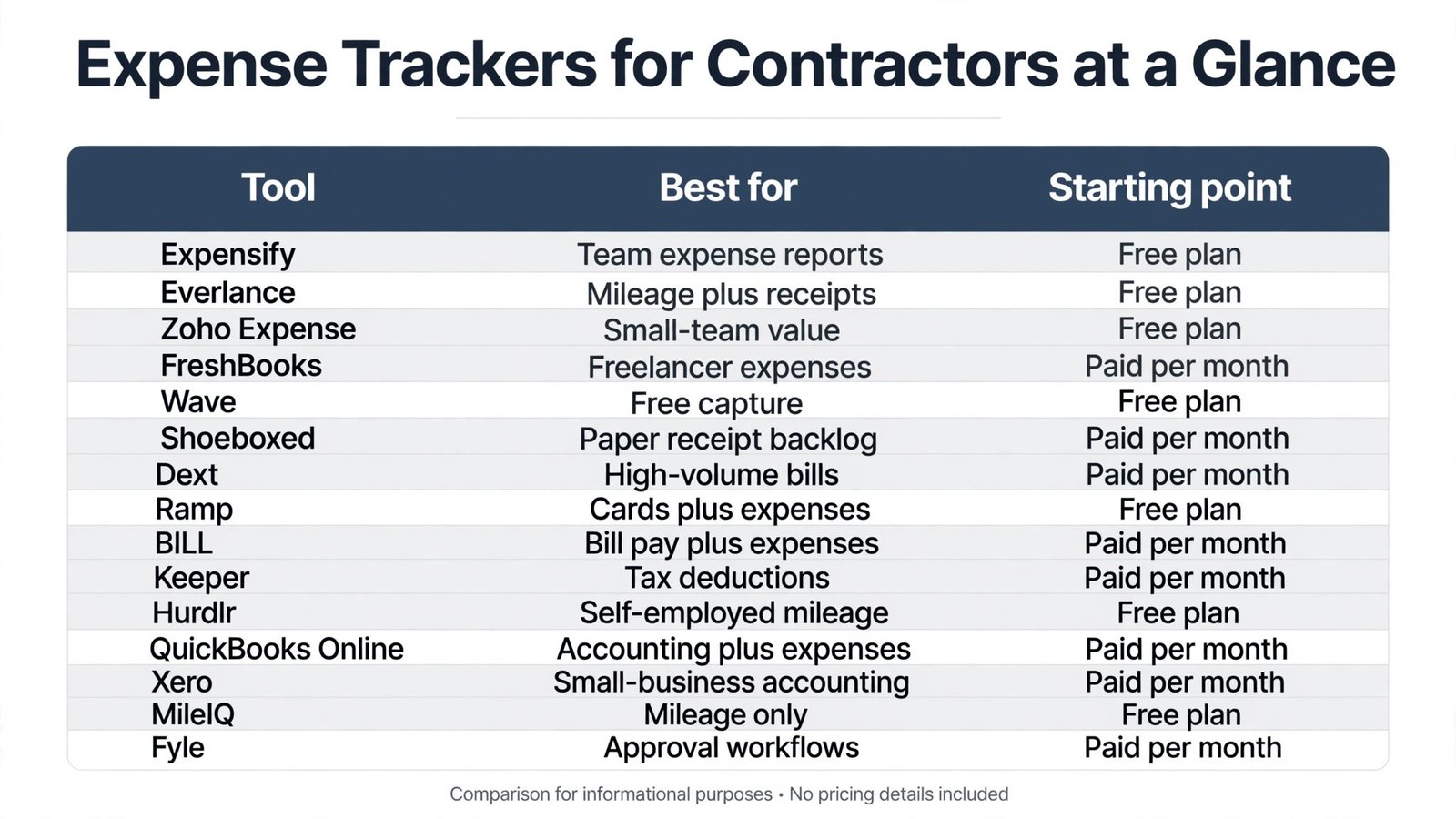
The 15 Tools at a Glance
The table below answers the cost question at a glance, and the answer depends on the crew size. best expense trackers for contractors ranges from free plans that cover the whole job to quote-only platforms, and the per-user price is the number that decides the bill for most crews.
| Tool | Starting price | Best for | Standout strength |
|---|---|---|---|
| Expensify | Free for individuals, Collect from 5 dollars a user a month | Receipt scanning for teams | SmartScan reads receipts |
| Everlance | Free, Premium from 8.99 dollars a month | Mileage tracking for drivers | Automatic trip detection |
| Zoho Expense | Free up to 3 users, from 3 dollars a user a month | Small crews on a budget | Cheapest paid tier here |
| FreshBooks | Lite from about 9 dollars a month | Invoicing plus expenses | Expenses inside the invoice |
| Wave | Free | Free accounting plus expenses | Zero cost for the core |
| Shoeboxed | Pricing on the vendor site | Receipt scanning by mail | Send receipts in an envelope |
| Dext | Pricing on the vendor site | Receipt capture for accountants | Built for bookkeepers |
| Ramp | Free | Corporate cards plus expenses | Free cards with built-in controls |
| BILL | Pricing on the vendor site | Paying suppliers and subcontractors | Bill pay built in |
| Keeper | Pricing on the vendor site | Tax deductions for freelancers | Finds deductions automatically |
| Hurdlr | Free tier | Mileage and income tracking | Automatic mileage and income |
| QuickBooks Online | Pricing on the vendor site | The standard small business ledger | Every accountant knows it |
| Xero | Pricing on the vendor site | Cloud accounting with expenses | Clean interface, strong bank feeds |
| MileIQ | Free plan | Simple mileage logging | One job done well |
| Fyle | Pricing on the vendor site | Real-time expense reporting | Reports the same day |
Why Receipts Left in the Truck Cost Real Money at Tax Time
A receipt left in the truck is money lost at tax time. The contractor who keeps receipts in a shoebox guesses at deductions, and the guess is always low. The contractor who scans every receipt the same day claims the full amount, and the difference over a year is often more than the cost of the tool. The software is not an admin expense. It is a tax tool.
The cost of the wrong tracker is measured in missed deductions and hours of sorting. A system that only records what you type still needs you to type, and a system that charges per user punishes a growing crew. The best expense trackers for contractors below are priced by what a real crew pays, because the individual price tells you nothing about the five-person bill.
How We Priced the Best Expense Trackers for Contractors
We priced every tool from its own published page and from current comparisons dated September and October 2026. Where a vendor publishes no list price, the draft says so directly instead of guessing a number. Annual billing is quoted as a monthly equivalent, and the per-user maths is shown for a five-person crew, because that is the size that decides the real bill.
Our checks for each tool were simple and practical, and they all came back to the crew size.
- What does the free tier cover, and where does it stop.
- Does the tool scan receipts from a photo, or does it need manual entry.
- Does it track mileage automatically, or does it need a separate app.
- Does it sync with the accounting system the contractor already uses.
Best Pick by Job
The right pick from best expense trackers for contractors depends on the size of the crew and whether mileage matters. The table below matches five common situations to one pick each, starting with the solo contractor.
| Job | Best pick | Why |
|---|---|---|
| A solo contractor who wants free | Wave | Free accounting and expense tracking with no monthly fee. |
| A contractor who drives all day | Everlance | Automatic mileage at 8.99 dollars a month or 69.99 dollars a year. |
| A three-person crew on a budget | Zoho Expense | Free for up to three users, then 3 dollars a user a month. |
| A crew that needs spending controls | Ramp | Free corporate cards with limits and approvals built in. |
| A contractor whose accountant uses QuickBooks | QuickBooks Online | Expenses inside the ledger the accountant already knows. |
The 15 Tools in Detail
The best expense trackers for contractors below are priced one by one. Each section gives the starting price, the tier that holds the feature you actually need, and the bill at the volume a real contractor pays.
1. Expensify
Expensify offers a free plan for individuals, and the Collect plan costs 5 dollars a user a month billed annually. The free tier covers receipt scanning and a basic expense report, while Collect adds approval workflows and card sync. A five-person crew pays about 25 dollars a month, which is the figure that matters for a contractor rather than the individual price.
Expensify suits a contractor with a small crew who needs receipts scanned and approved without a finance department. SmartScan reads the receipt, matches it to the card charge and builds the report, which removes the shoebox entirely. The mileage tracking is the part a contractor uses most, and it is included rather than sold separately.
A five-person crew pays about 25 dollars a month on Collect, which is 300 dollars a year for the whole crew.
Watch the approval limits. The free plan covers one person, and a crew of any size needs the Collect tier.
2. Everlance
Everlance offers a free plan with basic mileage tracking, and Premium costs 8.99 dollars a month or 69.99 dollars a year. The Professional plan costs 99.99 dollars a year and adds receipt scanning and tax reports. A contractor who drives daily pays about 70 dollars a year for the plan that covers the whole job.
Everlance suits a contractor who drives between sites all day and needs the mileage logged without thinking about it. The app detects trips automatically and separates business from personal, which is the difference between a clean deduction and a guess at tax time. Receipts attach to the same trip, so the whole job is in one place.
A contractor who drives daily pays about 70 dollars a year for Premium, which covers the mileage and the receipts.
Watch the free tier limits. Automatic trip detection is limited on the free plan, so a daily driver needs Premium.
3. Zoho Expense
Zoho Expense is free for up to three users, and the paid plan costs 3 dollars a user a month billed annually. A three-person crew pays nothing, and a five-person crew pays about 15 dollars a month. That is the cheapest paid tier in this guide, and it includes receipt scanning and approval workflows from the start.
Zoho Expense suits a small contractor who already uses Zoho books or wants the cheapest real system. The receipt scanner works from a phone photo, the approval flow is simple, and the reports export cleanly to an accountant. It is the least expensive way to stop keeping receipts in a truck.
A five-person crew pays about 15 dollars a month, which is 180 dollars a year and the cheapest team total here.
Watch the learning curve. Zoho’s settings take an afternoon to learn, and the first week needs patience.
4. FreshBooks
FreshBooks Lite costs about 9 dollars a month and covers invoicing plus expense tracking for a solo contractor. The Plus plan costs more and adds recurring invoices and double-entry accounting. A contractor who invoices from the same system pays about 9 dollars a month for both jobs, which is cheaper than two separate tools.
FreshBooks suits a contractor who sends invoices and tracks expenses in the same workflow. The expense attaches to the client, the invoice carries the receipt, and the tax report pulls both together. That single flow is the reason to pick FreshBooks over a standalone tracker.
A solo contractor pays about 9 dollars a month for invoicing plus expenses, which is 108 dollars a year for both jobs.
Watch the client limit. Lite covers a small client list, and a growing contractor will need the Plus tier.
5. Wave
Wave is free for accounting, invoicing and expense tracking, with no monthly fee at any tier. The only charges are card processing fees when a client pays by card, which is a percentage of the payment rather than a subscription. A contractor who wants the cheapest system of all pays nothing for the software itself.
Wave suits a solo contractor who wants a free ledger that also tracks expenses. Receipts scan from a phone, the categories are built for small business, and the tax reports are included. It is the only tool in this guide with no paid tier to climb, which makes the budget simple.
A solo contractor pays nothing for the software itself, and the only charges are the card processing fees on client payments.
Watch the support limits. Free software means community support, and a contractor who needs a phone call will miss it.
6. Shoeboxed
Shoeboxed does not publish a list price, so the cost is quoted per plan and the vendor site is the only source. The service is different from the others here because the team scans paper receipts you mail in, which is a physical service rather than a pure app. Ask for the price before you commit, because the comparison depends on the plan.
Shoeboxed suits a contractor who still has a box of paper receipts and wants someone else to digitise them. The envelope service turns a pile of paper into a searchable archive, and the app handles the receipts you scan yourself. It is the only tool here that solves the paper problem directly.
Shoeboxed quotes per plan, so ask for the number before you compare it with the printed prices in this guide.
Watch the missing price. Shoeboxed quotes per plan, so ask for the number before you compare it with the printed prices here.
7. Dext
Dext does not publish a list price, so the cost is quoted per plan and the vendor site is the only source. The tool is built for bookkeepers and accountants, which means the price reflects a professional workflow rather than a single contractor. Ask for the number before you trial it, because the comparison depends on the tier.
Dext suits a contractor whose accountant already uses it, because the receipt capture feeds straight into the bookkeeper’s workflow. The app scans a receipt, extracts the data and pushes it to the accounting system without a manual step. That handoff is the reason to pick Dext over a general tracker.
Dext quotes per plan, so ask for the number before you compare it with the printed prices in this guide.
Watch the accountant dependency. Dext shines when a bookkeeper runs it, and it is overkill for a contractor working alone.
8. Ramp
Ramp is free, with no monthly fee for the core platform. The company makes money on card interchange rather than subscriptions, so a contractor gets corporate cards, expense controls and approval workflows for zero dollars a month. The only cost is the time to set up the cards and the policies.
Ramp suits a contractor with a crew who needs spending controls on every card. Each card carries its own limit, each expense needs an approval, and the accounting sync runs automatically. It is the only free tool here that controls spending before it happens rather than recording it after.
Ramp charges no monthly fee, so a crew of any size pays nothing for the cards, the controls and the approvals.
Watch the eligibility. Ramp is built for registered businesses with a bank account, and a sole trader may not qualify.
9. BILL
BILL does not publish a list price, so the cost is quoted per plan and the vendor site is the only source. The platform covers bill pay and expense management together, which is a wider job than the trackers in this guide. Ask BILL for the number before you compare it with the printed prices here.
BILL suits a contractor who pays subcontractors and suppliers every week and wants the payments in the same system as the expenses. The approval workflow covers both, and the audit trail is built in. A contractor who only tracks receipts does not need the bill pay side.
BILL quotes per plan, so ask for the number before you compare it with the printed prices in this guide.
Watch the scope. Bill pay is the product, and a contractor who only needs receipt tracking will pay for features it never uses.
10. Keeper
Keeper does not publish a list price, so the cost is quoted per plan and the vendor site is the only source. The tool is built for freelancers and contractors who want deductions found automatically, and the price depends on the plan. Ask for the number before you trial it.
Keeper suits a contractor who wants the tax deduction found rather than entered. The app watches the bank feed, flags expenses that qualify as deductions and builds the tax report. That automation is the difference from a tracker that only records what you type.
Keeper quotes per plan, so ask for the number before you compare it with the printed prices in this guide.
Watch the missing price. Keeper quotes per plan, so ask for the number before you compare it with the printed prices here.
11. Hurdlr
Hurdlr offers a free tier with mileage tracking and basic expense recording, and the paid plans are listed on the vendor site. The free tier covers the core job of logging miles and expenses, while the paid plans add tax estimates and full reports. A contractor who drives daily can start free and upgrade when the tax season approaches.
Hurdlr suits a contractor who wants mileage and income tracked together without a second app. The app logs the miles, records the income and estimates the tax, which is the whole picture a sole trader needs. The free tier is a working system rather than a trial.
A contractor who drives daily can start free and upgrade when the tax season approaches, and the paid plans are listed on the vendor site.
Watch the paid plan details. The vendor site lists the paid tiers, so check what the upgrade adds before you buy.
12. QuickBooks Online
QuickBooks Online does not publish a single list price in this guide because the plans and promotions change often, so the vendor site is the source. The platform is the standard small business ledger, and the expense tracking sits inside a full accounting system. Ask QuickBooks Online for the current plan price before you compare it with the printed prices here.
QuickBooks Online suits a contractor whose accountant already works in QuickBooks, because the expense data flows straight into the ledger the accountant uses. The receipt scanner, the mileage tracker and the tax reports are all inside the same system. That familiarity is worth more than a cheaper standalone tracker for most contractors.
QuickBooks Online prices change often, so the vendor site is the source for the current plan price before you compare it.
Watch the price changes. QuickBooks runs frequent promotions, so the price you see today may not be the price next month.
13. Xero
Xero does not publish a single list price in this guide because the plans change by region, so the vendor site is the source. The platform is a cloud ledger with expense tracking built in, and the bank feeds are among the best in the category. Ask Xero for the current plan price before you compare it with the printed prices here.
Xero suits a contractor who wants a clean ledger with strong bank feeds and expense tracking in one place. The receipt scanner works from a phone, the expenses attach to projects, and the accountant can log in directly. It is the strongest choice for a contractor who also needs full accounting.
Xero prices differ by country, so the number on the vendor site is the only reliable figure before you compare it.
Watch the regional pricing. Xero prices differ by country, so the number on the vendor site is the only reliable figure.
14. MileIQ
MileIQ offers a free plan with a limited number of automatic drives each month, and the paid plan is listed on the vendor site. The free tier covers a light driver, while a contractor who drives daily needs the paid plan. The tool does one job, and the price reflects that focus.
MileIQ suits a contractor who only needs mileage logged and nothing else. The app detects drives automatically, the swipe sorts business from personal, and the report is ready for the accountant. A contractor who also needs receipt scanning should pick Everlance or Expensify instead.
A daily driver will outgrow the free plan quickly, and the paid plan is listed on the vendor site for the full mileage cover.
Watch the drive limit. The free plan caps the number of automatic drives, so a daily driver will hit the ceiling quickly.
15. Fyle
Fyle does not publish a list price, so the cost is quoted per plan and the vendor site is the only source. The platform is built for teams that want expenses reported the same day rather than at the end of the month, and the price depends on seats. Ask for the number before you trial it.
Fyle suits a contractor with a crew who wants expenses reported as they happen. The card feed pushes each charge into the app in real time, the employee categorises it on the spot, and the manager approves it the same day. That speed is the difference from a tracker that waits for the month end.
Fyle quotes per plan, so ask for the number before you compare it with the printed prices in this guide.
Watch the fit. Real-time reporting matters for a team, and a solo contractor will not use the feature that justifies the price.
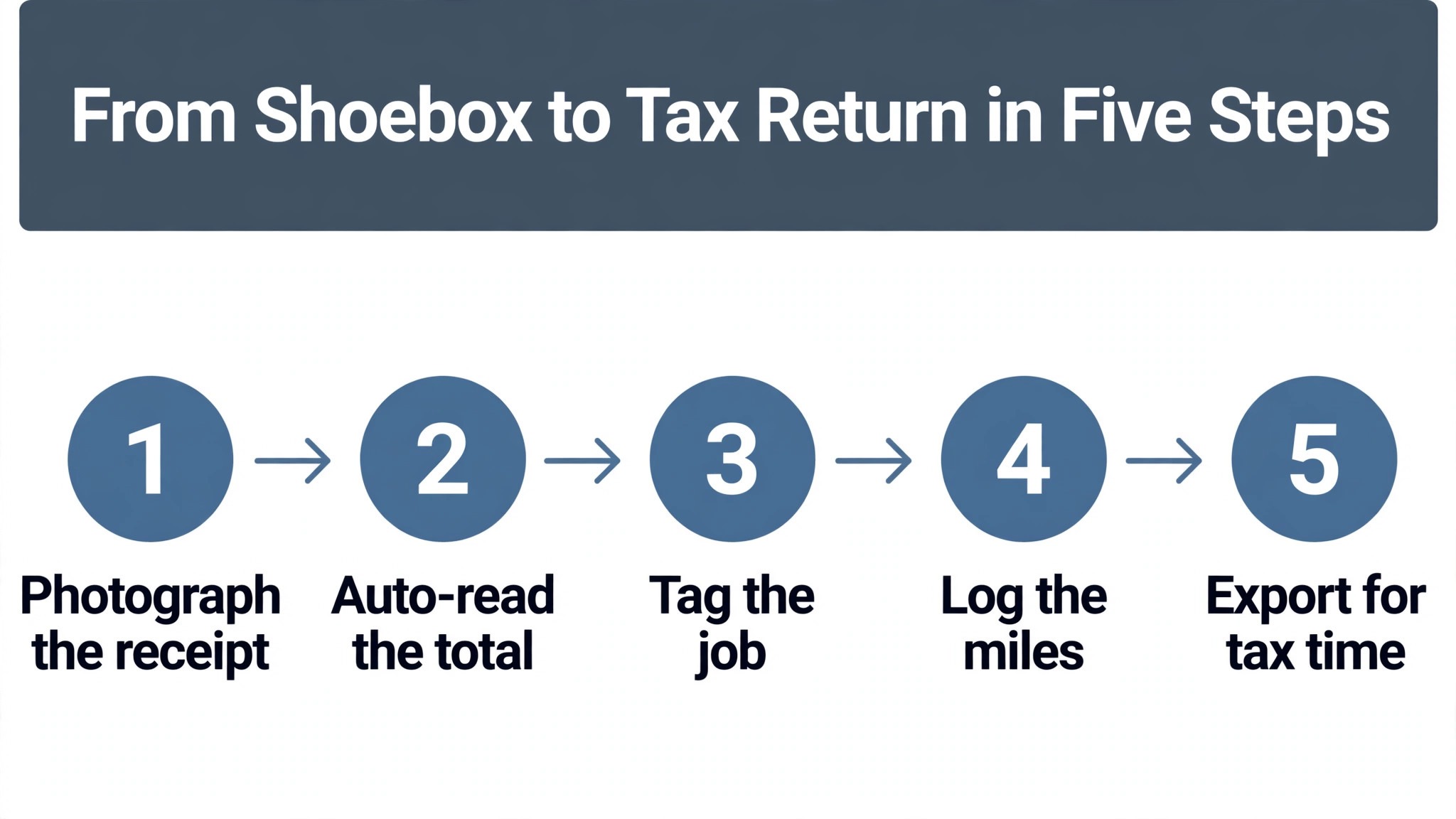
From Shoebox to Tax Return in Five Steps
An expense moves through five stages, and best expense trackers for contractors should carry it through all of them without a second system. The table below shows what the bill looks like at three crew sizes.
| Situation | Pick | Monthly cost |
|---|---|---|
| Solo contractor, free start | Wave | 0 dollars a month for the software |
| Five-person crew, approvals | Expensify Collect | About 25 dollars a month |
| Daily driver, mileage plus receipts | Everlance Premium | About 70 dollars a year |
The free tier is the line most contractors miss. Wave, Zoho Expense and Ramp all cost nothing for the core job, and a solo contractor can run the whole year without a subscription. The paid tiers buy approval workflows, team controls and tax reports, which matter only when there is a team to control. A solo contractor who pays 5 dollars a user a month for a team plan is buying features for a team that does not exist.
The second cost hides in the per-user maths. Expensify Collect at 5 dollars a user costs 25 dollars a month for a five-person crew, while Zoho Expense at 3 dollars a user costs 15 dollars. The 10 dollar gap is small, but the feature gap is real. Expensify adds SmartScan and card sync, while Zoho adds the cheapest price. Compare the two on the feature that matters to your crew, not on the 10 dollars.
The card feed is the feature that separates the dearest tools from the free ones. Expensify and Fyle both pull each card charge into the app in real time, so the expense is categorised on the spot and the manager approves it the same day. A contractor who waits for the month-end statement spends a day sorting receipts, while a contractor with a live feed spends ten minutes. The hours saved are the real return on the paid tier, and they are larger than the monthly price.
The accountant’s time is the cost most contractors forget to count. A tracker that exports clean reports saves the accountant an hour at tax time, and the hour saved is worth more than a year of the subscription. A contractor who hands over a shoebox pays the accountant to sort it, while a contractor who hands over a clean export pays only for the filing. The software is therefore a way to buy the accountant’s time back, and the saving is measured in the invoice.
Frequently Asked Questions
What is the cheapest expense tracker for a contractor?
Wave is free, and best expense trackers for contractors also includes Zoho Expense free for up to three users and Ramp free for the core platform. A solo contractor pays nothing for the software with any of those three. The cheapest paid tier is Zoho Expense at 3 dollars a user a month, which costs about 15 dollars a month for a five-person crew.
Do I need to pay for mileage tracking?
Not always. Everlance offers a free plan with basic mileage tracking, and MileIQ offers a free plan with a limited number of automatic drives. A contractor who drives daily will outgrow both free tiers and should budget about 70 dollars a year for Everlance Premium or the paid MileIQ plan.
Can an expense tracker replace my accountant?
No. A tracker records the expenses, categorises them and builds the report, but the accountant still checks the deductions and files the return. The tools in this guide save the accountant time, which saves you money, but they do not replace the judgement.
What is the best expense tracker for a contractor with a crew?
Expensify Collect at 5 dollars a user a month is the cheapest team option with approval workflows, and Ramp is free with spending controls on every card. A five-person crew pays about 25 dollars a month on Expensify, and nothing on Ramp, so the choice depends on whether you want approvals or spending controls.
Should I pay for a tool that finds tax deductions for me?
For a contractor who misses deductions every year, yes. Keeper watches the bank feed and flags expenses that qualify, which is a job best expense trackers for contractors mostly leaves to the user. The price is quoted per plan, so ask for the number and compare it with the tax you saved last year.
How much should a five-person crew budget each month?
Between 15 and 25 dollars a month covers the realistic options. Zoho Expense costs about 15 dollars a month for five users, Expensify Collect costs about 25 dollars, and Ramp costs nothing. Add card processing only if clients pay by card through the same system.
Our Pick, Stated Plainly — Expensify Is the Contractor Default
The question we opened with has a short answer, and it depends on the crew. best expense trackers for contractors costs between zero and about 25 dollars a month for a five-person crew, and a solo contractor should budget nothing. The cheapest option is a free plan that works, and the dearest option is a quote-only platform that only pays when the crew is large. Everything between those two is a matter of crew size and mileage.
Our pick is Wave for a solo contractor who wants the cheapest system of all, and Expensify Collect for a crew that needs approvals. Start with the free tier, scan a month of real receipts, and buy the plan that matches the crew you actually run.