
A stager can either spend a weekend hauling furniture into an empty living room, or upload one photo and show the same room furnished in five styles before lunch. The physical route gives buyers a room they can walk through, and for a high-value listing it still earns its fee. The virtual route costs a fraction of the price, turns around in minutes, and lets an agent test three styles against three buyer profiles without moving a single chair. That is the choice the best ai interior design tools for home stagers has to settle, and the 15 tools below settle it in 15 different ways.
That contrast sits at the center of the this shortlist. AI staging has moved from a novelty to the default first step for most listings, while human-edited staging has become the premium finish for homes where the photo has to be flawless. The smart question is not which approach is better in general, but which room, which price point, and which buyer you are staging for.
We compared fifteen tools on the details that decide a staging job. Render quality on real listing photos, the cost per image at real volume, style range, furniture realism, and how fast a staged photo reaches the listing all matter more than a long feature list. Prices below come from vendor pages and recent comparisons checked in November 2026, priced for the best ai interior design tools for home stagers at real volumes.
The 15 Tools at a Glance
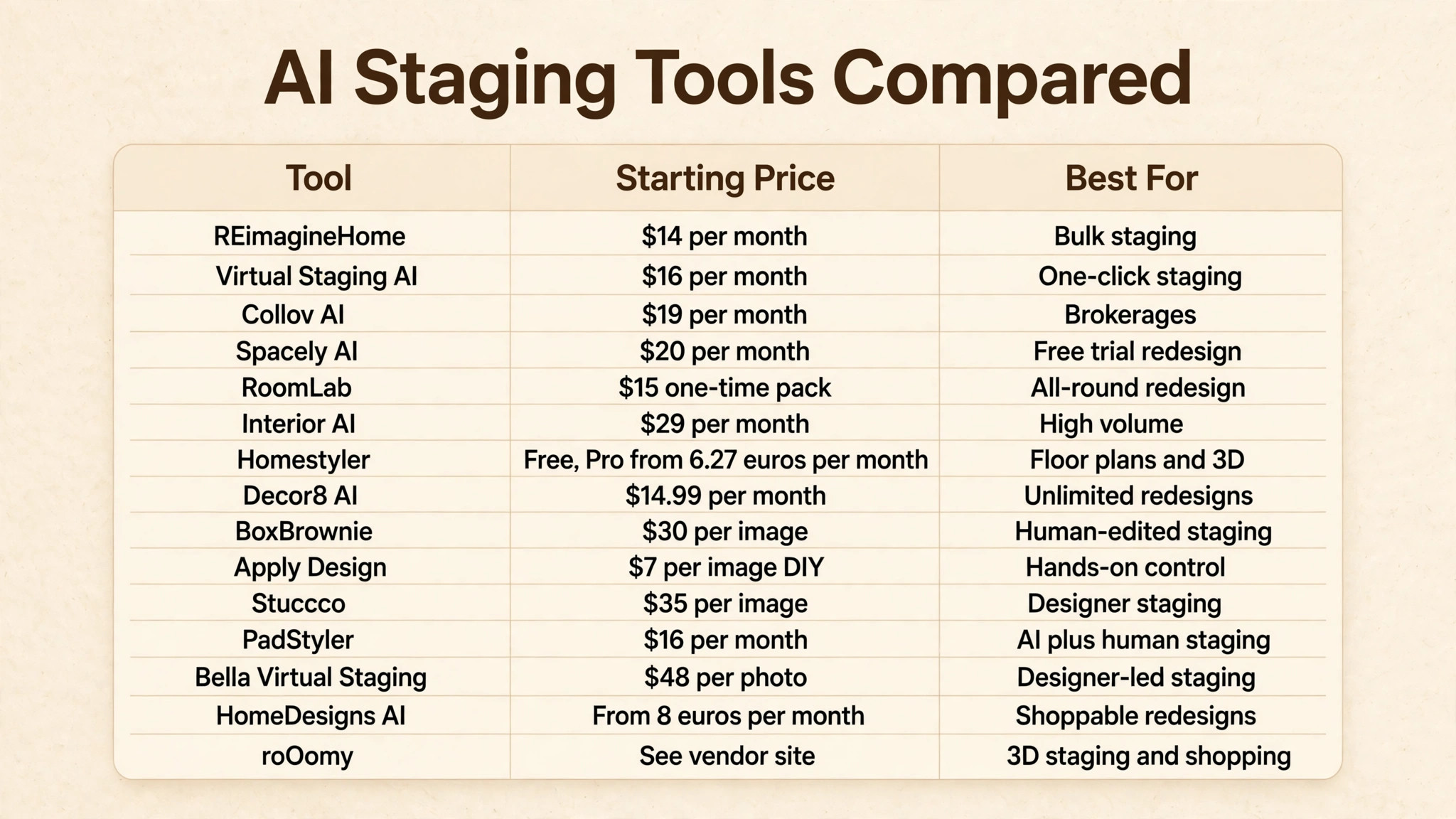
The table below lines up all fifteen tools on starting price and the staging job each one handles best. The best ai interior design tools for home stagers ranges from a few dollars per image to a monthly subscription, so the cheapest option depends on how many rooms you stage each month.
| Tool | Starting price | Best for | Standout strength |
|---|---|---|---|
| REimagineHome | From about 14 dollars a month, with a free trial of 5 designs | Bulk listing staging at scale | REimagineHome stages rooms fast and adds renovation previews and exterior edits on the same subscription, which makes it useful for dated listings as well as empty ones. |
| Virtual Staging AI | From about 16 dollars a month billed yearly, with a free trial | Fast one-click staging on a budget | Virtual Staging AI is built for agents who want a staged photo in seconds. |
| Collov AI | From about 19 dollars a month billed yearly, with watermarked trials | Brokerages and listing volume | Collov AI is built for real estate teams, with listing extras like twilight conversion, lawn replacement, and season changes alongside staging. |
| Spacely AI | From about 20 dollars a month billed yearly, with 40 free trial credits | Trying redesign free before paying | Spacely AI offers the most generous trial in this category, with 40 credits and no card required, and it works with professional design tools like SketchUp and Revit. |
| RoomLab | From a 15 dollar one-time pack, with one free image | All-round room redesign in one workspace | RoomLab covers restyling, virtual staging, decluttering, furniture swaps, sketch-to-render, and before-and-after video in one workspace. |
| Interior AI | From about 29 dollars a month billed yearly | High-volume rendering at the lowest per-render cost | Interior AI is the volume play. |
| Homestyler | Free plan available, Pro from about 6.27 euros a month | Floor plans and 3D modeling | Homestyler is the 3D planner on this list, with a free plan offering unlimited 1K renders and a library of over a million 3D models. |
| Decor8 AI | From about 14.99 dollars a month | Professional stagers who want unlimited redesigns | Decor8 AI offers unlimited redesigns on a single plan, which suits professional stagers who iterate on a room until it looks right. |
| BoxBrownie | About 30 dollars per image, with image enhancement at 2 dollars per image | Human-edited staging on high-value listings | BoxBrownie is the benchmark for human-edited staging. |
| Apply Design | From about 7 dollars per image DIY, or 10.50 dollars per image one-click AI | Hands-on control of every furniture piece | Apply Design sits between pure AI and manual services. |
| Stuccco | About 35 dollars per image pay as you go | Designer staging with fast delivery | Stuccco is a designer-led service aimed at agents and photographers, with standard staging at 35 dollars per image and delivery in about 24 hours. |
| PadStyler | From about 16 dollars a month billed yearly, with a free trial | AI plans plus human bespoke staging | PadStyler combines AI staging plans with a human bespoke service, so a stager can use AI for routine rooms and order human staging for the hero shots. |
| Bella Virtual Staging | About 48 dollars per photo, with a free trial | Designer-led staging with MLS disclosure help | Bella Virtual Staging is a designer-led service that also helps with MLS disclosure, which matters in markets where staged photos carry strict rules. |
| HomeDesigns AI | From about 8 euros a month billed yearly | Shoppable photo redesigns | HomeDesigns AI redesigns a room from a photo and matches the furniture to products buyers can actually purchase, with a Furniture Finder that links pieces to retailers. |
| roOomy | Pricing on the vendor site | 3D staging with furniture shopping | roOomy stages rooms in 3D and connects the staged furniture to products buyers can purchase, which gives agents a staging tool that also works as a shopping guide. |
Best Pick by Job
Staging jobs split by volume and by how much control you need over each piece of furniture. The best ai interior design tools for home stagers has a clear winner in each lane, so start from the job and work backward to the tool.
| Job | Pick | Why it wins |
|---|---|---|
| Staging many listings every month | REimagineHome | Low monthly price with bulk staging and renovation previews. |
| One listing that must look perfect | BoxBrownie | Human editors deliver the most realistic result per image. |
| Trying AI staging for the first time | Virtual Staging AI | Low monthly price and one-click staging with no learning curve. |
| Full control over every furniture piece | Apply Design | DIY editor lets you place each item exactly where you want it. |
| Staging plus floor plans and 3D | Homestyler | Free 3D planning with a huge model library behind it. |
| High-volume rendering on a budget | Interior AI | Per-render cost drops to a few cents at volume. |
What the best ai interior design tools for home stagers Actually Changes About a Listing
Staging changes the first five seconds a buyer spends with a listing, and those five seconds decide whether they scroll on or stop. An empty room photographs as a box with walls, and buyers struggle to judge its size or purpose. A furnished room gives scale, suggests a life lived there, and makes the space feel larger than the same square footage empty.
Agents report the effect in hard numbers. The National Association of Realtors found that most buyer agents say staging helps buyers picture a home as their own, and staged listings consistently draw more views and more showings than empty ones. The cost of staging has always been the objection, which is exactly why AI staging matters. When a staged photo costs seven dollars instead of three hundred, the return on the spend becomes hard to argue against.
The risk is a staged photo that looks staged. Warped furniture, wrong scale, and shadows that fall the wrong way tell a buyer the image is fake before they read the listing. That is why render quality, not price, should lead your shortlist, and why every tool below was judged first on what its images actually look like.
The 15 Tools in Detail
Each tool below was judged on the job it does best, its real price, and the point where it stops being the right choice for the best ai interior design tools for home stagers. The headline price and the true cost are often two different numbers for the best ai interior design tools for home stagers, so read the detail before you shortlist.
1. REimagineHome
REimagineHome stages rooms fast and adds renovation previews and exterior edits on the same subscription, which makes it useful for dated listings as well as empty ones. The Essential plan covers basic staging with 30 credits a month, and the Pro tier adds batch uploads and higher-resolution output. That said, per-design cost is higher than the cheapest rivals, and the best features sit on the Pro plan at about 29 dollars a month. For a buyer comparing the best ai interior design tools for home stagers, that combination of price and capability is the first thing to weigh.
Pricing starts at From about 14 dollars a month, with a free trial of 5 designs. Bulk listing staging at scale is the job it handles best, and that is the lens to judge it through.
Choose REimagineHome when pick REimagineHome if you stage many listings and want renovation previews in the same tool. Look elsewhere if skip it if you only stage a few rooms a month and a pay-per-image tool is cheaper.
2. Virtual Staging AI
Virtual Staging AI is built for agents who want a staged photo in seconds. Upload a photo, pick a room type and one of eight furniture styles, and the image comes back ready to publish. The Basic plan covers 6 photos a month, and Standard covers 20. The trade is clear. Style control is limited compared with DIY editors, so stagers who want to place each piece themselves will feel constrained.
Pricing starts at From about 16 dollars a month billed yearly, with a free trial. Fast one-click staging on a budget is the job it handles best, and that is the lens to judge it through.
Virtual Staging AI fits when pick Virtual Staging AI if speed and simplicity matter more than fine control. It fits less well if skip it if you need to adjust individual furniture pieces.
3. Collov AI
Collov AI is built for real estate teams, with listing extras like twilight conversion, lawn replacement, and season changes alongside staging. The higher tiers add 3D tours, which suits brokerages that want one vendor for listing visuals. The 3D tour features sit on the Premium tier at about 79 dollars a month, so the headline price understates the full package.
Pricing starts at From about 19 dollars a month billed yearly, with watermarked trials. Brokerages and listing volume is the job it handles best, and that is the lens to judge it through.
Pick Collov AI if pick Collov AI if you work for a brokerage that stages in volume and wants listing extras. Skip it if skip it if you stage alone and will never use the 3D tools.
4. Spacely AI
Spacely AI offers the most generous trial in this category, with 40 credits and no card required, and it works with professional design tools like SketchUp and Revit. That makes it a natural fit for stagers who already work in CAD software. That said, the monthly price is higher than the budget options, and the per-render cost is higher than Interior AI at volume.
Pricing starts at From about 20 dollars a month billed yearly, with 40 free trial credits. Trying redesign free before paying is the job it handles best, and that is the lens to judge it through.
Choose Spacely AI when pick Spacely AI if you want a long free trial and already design in CAD tools. Look elsewhere if skip it if you stage from photos only and never touch a floor plan.
5. RoomLab
RoomLab covers restyling, virtual staging, decluttering, furniture swaps, sketch-to-render, and before-and-after video in one workspace. The one-time pack model suits stagers who dislike subscriptions and want to pay per job. The trade is clear. It is a newer product than the established staging names, so the track record with agents is shorter and support resources are thinner.
Pricing starts at From a 15 dollar one-time pack, with one free image. All-round room redesign in one workspace is the job it handles best, and that is the lens to judge it through.
RoomLab fits when pick RoomLab if you want one workspace for staging, restyling, and video without a monthly bill. It fits less well if skip it if you prefer a vendor with a long history in real estate staging.
6. Interior AI
Interior AI is the volume play. The Pro plan covers 1,000 designs a month, which brings the cost per render down to a few cents, and that matters when you stage dozens of rooms a week. It handles interior redesign and staging from a single photo. There is no free plan, and the interface is built for throughput rather than careful control of each render.
Pricing starts at From about 29 dollars a month billed yearly. High-volume rendering at the lowest per-render cost is the job it handles best, and that is the lens to judge it through.
7. Homestyler
Homestyler is the 3D planner on this list, with a free plan offering unlimited 1K renders and a library of over a million 3D models. Stagers who need floor plans alongside staged photos get both in one place. That said, it is a 3D modeling tool first and a photo stager second, so one-click staging from a listing photo is not its strength.
Pricing starts at Free plan available, Pro from about 6.27 euros a month. Floor plans and 3D modeling is the job it handles best, and that is the lens to judge it through.
8. Decor8 AI
Decor8 AI offers unlimited redesigns on a single plan, which suits professional stagers who iterate on a room until it looks right. The price is low for what it covers, and the workflow is simple enough to learn in an afternoon. The trade is clear. There is no free trial listed, so you commit before seeing how it handles your own listing photos.
Pricing starts at From about 14.99 dollars a month. Professional stagers who want unlimited redesigns is the job it handles best, and that is the lens to judge it through.
9. BoxBrownie
BoxBrownie is the benchmark for human-edited staging. A real editor stages the room within 48 hours, with unlimited revisions for two months, and the result still beats AI on realism for high-value listings. Image enhancement from the same vendor keeps the whole visual package in one place. The per-image price makes it the most expensive option at volume, and the 48-hour turnaround rules out same-day listings.
Pricing starts at About 30 dollars per image, with image enhancement at 2 dollars per image. Human-edited staging on high-value listings is the job it handles best, and that is the lens to judge it through.
10. Apply Design
Apply Design sits between pure AI and manual services. The DIY editor lets you place furniture yourself from 7 dollars per image, while the one-click AI staging starts at 10.50 dollars per image for stagers who want speed. That said, the per-image model gets expensive at volume, and the DIY editor takes longer than one-click tools.
Pricing starts at From about 7 dollars per image DIY, or 10.50 dollars per image one-click AI. Hands-on control of every furniture piece is the job it handles best, and that is the lens to judge it through.
11. Stuccco
Stuccco is a designer-led service aimed at agents and photographers, with standard staging at 35 dollars per image and delivery in about 24 hours. Real designers handle the work, so the results avoid the scale and shadow errors that AI tools sometimes make. The trade is clear. It is a per-image service with no subscription, so the cost scales linearly with volume and there is no bulk discount on the base price.
Pricing starts at About 35 dollars per image pay as you go. Designer staging with fast delivery is the job it handles best, and that is the lens to judge it through.
12. PadStyler
PadStyler combines AI staging plans with a human bespoke service, so a stager can use AI for routine rooms and order human staging for the hero shots. That split keeps costs down while protecting the photos that matter most. The human bespoke service is priced separately, so the headline subscription does not cover the premium work.
Pricing starts at From about 16 dollars a month billed yearly, with a free trial. AI plans plus human bespoke staging is the job it handles best, and that is the lens to judge it through.
13. Bella Virtual Staging
Bella Virtual Staging is a designer-led service that also helps with MLS disclosure, which matters in markets where staged photos carry strict rules. The per-photo price buys a careful, human result. That said, at 48 dollars per photo it is the most expensive per-image option here, so it only makes sense for listings where the photo quality justifies it.
Pricing starts at About 48 dollars per photo, with a free trial. Designer-led staging with MLS disclosure help is the job it handles best, and that is the lens to judge it through.
14. HomeDesigns AI
HomeDesigns AI redesigns a room from a photo and matches the furniture to products buyers can actually purchase, with a Furniture Finder that links pieces to retailers. That shoppable angle suits stagers who also advise buyers on furnishing. The trade is clear. The free trial gives three credits a day with the result paywalled, which makes it hard to judge the output before paying.
Pricing starts at From about 8 euros a month billed yearly. Shoppable photo redesigns is the job it handles best, and that is the lens to judge it through.
15. roOomy
roOomy stages rooms in 3D and connects the staged furniture to products buyers can purchase, which gives agents a staging tool that also works as a shopping guide. The 3D approach suits listings where buyers want to explore the room rather than just see a photo. Pricing is not published on the vendor site, so budgeting means a sales conversation, and the 3D workflow takes longer than one-click photo staging.
Pricing for roOomy is listed on the vendor site, so confirm the current figure there before you commit. 3D staging with furniture shopping is the job it handles best, and that is the lens to judge it through.
Staging Cost per Listing at Three Volumes
The table below prices one listing with six staged photos on each model, so you can see where subscriptions beat per-image pricing. The best ai interior design tools for home stagers splits cleanly here, and the crossover point is usually around ten listings a month.
| Model | 2 listings a month | 10 listings a month | 30 listings a month |
|---|---|---|---|
| BoxBrownie at 30 dollars per image | 360 dollars | 1,800 dollars | 5,400 dollars |
| Virtual Staging AI at 16 dollars a month | 16 dollars | 16 dollars | 16 dollars |
| REimagineHome at 14 dollars a month | 14 dollars | 14 dollars | 14 dollars |
| Apply Design DIY at 7 dollars per image | 84 dollars | 420 dollars | 1,260 dollars |
| Stuccco at 35 dollars per image | 420 dollars | 2,100 dollars | 6,300 dollars |
Staging Errors That Make a Listing Look Fake
A staged photo fails in specific, visible ways, and buyers notice every one of them. The best ai interior design tools for home stagers can produce beautiful images or obvious fakes depending on how the stager uses it, so these mistakes matter as much as the tool choice.
Furniture at the wrong scale. A sofa that is too large for the room or a rug that floats above the floor breaks the illusion instantly. Check every render at full size before it goes live, and compare furniture against doorways and windows for scale.
Staging every room the same way. When every photo uses the same style and the same furniture set, the listing reads as a template rather than a home. Vary styles by room and by buyer profile, and leave at least one room lightly staged.
Hiding the room behind furniture. Staging should show the space, not cover it. If the furniture hides the windows, the fireplace, or the flow between rooms, the photo works against the listing instead of for it.
Forgetting the disclosure. Many markets require staged photos to be labeled as virtually staged. Check the local rules before publishing, and keep the disclosure visible rather than buried in small print.
Using low-resolution source photos. AI staging cannot fix a dark, blurry, or crooked source photo. Shoot the empty room properly first, with straight lines and even light, or pay for a human editor who can correct the base image.

Your Staging Workflow From Empty Room to Live Listing
Work through these eight steps in order, and the best ai interior design tools for home stagers setup will hold up when the first real week arrives.
- Shoot the empty room in daylight with straight vertical lines and no clutter in frame.
- Pick the buyer profile for this listing before choosing a furniture style.
- Stage the living room and main bedroom first, since those photos carry the listing.
- Check every render at full size for scale errors, warped furniture, and bad shadows.
- Vary the style between rooms so the home reads as lived in rather than templated.
- Add the virtually staged disclosure required in your market before publishing.
- Compare the staged photo against the empty original to confirm the room still reads true.
- Save the best renders in a style library so the next listing starts from a proven look.
Frequently Asked Questions
How much does AI staging cost per photo for a home stager?
AI staging runs from about 7 dollars per image on DIY tools to 16 dollars a month for a subscription covering a set number of photos. Human-edited staging costs 30 to 48 dollars per image. A stager doing ten listings a month with six photos each will spend under 20 dollars a month on a subscription, against 1,800 dollars for human editing on every photo.
Can AI staging replace physical staging for home stagers?
It replaces physical staging for most mid-priced listings, where the photo matters more than the walkthrough. For luxury listings, physical staging still wins, because buyers walk the rooms and touch the furniture. Many stagers now use AI staging for the listing photos and reserve physical staging for the show home or the highest-value properties. That is the honest range for the best ai interior design tools for home stagers, and the right number inside it depends on volume and audience size.
Which AI interior design tool is best for real estate listing photos?
REimagineHome is the strongest all-rounder for listing volume, with fast staging plus renovation previews on the same subscription. Collov AI suits brokerages that need listing extras like twilight conversion, and Virtual Staging AI is the simplest one-click option for agents who want a staged photo in seconds.
Do virtually staged photos need a disclosure on the listing?
In most US markets, yes. Virtually staged photos should be labeled so buyers know the furniture is not physically present. Rules vary by state and MLS, so check the local requirement before publishing, and keep the disclosure on the photo or directly beneath it rather than hidden in the listing notes.
How long does AI staging take compared to human staging?
AI staging returns a finished image in seconds to a few minutes, while human-edited services take 24 to 48 hours per image. That speed changes the workflow, because an agent can stage a room, see the result, and try a different style in the same afternoon instead of waiting two days for a revision.
What makes one AI staging render look real while another looks fake?
Three things decide it. Correct furniture scale against doors and windows, shadows that match the light in the original photo, and a source photo shot straight with even light. Tools differ in how well they handle these, so always test with your own listing photos rather than the vendor demo images, which are chosen to flatter the product.
The Pick for Most Stagers, and When to Pay More
For most home stagers, REimagineHome is the pick that covers the most ground for the least money. At about 14 dollars a month it stages listings fast, handles renovation previews for dated rooms, and keeps the per-listing cost near zero once volume grows. Start with the free trial designs, stage two real listings, and judge the renders at full size before paying.
BoxBrownie is the runner-up, and it wins outright when a single listing must look flawless. A human editor at 30 dollars per image still beats every AI tool on realism, and for a luxury home that difference can be worth more than the fee. Use AI staging for volume and BoxBrownie for the listings where the photo has to be perfect.
Style choice deserves more thought than most stagers give it. A modern farmhouse look suits a suburban family home, while a minimalist style suits a city apartment, and mismatching the style to the buyer makes the room feel wrong even when the render is technically good. Keep a short note on each listing about who the buyer is, and choose the style from that note.
Batch staging changes the economics further. Tools that allow batch uploads let you stage a whole listing in one pass, which matters when you have six rooms and a deadline. Check the batch limit on your plan before you promise a same-day turnaround to an agent.
Resolution is another quiet differentiator. Some tools return images that look fine on a phone but fall apart on a large monitor or a printed flyer. Confirm the output resolution on your plan, and test one render at the largest size your listings ever use.