Some rental operators still take bookings by phone and a paper diary, while others run every vessel through a live online calendar that blocks double bookings before they happen. The phone-first approach feels personal, and for a single boat with repeat customers it can work for years. The moment a second boat joins the fleet, or a guest wants to book at midnight from another time zone, the diary starts costing money in missed calls and crossed wires. That is the choice the best booking software for boat rentals has to settle, and the 10 tools below settle it in 10 different ways.
That split is the real decision behind the this shortlist. A cheap per-booking fee looks harmless until a busy summer turns it into your largest monthly bill, and a flat subscription looks expensive until it quietly saves you thousands in commission. The right pick depends on how many boats you run, how guests find you, and whether you sell direct or through resellers.
We compared ten platforms on the things that break boat rentals in practice. Vessel availability by the hour and the day, captain scheduling, weather cancellations, safety waivers, and the true cost at real booking volumes all matter more than a polished booking page. Prices below come from vendor pages and recent comparisons checked in November 2026, and every figure should be confirmed with the vendor before you sign.
The 10 Tools at a Glance
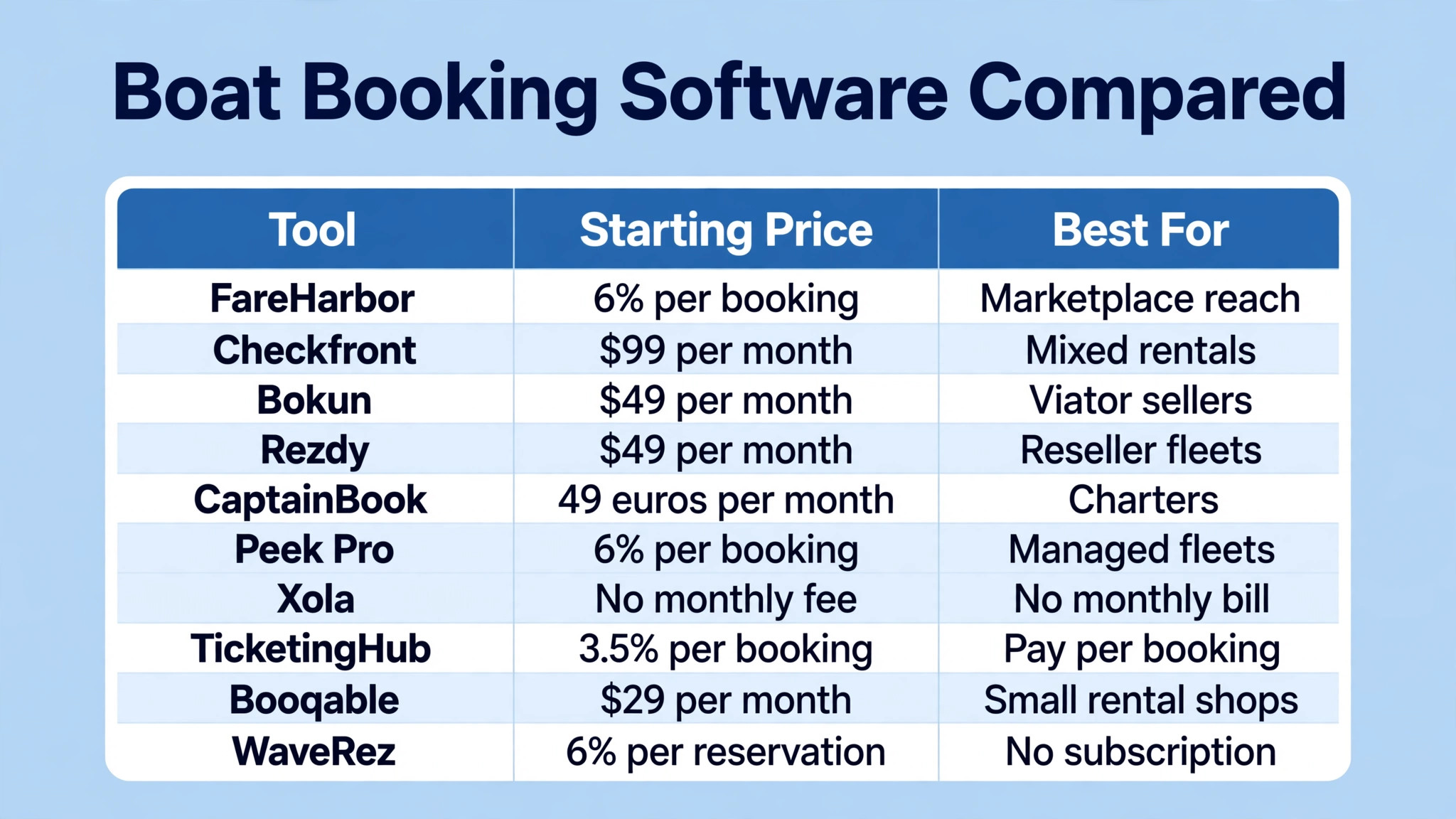
The table below lines up all ten platforms on starting price and the job each one handles best, so you can shortlist two or three before reading the detail. The best booking software for boat rentals is a crowded field, and the cheapest headline price is rarely the cheapest at your volume.
| Tool | Starting price | Best for | Standout strength |
|---|---|---|---|
| FareHarbor | No monthly fee, typically about 6 percent per booking paid by the guest | Established fleets that want marketplace reach | FareHarbor is the most widely used booking platform among tour and activity operators, and boat rental businesses benefit from that scale. |
| Checkfront | From about 99 dollars a month plus a 3 percent online booking fee | Operators renting boats alongside other equipment | Checkfront tracks every unit in real time, which is exactly what a rental business needs when boats, kayaks, and paddleboards share one calendar. |
| Bokun | From about 49 dollars a month plus 1 to 1.5 percent per booking | Operators selling heavily through Viator | Bokun pairs a low monthly price with the lowest percentage fees in this category, and its Viator integration is the reason many tour operators choose it. |
| Rezdy | From about 49 dollars a month plus 3 percent per online booking | Fleets selling through agents and resellers | Rezdy is built for operators whose bookings arrive through many channels at once. |
| CaptainBook | From about 49 euros a month with no direct booking fee | Sailing and day-charter operators | CaptainBook was built by a sailing operator, and it shows in the charter-first design. |
| Peek Pro | Quote-based, typically about 6 percent per booking | Larger fleets that want a managed platform | Peek Pro is a polished, full-service platform with strong reporting and a large operator network. |
| Xola | No subscription, partner fee plus card processing at about 2.39 percent plus 30 cents | Operators who want no monthly bill | Xola charges no monthly subscription, which makes it easy to start, and its checkout is fast enough that guests rarely abandon a booking. |
| TicketingHub | Pay as you go at about 3.5 percent per booking, or 2.75 percent on a yearly plan | Operators who prefer paying per booking | TicketingHub keeps the model simple. |
| Booqable | From about 29 dollars a month billed yearly | Small rental shops on a tight budget | Booqable is the budget pick that still behaves like real rental software. |
| WaveRez | No monthly subscription, about 6 percent per online reservation | Operators who want no subscription at all | WaveRez runs on a simple model with no monthly fee and no published setup cost, using Stripe for payments. |
Best Pick by Job
No single platform wins for every rental model, so match the pick to the shape of your operation. The best booking software for boat rentals rewards operators who know whether they are selling day charters, hourly rentals, or multi-day trips, because each model stresses a different part of the software.
| Job | Pick | Why it wins |
|---|---|---|
| Single boat, mostly direct bookings | CaptainBook | Flat monthly price with no direct booking fee keeps costs predictable. |
| Multi-boat fleet with resellers | Rezdy | Reseller channels and agent bookings are built in from the start. |
| Day charters and sailing trips | FareHarbor | Commission model means no monthly bill, and the marketplace brings bookings. |
| Mixed boats and equipment rentals | Checkfront | Hourly and daily inventory tracking covers boats plus kayaks and gear. |
| Tight budget, small rental shop | Booqable | Low monthly price with no booking fee suits low-volume operators. |
| Tours that also sell on Viator | Bokun | Viator integration and low percentage fees fit marketplace-heavy operators. |
How the best booking software for boat rentals Earns Its Fee Back
A booking platform earns its fee in three places, and only one of them shows up on the invoice. The first is the booking you would have lost, the midnight reservation from a guest who found your site while your phone was off. The second is the double booking you never have to refund, because live availability stopped two guests from buying the same boat for the same Saturday. The third is the hours your staff stops spending on the phone confirming times, collecting waivers, and chasing deposits.
Measure those three against the fee model before you compare feature lists. A platform charging 6 percent of bookings looks free until you run the numbers on a 200,000 dollar season, where it takes 12,000 dollars. A flat 99 dollar monthly plan looks dear in a quiet winter month, then costs almost nothing per booking once summer arrives. Seasonal operators feel this swing hardest, because a percentage fee sleeps in winter while a subscription keeps billing.
The other cost to weigh is the time your team spends inside the tool. A platform with clean vessel calendars and automatic waiver emails can cut daily admin to minutes, while a clumsy one turns every booking into a support ticket. Trial the two finalists with a real week of bookings, including a cancellation and a reschedule, before you commit to a season.
The 10 Tools in Detail
Each tool below was judged on the job it does best, its real price, and the point where it stops being the right choice for the best booking software for boat rentals. The headline price and the true cost are often two different numbers for the best booking software for boat rentals, so read the detail before you shortlist.
1. FareHarbor
FareHarbor is the most widely used booking platform among tour and activity operators, and boat rental businesses benefit from that scale. Its marketplace brings guests who would never find a small operator website, and the no-monthly-fee model means a quiet winter costs nothing. The trade is clear. The percentage fee is the trade. At high volume it becomes the most expensive option on this list, and the pricing is quote-based, so you will not know the exact rate until you talk to sales. For a buyer comparing the best booking software for boat rentals, that combination of price and capability is the first thing to weigh.
Pricing starts at No monthly fee, typically about 6 percent per booking paid by the guest. Established fleets that want marketplace reach is the job it handles best, and that is the lens to judge it through. Before paying for FareHarbor, run it on a real project from start to finish, since the handoff points between steps are where most tools either earn their price or lose it.
Choose FareHarbor when pick FareHarbor if your bookings come largely through marketplaces and you would rather pay per booking than per month. Look elsewhere if skip it if your annual revenue is high enough that 6 percent dwarfs a flat subscription.
2. Checkfront
Checkfront tracks every unit in real time, which is exactly what a rental business needs when boats, kayaks, and paddleboards share one calendar. Hourly and daily pricing sit side by side, and the booking page embeds cleanly into an existing website. The 3 percent fee applies to online bookings, and the monthly price is higher than the budget options, so low-volume operators pay for capacity they do not use.
Pricing starts at From about 99 dollars a month plus a 3 percent online booking fee. Operators renting boats alongside other equipment is the job it handles best, and that is the lens to judge it through. Trial Checkfront for a week on real work before any annual commitment, because a week of daily use exposes the friction that a sales demo never shows.
Checkfront fits when pick Checkfront if your fleet mixes boats with other rental gear and you want one calendar for all of it. It fits less well if skip it if you run boats only and a charter-focused tool covers your model for less.
3. Bokun
Bokun pairs a low monthly price with the lowest percentage fees in this category, and its Viator integration is the reason many tour operators choose it. All core features sit on every plan, so there is no feature ladder to climb as you grow. That said, the interface feels built for tours first and boats second, so vessel-specific workflows like captain assignment need a workaround or two.
Pricing starts at From about 49 dollars a month plus 1 to 1.5 percent per booking. Operators selling heavily through Viator is the job it handles best, and that is the lens to judge it through. A trial week with Bokun on your own data answers the fit question faster than any feature table, and the answer is usually obvious by day three.
Pick Bokun if pick Bokun if Viator and other marketplaces drive a large share of your bookings. Skip it if skip it if you need deep charter and crew scheduling out of the box.
4. Rezdy
Rezdy is built for operators whose bookings arrive through many channels at once. Agent logins, reseller pricing, and voucher handling are native, and the calendar keeps direct and agent bookings from colliding. The trade is clear. The 3 percent fee stacks up at volume, and the higher tiers climb to 249 dollars a month, so a growing fleet should model the total cost before committing.
Pricing starts at From about 49 dollars a month plus 3 percent per online booking. Fleets selling through agents and resellers is the job it handles best, and that is the lens to judge it through. Before paying for Rezdy, run it on a real project from start to finish, since the handoff points between steps are where most tools either earn their price or lose it.
Choose Rezdy when pick Rezdy if resellers and travel agents are a real channel for you, not a someday idea. Look elsewhere if skip it if nearly all your bookings come direct and a flat-fee tool is cheaper.
5. CaptainBook
CaptainBook was built by a sailing operator, and it shows in the charter-first design. Multi-day pricing, mixed hourly and daily trips, and captain scheduling are handled natively, and the flat price means a busy season costs the same as a quiet one. The euro pricing and smaller marketplace footprint mean operators who depend on reseller traffic will find less distribution here than on the big commission platforms.
Pricing starts at From about 49 euros a month with no direct booking fee. Sailing and day-charter operators is the job it handles best, and that is the lens to judge it through. Trial CaptainBook for a week on real work before any annual commitment, because a week of daily use exposes the friction that a sales demo never shows.
CaptainBook fits when pick CaptainBook if you run charters and want predictable costs that fall per booking as you grow. It fits less well if skip it if reseller marketplaces are your main source of guests.
6. Peek Pro
Peek Pro is a polished, full-service platform with strong reporting and a large operator network. Its dashboard makes it easy to see which boats earn their keep and which trips should be repriced. That said, pricing is not published, so budgeting means a sales conversation, and the percentage model carries the same high-volume cost as FareHarbor.
Pricing for Peek Pro is quote-based, so the vendor site is the place to confirm the current figure. Larger fleets that want a managed platform is the job it handles best, and that is the lens to judge it through. A trial week with Peek Pro on your own data answers the fit question faster than any feature table, and the answer is usually obvious by day three.
Pick Peek Pro if pick Peek Pro if you want a mature platform with strong support and you are comfortable with a quote-based price. Skip it if skip it if you need a published price before you invest trial time.
7. Xola
Xola charges no monthly subscription, which makes it easy to start, and its checkout is fast enough that guests rarely abandon a booking. The platform handles tours and rentals with a clean, modern interface. The trade is clear. The partner fee is not published, so the true per-booking cost is unclear until you ask, and boat-specific features are thinner than on charter-first tools.
Pricing starts at No subscription, partner fee plus card processing at about 2.39 percent plus 30 cents. Operators who want no monthly bill is the job it handles best, and that is the lens to judge it through. Before paying for Xola, run it on a real project from start to finish, since the handoff points between steps are where most tools either earn their price or lose it.
Choose Xola when pick Xola if a zero monthly bill matters more than deep marine features. Look elsewhere if skip it if you need captain scheduling and multi-day charter pricing built in.
8. TicketingHub
TicketingHub keeps the model simple. No monthly fee on pay as you go, a single percentage on every channel including cash at the till, and the option to pass the fee to guests or absorb it. At 3.5 percent it is not the cheapest per-booking rate, and the platform is newer in the boat space than the established names, so check references from marine operators.
Pricing starts at Pay as you go at about 3.5 percent per booking, or 2.75 percent on a yearly plan. Operators who prefer paying per booking is the job it handles best, and that is the lens to judge it through. Trial TicketingHub for a week on real work before any annual commitment, because a week of daily use exposes the friction that a sales demo never shows.
TicketingHub fits when pick TicketingHub if you want one rate across all channels with no subscription. It fits less well if skip it if your volume is high enough that a flat plan beats any percentage.
9. Booqable
Booqable is the budget pick that still behaves like real rental software. It tracks availability, takes online bookings, and handles the day-to-day of a small shop without a long setup process. That said, it is built for equipment rental generally, so marine-specific needs like captain scheduling and multi-day charter pricing are not its strength.
Pricing starts at From about 29 dollars a month billed yearly. Small rental shops on a tight budget is the job it handles best, and that is the lens to judge it through. A trial week with Booqable on your own data answers the fit question faster than any feature table, and the answer is usually obvious by day three.
Pick Booqable if pick Booqable if you run a small fleet and want the lowest honest monthly price. Skip it if skip it if your operation is charter-heavy or needs crew management.
10. WaveRez
WaveRez runs on a simple model with no monthly fee and no published setup cost, using Stripe for payments. It suits operators who would rather pay when a booking happens than pay for software in a quiet month. The trade is clear. The 6 percent rate is at the top of this list, and the setup fee is not published, so the total first-year cost needs a direct question to the vendor.
Pricing starts at No monthly subscription, about 6 percent per online reservation. Operators who want no subscription at all is the job it handles best, and that is the lens to judge it through. Before paying for WaveRez, run it on a real project from start to finish, since the handoff points between steps are where most tools either earn their price or lose it.
Choose WaveRez when pick WaveRez if you want zero subscription and are happy paying per reservation. Look elsewhere if skip it if your booking volume makes 6 percent the most expensive line on your profit and loss.
What a Season of Bookings Really Costs on Each Model
The table below prices a simple season, 400 bookings at an average of 250 dollars, so 100,000 dollars of revenue. The best booking software for boat rentals splits into two camps here, and the gap between them is the whole decision for a growing fleet.
| Scenario | CaptainBook Starter | FareHarbor at 6 percent | Checkfront 99 dollars plus 3 percent |
|---|---|---|---|
| 400 bookings, 100,000 dollars revenue | About 588 dollars a year | About 6,000 dollars | About 4,188 dollars a year |
| 200 bookings, 50,000 dollars revenue | About 588 dollars a year | About 3,000 dollars | About 2,688 dollars a year |
| 800 bookings, 200,000 dollars revenue | About 588 dollars a year | About 12,000 dollars | About 7,188 dollars a year |
| Winter months with no bookings | Still 49 euros a month | Nothing | Still 99 dollars a month |
| Reseller bookings through an agent | Marketplace fees may apply | Commission still applies | Offline bookings carry no fee |
Booking Mistakes That Cost Boat Operators Real Money
Most of the money lost on booking software is not the subscription. It is the avoidable error that the wrong setup invites, and the best booking software for boat rentals cannot fix a process the operator never defined. These five mistakes show up again and again in rental businesses.
Charging the fee to the wrong side. Operators who absorb a 6 percent fee on every booking give away thousands a season without noticing, because the cost hides inside each reservation. Decide before launch whether the guest pays the fee or you do, and check the setting on every channel, not just your own site.
Listing boats without buffer time. Back-to-back bookings with no turnaround gap mean the next guest arrives while the last one is still unloading. Build cleaning and fueling time into every vessel calendar, and test it with a full Saturday before peak season.
Skipping the waiver step. A booking without a signed safety waiver is a liability problem waiting for a bad day. Make the waiver part of checkout, not an email sent later, and confirm the platform stores it against the booking record.
Ignoring the cancellation policy. Weather cancellations need a clear rule, or every storm becomes a refund argument. Set the policy inside the platform, show it at checkout, and make sure staff can apply it without calling you.
Forgetting the captain. A boat is booked but no captain is assigned, and the guest finds out at the dock. Any platform you choose must tie crew scheduling to the vessel calendar, or you will run a second spreadsheet forever.

Your First-Week Setup List for a Boat Booking Platform
Work through these eight steps in order, and the best booking software for boat rentals setup will hold up when the first real week arrives.
- Load every vessel with its real capacity, hourly rate, and daily rate, then book a test trip on each one.
- Set turnaround buffers between bookings so cleaning and fueling never collide with the next guest.
- Connect your payment processor and run a real card payment, then refund it to confirm the flow.
- Add the safety waiver to checkout and confirm it attaches to the booking record.
- Write the weather cancellation policy in plain language and show it before payment.
- Assign captains to the calendar and confirm a booking cannot complete without crew.
- Connect your website booking button and test it from a phone on mobile data.
- Set up automatic confirmation and reminder emails with meeting point and what to bring.
Frequently Asked Questions
Do boat rental operators need booking software, or is a phone diary enough?
A phone diary works while you run one boat and your customers already know you. It breaks the first summer you add a second vessel, take online bookings, or sell through a reseller, because none of those channels can see the diary. Booking software earns its keep by keeping every channel pointed at the same live calendar, so a guest booking online and an agent booking by phone can never take the same boat.
What does booking software for boat rentals cost at a small fleet size?
A small fleet of two or three boats can run on a flat plan from about 49 dollars or euros a month, or on a commission plan with no monthly bill and roughly 6 percent per booking. At 100,000 dollars of annual revenue, the commission plan costs about 6,000 dollars while the flat plan costs under 1,000. Low-volume operators often start on commission and switch to flat pricing once bookings grow. That is the honest range for the best booking software for boat rentals, and the right number inside it depends on volume and audience size.
Can these platforms handle captains and multi-day charters?
The stronger ones can, and this is the feature to test first. Look for crew scheduling tied to the vessel calendar, multi-day pricing with overnight rates, and extras like food and fuel bundles. Platforms built for generic tours often handle day trips well and fall apart on multi-day charters, so run a three-day test booking before you commit.
How do weather cancellations work in boat booking software?
Most platforms let you define a cancellation policy and apply it per booking, with automatic refunds or rescheduling where the payment processor supports it. The important detail is whether the policy shows at checkout, because a guest who saw it before paying rarely argues about it after a storm. Check that staff can cancel and rebook without your help.
Is FareHarbor or Checkfront better for a boat rental business?
FareHarbor fits operators who want no monthly bill and value the marketplace traffic that comes with it, accepting a percentage fee on bookings. Checkfront fits operators who run boats alongside other equipment and want hourly inventory tracking with a flat monthly price. The deciding number is your annual booking revenue, since the percentage model gets expensive fast as volume grows.
Does boat booking software connect to Viator and other resellers?
Several platforms do, with Bokun and Rezdy among the strongest for reseller channels. The connection matters because reseller bookings can fill midweek gaps that direct bookings never touch. Check the fee on reseller bookings separately, since some platforms charge a different rate there, and confirm the calendar syncs both ways so a reseller sale blocks the boat everywhere.
Our Call, With the Runner-Up Named
For most rental operators, CaptainBook is the pick that holds up as volume grows. The flat monthly price with no direct booking fee means the software gets cheaper per booking every season, and its charter-first design handles the multi-day trips and captain scheduling that generic tour tools miss. Start on the Starter plan, load the fleet honestly, and let one full season prove the math.
Rezdy is the runner-up, and it wins outright when resellers drive a large share of your bookings. Its agent and marketplace channels are deeper than CaptainBook, and a fleet that sells through travel agents will fill boats that direct marketing never reaches. If more than a third of your revenue comes through resellers, take Rezdy instead and accept the 3 percent fee as the price of that distribution.
One detail worth checking during a trial is how the platform handles a guest who books the wrong boat. Some tools let the guest change vessels themselves, while others force staff to cancel and rebook, which costs time and risks losing the sale. The self-serve option matters more than it sounds, because guests who can fix their own mistake rarely call you about it.
Payment timing deserves a line in your comparison too. Some platforms release funds quickly, while others hold payouts until after the trip, which changes your cash flow in peak season. Ask each vendor when money lands in your account for a booking made today for a trip next month, and compare the answers side by side.
Support quality shows up at the worst moment, usually a Saturday morning when the calendar looks wrong. Check whether the vendor offers weekend support and how fast they answer, because a booking platform that only helps on weekdays leaves you alone exactly when your boats are busiest.
Finally, remember that migrating mid-season is painful, so the trial matters more than the sales call. Run both finalists with real bookings for two weeks, including a cancellation, a reschedule, and a reseller sale, and the right choice usually becomes obvious before the trial ends.