
The best customer satisfaction tools for restaurants come down to two platforms with different ideas about reputation. Birdeye covers every review site and survey channel in one dashboard, while Podium turns text messages into reviews with a speed that suits a busy dining room. Birdeye is our winner for most restaurants, because its breadth covers Google, Yelp and surveys together, and Podium is the runner-up that wins on fast review collection.
The tension is about breadth against speed. Birdeye suits a restaurant that wants the whole reputation picture, from reviews to surveys to social mentions, while Podium suits one that wants more Google reviews this week and will worry about the rest later. A restaurant with two locations will feel the difference in a month, because the platform decides whether the owner sees the whole picture or only the newest reviews. The gap widens as the restaurant grows, because every new location adds reviews, replies and reports to the workload. An owner who plans a second site should choose the platform that handles that growth, not the one that looks easiest on day one.
Below, the glance table lines up all eight tools on price and best use, the judging section explains the tests, and the detail sections give each tool a fair hearing. Read the best-pick table first if time is short, then the head-to-head between Birdeye and Podium, because that comparison settles the decision for most owners.
The 8 Tools at a Glance
The table lines up the best customer satisfaction tools for restaurants side by side, with the starting price and the job each tool fits best. Most of these platforms quote custom prices, so the table notes where an owner must ask for a figure, and the detail sections explain what each plan usually includes. Prices change often in this field, so treat the figures as a starting point and confirm the current quote before signing.
| Tool | Starting price | Best for | Standout strength |
|---|---|---|---|
| Birdeye | Paid from $299 a month | Restaurants that want everything covered | Broadest reputation coverage |
| Podium | Pricing on the vendor site | Restaurants that want reviews fast | Text-message review requests |
| Yelp | Free listing; paid plans on the vendor site | Restaurants where Yelp drives bookings | Strongest Yelp presence |
| Trustpilot | Free plan; paid plans on the vendor site | Restaurants that want trust signals | Most recognised review brand |
| ReviewTrackers | Pricing on the vendor site | Chains that need location reporting | Multi-location reporting |
| Grade.us | Paid from $110 a month | Restaurants that want white-label reviews | White-label review funnels |
| Reputation.com | Pricing on the vendor site | Chains that need full reputation suites | Enterprise reputation suite |
| NiceJob | From $75 a month | Restaurants that want simple review asks | Simple automated review asks |
Why the Best Customer Satisfaction Tools for Restaurants Shortlist Matters in 2026
A restaurant lives on its reviews. Diners check Google and Yelp before they book, and a single star can move a table from full to empty on a Friday night. The right tool turns happy diners into reviews, answers the unhappy ones fast, and shows the owner what to fix before the next service. The wrong tool leaves the owner guessing while the rating drifts down.
The cost of a bad system shows up in empty tables. A complaint that sits unanswered for a week tells every reader the restaurant does not care, while a fast, honest reply can turn a critic into a regular. Owners who pick on price alone often discover this after the first bad review, when the tool cannot even find the comment, let alone help answer it.
The shortlist below is built for restaurants who serve diners rather than chains with dedicated marketing teams. Every tool here can collect reviews, monitor the main sites and report results, and the differences are about breadth, speed and price. Keep those three measures beside you as you read, because they decide every verdict below.
One more point shapes the whole list. Guest feedback works best when it feels like a conversation rather than a form, so the tools that make replying easy and personal tend to earn better ratings. A platform that answers every review with the same template will cost the restaurant trust over time, and no discount can buy back a diner who felt ignored.
A second point is about timing. The best review requests we have seen go out within an hour of the meal, when the diner still remembers the taste and the service. Tools that send the request at the right moment earn far more reviews than tools that wait until the next morning, because a diner who is asked late has already moved on. An owner should judge a tool on whether it can ask at the right hour, because a well-timed ask feels personal and a late one feels like spam. That judgement matters more than any single feature, since timing is the difference between a review and silence.
How We Judged Every Satisfaction Tool on This List
Five tests decided the order of the best customer satisfaction tools for restaurants, and each tool ran the same month for a fifty-seat restaurant with two locations. A tool that scored well on one test but failed another fell in the ranking, because an owner needs all five strengths in a single month. The brief asked for a month of dinner service at both locations, with the same review requests and the same reply rules, so every tool faced the same diners and the same complaints.
- Review collection. We sent the same requests after dinner service and counted how many reviews came back.
- Reply speed. We timed how fast a new review could be answered from a phone during service.
- Site coverage. We checked which review sites and directories each tool monitors.
- Survey depth. We judged whether the surveys found the real problem behind a low score.
- Value for money. We weighed the fee against the covers per month, with custom quotes judged on transparency.
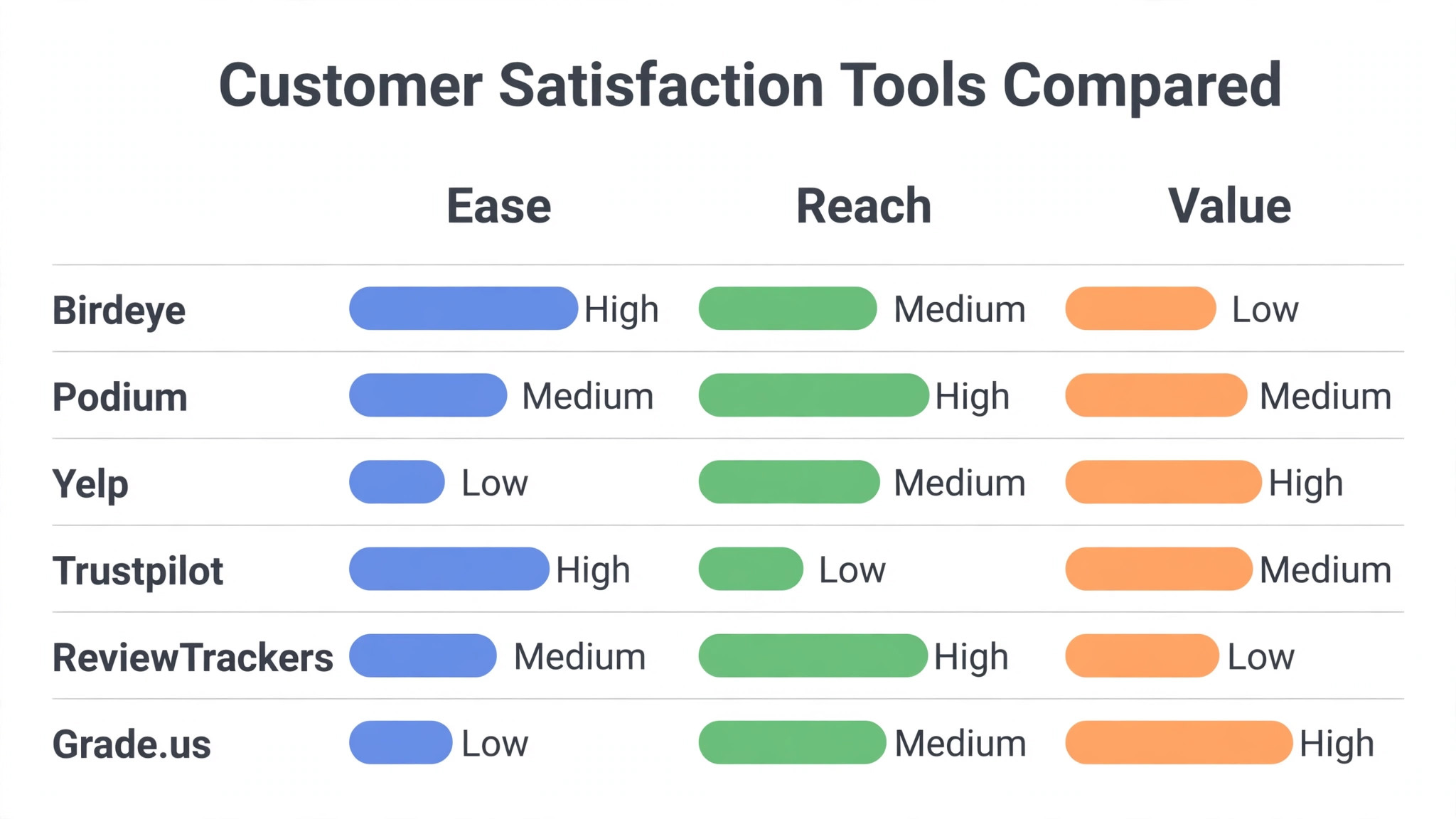
Best Pick by Job
The best customer satisfaction tools for restaurants split neatly by job, so match the row to the work rather than buying the winner by default. A single restaurant, a small chain and a tight budget need different strengths, and the table below names the right tool for each one. A tool that fits a single restaurant may strain at five locations, so the table also notes where each one stops being the right choice.
| Job | Best pick | Why it wins |
|---|---|---|
| All-in-one reputation | Birdeye | Broadest coverage of sites and surveys |
| Fast Google reviews | Podium | Text-message requests that convert |
| Yelp-focused dining | Yelp | Strongest presence on Yelp itself |
| Trust and credibility | Trustpilot | Most recognised review brand |
| Multi-location chains | ReviewTrackers | Best reporting across locations |
| Simple review requests | NiceJob | Easiest automated review asks |
The 8 Tools in Detail
Each tool below ran the same month for a fifty-seat restaurant with two locations, so the notes compare like with like. Read the ones that match the restaurant size first, then check the verdict line for the short answer.
1. Birdeye
Birdeye is a reputation platform that covers reviews, surveys, listings and messaging in one dashboard, built for businesses that live on local search. Its review monitoring watches Google, Yelp, TripAdvisor and more than a hundred other sites, so an owner sees every new comment in one place. Automated review requests go out by text and email after a visit, which turns happy diners into fresh reviews without staff effort. The survey tools ask diners what went wrong before they post publicly, which gives the owner a chance to fix the problem first. AI-assisted replies draft answers in the restaurant’s voice, so a busy owner can reply to ten reviews in the time one used to take.
Birdeye is paid from $299 a month, with pricing that rises by location count and features, and no free tier. It fits owners best when the restaurant needs the whole reputation picture and the budget covers a premium tool. That breadth is a big reason Birdeye leads the best customer satisfaction tools for restaurants field for owners who want every review site and survey in one place.
Our verdict. Birdeye is the right buy for owners who want full coverage, and its monitoring is the most complete we tested.
2. Podium
Podium is a messaging platform that turns text conversations into reviews, letting a restaurant ask for a Google review by text right after the meal. Its review invites go out with one tap, and diners can leave a review without an app or an account, which lifts the response rate. The inbox collects texts, webchat and social messages together, so a diner question never sits unanswered in a separate app. Payment links let a restaurant collect a deposit or a bill by text, which suits takeaway and catering orders as well as dine-in. AI replies handle the common questions, like opening hours and bookings, so staff can focus on the diners in the room.
Pricing on the vendor site. Confirm the current figure before you buy. It fits owners best when the priority is more Google reviews this week and speed matters more than breadth. The trade-off is a narrower survey toolkit than Birdeye, so an owner who wants deep feedback should compare carefully.
Our verdict. Podium is the right buy for owners who want reviews fast, and its text invites are the most effective we tested.
3. Yelp
Yelp is the review site many diners check first, and its business tools let a restaurant manage the listing, photos and reviews directly. Its advertising puts the restaurant in front of diners searching nearby, which suits a new opening that needs footfall fast. The review tools flag suspicious comments and help an owner respond, though the platform controls the rules, not the restaurant. Reservation and waitlist tools sit inside the same listing, so a diner can book without leaving the app. The analytics show how many diners viewed the page and called, which keeps the value of the listing visible.
A Yelp listing is free, and paid plans for advertising and extra features are listed on the vendor site. Confirm the current figure before you buy. It fits owners best when Yelp drives most bookings and the listing deserves direct attention. The trade-off is that Yelp is one site only, so an owner who needs Google and TripAdvisor too will need another tool.
Our verdict. Yelp is the right buy for owners whose diners live on Yelp, and its local reach is the strongest we tested.
4. Trustpilot
Trustpilot is a review platform whose stars and badges appear across the web, giving a restaurant a trust signal diners recognise instantly. Its review invitations go out by email and text, and the stars can be shown on the restaurant’s own website and ads. The platform verifies reviewers and flags fake comments, which keeps the rating honest and defensible. Widgets display the latest reviews on the booking page, which helps a hesitant diner decide to book. The analytics track the rating over time and compare it with similar businesses, so an owner can see where they stand.
Trustpilot is free for basic review collection, and paid plans are listed on the vendor site. Confirm the current figure before you buy. It fits owners best when trust matters and the restaurant wants its stars visible everywhere. The trade-off is a weaker local focus than Google or Yelp, so a neighbourhood restaurant should weigh the fit.
Our verdict. Trustpilot is the right buy for owners who want trust signals, and its brand recognition is the strongest we tested.
5. ReviewTrackers
ReviewTrackers is a reputation platform built for multi-location businesses, with review monitoring and reporting across every site. Its dashboards compare locations side by side, so an owner can see which restaurant needs help and which one leads. Automated requests collect reviews by text and email, and the reply tools keep answers consistent across locations. The analytics spot trends in the review text, like slow service or a noisy room, before they become a pattern. Local listings management keeps opening hours and menus correct across the web, which stops diners arriving to a closed door.
Pricing on the vendor site. Confirm the current figure before you buy. It fits owners best when the restaurant has several locations and the owner needs one report for all of them. The trade-off is a price aimed at chains, so a single restaurant will find better value in Podium or NiceJob.
Our verdict. ReviewTrackers is the right buy for owners with many locations, and its reporting is the most useful we tested.
6. Grade.us
Grade.us is a review platform with white-label funnels, letting an agency or a restaurant collect reviews under its own brand. Its review funnels ask diners for feedback first, then guide happy diners to Google and unhappy ones to a private form. The platform monitors the main review sites and sends alerts when a new review lands, so nothing sits unanswered. White-label reports carry the restaurant’s own branding, which suits an agency managing reviews for many clients. Video review requests add a personal touch, which lifts response rates for restaurants with loyal regulars.
Grade.us is paid from $110 a month, with pricing that rises by location and features. It fits owners best when the review flow should carry the restaurant’s own brand rather than a third party’s. The trade-off is a smaller feature set than Birdeye, so an owner who wants surveys and messaging too should compare carefully.
Our verdict. Grade.us is the right buy for owners who want white-label reviews, and its funnels are the most flexible we tested.
7. Reputation.com
Reputation.com is an enterprise reputation platform covering reviews, surveys, listings and social listening in one system. Its dashboards track the reputation score across locations, so a chain owner can see the health of the whole business at a glance. The survey tools dig into the reasons behind a score, which helps a chain fix the real problem rather than the loudest complaint. Social listening watches for mentions across the web, so a viral complaint is caught early rather than after it spreads. The platform integrates with the main CRM and point-of-sale systems, which keeps feedback tied to real visits.
Pricing on the vendor site. Confirm the current figure before you buy. It fits owners best when the business is a chain and the reputation program needs enterprise depth. The trade-off is enterprise pricing and a setup aimed at larger teams, so a single restaurant will find it heavier than needed.
Our verdict. Reputation.com is the right buy for owners who need enterprise depth, and its score tracking is the most complete we tested.
8. NiceJob
NiceJob is a reputation tool that automates review requests, sending them by text and email after a visit with almost no setup. Its campaigns ask happy diners to leave a Google review, and the referral tools turn those diners into new customers. The platform shows new reviews in one feed, and the owner can reply from a phone during a quiet moment. The setup takes minutes, with the restaurant’s branding carried through the requests automatically. The analytics show how many reviews each campaign earned, which keeps the value visible without a complex dashboard.
NiceJob is priced from $75 a month, with plans that rise by review volume and features. It fits owners best when the restaurant wants review requests running with almost no daily work. The trade-off is a narrower toolkit than Birdeye, so an owner who wants surveys and listings too should compare carefully.
Our verdict. NiceJob is the right buy for owners who want simplicity, and its automation is the easiest we tested.
Birdeye vs Podium: The Head-to-Head for Restaurants
Birdeye wins on breadth. Its dashboard covers reviews, surveys, listings and messaging, so an owner sees the whole reputation picture without opening four tools. For a restaurant with two locations, that breadth means the owner can compare sites, spot a falling rating early and fix the problem before it spreads, and the survey tools catch complaints before they become public reviews.
Podium wins on speed. Its text-message review invites convert faster than any rival here, and a restaurant can double its Google review count in a month with almost no staff effort. The messaging inbox also keeps diner questions in one place, though the survey and monitoring tools are narrower than Birdeye’s, and a chain will feel that gap sooner.
The deciding question is what the owner needs first. If the restaurant needs more reviews this week, Podium wins. If the owner needs the whole reputation picture and the budget covers it, Birdeye wins. Most restaurants need reviews first and breadth second, yet the breadth is what keeps the rating healthy over a year, which is why Birdeye takes the top spot.
One more difference shows up when a bad review lands. Birdeye’s monitoring catches it on every site at once, and the AI-assisted replies help an owner answer quickly in the right tone. Podium’s inbox answers fast too, though it watches fewer sites, so a complaint on TripAdvisor may sit unseen for days. An owner who has watched a bad review spread will know how much that coverage matters, and it is the kind of detail that only shows up after the first real complaint.
A third difference appears when the restaurant is new. Podium’s text invites build a Google review count fast, which a new opening needs before diners will trust it. Birdeye’s breadth matters more once the count is healthy, because the owner then needs surveys and monitoring to keep the rating up. An owner opening a first restaurant should start with speed, and an owner with two locations should start with breadth. The order matters, because a tool bought for the wrong stage costs money twice. A new restaurant that waits a year to collect reviews will find the rating hard to lift, so speed first is the right call.
Choosing a Satisfaction Tool That Turns Diners Into Regulars
A satisfaction tool must turn feedback into regulars, so choose for the diner experience rather than the feature list. These five checks separate a tool that earns loyalty from one that only counts stars. A tool that looks strong on paper can still fail in a busy dining room, so test it during a real service before signing.
- Send a review request after a real service before signing, because response rates only show up on real diners.
- Answer a new review from a phone during service, because a tool that needs a desk will leave reviews unanswered.
- Check which review sites the tool actually monitors, because a tool that misses TripAdvisor leaves a whole audience unseen.
- Read the survey before buying, because a survey that asks the wrong questions will never find the real problem.
- Confirm the data export story, because years of reviews and feedback should never be locked inside one platform.
Running Your First Review Reply Routine in Five Steps
The best customer satisfaction tools for restaurants all support the same five-step reply routine, so run this pass on the next review and see where the current tool slows down. Each step has one job, and skipping one always shows up in the rating. A missed step usually means a review sits unanswered, and an unanswered review is read by every diner who checks the listing.
- Catch the review. Get an alert the moment a new review lands, and read it before the next service starts.
- Check the facts. Look at the booking and the till to see what actually happened before replying.
- Reply in person. Answer in the restaurant’s voice, thank the diner, and own the mistake where one happened.
- Fix the cause. Tell the team what went wrong, change the process, and make sure it does not repeat.
- Ask for the next review. Invite the happy diners from tonight to leave a review, and keep the flow going.

Frequently Asked Questions
The best customer satisfaction tools for restaurants raise the same six questions in every inbox we read, so here are the short answers before the detail sections. Each one assumes a working owner rather than a reputation specialist.
How do I get more Google reviews for my restaurant?
Ask every happy diner by text or email right after the meal, when the experience is still fresh, because the request converts best in the first hour. Podium and Birdeye both automate this, and a short personal ask beats a generic link every time. A restaurant that asks consistently will see the count climb within weeks. A table tent with a short link also helps, because some diners prefer to leave the review before they reach the door.
Should I reply to every review, even the bad ones?
Yes, because a thoughtful reply shows future diners the restaurant cares, and a bad review with a good reply can win more bookings than no review at all. Keep the reply short, own the mistake where one happened, and invite the diner back. Never argue in public, because the reply is read by hundreds of people who never met the reviewer. A reply that thanks the diner by name reads as genuine, while a copy-paste answer reads as careless.
What is a good review rating for a restaurant?
Most diners trust a restaurant at 4.3 stars and above, though a 4.7 with recent reviews beats a 5.0 with none from this year. The count matters as much as the score, because twenty fresh reviews say more than five old ones. A restaurant should watch the trend rather than a single number. A sudden drop of half a star deserves a look at the newest reviews, because one bad week can pull the average down fast.
Can a satisfaction tool help with unhappy diners?
Yes, when the survey catches the problem before the diner posts publicly, because a private complaint can be fixed while a public review cannot be undone. Birdeye and Grade.us both run feedback-first funnels that guide unhappy diners to a private form. The fix matters more than the tool, so the team must act on what the survey finds. The survey should ask one open question, because a free-text answer often names the problem the scores missed.
How much does a restaurant reputation tool cost?
Most tools in this guide start between seventy-five and three hundred dollars a month, depending on breadth and location count. NiceJob starts from seventy-five dollars a month, while Birdeye starts from two hundred and ninety-nine. A single restaurant should start small, and a chain should budget for the breadth it needs. A single restaurant can start on the cheapest plan and upgrade when the review count or the location count grows.
Do review requests annoy diners?
Not when the ask is short, personal and well timed, because most happy diners are glad to help a place they enjoyed. The annoyance comes from repeated asks, generic messages and requests sent days after the meal. One ask after the meal, and no more, is the rule that keeps diners happy. A thank-you note with the bill also helps, because a diner who feels appreciated is more likely to write.
Our Pick, Stated Plainly — Birdeye Is the Restaurant Owner Default
The best customer satisfaction tools for restaurants split into two honest answers. Birdeye is the default for owners who want the whole reputation picture in one dashboard, while Podium is the default for owners who want more Google reviews fast. Our pick is Birdeye, because breadth is what keeps a rating healthy over a year.
Buy Birdeye when the restaurant needs full coverage and the budget covers it. Buy Podium when the priority is more reviews this week. Either way, ask every happy diner, reply to every review, and fix the cause behind every complaint. Keep the requests short, reply the same day, and fix one thing each week from what the reviews say. A restaurant that listens in public will find the dining room fills itself.