
Companies using marketing automation generate 451 percent more qualified leads than those relying on manual processes, according to HubSpot 2026 State of Marketing research, while cutting the cost per lead by about a third. That gap is the reason a startup with two marketers can outproduce a competitor with ten, and the best digital marketing tools for startups are the systems that close it.
The market splits into three camps. All-in-one platforms such as HubSpot cover CRM, email and automation in one login, specialists such as Semrush and Ahrefs own search, and connectors such as Zapier join the rest together. A pre-seed startup needs the free tiers of the first camp. A growth-stage startup needs one specialist plus one connector.
This guide compares twelve tools on the numbers that decide a startup purchase. We look at entry price, the cost at 2,000 monthly visitors, free tier generosity, the channel each tool owns and the point where the price jumps. Every price here is the published starting price, and vendors change them, so verify the current figure on the vendor site before you budget.
The 12 Tools at a Glance
| Tool | Best for | Starting price | Free plan |
|---|---|---|---|
| HubSpot | CRM plus marketing in one system | Free, Starter from about 20 dollars a month | Yes |
| Semrush | The broadest single marketing toolkit | About 140 dollars a month | Limited free account |
| Mailchimp | Email plus simple automation | About 13 dollars a month | Yes, up to 250 contacts |
| Buffer | Social scheduling at the lowest cost | About 6 dollars per channel a month | Yes, 3 channels |
| Hootsuite | Social management for a growing team | About 99 dollars a month | No, trial available |
| Canva | Design for every channel | Pro 10 dollars a month on annual billing | Yes |
| Ahrefs | SEO research, backlinks and rank tracking | About 29 dollars a month | Free Webmaster Tools |
| ActiveCampaign | Behavioural email automation | About 15 dollars a month | No, trial available |
| Zapier | Connecting apps without code | Free, paid from about 20 dollars a month | Yes |
| Sprout Social | Social analytics and team workflows | About 199 dollars a month | No, trial available |
| Moz | SEO tracking with a gentler learning curve | About 99 dollars a month | Limited free tools |
| Unbounce | Landing pages that convert | About 99 dollars a month | No, trial available |
Best Pick by Job
| Your job | Pick this tool | Why it fits |
|---|---|---|
| You need one system for marketing and sales | HubSpot | Free CRM plus email plus automation in one login |
| You need the widest single toolkit | Semrush | SEO, ads, content and social in one subscription |
| You send a weekly newsletter | Mailchimp | Familiar editor with a real free plan |
| You schedule social posts cheaply | Buffer | Lowest cost per channel on this list |
| You run social for a team of five | Hootsuite | Streams, approvals and reporting in one place |
| You design everything in-house | Canva | Templates plus brand kit at 10 dollars a month |
| You need exact backlink and keyword data | Ahrefs | The most trusted SEO database for the price |
| You automate email by behaviour | ActiveCampaign | Deep automation at a startup price |
| You connect apps without a developer | Zapier | Thousands of integrations with no code |
| You need social reporting for clients | Sprout Social | Analytics and approval workflows built in |
| You track rankings without the complexity | Moz | Clear reports with a gentler learning curve |
| You need landing pages that convert | Unbounce | AI page building plus A/B testing |
Why the Best Digital Marketing Tools for Startups Beat a Bigger Budget
A bigger budget buys more ads, yet it does not buy a better system. The best digital marketing tools for startups win by making a small team consistent, because consistency is what compounds. A newsletter sent every Tuesday for a year builds more trust than a viral post that never repeats, and a tool that makes the Tuesday send easy is worth more than a tool with a hundred features nobody opens.
The first test is the free tier. The best digital marketing tools for startups let a pre-seed team run a real motion before paying, with HubSpot free CRM, Canva free design and Buffer free scheduling covering the first months. A vendor that gates the useful features behind a paywall from day one is selling to funded companies, not to startups finding their first customers.
The second test is the upgrade path. A tool that jumps from free to 140 dollars a month with nothing in between forces a painful decision at the worst moment, which is when the startup starts growing. Check the price at each tier and the limits that trigger the jump, because the honest comparison is the tier you will actually need in six months rather than the tier you start on.
The third test is integration depth. A startup stack works when the email tool talks to the CRM, the CRM talks to the website and the analytics tool sees all of it. Zapier covers the gaps, yet the native integrations matter more, because a Zap that breaks silently is a lead that never reaches sales. Ask each vendor which integrations are native and which are third-party.
The 12 Tools in Detail
The twelve entries below follow the same order as the comparison table. Each one states the starting price, the free plan position, the strongest startup feature and the weakness that should make a specific kind of startup walk away. Read the entry that matches your best channel first, then check the two entries next to it before you decide.
1. HubSpot
HubSpot is the all-in-one choice for startups that want marketing and sales in one system. The free CRM covers contacts, deals and basic email tools at no cost, and paid plans start at about 20 dollars a month per seat for Starter. Marketing Hub Professional runs higher, near 100 dollars a month per seat, so the Starter tier is the one most startups buy first.
The strength is the single record. A visitor who downloads a guide, opens three emails and books a demo shows up as one person with one history, and the team can segment and automate on that history without exporting anything. The free tier is genuinely capable for a pre-seed startup, and the startup discount programs through accelerators can cut the paid price further.
The cost grows with seats and contacts, and the platform rewards teams that invest time in setup. A solo founder may find the system more than needed, while a team of three with a real pipeline will get value no standalone email tool can match. Choose HubSpot when the CRM is the centre of the business, not when a simple newsletter is enough.
2. Semrush
Semrush is the broadest single marketing toolkit a startup can buy. The Pro plan costs about 139.95 dollars a month, with Guru at about 249.95 and Business at about 499.95. A limited free account covers a handful of reports a day, which is enough to test the tool before paying.
The breadth is the draw. Keyword research, rank tracking, site audits, competitor analysis, advertising research, content planning and social scheduling all live in one subscription. A startup that buys Semrush does not need a separate SEO tool, a separate competitor tool or a separate content tool, and the time saved on tool-switching is real. The AI search tracking now covers visibility in AI overviews as well.
The price is the barrier. At 140 dollars a month, Semrush is the most expensive single tool on this list, and a startup that only needs keyword research will find Ahrefs Starter at 29 dollars a better buy. Choose Semrush when search is a core channel and the team will use at least three of its modules every week.
3. Mailchimp
Mailchimp remains the familiar email choice for startups that want a newsletter plus simple automation. The free plan covers up to 250 contacts and 500 sends a month, and paid plans start at about 13 dollars a month. Verified nonprofits receive a discount, though that matters less to a startup than the free tier does.
The editor is the easiest on this list for a non-designer to learn. Drag-and-drop blocks, a large template library and a straightforward audience dashboard mean a founder can send a decent newsletter after one training session. Automation covers welcome emails, product announcements and date-based reminders for launches and renewals.
The weakness is the price curve. Costs rise steeply as the list grows, and a list of 5,000 contacts lands near 45 dollars a month on Essentials before any discount. A startup that expects fast list growth should model the cost at 10,000 contacts before committing, because the bill can double while the budget stays flat.
4. Buffer
Buffer is the cheapest social scheduling tool a startup can buy. The free plan connects up to three channels, and the Essentials plan costs about 6 dollars per channel a month. The Team plan at about 12 dollars per channel adds collaboration, and the pricing scales with channels rather than with seats.
The simplicity is the strength. A founder schedules a week of posts in an hour, the AI drafting helps with captions, and the analytics show which posts earned engagement. The calendar view keeps the whole month visible, and the first-comment scheduling helps Instagram posts perform better. A startup that lives on LinkedIn and X will find Buffer covers the job for the price of a coffee.
The limits are depth and reporting. Buffer lacks the approval workflows and deep analytics of Hootsuite or Sprout Social, and the per-channel pricing can add up for a startup on five networks. Choose Buffer when the team is small and the social job is scheduling, and upgrade when reporting and approvals become the job.
5. Hootsuite
Hootsuite is the social management platform for a startup team that has grown past one person posting. Plans start at about 99 dollars a month, with a trial available and no permanent free plan. The platform covers scheduling, streams, inbox management, approvals and reporting across the major networks.
The team workflows are the draw. A junior marketer drafts, a manager approves and the post goes live on schedule, with the whole history visible in one place. Streams monitor mentions and keywords, so the team can answer a customer complaint before it becomes a thread. The reporting covers engagement, reach and team performance in a format a founder can read in five minutes.
The price is the barrier for a pre-seed startup. At 99 dollars a month, Hootsuite costs sixteen times the Buffer entry price, and a team of two will not use most of the approval features. Choose Hootsuite when social is a team job with a real budget, and choose Buffer when it is a founder job with a small one.
6. Canva
Canva is the design tool that lets a startup look like a company ten times its size. The free plan covers templates and basic design, and Canva Pro costs 10 dollars a month on annual billing, which is 120 dollars a year, or 15 dollars a month when billed monthly. The Pro tier adds the brand kit, background removal and premium templates.
The brand kit is the feature that matters most. A startup sets its colours, fonts and logo once, and every designer and marketer produces on-brand work from then on. Templates cover social posts, presentations, ads, documents and videos, and the AI tools resize a design for every channel in seconds. A founder with no designer can ship professional work daily.
The limits are depth and originality. Canva cannot replace a designer for a complex brand identity, and the templates are recognisable when overused. A startup that relies on the same three templates for a year will look like every other startup using them. Choose Canva for speed and consistency, and hire a designer when the brand needs to stand apart.
7. Ahrefs
Ahrefs is the SEO research tool that startups reach for when they need exact data. The Starter plan costs about 29 dollars a month, and the Lite plan runs about 129 dollars a month. Free Webmaster Tools cover a site the startup owns, with a limited site audit and keyword data.
The database is the strength. Keywords Explorer, Site Explorer and Content Explorer give a startup the search volume, difficulty and backlink data that decide which keywords are worth chasing. The AI content grade and keyword difficulty model help a small team prioritise, and the rank tracking shows whether the work is paying off week by week.
The learning curve is steeper than Moz, and the Starter plan limits the number of tracked keywords and reports. A startup that only needs basic rank tracking will find Moz simpler, while a startup that lives on search will find Ahrefs worth the effort. Choose Ahrefs when SEO is a core channel and the team will read the data every week.
8. ActiveCampaign
ActiveCampaign is the behavioural email tool for startups that want automation beyond a welcome series. Plans start at about 15 dollars a month for 1,000 contacts, with higher tiers adding CRM, sales automation and predictive sending. A trial is available, and there is no permanent free plan.
The automation builder is the draw. A startup can trigger emails from page visits, purchases, tag changes and engagement scores, building journeys that respond to what a customer actually does. The CRM sits beside the email, so a sales rep sees the same history as the marketer. The deliverability record is strong, and the templates cover the common startup journeys.
The interface carries more menus than Mailchimp, and a team that only sends a newsletter will find the depth unnecessary. The price also rises with contacts in the same way as Mailchimp, so a fast-growing list needs the same modelling. Choose ActiveCampaign when behaviour-driven email is the growth engine, and choose Mailchimp when the newsletter is the whole job.
9. Zapier
Zapier connects apps without code, and it is the glue in most startup stacks. The free plan covers 100 tasks a month, and paid plans start at about 20 dollars a month for 750 tasks. Higher tiers raise the task allowance and add multi-step workflows, premium apps and faster updates.
The integration count is the strength. Thousands of apps connect through Zapier, so a lead from a form can reach the CRM, the email tool and Slack in seconds without a developer. A startup can automate the handoffs that otherwise eat a founder afternoon, and the AI features now draft and test workflows from a plain-language description.
The cost is per task, and a busy startup can burn through the allowance faster than expected. A workflow that fires on every form fill, every email open and every Slack message adds up, so the team should audit the task count monthly. Choose Zapier when the stack has gaps to bridge, and prefer native integrations where they exist.
10. Sprout Social
Sprout Social is the social platform for startups that need reporting and team workflows. Plans start at about 199 dollars a month, with a trial available and no permanent free plan. The platform covers scheduling, inbox management, listening, analytics and approval workflows across the major networks.
The reporting is the draw. A startup that reports social results to investors or clients gets clean dashboards showing engagement, reach and response times, and the approval workflow keeps every post on brand. The listening tools track mentions and competitors, which helps a small team spot a trend before it becomes a crisis.
The price is the barrier. At 199 dollars a month, Sprout Social is the most expensive social tool on this list, and a startup with one marketer will not use the team features. Choose Sprout Social when social reporting is a deliverable and the team is large enough to need approvals, and choose Buffer when it is not.
11. Moz
Moz is the SEO tracking tool with the gentlest learning curve on this list. The Pro plan costs about 99 dollars a month, and limited free tools cover domain authority checks and a handful of keyword queries. The platform covers keyword research, rank tracking, site audits and link research in a clear interface.
The clarity is the strength. A founder who is new to SEO can read a Moz report and understand what to fix, while the same report in Ahrefs or Semrush takes longer to learn. The domain authority metric is widely cited, and the keyword difficulty scores help a small team pick winnable terms. The community and learning resources are the best in the category.
The database is smaller than Ahrefs or Semrush, and the price is high for the depth offered. A startup that outgrows the basics will need to switch, and the 99-dollar price buys more data elsewhere. Choose Moz when the team is learning SEO and needs clear guidance, and choose Ahrefs when the team already knows the work.
12. Unbounce
Unbounce builds landing pages that convert, and it is the tool for startups that run paid campaigns. Plans start at about 99 dollars a month, with a trial available and no permanent free plan. The platform covers drag-and-drop page building, AI-generated copy, A/B testing and pop-ups.
The conversion focus is the draw. A startup can build a landing page for each campaign, test two versions and keep the winner, all without a developer. The AI page builder drafts a first version from a description, and the Smart Traffic feature routes visitors to the version most likely to convert for them. The templates cover the common startup pages, from waitlists to webinar signups.
The price is the barrier for a pre-seed startup, and a team that only needs one landing page will find a cheaper option in HubSpot or Mailchimp. Choose Unbounce when paid traffic is a real channel and the landing page decides the cost per lead, and skip it when the website already converts well enough.
What a 2,000-Visitor Month Costs
| Tool | Monthly cost at 2,000 visitors | What drives the cost |
|---|---|---|
| HubSpot | Free to about 20 dollars | Free CRM, Starter per seat |
| Semrush | About 140 dollars | Pro plan, flat rate |
| Mailchimp | Free to about 13 dollars | Free plan covers 250 contacts |
| Buffer | Free to about 6 dollars | Free plan covers 3 channels |
| Hootsuite | About 99 dollars | Flat plan, no free tier |
| Canva | Free to 10 dollars | Pro on annual billing |
| Ahrefs | About 29 dollars | Starter plan |
| ActiveCampaign | About 15 dollars | 1,000 contacts tier |
| Zapier | Free to about 20 dollars | Free plan covers 100 tasks |
| Sprout Social | About 199 dollars | Flat plan, no free tier |
| Moz | About 99 dollars | Pro plan |
| Unbounce | About 99 dollars | Flat plan |
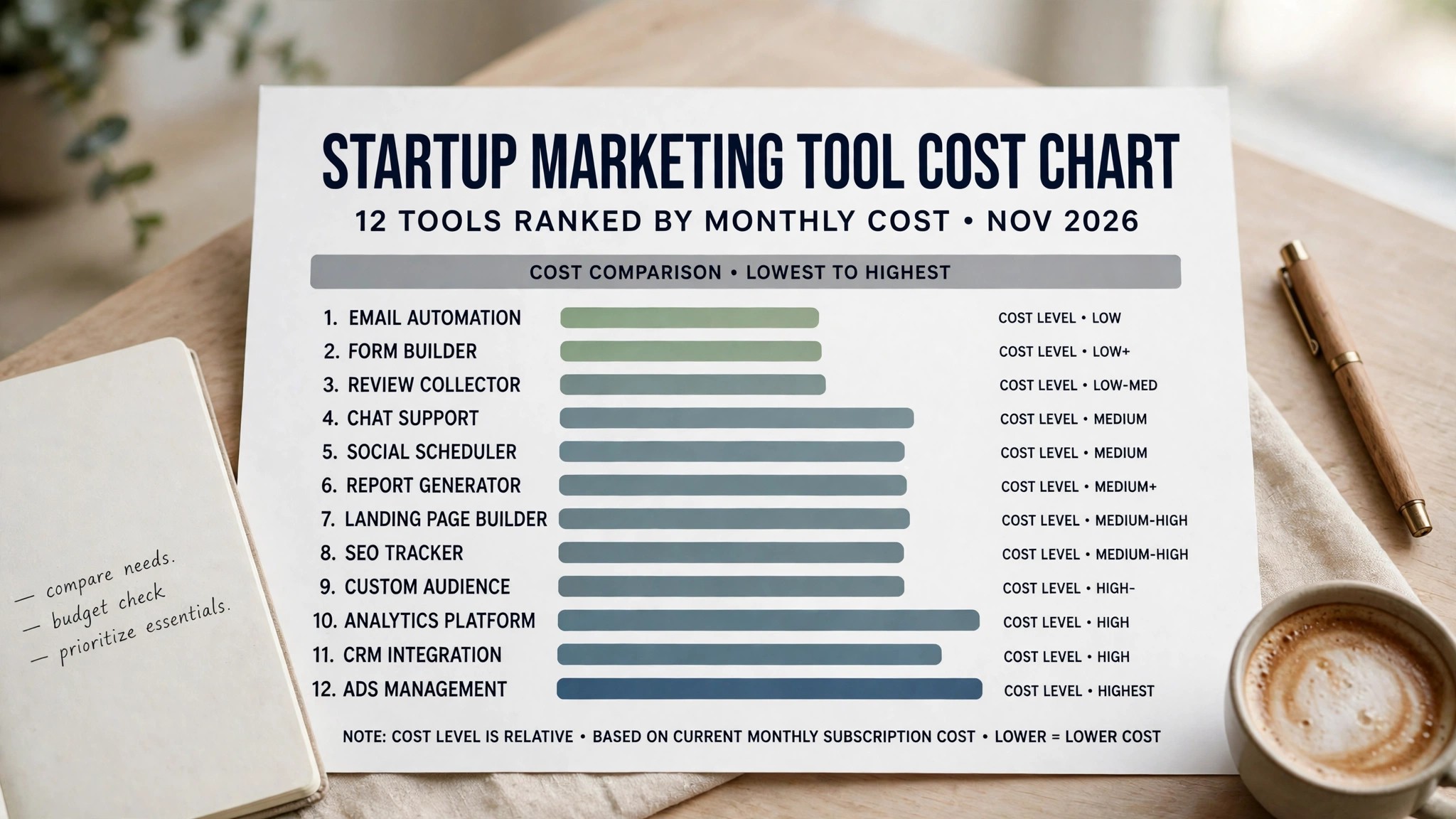
The table uses published starting prices, so confirm each figure on the vendor site before you budget. The pattern is what matters. A capable startup stack costs under 200 dollars a month when it leans on free tiers, and the jump comes when Semrush or a social suite enters the picture. A pre-seed startup can run on HubSpot free, Canva free, Buffer free and Zapier free for nothing, then add Ahrefs at 29 dollars when search becomes a channel.
The hidden cost is the per-seat and per-contact curve. HubSpot Starter at 20 dollars per seat costs 100 dollars a month for a team of five, and Mailchimp at 45 dollars for 5,000 contacts costs more than ActiveCampaign at the same list size. Model the cost at the team size and list size expected in a year, because the cheapest entry price rarely stays cheapest at scale. The best digital marketing tools for startups stay affordable at the size you expect in a year, not just the size you have today.
Startup Marketing Errors That Burn the First Budget
The first error is buying the whole stack before the first customer. A startup that subscribes to Semrush, Sprout Social, Hootsuite and Unbounce in month one spends over 500 dollars a month before knowing which channel works. The best digital marketing tools for startups prove themselves one at a time, so buy the tool that fixes the current bottleneck and nothing else.
The second error is running five channels badly instead of one channel well. A team that posts on six networks, sends a newsletter and runs ads will do none of them properly, and the analytics will not show which one deserves more effort. Pick the channel where the first ten customers came from, master it for a quarter and only then add the next one.
The third error is measuring vanity numbers. Follower counts and page views feel good, yet they do not pay salaries. Track the cost per lead, the conversion rate and the revenue per channel, and cut the channel that costs the most per customer. A dashboard that only shows traffic is a dashboard that hides the truth.
The fourth error is letting tools drift apart. A lead that enters a form and never reaches the CRM is a lead that never gets a call, and a Zap that broke silently is the usual cause. Audit the integrations monthly, test the lead flow end to end and fix the broken connection the day it is found rather than the quarter it is noticed.
From Zero to First 100 Leads
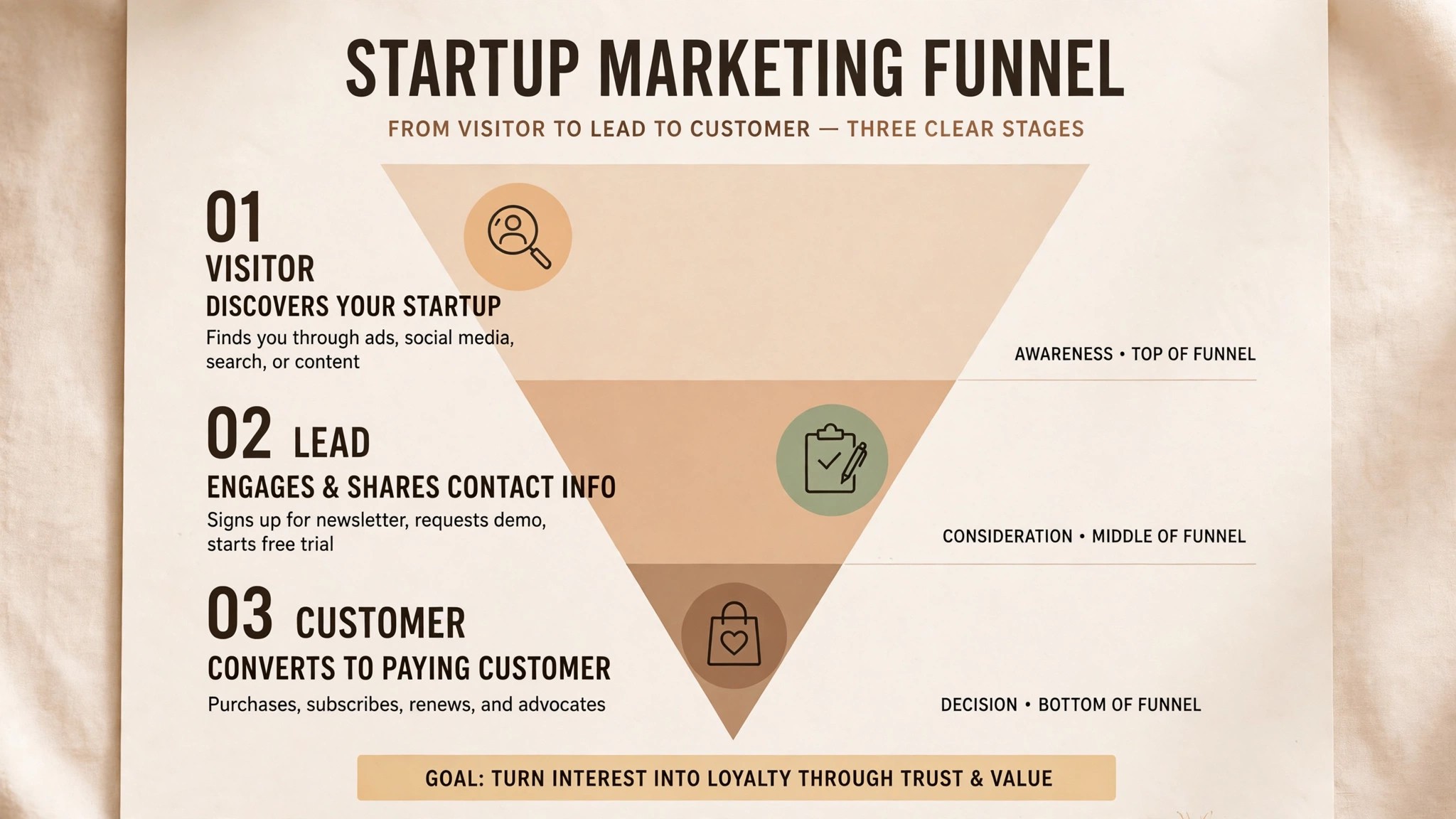
A startup marketing stack should produce its first hundred leads within a quarter. The sequence below keeps the build small enough to finish and real enough to learn from, and the best digital marketing tools for startups all support a gradual rollout that starts with one channel before the rest.
- Pick the channel where the first ten customers came from and write it down.
- Set up the free CRM and connect the website form to it the same day.
- Publish one lead magnet that solves a specific problem for the target customer.
- Schedule two weeks of social posts pointing at the lead magnet.
- Send the first newsletter to the founding list, even if it holds twenty names.
- Connect the email tool to the CRM so every lead is visible in one place.
- Review the cost per lead after 30 days and cut the channel that costs most.
- Add the next tool only when the current stack has a proven bottleneck.
Frequently Asked Questions
Can a pre-seed startup run marketing on free tools alone?
Yes, HubSpot free CRM, Canva free design, Buffer free scheduling and Zapier free automation cover a real motion for nothing. Add Ahrefs Starter at about 29 dollars a month when search becomes a channel, and add Semrush only when the team uses at least three of its modules every week.
Is Semrush worth 140 dollars a month for a startup?
Yes when search is a core channel and the team uses keyword research, rank tracking, site audits and competitor analysis every week. No when the startup only needs keyword data, because Ahrefs Starter at 29 dollars a month covers that job for a fifth of the price.
How does Canva Pro pricing work for a startup team?
Canva Pro costs 10 dollars a month on annual billing, which is 120 dollars a year, or 15 dollars a month when billed monthly. The Pro tier adds the brand kit, background removal and premium templates, and the brand kit is the feature that keeps every design on brand.
Does ActiveCampaign suit a startup that only sends a newsletter?
No, ActiveCampaign is built for behaviour-driven automation, and a team that only sends a newsletter will find the depth unnecessary. Mailchimp at about 13 dollars a month covers the newsletter job with a simpler interface and a real free plan for small lists.
What should a startup check before buying Hootsuite?
Check three things. Whether the team is large enough to need approval workflows, whether the social reporting is a deliverable for investors or clients, and whether the 99-dollar monthly price fits the budget. A team of two will find Buffer at 6 dollars a channel a better buy.
Which tool gives the best value for a startup on a tight budget?
Buffer gives the best value for social scheduling at 6 dollars a channel, Ahrefs Starter gives the best value for SEO at 29 dollars a month, and HubSpot free gives the best value overall because the CRM costs nothing. The combination of the three covers most of a startup first year for under 40 dollars a month.
Build the Stack Around Your Best Channel
If your best channel is search, pick Ahrefs at 29 dollars and add Semrush when the team outgrows it. If your best channel is email, pick Mailchimp for the newsletter or ActiveCampaign for behaviour-driven journeys. If your best channel is social, pick Buffer for scheduling or Hootsuite when the team needs approvals.
If you need one system for marketing and sales, pick HubSpot and let the free CRM carry the first year. If you design everything in-house, pick Canva Pro at 10 dollars a month and set the brand kit on day one. If you connect apps without a developer, pick Zapier and automate the handoffs that eat founder afternoons.
If you need social reporting for clients, pick Sprout Social and let the dashboards do the talking. If you track rankings without the complexity, pick Moz and learn SEO at a gentle pace. And if you run paid campaigns, pick Unbounce and let the landing page decide the cost per lead. The best digital marketing tools for startups are the ones that fit the channel that already works, so build around that channel first and add the rest only when it earns its place.