
Which grant management software should a research lab buy, and what does it cost when the award portfolio grows? This guide compares the best grant management software for research labs on price, fit and the limits that only show up after launch, and it names the pick outright.
Fluxx leads this list because its full lifecycle workflow, from application to closeout, fits the way research funders actually work, while Submittable is the strongest choice for a lab that runs competitive review programmes.
This guide compares eight platforms on application intake, review, compliance reporting and price, using published figures where they exist and honest quote ranges where they do not, so a lab can budget before the sales calls start.
Why the Best Grant Management Software for Research Labs Is Not Generic Grant Software
Research labs need different grant software from a general nonprofit, because awards carry compliance rules, effort reporting, sub-awards and audit trails that a simple tracker cannot handle. That is the first filter this guide applies to the best grant management software for research labs.
The expensive mistake is buying a grantseeker tool when the lab is a grantmaker, or the reverse, since the two sides of grant management share almost no workflow.
– Full lifecycle coverage, from intake and review through payments to closeout and reporting. – Compliance features, including audit trails, effort reporting and sub-award tracking. – Review workflows that handle peer review, scoring and committee decisions. – Published prices where they exist, and honest quote ranges where vendors hide them.
The 8 Tools at a Glance
Eight platforms cover the grant lifecycle from both sides, and the table below shows the starting price for each, with quote-only vendors marked honestly. The table below compares the best grant management software for research labs side by side.
| Tool | Starting price | Best for | Free option |
|---|---|---|---|
| Fluxx | Quote only | foundations managing the full grant lifecycle | No free plan |
| Foundant | Quote only | community foundations needing deep customisation | No free plan |
| Blackbaud Grantmaking | Quote only | large foundations already inside the Blackbaud ecosystem | No free plan |
| Submittable | From about $10,000 a year | competitive grant, scholarship and award programmes | No free plan |
| SmartSimple | Quote only | funders that need a configurable platform across grants and scholarships | No free plan |
| Instrumentl | From about $299 a month | labs seeking grants, from discovery to post-award | 14-day trial |
| CyberGrants | Quote only | corporate giving programmes and employee grants | No free plan |
| Good Grants | From about $3,950 a year | small funders that want a published price and a fast start | Free trial |
Best Pick by Job
A grantseeker and a grantmaker need different software, so the table below matches each lab shape to its pick, with the yearly cost beside it.
| Job | Pick | Why it wins | Monthly cost |
|---|---|---|---|
| Foundation managing full lifecycle | Fluxx | Most widely adopted grantmaker platform | Quote only, about $15,000 to $50,000 a year |
| Competitive review programme | Submittable | Intake, scoring and awards in one place | From about $10,000 a year |
| Lab seeking new grants | Instrumentl | Discovery through post-award in one tool | From about $299 a month |
| Small funder, published price | Good Grants | Only vendor with prices on the page | From about $3,950 a year |
| Large foundation in Blackbaud stack | Blackbaud Grantmaking | Deep integration with Raiser’s Edge | Quote only, about $20,000 to $100,000 a year |
The 8 Tools in Detail
Read each platform for the side of grants it serves, since grantmaker tools and grantseeker tools solve different problems and buying the wrong side wastes the whole budget. Start with the tools that match your job, then check the price, because the best grant management software for research labs differ more on fit than on features.
1. Fluxx
Fluxx is the most widely adopted modern grantmaking platform, covering applications, approvals, payments and grantee reporting in one system. Its strength is workflow depth, since the full lifecycle from intake to closeout runs inside Fluxx without spreadsheets beside it.
Pricing is quote-based and reported at about 15,000 to 50,000 dollars a year depending on organisation size and modules. Skip it for a lab that only seeks grants, because Fluxx serves grantmakers and its price assumes a funding portfolio.
2. Foundant
Foundant Grant Lifecycle Manager is built for community foundations, where each fund follows different rules and off-the-shelf workflows rarely fit. Its strength is customisation, since review stages, forms and reports bend to the foundation’s own process rather than forcing a standard one.
Pricing is quote-only, and Foundant also offers Scholarship Lifecycle Manager for foundations running award programmes. Skip it when the process is standard, because the customisation power adds setup time a simple funder does not need.
3. Blackbaud Grantmaking
Blackbaud Grantmaking, formerly GIFTS Online, is the enterprise grant platform for foundations already running Raiser’s Edge or Financial Edge. Its strength is integration, since grant data flows into the fundraising and accounting systems the foundation already uses.
Pricing is quote-based and reported at about 20,000 to 100,000 dollars a year, with implementation measured in months. Skip it outside the Blackbaud stack, because the price and the implementation only pay off when the ecosystem is already in place.
4. Submittable
Submittable runs application intake, peer review, scoring and award management for organisations that give money away competitively. Its strength is review, since assignable reviewers, scoring rubrics and committee workflows handle thousands of applications cleanly.
Pricing starts at about 10,000 dollars a year for nonprofits, with higher tiers adding disbursement and enterprise features. Skip it for tracking grants already won, because Submittable runs review programmes rather than post-award grant management.
5. SmartSimple
SmartSimple is a configurable cloud platform that foundations use for grants, scholarships and community investment programmes. Its strength is configuration, since the platform adapts to complex eligibility rules and multi-stage review without custom code.
Pricing is quote-based and reported at about 15,000 to 40,000 dollars a year depending on the modules chosen. Skip it for a small single programme, because the platform’s power assumes a portfolio large enough to justify the setup.
6. Instrumentl
Instrumentl follows a grant from the first funder search through application tracking to post-award reporting and accounting integration. Its strength is coverage, since discovery, pipeline and full lifecycle tiers let a lab buy exactly the stage it needs.
Discover starts at about 299 dollars a month on annual billing, with Pre-Award at about 499 dollars and Full Lifecycle at about 999 dollars. Skip it for running a grantmaking programme, because Instrumentl serves grantseekers and does not run peer review for others.
7. CyberGrants
CyberGrants, now part of Bonterra, manages corporate grants, employee giving and matching gifts for large companies. Its strength is corporate scale, since it handles high volumes of employee requests and matching payments without manual work.
Pricing is quote-based and enterprise, with contracts sized by programme volume and employee count. Skip it for a research lab, because its corporate giving focus fits companies giving to nonprofits rather than labs managing research awards.
8. Good Grants
Good Grants offers clean application and review management with published annual prices, which is rare in this category. Its strength is transparency, since Intro at about 3,950 dollars a year and Premium at about 7,900 dollars are printed on the pricing page.
The plans cover up to 10,000 applications with unlimited users and no distribution fees, and an enterprise tier is quoted separately. Skip it for complex compliance needs, because its reporting and audit tools are lighter than the enterprise grantmaker platforms.
Grant software serves two sides that share almost no workflow, and a lab that buys the wrong side wastes the whole budget, so the first decision is which side the lab sits on. Grantseekers find funders, track applications and report on awards won, while grantmakers run intake, review, payments and closeout, and the tools for each side are built differently from the ground up.
Running a Grant Cycle From Intake to Closeout in One System
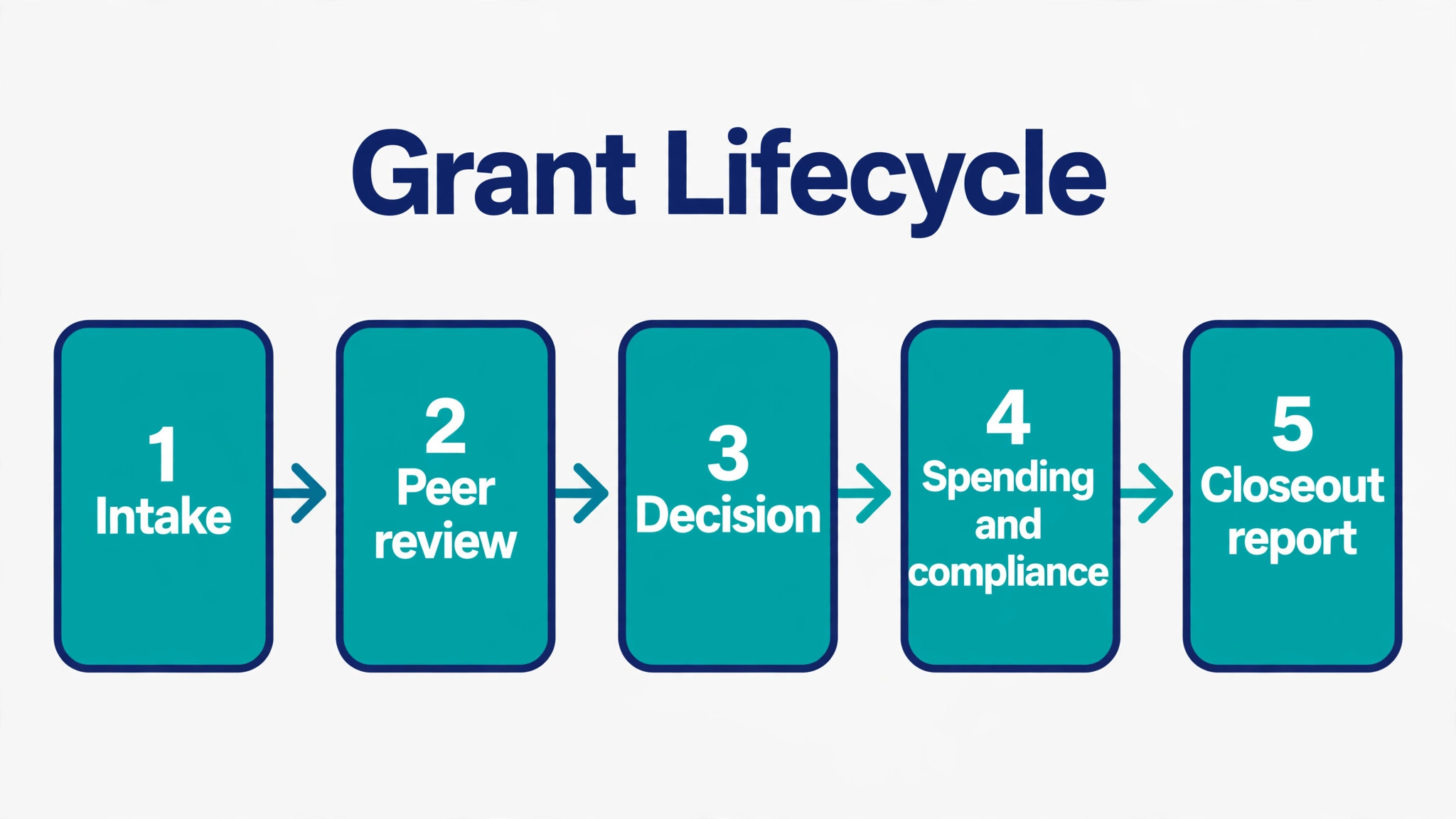
A grant cycle runs from intake to closeout in six stages, and the software earns its price when every stage hands cleanly to the next.
Open intake with an online form. Publish the application form, set the deadline, and let the system check eligibility before a human reads anything.
Run peer review inside the tool. Assign reviewers, collect scores, and keep every comment attached to the application it belongs to.
Decide and notify in one step. Record the committee decision, generate award letters, and notify winners and losers from the same screen.
Track spending and compliance. Log budgets, effort and sub-awards against each grant, and flag any award drifting off its plan.
Close out with the final report. Collect the final narrative and financial report, archive the file, and hand the auditor a complete record.
Confirm the data export format. Ask the vendor to export one complete award file before signing, and check that an auditor could follow it, because a system that cannot export cleanly traps the lab’s history.
Grant Software Costs at 10, 50 and 200 Active Awards
Grant software pricing is mostly hidden, so the table below uses published figures where they exist and reported ranges where vendors quote only, with the volume that drives each price. The table below prices the best grant management software for research labs at the volume a working buyer actually reaches.
| Tool | Entry plan | Cost at volume | What changes |
|---|---|---|---|
| Fluxx | Quote only | About $15,000 to $50,000 a year reported | Full lifecycle for grantmakers |
| Submittable | From about $10,000 a year | Per programme, not per user | Competitive review programmes |
| Blackbaud Grantmaking | Quote only | About $20,000 to $100,000 a year reported | Enterprise, inside the Blackbaud stack |
| Instrumentl | From about $299 a month annual | Up to 3 users on Discover | Grantseeking from discovery to award |
| Good Grants | From about $3,950 a year | Up to 10,000 applications | Only vendor with published prices |
| CyberGrants | Quote only | Enterprise, per programme | Corporate giving and employee grants |
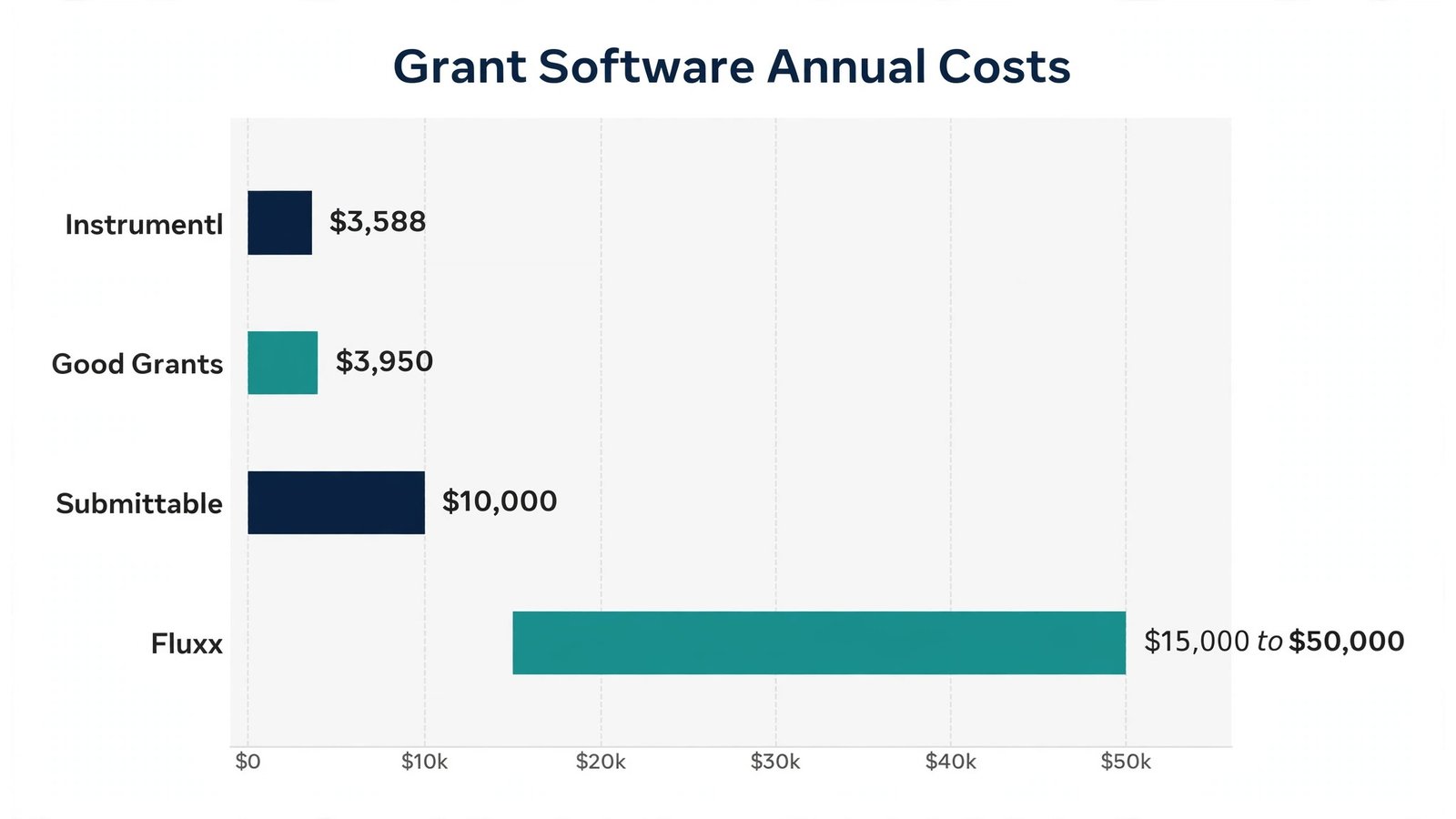
A lab with ten active awards can run on Instrumentl at about 299 dollars a month, or about 3,588 dollars a year, while a funder managing fifty awards on Fluxx should budget 15,000 to 50,000 dollars a year, which is why the two sides of this market barely overlap on price.
How Research Labs Prove Compliance to Funders
An audit trail is the first thing a funder checks, since every approval, payment and report change must carry a name, a timestamp and a reason that an auditor can follow without asking the lab. A grant system that logs decisions automatically gives the lab that record for free, while a lab that tracks decisions in email must rebuild the trail by hand when the audit arrives. The check is simple, which is to open any past award and trace it from application to payment, and if the trail has gaps, the system is not doing its job.
Effort reporting ties salaries to awards, since researchers split their time across several grants and each funder pays only for the share of effort its award received. A lab that guesses effort allocations invites findings, while one that records effort monthly, with the researcher confirming the split, can defend every dollar. The software should make effort entry easy, because a form that takes an hour to complete will be filled in late or not at all, and late effort reports are the most common audit finding in research labs.
Sub-award monitoring covers the money that flows to partner labs, and it is the part of grant management most often forgotten until an audit finds it. A prime recipient must check that each sub-recipient spends correctly, reports on time and follows the same rules, yet many labs track sub-awards in a spreadsheet beside the main system. The grant tool should list sub-awards against their parent award, show the spending per partner, and flag any partner that misses a report, because the prime recipient carries the risk for all of them.
Budget against actual tracking is the daily work of grant management, since a lab that discovers an overspend in month eleven cannot fix it, while one that sees it in month three can move funds or cut costs. The system should show each award’s budget, spending and remaining balance on one screen, with alerts when a line item passes a threshold the lab sets. Monthly review takes an hour and prevents the year-end surprise that forces a lab to return unspent funds or explain an overrun.
Financial reports come in the format each funder expects, and the formats differ enough that a single report template rarely satisfies all of them. Federal funders want standard forms with specific cost categories, foundations want narrative plus numbers, and corporate funders want short summaries with charts. A grant system that exports the data cleanly lets the lab reshape it per funder, while one that locks reporting into a single format forces manual rework every quarter, which is the hidden cost that makes a cheap system expensive.
Document retention rules decide how long a lab must keep award files, and the answer is usually years after closeout, not months. Federal awards commonly require records for three years after the final report, and some funders require longer, so a lab that deletes files at closeout creates a gap an auditor will find. The grant system should archive the full award file, including the application, the agreement, every report and the closeout letter, and keep it searchable for the whole retention period.
Conflict of interest disclosures protect the lab when a reviewer, a researcher or a board member has a financial link to an applicant or a vendor. The disclosure should be collected before review starts, stored with the award file, and checked whenever a decision involves the disclosed party. A grant system that prompts for disclosures at intake and flags conflicts during review turns a policy into a workflow, while a lab that relies on memory will miss the one disclosure that matters.
Closeout checklists finish an award properly, since the final narrative report, the final financial report, the return of unspent funds and the archiving of the file all need doing before the award is truly closed. A lab that closes awards late pays for it in audit findings and delayed final payments, while one that treats closeout as a checklist with an owner and a deadline finishes on time. The grant system should generate the closeout tasks automatically when the end date approaches, so nothing waits for someone to remember it.
The single audit under Uniform Guidance applies to labs spending above the federal threshold, and it examines both the financial statements and compliance with federal rules across all awards. A lab approaching the threshold should prepare early, since the audit covers the whole organisation rather than one award, and the findings follow the lab for years. Good grant software makes the single audit easier by keeping the records, the effort reports and the sub-award files in one place, yet it cannot fix a lab whose processes live outside the system.
Exporting the audit package is the final test of any grant system, since the auditor will ask for the full award file, the financial reports, the effort records and the sub-award files in a format that can be reviewed. A system that exports cleanly, with complete records and a clear structure, shortens the audit by weeks, while one that exports partial data forces the lab to rebuild files by hand. Before signing a contract, ask the vendor to export one complete award file and check that it contains everything an auditor would ask for.
Indirect cost rates decide how much of each award actually reaches the research, since funders pay a negotiated percentage on top of direct costs to cover facilities, administration and utilities. A lab that misapplies its indirect rate will under-recover overhead for years, while one that tracks the rate per funder and per award type can forecast its real income accurately. The grant system should store the rate per award and apply it automatically to spending reports, because a manual calculation done quarterly will drift from the truth.
Multi-year awards need a different kind of tracking, since budgets, effort and reporting all roll forward across years, and a system that treats each year as a separate award will lose the thread. The grant tool should show the full award timeline, with each year’s budget and spending beside the cumulative totals, so the lab can see at a glance whether a three-year award is on track. Carry-forward rules add another layer, because some funders allow unspent money to move to the next year while others require it back, and the system should flag which rule applies.
Collaboration across institutions is now normal in research, with a single award split across a lead lab and several partners, each with its own finance system and reporting calendar. The grant tool should track each partner’s spending and reports against the shared award, and alert the lead lab when a partner falls behind, because the lead carries the reporting duty for the whole award. A quarterly check-in with each partner, backed by the system’s numbers, keeps the collaboration honest and the funder confident.
Grant Tracking Mistakes That Put Research Funding at Risk
Grant mistakes cost funding, not just time, so the five below are the ones that put awards and audits at risk. Each one below wastes money on the best grant management software for research labs in a different way.
Buying a grantseeker tool to run a grantmaker programme. Discovery and deadline tracking cannot run peer review, scoring and payments, so match the tool to the side of grants you sit on.
Skipping the audit trail check. An auditor will ask who approved what and when, so the tool must log every decision with a name and a timestamp.
Underestimating implementation time. Enterprise grant platforms take months to configure, so a lab that buys in October cannot run a January deadline on the new system.
Forgetting sub-award tracking. Research awards often flow to partner labs, and a tool without sub-award tracking leaves those funds invisible until audit time.
Letting reporting stay in spreadsheets. A grant system that cannot produce the funder report forces a manual rebuild every quarter, which defeats the purpose of buying it.
Eight Steps to Get a Lab Onto Grant Software Before the Next Deadline
Work these eight steps before the next funding deadline, because a lab that starts early can test the system on a real cycle. Every check below applies to the best grant management software for research labs the same way.
- Decide whether the lab is a grantmaker, a grantseeker, or both.
- List every compliance report the funders require.
- Check the audit trail logs a name and time on each decision.
- Test peer review scoring with a real committee.
- Confirm sub-award tracking covers partner labs.
- Migrate one past award end to end before going live.
- Train the grants officer first, then the researchers.
- Set the closeout checklist for the first award on the system.
Frequently Asked Questions
How much does grant management software cost a research lab?
A grantseeking lab can start on Instrumentl at about 299 dollars a month on annual billing, or about 3,588 dollars a year, which covers discovery, pipeline tracking and post-award work for up to three users. A grantmaking funder pays far more, with Fluxx reported at about 15,000 to 50,000 dollars a year and Blackbaud Grantmaking reported at about 20,000 to 100,000 dollars a year, both quote-only.
Submittable starts at about 10,000 dollars a year for competitive review programmes, and Good Grants publishes about 3,950 dollars a year, so the real range runs from about 4,000 dollars to six figures depending on which side of grants the lab sits on. That is the short answer for the best grant management software for research labs.
What is the difference between Fluxx and Foundant for a research funder?
Fluxx is the most widely adopted modern grantmaking platform, built for foundations managing the full lifecycle from application to closeout, with strong workflow automation and reporting, priced by quote at a reported 15,000 to 50,000 dollars a year. Foundant Grant Lifecycle Manager is the favourite of community foundations, where grantmaking processes vary widely and need deep customisation, also quote-only. A research funder with standard cycles should start with Fluxx, while a funder with unusual review rules or many named funds should ask Foundant how its customisation handles them.
Can a small lab use Submittable for grant review?
Submittable fits a lab that runs competitive grant, scholarship or award programmes with formal review, starting at about 10,000 dollars a year, and it covers application intake, reviewer assignment, scoring and award management in one place. It is built for review programmes rather than for tracking grants a lab has already won, so a small lab that only chases funding should look at Instrumentl instead. The price is high for a single small programme, so Submittable earns its place when the lab runs several review cycles a year.
Does Instrumentl cover the full grant lifecycle?
Instrumentl covers discovery through post-award tracking, with its Discover tier at about 299 dollars a month for funder research, Pre-Award at about 499 dollars for pipeline tracking, and Full Lifecycle at about 999 dollars for post-award work and accounting integrations. That makes it the most complete grantseeker platform here, and the only one that follows a grant from the first search to the final report. A lab that also makes grants to others needs a grantmaker tool beside it, since Instrumentl serves the seeking side only.
Why do most grant platforms hide their prices?
Grant platforms price by organisation size, award volume, user count and modules, so a single list price would mislead more than it helps, and vendors prefer a sales call that sizes the deal. The reported ranges give a working budget, with Fluxx at about 15,000 to 50,000 dollars a year and Blackbaud at about 20,000 to 100,000 dollars, while Good Grants is the exception with published prices from about 3,950 dollars a year. Ask every vendor for the implementation cost separately, because setup and training can add thousands on top of the subscription.
What should a lab check before signing a grant software contract?
Check the audit trail first, since every approval, payment and report change must carry a name and a timestamp an auditor can follow. Then check data export, because a lab must be able to leave with its full award history if the contract ends. Confirm the implementation timeline in writing, check whether training and support are included or billed separately, and ask for the renewal terms, since some contracts auto-renew with a price rise that needs 60 days notice to stop.
The Grant Software Bill at Three Portfolio Sizes
At ten active awards, Instrumentl Discover at about 299 dollars a month, or 3,588 dollars a year, covers a grantseeking lab, while Good Grants at about 3,950 dollars a year covers a small review programme, and the runner-up costs only a few hundred dollars more per year. That is the bill the best grant management software for research labs produce at this volume.
At 50 awards the grantmaking side takes over, with Fluxx reported at 15,000 to 50,000 dollars a year and Submittable from about 10,000 dollars a year, so the pick costs at least three times the small-lab bill, and the cheaper option is enough only when the programme is a simple competitive review.
At 200 awards the enterprise tier applies, with Blackbaud Grantmaking reported at 20,000 to 100,000 dollars a year and Fluxx at the top of its range, while a grantseeking lab at that size sits on Instrumentl Full Lifecycle at about 999 dollars a month, or about 12,000 dollars a year, which is a tenth of the grantmaker bill.
At ten active awards, the grantseeking side costs about 3,588 dollars a year on Instrumentl Discover, while the grantmaking side starts near 10,000 dollars a year on Submittable, so the two sides of this market barely overlap. A lab should name its side before budgeting, because the wrong side costs three times as much and still misses the workflow.
| Scenario | Our pick | Runner-up cost | What the gap means |
|---|---|---|---|
| 10 active awards | Instrumentl, about $3,588 a year | Good Grants, about $3,950 a year | Grantseeking is cheap at small scale |
| 50 active awards | Submittable, from about $10,000 a year | Fluxx, $15,000 to $50,000 a year | Review programmes stay cheaper than full lifecycle |
| 200 active awards | Fluxx, up to about $50,000 a year | Blackbaud, up to about $100,000 a year | Enterprise grantmaking costs five figures and up |