
A 20-room hotel that takes bookings from five channels without a channel manager will double-book a room within a month, and the guest who arrives to a full house never comes back. This guide compares the best hospitality tools for small hotels on the numbers that decide whether a small property runs smoothly or drowns in admin, starting with channel coverage, then the total monthly cost at 20 rooms, then how fast a new owner learns the system.
Little Hotelier is the pick for a tiny bed and breakfast, because it packages a front desk, a booking engine and a channel manager from 29 dollars a month on Basics. Cloudbeds is the pick for an independent hotel that wants everything in one login, because its property management, channel manager, booking engine and payments share one subscription. Hotelogix is the pick for a budget hotel, because it starts at 3.99 dollars a room a month.
Every price below is either published or reported in an independent guide, and every quote-based tool is marked as pricing on the vendor site rather than given an invented number. Read the decision matrix first, then the tool that matches your room count, because a system built for a 200-room hotel bills very differently from one built for a 12-room inn, and the wrong size is the most common wasted purchase in this category.
Why the Best Hospitality Tools for Small Hotels Decision Starts With the Channel Manager
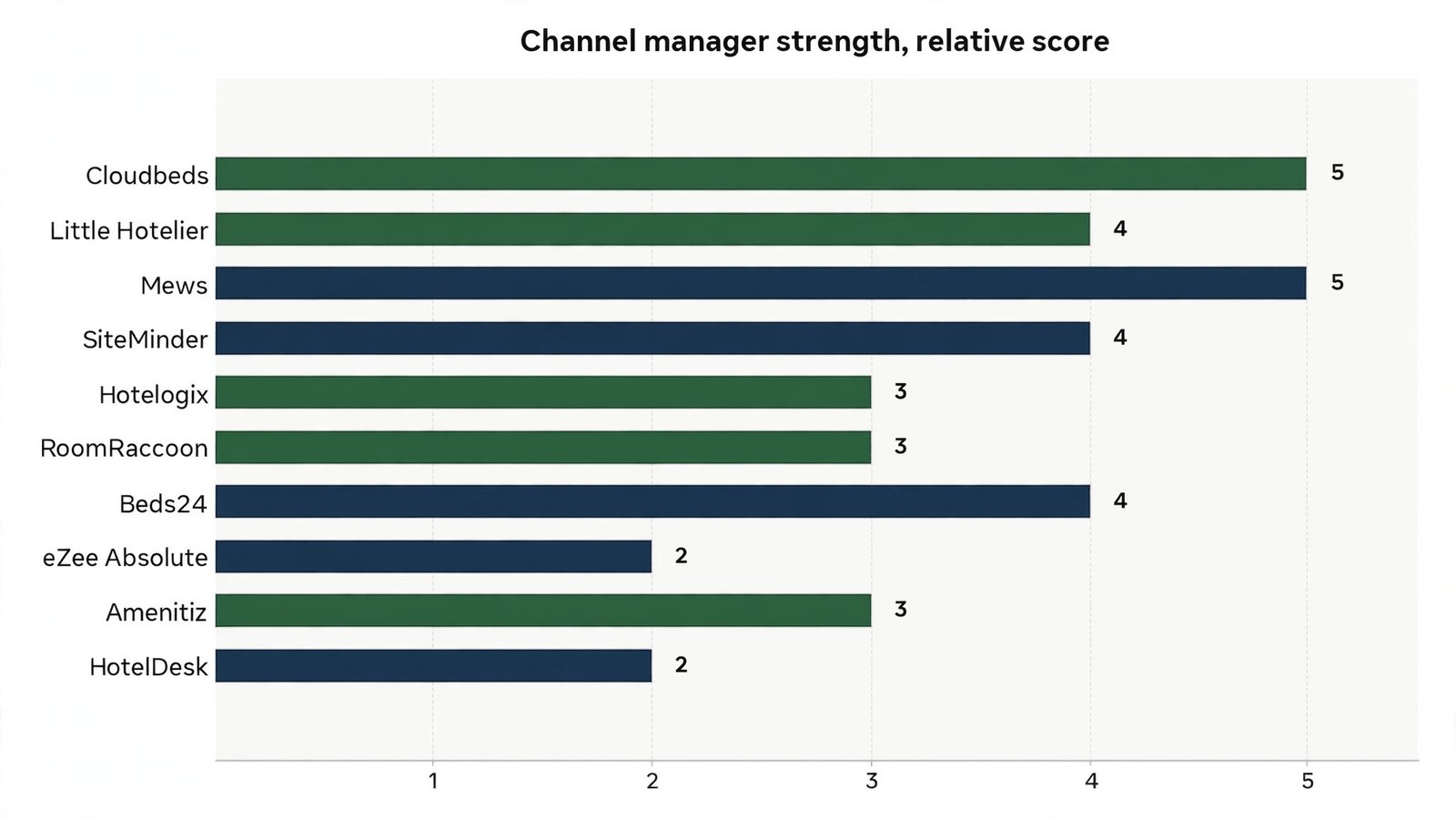
Channel coverage is the first number to check because it decides whether the property can sell everywhere without double-booking. A channel manager that connects Booking.com, Expedia, Airbnb and the hotel’s own site, and updates availability in real time across all of them, is the core of the purchase. Cloudbeds, SiteMinder and Little Hotelier all include it, while a property management system without one forces the owner to update each channel by hand.
Total monthly cost is the second number. Little Hotelier Basics starts at 29 dollars a month, Hotelogix at 3.99 dollars a room a month, and Amenitiz at 42 euros a month, while Mews starts from about 300 euros a month and Cloudbeds is quoted per property. The cost section below prices a 20-room hotel on each tool, because the per-room and per-property models cross over at different sizes.
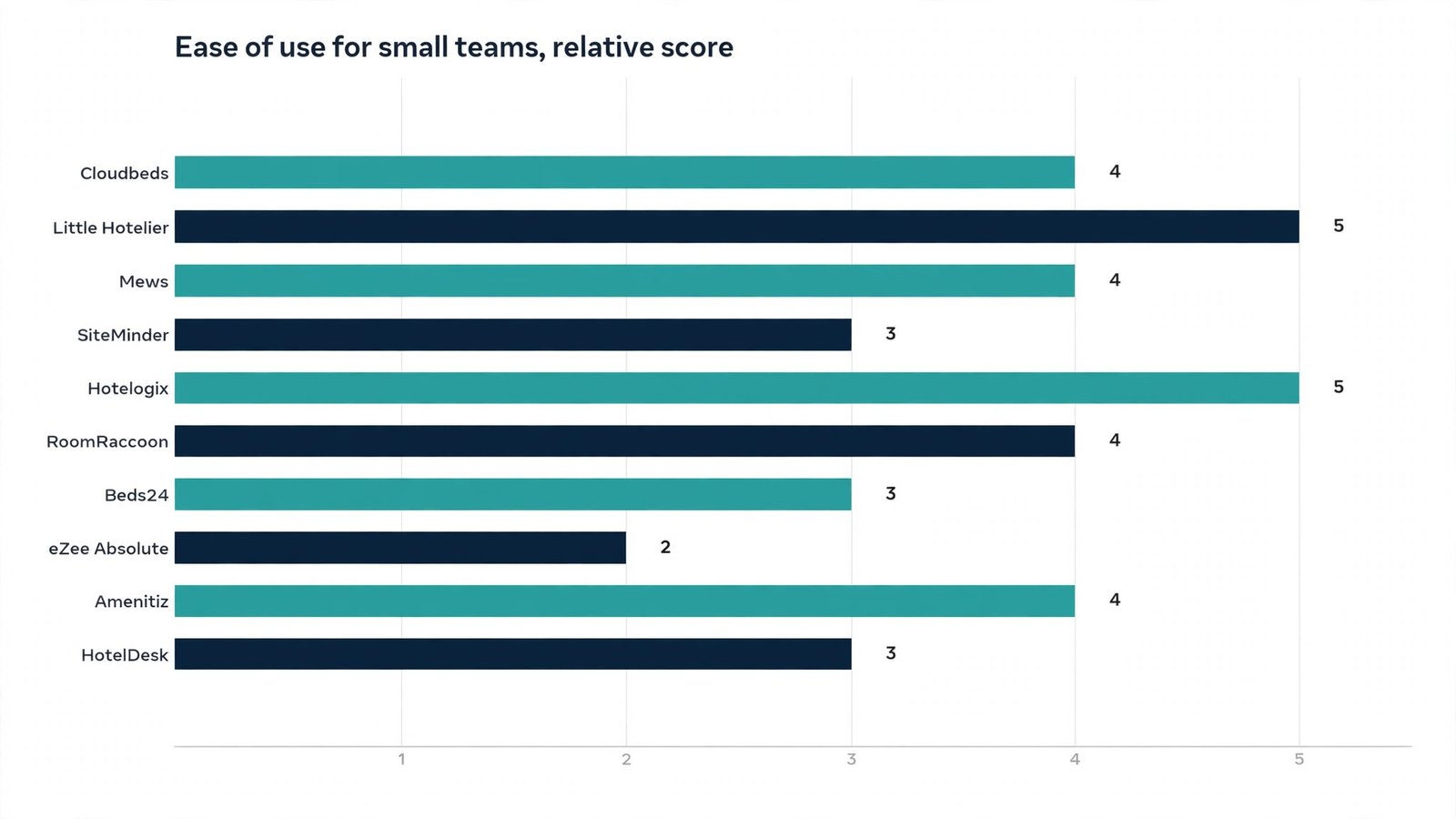
Ease of use is the third number. A small hotel is often run by the owner, who has no IT team and no time for a week of training. Little Hotelier is learnable in an afternoon, HotelDesk is built for small teams, and Mews is the most powerful system here but also the one that takes longest to learn.
- Check the channel list first, because a missing channel is a missing revenue stream.
- Price the total at your room count, not the headline rate, because per-room and per-property models cross over.
- Confirm the booking engine is included, because direct bookings are the cheapest ones.
- Ask about support hours, because a booking problem at 9pm needs an answer at 9pm.
The 10 Tools at a Glance
The table below lines up the best hospitality tools for small hotels side by side, with the starting price and the job each one fits best. Prices marked as reported come from independent guides, and quote-based tools are listed as pricing on the vendor site.
| Tool | Starting price | Best for | Standout strength |
|---|---|---|---|
| Cloudbeds | From about $100 a month (reported) | Independents wanting all-in-one | PMS, channel manager and booking engine together |
| Little Hotelier | Basics from $29 a month | B&Bs and very small properties | Simplest all-in-one for small teams |
| Mews | From about €300 a month (reported) | Tech-forward boutique hotels | Open API and automation depth |
| SiteMinder | Pricing on the vendor site | Distribution-first hotels | Largest channel network |
| Hotelogix | From $3.99 a room a month | Budget hotels | Lowest per-room entry price |
| RoomRaccoon | From about $188 a month (reported) | Small independents wanting upsells | Built-in upselling and dynamic pricing |
| Beds24 | Pricing on the vendor site | Small properties wanting control | Flexible channel and rate control |
| eZee Absolute | Pricing on the vendor site | Hotels wanting a full suite | PMS plus restaurant and POS options |
| Amenitiz | From €42 a month | Independent hotels, 11 to 30 rooms | All-inclusive price with payments |
| HotelDesk | From $50 a month per property | Hostels and guesthouses | Clear per-property pricing |
The Scoring Test Every Hotel Tool Had to Pass
A small-hotel tool earns its place on four measures, and the matrix below scores each tool from 1 to 5 on each one. Channel manager strength carries the most weight, because distribution is the revenue engine. Total cost at 20 rooms comes next, because a small property cannot absorb enterprise pricing. Ease of use for a small team and booking-engine quality share the remaining weight.
Cloudbeds scores highest overall, Little Hotelier scores highest on ease of use, and Hotelogix scores highest on cost per room. No tool leads on all four measures, which is why the best pick depends on the room count rather than the brand name.
| Tool | Channel manager | Cost at 20 rooms | Ease of use | Booking engine |
|---|---|---|---|---|
| Cloudbeds | 5 | 3 | 4 | 5 |
| Little Hotelier | 4 | 5 | 5 | 4 |
| Mews | 4 | 2 | 3 | 4 |
| SiteMinder | 5 | 3 | 3 | 3 |
| Hotelogix | 4 | 5 | 4 | 4 |
| RoomRaccoon | 4 | 3 | 4 | 4 |
| Beds24 | 4 | 4 | 3 | 3 |
| eZee Absolute | 3 | 3 | 3 | 4 |
| Amenitiz | 4 | 4 | 4 | 4 |
| HotelDesk | 3 | 5 | 5 | 3 |
The scores are relative, not absolute, and they reflect published pricing and documented features rather than a single test booking. The point of scoring the best hospitality tools for small hotels this way is that the cheapest headline price is rarely the cheapest month once channels and add-ons are counted, and the matrix keeps that difference visible. Use the scores to narrow the field to two or three candidates, then run a trial with real bookings before committing.
Check the channel fees separately from the monthly subscription, because the two together are the real cost. A platform with a low monthly fee and a three-percent booking commission can cost more than a dearer subscription with no commission once your rooms fill.
Best Pick by Job
| Job | Pick | Why it wins | Monthly cost |
|---|---|---|---|
| Tiny B&B under 20 rooms | Little Hotelier | Simplest all-in-one, learnable in a day | Basics from $29 a month |
| Independent hotel, all-in-one | Cloudbeds | PMS, channel manager and booking engine together | From about $100 a month |
| Budget hotel | Hotelogix | Lowest per-room entry price | From $3.99 a room a month |
| Tech-forward boutique | Mews | Open API, automation and modern design | From about €300 a month |
| Hostel or guesthouse | HotelDesk | Clear per-property pricing | From $50 a month |
| Upsells and dynamic pricing | RoomRaccoon | Built-in upselling tools | From about $188 a month |
What a 20-Room Hotel Really Pays
The starting price answers the wrong question for a hotel owner. The right question is what the system costs each month at 20 rooms, because per-room pricing, per-property pricing and booking fees cross over at different sizes. The table below prices that month for each tool that publishes or reports a rate.
Little Hotelier Basics at 29 dollars a month plus 1 percent of booking value is the cheapest start, while Pro runs about 109 to 179 dollars a month depending on rooms. Hotelogix at 3.99 dollars a room a month costs about 80 dollars a month at 20 rooms on its entry tier, and about 160 dollars on Premium before add-ons. Amenitiz at 42 euros a month is the cheapest all-inclusive option in this field for an 11 to 30 room property.
Cloudbeds at about 15 dollars a room a month costs about 300 dollars a month at 20 rooms, with entry plans reported at 180 to 320 dollars a month depending on the tier. Mews from about 300 euros a month is the dearest option here for a small property, and the price only pays when the automation and API depth are actually used. HotelDesk Growth at 100 dollars a month covers 150 beds, which suits a hostel better than a 20-room hotel.
| Tool | How it is priced | Cost at 20 rooms | Notes |
|---|---|---|---|
| Little Hotelier | Per property | From $29 a month | Plus 1% of booking value on Basics |
| Hotelogix | Per room | About $80 a month | Premium about $160 before add-ons |
| Amenitiz | Per property | From €42 a month | All-inclusive with payments |
| Cloudbeds | Per room | About $300 a month | Entry reported $180 to $320 |
| RoomRaccoon | Tiered subscription | From about $188 a month | Upselling included |
| Mews | Per property | From about €300 a month | Quote-based above entry |
| HotelDesk | Per property | $50 to $100 a month | $50 covers 15 beds, $100 covers 150 |
Read the table as a decision rule rather than a ranking. A property under 20 rooms should buy on simplicity and entry price, and Little Hotelier or Hotelogix wins. A property of 20 to 30 rooms should buy on the all-inclusive total, and Amenitiz or Cloudbeds wins. A property that wants automation depth should buy Mews, and accept the price, because the cheapest system that cannot automate is the most expensive one in staff hours.
The Channel Manager Test
The channel manager deserves its own section because it decides whether the property can sell everywhere without double-booking. The test is simple, and every owner should run it before signing. List the channels the property actually uses, then check each one against the vendor’s channel list, then ask how fast availability updates when a booking arrives.
A good channel manager updates all channels within seconds of a booking, so a room sold on Booking.com disappears from Expedia before another guest can book it. A slow one updates every few minutes, which is enough time for a double-booking on a busy weekend. SiteMinder runs the largest channel network in this field, Cloudbeds covers more than 300 channels through its marketplace, and Little Hotelier covers the main channels a small property needs without the long tail.
The booking engine is the second half of the test. Direct bookings through the hotel’s own site cost no commission, while an online travel agency takes 15 to 20 percent of the rate. A booking engine that converts well pays for the whole system, because every direct booking saves the commission.
Cloudbeds and Amenitiz include a strong booking engine, Little Hotelier includes one on all plans, and a property that drives traffic to its own site should weight the booking engine as heavily as the channel manager. The best hospitality tools for small hotels treat the booking engine as a revenue tool rather than a form, and the conversion rate on the hotel’s own site is the number to ask about in the demo.
The 10 Tools in Detail
Each tool below is scored on the same four numbers, so read the ones that match your room count before comparing prices. The best hospitality tools for small hotels differ more on channel coverage and pricing model than on the front-desk screen, and the detail sections show where each one wins and where it costs more than it first appears.
1. Cloudbeds
Cloudbeds is the all-in-one pick, and its strength is that the property management system, channel manager, booking engine and revenue management share one subscription. Inventory, rates and payments live in one bill, the integration marketplace covers more than 400 tools, and the platform scales from a 5-room bed and breakfast to a 500-room hotel without a switch. The breadth suits an independent hotel that wants one vendor rather than four.
Pricing is quote-based, with small properties commonly quoted from about 100 dollars a month and entry plans reported at 180 to 320 dollars a month depending on the tier, or roughly 15 dollars a room. The integration marketplace covers more than 400 tools, so a property can add revenue management, messaging and payments without switching systems. Skip it for a tiny bed and breakfast, because the price and the depth only pay when the property uses the distribution tools, and a 10-room inn will find Little Hotelier simpler and cheaper.
2. Little Hotelier
Little Hotelier, from SiteMinder, is the small-property pick, and its strength is simplicity. The platform packages a simple front desk, booking engine and channel manager for owners who run the place themselves and want something they can learn in an afternoon. The Basics plan starts at 1 dollar a day plus 1 percent of total booking value, and the 30-day free trial needs no card.
Pro runs from about 109 dollars a month depending on rooms, and the pricing moves with room count. Skip it for a property over 30 rooms, because the platform is built for small accommodation providers and the multi-property and automation depth is thinner than Cloudbeds or Mews, and a growing hotel will outgrow it.
3. Mews
Mews is the modern pick, and its strength is API-first automation. The platform folds revenue management, distribution and messaging into one system, the open API connects to almost anything, and the interface feels built in 2026 rather than 2006. Tech-forward boutique hotels and groups get the most from it, because the automation removes front-desk work rather than moving it.
Pricing is quoted per property, with the entry reported at about 300 euros a month and mid-tier plans at 500 to 800 euros a month. The Mews OS update folds revenue management, distribution and messaging into the platform, so a property that adopts it gets more automation without a second system. Skip it for a small bed and breakfast, because the entry floor is the highest in this field and the price only pays when the property uses the automation depth, and a 12-room inn will not.
4. SiteMinder
SiteMinder is the distribution pick, and its strength is the largest channel network in this field. The platform connects a property to hundreds of booking channels, updates availability in real time, and suits a hotel whose revenue depends on being listed everywhere. The channel manager is the product, and the property management tools sit beside it rather than leading it.
No list price exists for this one, so ask for the current plan cost before budgeting. Skip it as a standalone property management system, because SiteMinder is distribution-first and a hotel that needs a full front desk should pair it with a PMS rather than expecting one platform to do both jobs.
5. Hotelogix
Hotelogix is the budget pick, and its strength is the lowest per-room entry price in this field. The platform covers the front desk, channel manager, booking engine and housekeeping in one login, with multi-property support that suits a small group. The price suits a budget hotel that needs the full stack without an enterprise bill.
Pricing starts at 3.99 dollars a room a month, which works out at about 80 dollars a month for a 20-room hotel, with Premium at about 160 dollars before add-ons. Skip it for the most modern interface, because the design is older than Mews or Cloudbeds, and a design-led boutique hotel will notice the difference every day.
6. RoomRaccoon
RoomRaccoon is the upsell pick, and its strength is built-in upselling and dynamic pricing. The platform suggests room upgrades, late check-outs and extras at booking, adjusts rates with demand, and suits a small independent hotel that wants more revenue per booking rather than more bookings. The European strength suits properties with mostly European guests.
Pricing starts at about 188 dollars a month, with tiered subscriptions that scale with rooms and features. Skip it for a property that needs the widest channel network, because the distribution depth is thinner than SiteMinder or Cloudbeds, and a hotel that lives on channel volume will want the bigger network.
7. Beds24
Beds24 is the control pick, and its strength is flexible channel and rate control. The platform gives the owner detailed control over rates, availability and restrictions across channels, which suits a property that manages pricing by hand and wants the tools to do it precisely. The channel manager covers the main booking sites without the enterprise price.
Pricing comes from the vendor on request, so check the live figure before you commit. Skip it for the simplest setup, because the flexibility comes with a learning curve, and an owner who wants to learn the system in an afternoon will find Little Hotelier faster.
8. eZee Absolute
eZee Absolute is the suite pick, and its strength is the breadth of the eZee family. The property management system connects to restaurant management, point of sale and channel management in one suite, which suits a hotel with a restaurant or bar that wants one vendor for the whole operation. The depth suits a property that runs more than rooms.
The vendor does not publish a price, so confirm the current plan cost before budgeting. Skip it for a rooms-only property, because the restaurant and point-of-sale depth adds cost a bed and breakfast does not need, and a rooms-only inn will get more from Little Hotelier for less.
9. Amenitiz
Amenitiz is the value pick, and its strength is an all-inclusive price. The platform covers the property management system, channel manager, booking engine and payments from 42 euros a month, with no separate bill for each piece. Independent hotels with 11 to 30 rooms get the most from it, because the all-inclusive model removes the add-on maths that pushes other platforms higher.
Pricing starts at 42 euros a month, with higher tiers as rooms and features grow. The all-inclusive model is the detail that matters, because a property that pays one price for the PMS, channel manager, booking engine and payments never faces a surprise add-on bill. Skip it for a property over 30 rooms, because the platform is built for independents and the enterprise depth is thinner than Cloudbeds or Mews, and a larger hotel will outgrow it.
10. HotelDesk
HotelDesk is the hostel pick, and its strength is clear per-property pricing. Starter costs 50 dollars a month per property and covers 15 beds, Growth costs 100 dollars a month and covers 150 beds, and Pro costs 500 dollars a month flat for up to 25 properties with unlimited beds. A hostel or guesthouse can price the whole operation from that table without a sales call.
The trade-off is youth, because HotelDesk is newer than the field leaders and the channel list is shorter. Skip it for a hotel that needs the widest distribution, because the channel depth is thinner than SiteMinder or Cloudbeds, and a property that lives on channel volume will want the bigger network.
Switching Systems Without Losing a Booking
Switching hotel software is the moment most properties lose money, because a double-booking or a lost reservation costs more than a month of subscription savings. Run the move in order and check the numbers at each step, and keep the old system live until the new one has taken real bookings. The best hospitality tools for small hotels make the move easy with a guided import, but no import fixes a wrong rate, so check the rates and the availability on every channel before the first booking arrives on the new system.
- Export reservations, rates and guest data, and check the next 30 days of bookings line by line.
- Set up the channel manager first, and confirm availability matches on every channel before going live.
- Test the booking engine with a real card, and confirm the reservation lands in the front desk.
- Train the front desk on the new system with a quiet week, not a busy weekend.
- Keep the old system active for 30 days, so stragglers and long-lead bookings finish cleanly.
A clean rate and availability setup matters more than any feature, because a room sold twice is a guest lost whatever the new software does well. Treat the move as a distribution project first and a software switch second.
Frequently Asked Questions
How much do the best hospitality tools for small hotels cost?
Entry prices run from 29 dollars a month for Little Hotelier Basics to about 300 euros a month for Mews, with Hotelogix at 3.99 dollars a room a month and Amenitiz at 42 euros a month in the middle. A 20-room hotel pays about 80 dollars a month on Hotelogix, about 109 to 179 dollars on Little Hotelier Pro, about 300 dollars on Cloudbeds and about 300 euros on Mews. Price the total at your room count, because per-room and per-property models cross over, and add the booking fees and the add-ons before comparing, because the headline price is rarely the whole month.
Which hotel software is best for a small hotel under 20 rooms?
Little Hotelier is best for a property under 20 rooms, because it packages a front desk, booking engine and channel manager from 29 dollars a month and is learnable in an afternoon. Hotelogix is best for a budget property, because 3.99 dollars a room a month is the lowest per-room entry in this field. Amenitiz is best for an 11 to 30 room independent hotel that wants an all-inclusive price with payments included, because the single bill removes the add-on maths that pushes other platforms higher.
Do small hotels need a channel manager?
Yes, when the property sells on more than one channel. A channel manager updates availability in real time across Booking.com, Expedia, Airbnb and the hotel’s own site, so a room sold on one channel disappears from the others before it can be double-booked. A property that only takes direct bookings does not need one, but a property on two or more channels will double-book without it, usually on the busiest weekend of the year.
What is the difference between a PMS and a channel manager?
A property management system runs the front desk, handling reservations, check-in, housekeeping and billing, while a channel manager distributes availability and rates to booking channels and updates them in real time. Most tools in this field bundle both, including Cloudbeds, Little Hotelier and Hotelogix, while SiteMinder is distribution-first and pairs with a separate PMS. A small hotel usually wants both in one login.
How long does it take to set up hotel software?
Little Hotelier and HotelDesk take days, because both are built for small teams and the setup is guided. Cloudbeds and Hotelogix take 1 to 2 weeks, including the channel connections and the booking engine. Mews takes 1 to 2 weeks as well, with more time when the automation and API integrations are configured. Budget the setup time beside the price, because a system that takes a month to deploy costs a month of the old process, and a property should start the move in the quiet season rather than before a busy weekend.
Can hotel software increase direct bookings?
Yes, through the booking engine. Direct bookings through the hotel’s own site cost no commission, while an online travel agency takes 15 to 20 percent of the rate. A booking engine that converts well pays for the whole system, because every direct booking saves the commission. Cloudbeds, Amenitiz and Little Hotelier all include a booking engine, and a property that drives traffic to its own site should weight it as heavily as the channel manager.
Our Pick for Small Hotels, Stated Plainly
Little Hotelier is the pick for a tiny bed and breakfast, because it packages the front desk, booking engine and channel manager from 29 dollars a month and is learnable in an afternoon. Cloudbeds is the pick for an independent hotel that wants everything in one login, because its property management, channel manager, booking engine and payments share one subscription. Hotelogix is the pick for a budget hotel, because 3.99 dollars a room a month is the lowest per-room entry in this field.
Buy the system that matches the room count. A property under 20 rooms needs simplicity and a low entry price, a property of 20 to 30 rooms needs an all-inclusive total, and a tech-forward boutique needs automation depth. Match the room count first and the price second, and the system will still fit when the property adds rooms. A system that fits 20 rooms today should still fit at 30 rooms tomorrow, too. That is the short version of the whole comparison, and it holds because the best hospitality tools for small hotels win on different numbers, so the right buy is the one whose strength matches the property.