


A newsletter that reaches the inbox is worth more than a newsletter with clever copy that lands in spam, and that single fact should drive the purchase. This guide compares the best newsletter platforms on the numbers that decide whether a publication grows or stalls, starting with deliverability, then the cost of the list at 1,000 and 10,000 subscribers, then the monetisation cut each platform takes.
Beehiiv leads this field for a newsletter run as a publication, because it charges nothing on paid subscriptions and gives away a free plan up to 2,500 subscribers. Kit is the stronger pick for a creator who sells courses and products from the list, while MailerLite is the cheapest honest start for a plain weekly send. The rest of the field splits between general email tools that happen to send newsletters and publishing platforms that treat the newsletter as the product itself.
Every price below is the published starting price for a small list, and every cost comparison uses the same two list sizes so the numbers stay comparable. Read the decision matrix first, then the tool that matches your job, because a platform that is cheap at 500 subscribers can be the most expensive one you own at 10,000.
In this article
- Why the Best Newsletter Platforms Decision Comes Down to Deliverability and Cost at Scale
- The 10 Tools at a Glance
- How Each Newsletter Platform Earned Its Score
- Best Pick by Job
- What a 10,000-Subscriber Month Really Costs
- The 10 Tools in Detail
- Moving Your List Without Losing Readers
- Frequently Asked Questions
- Our Pick for Newsletter Platforms, Stated Plainly
Why the Best Newsletter Platforms Decision Comes Down to Deliverability and Cost at Scale
Deliverability is the first number to check because it multiplies everything else. A platform that places 98 of every 100 sends in the inbox delivers twice the value of a cheaper tool that places 90, even before price enters the comparison. Shared sending domains, authentication setup and spam complaint handling all move that number, and the platforms below differ on each of them.
Cost at scale is the second number, and it is where most buyers get surprised. Beehiiv is free to 2,500 subscribers, then Scale starts at 49 dollars a month. Mailchimp is free to 250 contacts, then Essentials starts at 13 dollars a month and climbs steeply with list size. Substack charges nothing up front and takes 10 percent of paid subscription revenue, which is the cheapest option for a free newsletter and the most expensive one once paid subscriptions pass a few thousand dollars a month.
Monetisation is the third number. Beehiiv takes 0 percent of paid subscriptions on its paid plans. Kit takes 3.5 percent plus 30 cents per transaction on its creator commerce. Substack takes 10 percent plus card fees. A publication earning 2,000 dollars a month from paid readers keeps 2,000 dollars on Beehiiv, about 1,930 dollars on Kit and about 1,800 dollars on Substack before card fees, and that gap grows every month the list grows.
- Check the inbox placement rate and the authentication tools before comparing features.
- Price the platform at your list size in 12 months, not at the size you have today.
- Compare the revenue cut next to the monthly plan price, because the cut is the bigger number once you charge readers.
- Confirm the free plan limits, since subscriber caps and send limits decide when the bill starts.
The 10 Tools at a Glance
The table below lines up the best newsletter platforms side by side, with the starting price and the job each one fits best. Prices are monthly starting rates for a small list, and several rise with subscriber count, so the detail sections give the cost at 1,000 and 10,000 subscribers where it matters.
| Tool | Starting price | Best for | Standout strength |
|---|---|---|---|
| Beehiiv | Free to 2,500 subscribers; Scale from $49 a month | Newsletters run as a publication | 0 percent cut on paid subscriptions |
| Kit | Free to 10,000 subscribers; Creator from $29 a month | Creators who sell from the list | Tags, sequences and creator commerce |
| MailerLite | Free to 250 subscribers; paid from $10 a month | Plain weekly sends on a budget | Low cost and a simple editor |
| Mailchimp | Free to 250 contacts; Essentials from $13 a month | General email marketing | Deepest integration library |
| Substack | Free; 10 percent of paid revenue | Writers who want zero setup | Built-in audience and discovery |
| Ghost | From $9 a month | Owning the site, members and data | Publishing and memberships in one place |
| Buttondown | Free; paid from $9 a month | Plain-text newsletters for developers | Clean writing-first experience |
| Brevo | Free; Starter from $25 a month | Transactional plus newsletter email | Strong automation at a low entry price |
| Constant Contact | From $12 a month | Small businesses and local lists | Event and list tools for local marketing |
| Flodesk | From $38 a month | Design-led newsletters | Flat price with unlimited subscribers |
How Each Newsletter Platform Earned Its Score
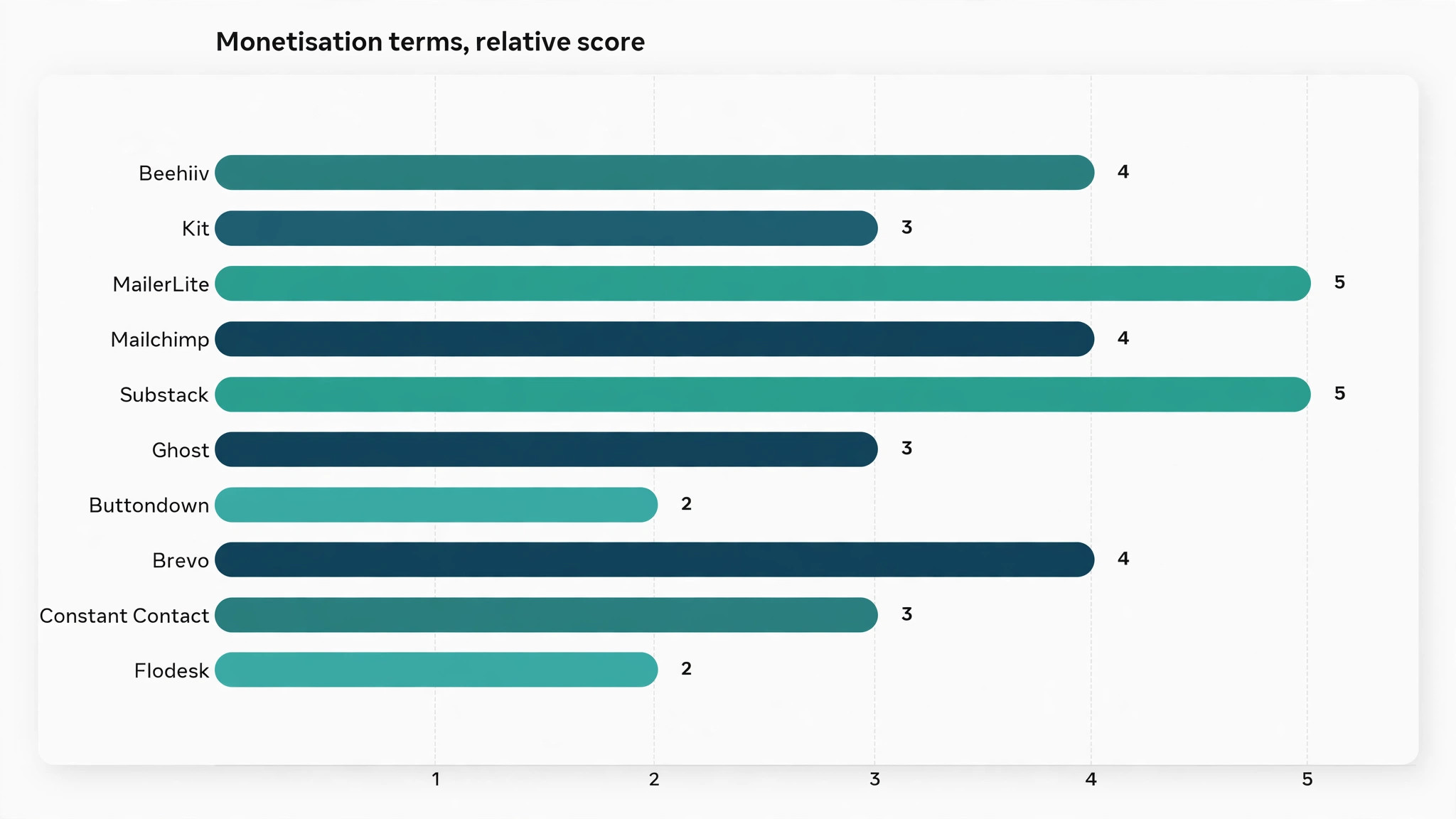
A newsletter platform earns its place on four measures, and the matrix below scores each tool from 1 to 5 on each one. Deliverability carries the most weight, because an unread email has no value whatever its design. Cost at 10,000 subscribers comes next, because a platform that is cheap at 500 readers and punishing at 10,000 traps a growing publication. Monetisation terms and ease of use share the remaining weight.
Beehiiv scores highest on monetisation and cost at scale, Kit scores highest on selling from the list, and MailerLite scores highest on ease of use for a simple weekly send. No tool leads on all four measures, which is why the best pick depends on the job rather than the brand name.
| Tool | Deliverability | Cost at 10,000 | Monetisation | Ease of use |
|---|---|---|---|---|
| Beehiiv | 5 | 4 | 5 | 4 |
| Kit | 4 | 3 | 4 | 4 |
| MailerLite | 4 | 5 | 3 | 5 |
| Mailchimp | 4 | 3 | 2 | 3 |
| Substack | 4 | 2 | 2 | 5 |
| Ghost | 4 | 4 | 4 | 3 |
| Buttondown | 4 | 4 | 3 | 4 |
| Brevo | 4 | 4 | 3 | 4 |
| Constant Contact | 3 | 3 | 2 | 4 |
| Flodesk | 4 | 5 | 3 | 4 |
The scores are relative, not absolute, and they reflect published pricing and documented features rather than a single test send. Use them to narrow the field to two or three candidates, then run a trial send to your own list before committing. The point of scoring the best newsletter platforms this way is that no single number decides the purchase, and the matrix keeps the four numbers visible at once instead of letting one flashy feature hide a bad price.
Check the subscriber ceiling on the plan you pick before you commit. A platform that looks cheap at 1,000 subscribers can cost three times as much by 10,000, so map your list growth for the next twelve months against the tiers in the table above.

Best Pick by Job
| Job | Pick | Why it wins | Monthly cost |
|---|---|---|---|
| Newsletter as a publication | Beehiiv | 0 percent revenue cut and growth tools built in | Free to 2,500 subscribers |
| Creator selling courses and products | Kit | Tags, sequences and commerce in one place | Creator from $29 a month |
| Plain weekly send on a budget | MailerLite | Lowest paid entry and a simple editor | Paid from $10 a month |
| General marketing email | Mailchimp | Largest integration library | Essentials from $13 a month |
| Writing with zero setup | Substack | Free to start with built-in discovery | 10 percent of paid revenue |
| Owning site, members and data | Ghost | Publishing and memberships together | From $9 a month |
| Design-led newsletter | Flodesk | Flat price, unlimited subscribers | From $38 a month |
What a 10,000-Subscriber Month Really Costs
The starting price on a pricing page answers the wrong question. The right question is what the platform costs when the list reaches 10,000 subscribers and a share of them pay, because that is the month the bill either stays flat or jumps. The table below prices that month for each tool, using published rates and the revenue cut where one applies.
Flodesk is the cheapest metered month at 38 dollars, because the price never moves with the list. MailerLite follows at about 89 dollars a month, and Mailchimp Essentials at about 110 dollars a month. Beehiiv Lite runs about 119 dollars a month on annual billing at 10,000 subscribers, and it still takes nothing from paid subscriptions, which is why its total month stays low even though the plan price is higher than MailerLite.
Substack is the outlier in the table. The plan costs nothing, but a publication earning 2,000 dollars a month from paid readers hands Substack about 200 dollars, plus card fees. At 5,000 dollars a month of paid revenue the cut reaches about 500 dollars, which is more than any monthly plan in this field. The free start is genuine, and so is the cost once the publication succeeds.
| Tool | Plan cost at 10,000 | Revenue cut on $2,000 paid | Total month |
|---|---|---|---|
| Beehiiv | About $119 a month | $0 | About $119 |
| Kit | About $139 a month | About $70 | About $209 |
| MailerLite | About $89 a month | No paid subscriptions | About $89 |
| Mailchimp | About $110 a month | No paid subscriptions | About $110 |
| Substack | $0 | About $200 | About $200 |
| Ghost | About $29 a month | $0 | About $29 |
| Buttondown | Pricing on the vendor site | No paid subscriptions | Pricing on the vendor site |
| Brevo | Pricing on the vendor site | No paid subscriptions | Pricing on the vendor site |
| Constant Contact | Pricing on the vendor site | No paid subscriptions | Pricing on the vendor site |
| Flodesk | $38 a month | No paid subscriptions | About $38 |
Ghost looks cheapest in that table at about 29 dollars a month, and for a publication that sells memberships through its own site it is, because Ghost takes no cut beyond card fees. The catch is that Ghost charges for the site and the membership system together, so the comparison only holds when the publisher wants the site as well as the newsletter. A writer who only needs email will pay less on MailerLite and get nothing extra to manage.
Read the table as a decision rule rather than a ranking. A free newsletter with no paid tier should buy on plan price alone, and Flodesk or MailerLite wins. A paid publication should buy on plan price plus the revenue cut, and Beehiiv or Ghost wins. A creator selling products should add the commerce cut, and Kit wins despite a higher plan price, because its selling tools earn the difference back.
The 10 Tools in Detail
Each tool below is scored on the same four numbers, so read the ones that match your job before comparing prices. The best newsletter platforms differ more on revenue terms and list-size pricing than on the editor, and the detail sections show where each one wins and where it costs more than it first appears.
1. Beehiiv
Beehiiv is built for newsletters run as a business, and its growth stack is the reason it leads this list. Recommendations, referrals, an ad marketplace and paid subscriptions sit inside the platform rather than arriving through add-ons, so a publication can grow and earn without stitching tools together. The editor is clean, analytics show which issues convert readers to paying subscribers, and automations arrive on the paid plans.
Launch is free up to 2,500 subscribers, Scale starts at 49 dollars a month and the platform takes 0 percent of paid subscription revenue on paid plans, which is the best monetisation term in this field. For a publication that charges readers, that single term is worth more than any template library, and it is the main reason the best newsletter platforms comparison keeps coming back to Beehiiv for this job. Skip it when the newsletter is a side channel for a shop or a course business, because its commerce and automation depth is thinner than Kit for selling products from the list.
2. Kit
Kit, formerly ConvertKit, is built for creators who sell from the list, and its tagging and sequence system is the strongest here for that job. Subscribers carry tags that drive which sequences they receive, products and paid newsletters sell through the same account, and the Creator Network helps one creator’s audience find another’s. The broadcast editor is plain, which suits writers who send often.
The free plan covers up to 10,000 subscribers for broadcasts, while Creator starts at 29 dollars a month and adds visual automations and unlimited sequences. Kit takes 3.5 percent plus 30 cents on commerce transactions, processing included. The commerce cut is the number to watch, because a creator selling 2,000 dollars a month of products pays about 70 dollars in fees on top of the plan, which is still cheaper than running a separate shop and email tool. Skip it when the newsletter itself is the product, because Beehiiv’s growth and monetisation tools serve a publication better at the same list size.
3. MailerLite
MailerLite is the budget pick for a straightforward weekly send, and its strength is how little stands between writing and sending. The editor is simple, templates are clean, and routine automations cover welcome sequences and basic segmentation without a learning curve. Deliverability is solid for a low-cost tool, and support answers quickly on paid plans.
The free plan covers up to 250 subscribers, paid plans start near 10 dollars a month, and the cost at 5,000 subscribers runs about 49 dollars a month, which undercuts Mailchimp and Kit at the same size. Skip it when the newsletter needs paid subscriptions or a referral engine, because those features are thin or absent and the publication would need a second tool.
4. Mailchimp
Mailchimp is the generalist of this field, and its strength is the size of its ecosystem. More than 300 integrations connect it to shops, CRMs and ad platforms, the template library is the largest here, and hiring someone who already knows the tool is easy. For a business that sends campaigns, transactional email and ads from one account, that breadth is real value.
The free plan covers 250 contacts and 500 sends a month, Essentials starts at 13 dollars a month and Standard at 20 dollars a month for 500 contacts, with prices climbing steeply as the list grows. The integration library is the reason to stay despite the price, because a shop that already runs on Shopify or WooCommerce can connect campaigns, abandoned carts and customer data without custom work. Skip it for a pure newsletter business, because the interface is built around campaigns rather than publishing, and the cost at 10,000 contacts runs about 110 dollars a month on Essentials.
5. Substack
Substack is the fastest way to start a paid newsletter, and its strength is discovery. Readers already browse Substack for writers to follow, recommendations move subscribers between publications, and the writer pays nothing until readers pay. The writing experience is the simplest in this field, with no templates to tune and no settings to learn.
Publishing is free and Substack takes 10 percent of subscription revenue plus card fees once readers pay, which makes it the cheapest start and the most expensive platform once paid revenue passes a few thousand dollars a month. Skip it when owning the audience data and the site matters, because the publication lives on Substack’s platform and the writer controls less of the experience than on Ghost or Beehiiv.
6. Ghost
Ghost is the ownership pick, and its strength is that the site, the members and the data all belong to the publisher. The platform combines a blog, a membership system and newsletters in one place, so a publication can sell memberships, run a paid tier and send issues without a second tool. The editor is fast and the reading experience is clean.
Starter starts at 9 dollars a month on the pricing page we checked, with higher tiers adding staff users and advanced features. There is no free plan, and the platform takes no cut of membership revenue beyond card fees. The site itself is the second product in the purchase, because a Ghost publication gets a fast blog, member accounts and paid tiers in the same install, which removes the need for a separate website and membership tool. Skip it when the goal is the fastest possible launch, because setup takes longer than Substack or Beehiiv and the growth tools are thinner.
7. Buttondown
Buttondown is the writing-first pick, and its strength is restraint. The editor is plain Markdown, the interface stays out of the way, and the platform handles subscriptions, archives and RSS without asking the writer to manage anything. Developers like it because the API is clean and the pricing is simple.
The free plan covers small lists, paid plans start at 9 dollars a month, and the cost scales gently with subscribers. Skip it when the newsletter needs advanced automation, A/B testing or a visual template library, because Buttondown deliberately offers fewer of those features than MailerLite or Mailchimp.
8. Brevo
Brevo is the value pick for a business that sends newsletters and transactional email from one account. Its automation builder covers welcome journeys, abandoned carts and re-engagement without a higher tier, and the free plan includes a useful number of sends each month. The contact management is stronger than its price suggests.
The free plan covers 300 emails a day, Starter starts at 25 dollars a month, and the price scales with monthly send volume rather than list size, which suits businesses with large lists that send rarely. That volume model is the detail most buyers miss, because a shop with 20,000 contacts that sends twice a month pays far less on Brevo than on a platform that charges per contact. Skip it when the newsletter is a publication with paid subscribers, because Brevo has no paid-subscription system and the writer would need a separate tool for that.
9. Constant Contact
Constant Contact is the local-business pick, and its strength is the list and event tooling around the email itself. Sign-up forms, event registration and social posting sit next to the newsletter, which suits a shop, a restaurant or a local service business that meets customers in person. Support is reachable by phone, which matters to owners who do not want to wait on chat.
Lite starts at 12 dollars a month, with higher tiers adding automation and e-commerce tools. The editor is older than the field leaders and the template designs are less modern. Skip it for a publication business, because the pricing climbs with contacts and the monetisation tools are thinner than Beehiiv or Ghost.
10. Flodesk
Flodesk is the design pick, and its strength is a flat price. Every plan includes unlimited subscribers, so a list that doubles costs nothing extra, and the templates are the most attractive in this field for a visual brand. The workflow builder is simple, and the checkout and form tools cover the basics of selling from the list.
Plans start at 38 dollars a month with unlimited subscribers and unlimited sends, which makes Flodesk the cheapest option in this field once a list passes about 5,000 subscribers. The flat price also removes the usual growth penalty, because a list that doubles in a month costs nothing extra, and the owner can run a giveaway or a viral issue without watching the bill. Skip it when advanced segmentation or deep automation matters, because Flodesk is deliberately simpler than Kit or Mailchimp and the analytics are lighter.
Moving Your List Without Losing Readers
Switching platforms is the moment most newsletters lose readers, so run the move in order and check the numbers at each step. The best newsletter platforms all import subscribers, but the import only works when the list is clean and the sending domain is authenticated before the first send. A rushed move usually shows up as a deliverability dip in the first two weeks, and the fix is almost always a dirty list or missing authentication rather than the new platform itself.
- Export the list with tags and engagement history, then remove addresses that have not opened in 12 months.
- Set up SPF, DKIM and DMARC on the new platform and send a test to seed accounts first.
- Import the list in segments, starting with the most engaged readers, and watch the first three sends for spam complaints.
- Send a short note from the new platform explaining the move, so readers recognise the sender name.
- Keep the old platform active for 30 days, so stragglers and automations finish cleanly.
A clean list of 8,000 engaged readers outperforms a dirty list of 12,000 on every platform, because inbox placement follows engagement. Treat the move as a list-quality project first and a software switch second.
Frequently Asked Questions
How much do the best newsletter platforms cost at 5,000 subscribers?
The spread is wide at 5,000 subscribers. Beehiiv Lite runs about 95 dollars a month on annual billing, MailerLite about 49 dollars a month, Mailchimp about 100 dollars a month on Standard, and Flodesk stays at 38 dollars a month because its price is flat. Substack costs nothing at that size until readers pay, then takes 10 percent of paid revenue. Price the platform at the list size you expect in a year, not the size you have today.
Which newsletter platform has the best deliverability?
Deliverability depends on the sender as much as the platform, but Beehiiv, Mailchimp and MailerLite consistently place well in independent tests, and all three give the sender control over authentication and dedicated sending options on higher tiers. Set up SPF, DKIM and DMARC, keep the list clean, and avoid purchased lists, because no platform can rescue a sender with high complaint rates.
Can I switch newsletter platforms without losing subscribers?
Yes, when the move is run in segments with a clean list and authenticated sending. Export subscribers with their tags, import the most engaged segment first, and send a short note explaining the move. Keep the old platform running for 30 days so automations and stragglers finish. Most losses come from importing a dirty list all at once, not from the switch itself, and a segmented move keeps the engaged core reading while the rest of the list follows.
Is Substack or Beehiiv better for a paid newsletter?
Substack is better for starting free and testing whether readers will pay, because it costs nothing until they do. Beehiiv is better once paid revenue passes a few hundred dollars a month, because it takes 0 percent of subscription revenue on paid plans while Substack takes 10 percent. A publication earning 2,000 dollars a month keeps about 200 dollars more on Beehiiv before card fees.
Do I need a paid plan to start a newsletter?
No. Beehiiv is free to 2,500 subscribers, Kit is free to 10,000 subscribers for broadcasts, and MailerLite and Mailchimp offer free plans for small lists. Start free, prove the newsletter earns readers, and pay only when the list or the monetisation features demand it. The free plan limits that matter most are subscriber caps, send limits and the revenue cut, and the cheapest free start is the one whose paid plan still fits when the list grows past the free tier.
What is the cheapest newsletter platform for a large list?
Flodesk is the cheapest at a large list because its 38 dollar monthly price covers unlimited subscribers. MailerLite is the cheapest metered option, at about 89 dollars a month for 10,000 subscribers. Beehiiv Lite runs about 119 dollars a month on annual billing at 10,000 subscribers, and Mailchimp Essentials about 110 dollars a month. Compare the flat price against the revenue cut before deciding.
Our Pick for Newsletter Platforms, Stated Plainly
Beehiiv is the pick for a newsletter run as a publication, because the 0 percent revenue cut and the growth tools compound every month the list grows. Kit is the pick for a creator who sells courses and products, because its tagging and commerce turn the list into a storefront. MailerLite is the pick for a plain weekly send on a budget, because it is the cheapest honest start and the easiest to run. That is the short version of the whole comparison, and it holds because the best newsletter platforms win on different numbers, so the right buy is the one whose strength matches the job.
Buy the platform that matches the job the newsletter actually does. A publication needs growth and monetisation, a creator needs selling, and a small business needs a simple weekly send. Match the job first and the price second, and the platform will still fit when the list is ten times bigger. That match is the whole decision, and every number in this guide exists to make it clearly and quickly. Start with the job.