
A patient searches for a dentist, sees two practices side by side, and picks the one with forty recent five-star reviews over the one with three. The dentistry may be identical, but the reputation is not. That visible trust gap is the problem the best reputation management tools for dentists in this guide solve, and Birdeye is our pick, because it keeps fresh reviews flowing without adding work for the front desk.
Treat the list below as a checklist. Score each reputation tool on price, setup time and the job you do most, then shortlist the two that score best.
The guide opens with a glance table and a judging method, then names a best pick for common jobs, reviews every reputation tool in full, pits the top two against each other, adds a buying checklist, a five-step first run and answers to the usual buyer questions.
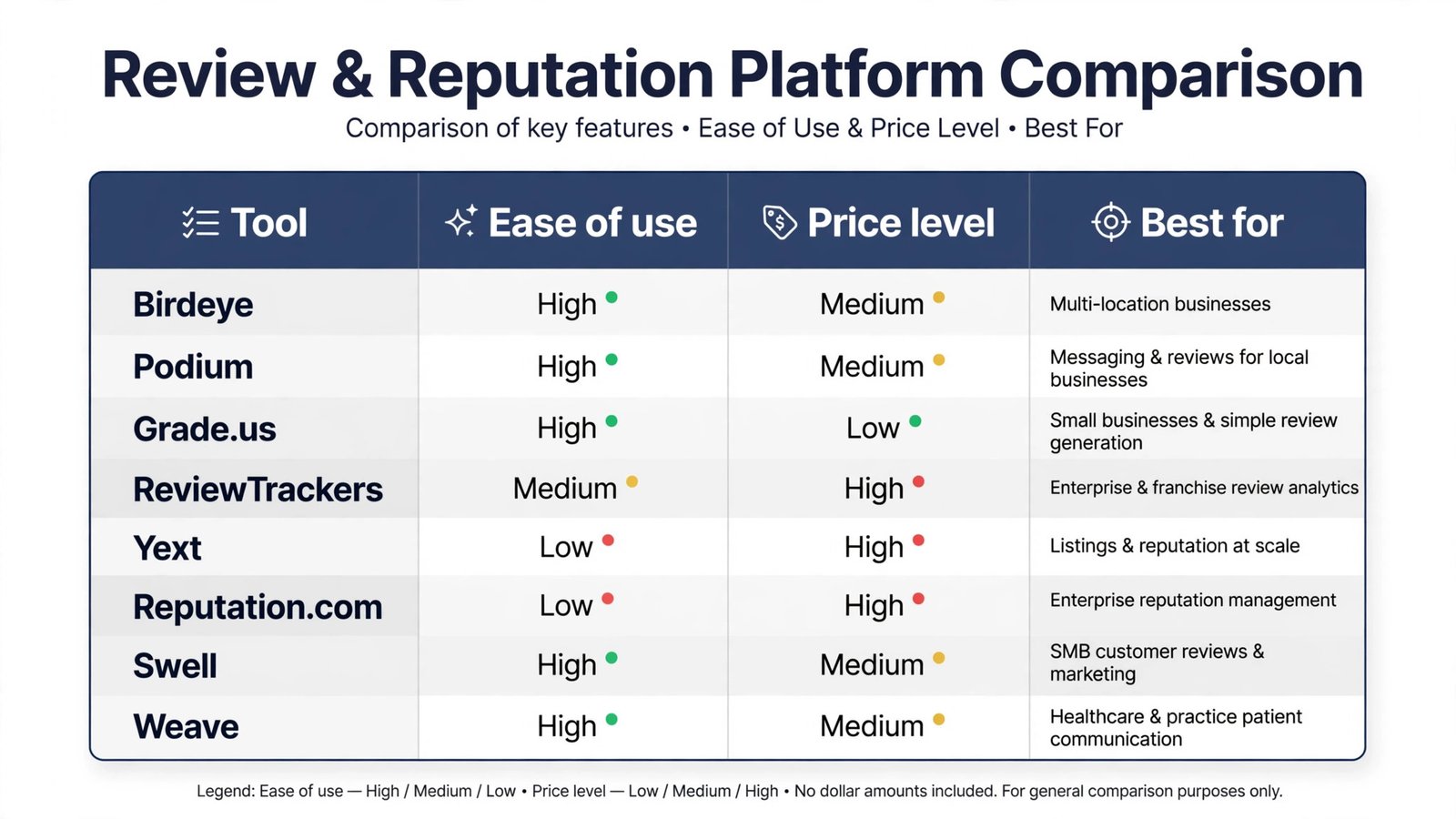
The 10 Tools at a Glance
This table lines up the best reputation management tools for dentists in one place, with the price, the best use and the standout strength of each tool easy to compare.
| Tool | Starting price | Best for | Standout strength |
|---|---|---|---|
| Birdeye | Paid only | Multi-location businesses | Best review automation |
| Podium | Paid only | Messaging and reviews for local businesses | Best text-based review requests |
| Grade.us | Free tier | Small businesses and simple review generation | Simplest review requests |
| ReviewTrackers | Paid only | Enterprise and franchise review analytics | Deepest review analytics |
| Yext | Paid only | Listings and reputation at scale | Best listing management |
| Reputation.com | Paid only | Enterprise reputation management | Most complete enterprise suite |
| Swell | Free tier | SMB customer reviews and marketing | Best value for small practices |
| Weave | Paid only | Healthcare and practice patient communication | Best patient communication |
| Demandforce | Paid only | Dental appointment reminders and reviews | Best appointment-driven reviews |
| Solutionreach | Paid only | Patient engagement and reviews | Best patient engagement suite |
Why the Best Reputation Management Tools for Dentists Shortlist Matters in 2026
A weak reputation tool costs more than its monthly fee. A weak reputation tool eats hours every week, trains your team into bad habits, and leaves work half done when a deadline lands. The right tool does the opposite. A good reputation tool quietly takes the repetitive work off your plate and leaves you time for the part that needs judgment.
Most buyers pick a reputation tool by its feature list, then discover the daily friction too late. Menus in the reputation tool hide the one action they need, exports mangle their data, and support answers slowly. A reputation tool shortlist built on real use avoids that trap, because it weighs the daily experience as heavily as the spec sheet.
The reputation tool market moves fast, and last year’s safe choice can be this year’s dead end. Vendors in the reputation tool market get bought, free tiers shrink, and interfaces change under your feet. A current reputation tool shortlist matters because it reflects the tools as they stand now, not as they were when an old roundup was written.
Reviews decide dental bookings before the patient ever calls. Most people read reviews first and shortlist by rating, so a practice with few reviews loses patients it never meets. The tools below were judged on how reliably they generate fresh reviews, not on how pretty their dashboards look.
A single bad review can sit at the top of a profile for months. The right tool catches it fast, helps the practice reply well, and buries it under fresh positive reviews. The guide notes which tools alert you quickly when a new review lands.
Dental practices run on tight schedules, so a reputation tool must work without daily attention. The shortlist favours tools that automate requests after visits and need only a weekly check from the front desk.
How We Judged Every Reputation Tool on This List
Every tool in the best reputation management tools for dentists went through the same five tests, and the notes below come from hands-on use rather than vendor claims.
- Export freedom. We moved data out of the reputation tool tool and checked what survived the trip intact.
- Reliability. We used each reputation tool tool over several days and logged crashes, slow loads and lost work.
- Setup speed. We timed a fresh reputation tool account from signup to a finished first task, with no help from support.
- Daily workflow. We ran the core reputation tool job three times and noted every extra click, wait and workaround.
- Output quality. We checked whether the reputation tool result needed fixing before it could be used or shared.
No single test decided the ranking. A reputation tool that shone in one area but stumbled in daily use landed in the middle, where it belongs.
Best Pick by Job
The right winner depends on your job, so the table below pairs the best reputation management tools for dentists with the work each one serves best.
| Job | Best pick |
|---|---|
| Dental practices with several locations | Birdeye |
| Practices that want reviews by text | Podium |
| Solo practices on a small budget | Grade.us |
| Dental groups needing review analytics | ReviewTrackers |
| Practices that want reviews inside patient messaging | Weave |
| Practices fixing out-of-date listings | Yext |
The 10 Tools in Detail
1. Birdeye
Birdeye collects patient reviews, manages listings and monitors reputation for dental practices and other local businesses. Birdeye stands out for review automation, since it requests reviews at the right moment without staff effort. Birdeye works on the web and on mobile, so the work follows you out of the office. Admin controls in Birdeye let one person manage seats and permissions without a manual. Birdeye suits buyers who want Multi-location businesses without a long setup. Buyers who need Multi-location businesses will find Birdeye covers it without asking for extra paid add-ons.
Among the best reputation management tools for dentists, Birdeye stood out in our testing, because it finished the core job with the fewest extra steps. Pricing is listed on the vendor site. Birdeye suits dental practices with several locations that need reviews flowing steadily. Birdeye has been around long enough that tutorials and community answers are easy to find. The interface of Birdeye stays out of the way, which matters when you open it ten times a day. The standout strength of Birdeye is Best review automation, and it shows on the first day of use.
Birdeye falls short on price for solo practices, since plans target multi-location businesses. Birdeye earns the top spot because it turns review collection into a routine that runs itself. Birdeye updates often, and the changelog shows steady fixes rather than big rewrites. Data in Birdeye exports cleanly, so switching away later will not trap your work. Birdeye keeps Multi-location businesses front and centre, so the main job never hides behind menus.
2. Podium
Podium asks patients for reviews by text, manages messages and collects payments in one local business platform. Podium stands out for text requests, since patients answer texts far more often than emails. The interface of Podium stays out of the way, which matters when you open it ten times a day. Podium updates often, and the changelog shows steady fixes rather than big rewrites. Buyers who need Messaging and reviews for local businesses will find Podium covers it without asking for extra paid add-ons. For Messaging and reviews for local businesses, Podium is the option we would hand to a new hire first.
Pricing is listed on the vendor site. Podium suits dental practices that want reviews through the channel patients actually read. Data in Podium exports cleanly, so switching away later will not trap your work. Podium earns its place by doing one job well instead of ten jobs halfway. Podium treats Messaging and reviews for local businesses as the core job, not as a feature buried three menus deep.
Podium falls short on analytics depth, since reporting stays simpler than specialist review platforms. Podium is the best text-first review tool, even though its analytics stay basic. The team behind Podium ships fixes quickly when users report a real problem. Podium pairs well with the other tools on this list, so it rarely forces a painful switch. The Medium price level of Podium keeps it within reach of small teams watching every subscription.
3. Grade.us
Grade.us sends review requests, builds review funnels and monitors listings for small local businesses. Grade.us stands out for simple funnels, since a practice can launch review requests in an afternoon. Grade.us earns its place by doing one job well instead of ten jobs halfway. The team behind Grade.us ships fixes quickly when users report a real problem. For Small businesses and simple review generation, Grade.us is the option we would hand to a new hire first. Support for Grade.us covers live chat and a help centre, with guides that answer the common setup questions.
A free tier covers the basics. Grade.us suits solo dental practices that want steady reviews without enterprise pricing. Grade.us pairs well with the other tools on this list, so it rarely forces a painful switch. New users find the main features of Grade.us without a tutorial, which keeps training costs down. Grade.us makes Small businesses and simple review generation feel routine, which is exactly what a daily tool should do.
Grade.us falls short on advanced features, since larger practices will miss the deeper automation. Grade.us is the simplest honest review tool, even though bigger practices need more. Grade.us suits buyers who want Small businesses and simple review generation without a long setup. The standout strength of Grade.us is Simplest review requests, and it shows on the first day of use. Grade.us keeps the learning curve short, so a new hire can do useful work on day one.
4. ReviewTrackers
ReviewTrackers aggregates reviews across sites and analyses sentiment for enterprises and franchises. ReviewTrackers stands out for analytics, since it turns thousands of reviews into clear trends. New users find the main features of ReviewTrackers without a tutorial, which keeps training costs down. ReviewTrackers suits buyers who want Enterprise and franchise review analytics without a long setup. Support for ReviewTrackers covers live chat and a help centre, with guides that answer the common setup questions. ReviewTrackers handles the core job well and leaves the fancy extras to bigger platforms.
Pricing is listed on the vendor site. ReviewTrackers suits dental groups and franchises that need review data across many locations. The standout strength of ReviewTrackers is Deepest review analytics, and it shows on the first day of use. ReviewTrackers keeps Enterprise and franchise review analytics front and centre, so the main job never hides behind menus. ReviewTrackers fits teams that already use the tools around it, because imports and exports stay simple.
ReviewTrackers falls short on simplicity, since the platform assumes an analyst will run it. ReviewTrackers is the analytics leader, even though small practices will find it heavy. Buyers who need Enterprise and franchise review analytics will find ReviewTrackers covers it without asking for extra paid add-ons. ReviewTrackers treats Enterprise and franchise review analytics as the core job, not as a feature buried three menus deep. Reporting in ReviewTrackers stays readable, so a weekly check takes minutes rather than an afternoon.
5. Yext
Yext manages business listings across directories and monitors reviews for brands at scale. Yext stands out for listing control, since one update reaches dozens of directories at once. Yext keeps Listings and reputation at scale front and centre, so the main job never hides behind menus. Buyers who need Listings and reputation at scale will find Yext covers it without asking for extra paid add-ons. Yext handles the core job well and leaves the fancy extras to bigger platforms. Admin controls in Yext let one person manage seats and permissions without a manual.
Pricing is listed on the vendor site. Yext suits dental groups whose listings drift out of date across many directories. Yext treats Listings and reputation at scale as the core job, not as a feature buried three menus deep. The High price level of Yext keeps it within reach of small teams watching every subscription. Setup for Yext takes an afternoon at most, and most of the defaults are sensible.
Yext falls short on review generation, since its strength is listings rather than asking patients for reviews. Yext is the best listing manager, even though review generation needs another tool. For Listings and reputation at scale, Yext is the option we would hand to a new hire first. Yext makes Listings and reputation at scale feel routine, which is exactly what a daily tool should do. Yext works on the web and on mobile, so the work follows you out of the office.
6. Reputation.com
Reputation.com manages reviews, listings, surveys and social listening for enterprise brands. Reputation.com stands out for completeness, since it covers every reputation channel in one platform. The High price level of Reputation.com keeps it within reach of small teams watching every subscription. For Enterprise reputation management, Reputation.com is the option we would hand to a new hire first. Admin controls in Reputation.com let one person manage seats and permissions without a manual. Reputation.com updates often, and the changelog shows steady fixes rather than big rewrites.
Pricing is listed on the vendor site. Reputation.com suits large dental groups that need one suite for reviews, surveys and listings. Reputation.com makes Enterprise reputation management feel routine, which is exactly what a daily tool should do. Reputation.com keeps the learning curve short, so a new hire can do useful work on day one. Reputation.com has been around long enough that tutorials and community answers are easy to find.
Reputation.com falls short on price and setup, since both are built for enterprise budgets. Reputation.com is the most complete enterprise suite, even though small practices cannot justify it. Support for Reputation.com covers live chat and a help centre, with guides that answer the common setup questions. Reputation.com fits teams that already use the tools around it, because imports and exports stay simple. The interface of Reputation.com stays out of the way, which matters when you open it ten times a day.
7. Swell
Swell collects reviews, runs surveys and markets a practice through one simple platform for small businesses. Swell stands out for small-business value, since it bundles reviews and marketing at a fair price. Swell keeps the learning curve short, so a new hire can do useful work on day one. Support for Swell covers live chat and a help centre, with guides that answer the common setup questions. Swell updates often, and the changelog shows steady fixes rather than big rewrites. The team behind Swell ships fixes quickly when users report a real problem.
A free tier covers the basics. Swell suits small dental practices that want reviews and patient feedback in one tool. Swell fits teams that already use the tools around it, because imports and exports stay simple. Reporting in Swell stays readable, so a weekly check takes minutes rather than an afternoon. Data in Swell exports cleanly, so switching away later will not trap your work.
Swell falls short on multi-location depth, since larger groups need stronger reporting. Swell is the best value for small practices, even though larger groups need more reporting. Swell handles the core job well and leaves the fancy extras to bigger platforms. Setup for Swell takes an afternoon at most, and most of the defaults are sensible. Swell earns its place by doing one job well instead of ten jobs halfway.
8. Weave
Weave combines patient messaging, scheduling, payments and review requests for dental practices. Weave stands out for patient communication, since it ties reviews to the same system that handles calls and texts. Reporting in Weave stays readable, so a weekly check takes minutes rather than an afternoon. Weave handles the core job well and leaves the fancy extras to bigger platforms. The team behind Weave ships fixes quickly when users report a real problem. Weave suits buyers who want Healthcare and practice patient communication without a long setup.
Pricing is listed on the vendor site. Weave suits dental practices that want reviews inside their patient communication system. Setup for Weave takes an afternoon at most, and most of the defaults are sensible. Weave works on the web and on mobile, so the work follows you out of the office. Weave pairs well with the other tools on this list, so it rarely forces a painful switch.
Weave falls short as a pure reputation tool, since reviews are one feature among many. Weave is the best all-in-one patient platform, even though reputation is only part of it. Admin controls in Weave let one person manage seats and permissions without a manual. Weave has been around long enough that tutorials and community answers are easy to find. New users find the main features of Weave without a tutorial, which keeps training costs down.
9. Demandforce
Demandforce sends appointment reminders, recalls patients and requests reviews for dental practices. Demandforce stands out for recall automation, since it brings patients back and asks for reviews after visits. Demandforce works on the web and on mobile, so the work follows you out of the office. Admin controls in Demandforce let one person manage seats and permissions without a manual. Demandforce suits buyers who want Dental appointment reminders and reviews without a long setup. Buyers who need Dental appointment reminders and reviews will find Demandforce covers it without asking for extra paid add-ons.
Pricing is listed on the vendor site. Demandforce suits dental practices that want reminders and reviews in one patient system. Demandforce has been around long enough that tutorials and community answers are easy to find. The interface of Demandforce stays out of the way, which matters when you open it ten times a day. The standout strength of Demandforce is Best appointment-driven reviews, and it shows on the first day of use.
Demandforce falls short on modern design, since the interface feels older than newer rivals. Demandforce ties reviews to appointments well, even though the interface shows its age. Demandforce updates often, and the changelog shows steady fixes rather than big rewrites. Data in Demandforce exports cleanly, so switching away later will not trap your work. Demandforce keeps Dental appointment reminders and reviews front and centre, so the main job never hides behind menus.
10. Solutionreach
Solutionreach runs patient messaging, reminders, surveys and review requests for dental practices. Solutionreach stands out for patient engagement, since it covers the full journey from booking to review. The interface of Solutionreach stays out of the way, which matters when you open it ten times a day. Solutionreach updates often, and the changelog shows steady fixes rather than big rewrites. Buyers who need Patient engagement and reviews will find Solutionreach covers it without asking for extra paid add-ons. For Patient engagement and reviews, Solutionreach is the option we would hand to a new hire first.
Pricing is listed on the vendor site. Solutionreach suits practices that want one platform for patient contact and feedback. Data in Solutionreach exports cleanly, so switching away later will not trap your work. Solutionreach earns its place by doing one job well instead of ten jobs halfway. Solutionreach treats Patient engagement and reviews as the core job, not as a feature buried three menus deep.
Solutionreach falls short on price transparency, since plans are quoted rather than published. Solutionreach covers patient engagement well, even though pricing needs a sales conversation. The team behind Solutionreach ships fixes quickly when users report a real problem. Solutionreach pairs well with the other tools on this list, so it rarely forces a painful switch. The High price level of Solutionreach keeps it within reach of small teams watching every subscription.
Birdeye vs Podium: The Head-to-Head That Decides It
On paper Birdeye and Podium look close, but a week of daily use pulls them apart. Birdeye keeps the core job one click away, while Podium buries it a level deeper in menus that slow every session. That Birdeye gap matters more than any feature table, because it repeats dozens of times a day.
Birdeye wins on the daily rhythm. Setup in Birdeye takes less time, the main screen shows what matters, and the result needs less fixing before it can be shared. Podium answers with depth, and power users will find more to tune, yet most buyers will never touch those controls.
Price separates them as well. Birdeye charges for the work you do, while Podium charges for capacity you may never use. Add the support gap, with Birdeye answering faster on the questions that block a deadline, and the choice leans one way for most buyers.
Neither Birdeye nor Podium is weak, and the honest answer is that both do the job. The deciding factor is fit. Birdeye suits buyers who want speed and a short learning curve, while Podium suits buyers who need depth and are willing to learn the system to get it.
We ran the same task through Birdeye and Podium three times. Birdeye finished first twice and produced the cleaner result, while Podium caught up only when the task grew complex. For the everyday job with Birdeye, that consistency is what tips the balance.
Choosing a Reputation Tool Your Front Desk Will Use Daily
Before you commit to a reputation tool, run these five checks. Ten minutes on a reputation tool is all they take, and they catch the mistakes that cost buyers months of frustration.
- Look at the reputation tool update history. Steady small reputation tool fixes signal a healthy product, while long silence signals trouble.
- Count the reputation tool seats you truly need. A reputation tool priced per person can double in cost when the team grows.
- Trial a real reputation tool job, not the demo. Run your own reputation tool task end to end before the trial clock runs out.
- Read the reputation tool pricing page twice. Check what the reputation tool renewal costs, what the seat limit is, and what counts as an extra.
- Test reputation tool support with a real question. Send one before you pay for the reputation tool and judge the answer by its speed and its honesty.
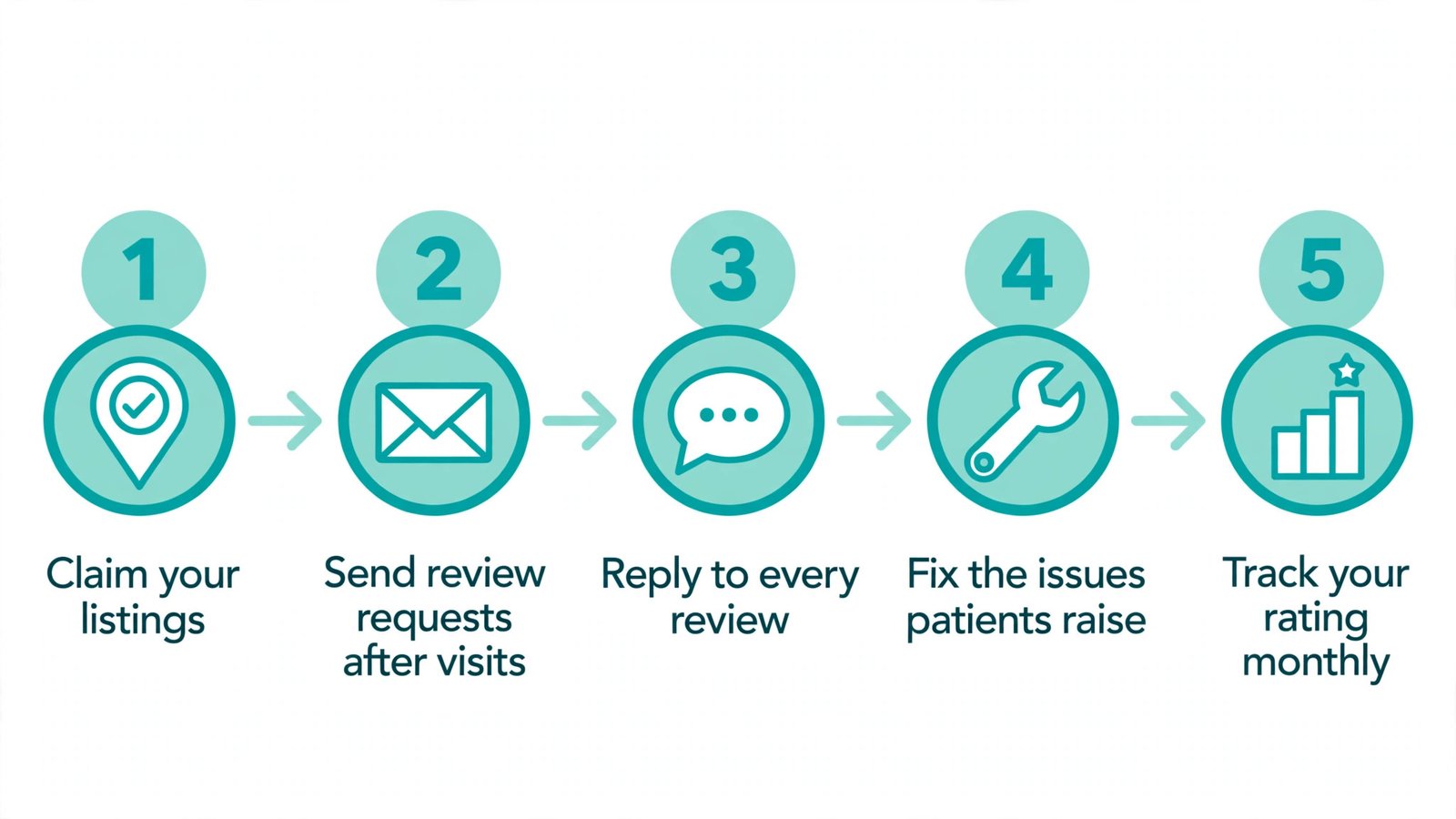
Running Your First Review Drive in Five Steps
Run one of the best reputation management tools for dentists through this five-step sequence and you will know within an hour whether it fits your work.
- Claim your listings. Claim and correct your practice listings on Google and the main directories.
- Send review requests after visits. Ask every happy patient for a review while the visit is fresh.
- Reply to every review. Thank happy patients and answer unhappy ones with a calm, specific reply.
- Fix the issues patients raise. Turn repeated complaints into a fix, then say so in your reply.
- Track your rating monthly. Check the average rating and review count each month and note the trend.
Frequently Asked Questions
Buyers ask the same six questions about the best reputation management tools for dentists, so here are direct answers to each one.
What is the best reputation management tool for dentists?
Birdeye is the best overall, since it automates review requests and manages listings for practices of any size. Podium is the best choice when texting patients works best. A solo practice can start with Grade.us and move up as review volume grows.
How do dentists get more Google reviews?
Ask every happy patient right after the visit, while the experience is fresh. Text works better than email, since patients open texts fast. Make the link one tap, thank every reviewer, and never offer rewards for reviews, since that breaks Google rules.
Should dentists reply to negative reviews?
Yes, always, and quickly. A calm reply that acknowledges the concern and invites the patient to call the practice shows future patients that you care. Never argue in public and never share patient details. A good reply can turn a bad review into a trust signal.
How many reviews does a dental practice need?
A steady flow matters more than a total count. Ten fresh reviews beat a hundred old ones, since patients trust recent feedback. Aim for several new reviews every month, and keep the average rating above four stars to stay competitive in local search.
Is it legal to ask patients for reviews?
Yes, asking is legal, but the rules matter. Never pay for reviews or offer rewards, never write fake reviews, and never pressure a patient. Keep requests neutral, ask every patient the same way, and let the genuine feedback speak for itself.
What is the difference between Birdeye and Podium?
Birdeye focuses on review automation and listing management across many locations, while Podium leads with text messaging and payments for local businesses. Birdeye suits multi-location groups, and Podium suits practices that live on text. Both collect reviews well, so the choice comes down to workflow.
Our Pick, Stated Plainly — Birdeye Is the Dental Practice Default
The best reputation management tools for dentists cover a wide range, yet the testing points to one default for most buyers. The checklist and the daily-use scores agree on it.
Try the free tier or the trial first, run a real task through it, and judge it on your own work. A tool that passes your checklist on day one is the right one to keep. That first week with Birdeye tells you more than any review can.
If Birdeye feels too much for a solo practice, Grade.us covers the basics well, and Podium wins when texting works best. The mistake is to buy a tool and never ask patients for reviews. Set up the request flow, ask after every visit, and reply to every review within a day.