Final Cut Pro is the faster rendering story in this field, and its Mac speed is the reason the runner-up keeps winning editors who work on Apple hardware. Yet the top 10 video editing software in this guide is ranked on what an editor actually finishes, and on that test Premiere Pro pulls ahead, because it runs on any machine, opens any format, and hands a project to any collaborator without a conversion step.
That compatibility gap is the whole story for a working editor. A tool that only runs on one brand of computer limits who you can hire and who you can hand a project to, while a tool that runs everywhere keeps the work moving when the hardware changes.
This guide compares ten editors on the same five tests, from cutting speed to export quality, and names the best pick for six common jobs. Read the glance table first, then jump to the tool that matches your editing style.
The 10 Tools at a Glance
Start your shortlist with the table below. It sets the top 10 video editing software side by side on price, best use and standout strength, so the field narrows in a minute.
| Tool | Starting price | Best for | Standout strength |
|---|---|---|---|
| Adobe Premiere Pro | Pricing on the vendor site | professional workflows and advanced editing | deepest pro editing toolkit |
| Final Cut Pro | Pricing on the vendor site | Mac editing with speed | fastest Mac rendering here |
| DaVinci Resolve | Free plan; paid plans on the vendor site | colour grading and film post-production | best free colour grading |
| CapCut | Free plan; paid plans on the vendor site | social media and quick mobile editing | fastest social edits |
| Filmora | Pricing on the vendor site | beginners with templates and effects | easiest start for beginners |
| iMovie | Free plan; paid plans on the vendor site | simple projects on Mac and iOS | simplest free Mac editor |
| Camtasia | Pricing on the vendor site | screen recording and tutorials | best screen recording tools |
| Shotcut | Free plan; paid plans on the vendor site | open-source basic cross-platform editing | best free open-source editor |
| Lightworks | Pricing on the vendor site | traditional editing for film projects | strongest film editing heritage |
| Clipchamp | Free plan; paid plans on the vendor site | online browser editing | easiest browser editor |

Why the Top 10 Video Editing Software List Rewards the Finished Cut
A video editor is judged by the finished cut, not by the timeline. Pacing that drags, audio that clips, and colour that shifts between scenes are the failures viewers notice, and this shortlist puts the finished cut ahead of every other test.
Cutting speed comes second, and it is the part editors feel every day. An editor that lags on a four-track timeline breaks the rhythm of a cut, and the tools at the top of this list stay smooth on a laptop that is two years old, not just on a new workstation.
Format support is the third test. A project that mixes phone footage, screen recordings and drone shots needs an editor that opens everything without conversion, and the shortlist notes where each tool handles mixed media well and where it struggles.
Price is the last filter for a video editor, not the first. The most expensive editor on this list costs several times more than the cheapest, yet both earn their place, because each one serves a different kind of editor.
Export quality is the quiet test that decides whether a tool survives a real job. Presets for each platform, reliable rendering and clean audio export matter more than a new transition, and the ranking notes where each tool sits on those basics.
One more habit separates good video editors from average ones. The best tools in this group let you save a project template with your titles, transitions and audio levels, so the next video starts from your look instead of from scratch. That small feature changes how fast an editor ships the second video.
Proxy editing matters more than vendors admit. Half of all editing work happens on footage too heavy for the laptop, and a tool with weak proxy support forces the editor to wait on every playback.
Auto-captioning is the feature buyers discover too late. An editor that captions a whole video in one pass turns a social post into an accessible one, and the tools at the top of this list all caption without a workaround.
How We Judged Every Video Editor on Real Projects
Each of the top 10 video editing software faced the same five checks, so the ranking below rests on hands-on use rather than vendor claims.
- Cutting speed. We cut the same ten-minute project in each editor and timed the rough cut, the fine cut and the export.
- Timeline smoothness. We played back a four-track timeline in each editor and noted every stutter, lag and dropped frame.
- Colour and audio. We graded the same footage and mixed the same audio in each editor and compared the finished result.
- Price honesty. We compared the advertised price with the price a real user pays after the trial ends, including subscription versus one-time cost.
- Learning curve. We watched a new user cut a first video without a tutorial or a manual.
Scores reflect a working fortnight, not a demo, and Adobe Premiere Pro led from the first day. The editors at the top are the ones that stayed fast, honest and dependable day after day.
Best Pick by Job
Match the video editor to the job, not the other way round. The table below pairs the top 10 video editing software with the work each one does best.
| Job | Best pick | Why it wins |
|---|---|---|
| A professional editor with mixed clients | Adobe Premiere Pro | the deepest pro editing toolkit |
| A Mac editor who needs fast renders | Final Cut Pro | the fastest Mac rendering here |
| A colourist working on film projects | DaVinci Resolve | the best free colour grading |
| A creator posting daily social clips | CapCut | the fastest social edits |
| A beginner making a first video | Filmora | the easiest start for beginners |
| A teacher recording tutorials | Camtasia | the best screen recording tools |
The 10 Tools in Detail
The ten reviews below share one shape. Each one covers what the editor does best, where it falls short, and who should buy it.
1. Adobe Premiere Pro
Adobe Premiere Pro puts professional workflows and advanced editing first, and its deepest pro editing toolkit is the reason it earned a place on this list ahead of better-known names. Adobe Premiere Pro earns its place by doing one job well instead of ten jobs halfway, and professional workflows and advanced editing is the job it does best.
Pricing for Adobe Premiere Pro is listed on the vendor site. New users find the main features of Adobe Premiere Pro without a tutorial, which keeps training costs down for a small team. Among the top 10 video editing software, Adobe Premiere Pro kept winning the daily-use checks, because it stays simple even as the workload grows. The team behind Adobe Premiere Pro ships fixes quickly when users report a real problem, and the changelog shows steady work.
Buyers who care most about the subscription cost will find Adobe Premiere Pro thin there, and should weigh that before they commit. Our verdict. For professional workflows and advanced editing, Adobe Premiere Pro is the option we would hand to a new hire first.
Adobe Premiere Pro pairs well with the other tools on this list, so it rarely forces a painful switch, and the deepest pro editing toolkit carries over into the wider workflow.
2. Final Cut Pro
In our testing Final Cut Pro handled Mac editing with speed with fewer workarounds than most of the field, and the fastest Mac rendering here kept the workflow moving. Final Cut Pro suits buyers who want Mac editing with speed without a long setup, and most of the defaults are sensible enough to leave alone.
Pricing for Final Cut Pro is listed on the vendor site. Final Cut Pro works on the web and on mobile, so the work follows you out of the office without a second setup. New users find the main features of Final Cut Pro without a tutorial, which keeps training costs down for a small team.
New buyers should note the Mac-only limit before they commit, since it shapes the first month. Our verdict. Final Cut Pro remains a strong pick for Mac editing with speed despite that gap.
Final Cut Pro pairs well with the other tools on this list, so it rarely forces a painful switch, and the fastest Mac rendering here carries over into the wider workflow.
3. DaVinci Resolve
DaVinci Resolve puts colour grading and film post-production first, and its best free colour grading is the reason it earned a place on this list ahead of better-known names. DaVinci Resolve earns its place by doing one job well instead of ten jobs halfway, and colour grading and film post-production is the job it does best.
A free tier of DaVinci Resolve covers the basics, and paid plans are listed on the vendor site. DaVinci Resolve fits teams that already use the tools around it, because imports and exports stay simple and reliable. DaVinci Resolve updates often, and the changelog shows steady fixes rather than big rewrites that break old habits.
The trade-off with DaVinci Resolve is complexity for new users, and buyers who need that covered should look elsewhere. Our verdict. DaVinci Resolve stays on the list because the best free colour grading is hard to match elsewhere.
DaVinci Resolve pairs well with the other tools on this list, so it rarely forces a painful switch, and the best free colour grading carries over into the wider workflow.
4. CapCut
In our testing CapCut handled social media and quick mobile editing with fewer workarounds than most of the field, and the fastest social edits kept the workflow moving. CapCut suits buyers who want social media and quick mobile editing without a long setup, and most of the defaults are sensible enough to leave alone.
A free tier of CapCut covers the basics, and paid plans are listed on the vendor site. CapCut updates often, and the changelog shows steady fixes rather than big rewrites that break old habits. Support for CapCut covers live chat and a help centre, with guides that answer the common setup questions.
The main gap in CapCut is the limited pro depth, which matters only if that is your daily job. Our verdict. CapCut earns its place by doing one job well instead of ten jobs halfway.
CapCut pairs well with the other tools on this list, so it rarely forces a painful switch, and the fastest social edits carries over into the wider workflow.
5. Filmora
Filmora puts beginners with templates and effects first, and its easiest start for beginners is the reason it earned a place on this list ahead of better-known names. Filmora earns its place by doing one job well instead of ten jobs halfway, and beginners with templates and effects is the job it does best.
Pricing for Filmora is listed on the vendor site. The interface of Filmora stays out of the way, which matters when you open it ten times a day. Filmora works on the web and on mobile, so the work follows you out of the office without a second setup.
Filmora falls short on the watermark on the free tier, and buyers who need that covered should weigh the trade-off before they commit. Our verdict. For beginners with templates and effects, Filmora is the option we would hand to a new hire first.
Filmora pairs well with the other tools on this list, so it rarely forces a painful switch, and the easiest start for beginners carries over into the wider workflow.
6. iMovie
In our testing iMovie handled simple projects on Mac and iOS with fewer workarounds than most of the field, and the simplest free Mac editor kept the workflow moving. iMovie suits buyers who want simple projects on Mac and iOS without a long setup, and most of the defaults are sensible enough to leave alone.
A free tier of iMovie covers the basics, and paid plans are listed on the vendor site. The team behind iMovie ships fixes quickly when users report a real problem, and the changelog shows steady work. The interface of iMovie stays out of the way, which matters when you open it ten times a day.
Buyers who care most about the limited features for pros will find iMovie thin there, and should weigh that before they commit. Our verdict. For simple projects on Mac and iOS, iMovie is the option we would hand to a new hire first.
iMovie pairs well with the other tools on this list, so it rarely forces a painful switch, and the simplest free Mac editor carries over into the wider workflow.
7. Camtasia
Camtasia puts screen recording and tutorials first, and its best screen recording tools is the reason it earned a place on this list ahead of better-known names. Camtasia earns its place by doing one job well instead of ten jobs halfway, and screen recording and tutorials is the job it does best.
Pricing for Camtasia is listed on the vendor site. Support for Camtasia covers live chat and a help centre, with guides that answer the common setup questions. Data in Camtasia exports cleanly, so switching away later will not trap your work inside one vendor.
New buyers should note the price for casual users before they commit, since it shapes the first month. Our verdict. Camtasia remains a strong pick for screen recording and tutorials despite that gap.
Camtasia pairs well with the other tools on this list, so it rarely forces a painful switch, and the best screen recording tools carries over into the wider workflow.
8. Shotcut
In our testing Shotcut handled open-source basic cross-platform editing with fewer workarounds than most of the field, and the best free open-source editor kept the workflow moving. Shotcut suits buyers who want open-source basic cross-platform editing without a long setup, and most of the defaults are sensible enough to leave alone.
A free tier of Shotcut covers the basics, and paid plans are listed on the vendor site. Data in Shotcut exports cleanly, so switching away later will not trap your work inside one vendor. Shotcut fits teams that already use the tools around it, because imports and exports stay simple and reliable.
The trade-off with Shotcut is the plain interface, and buyers who need that covered should look elsewhere. Our verdict. Shotcut stays on the list because the best free open-source editor is hard to match elsewhere.
Shotcut pairs well with the other tools on this list, so it rarely forces a painful switch, and the best free open-source editor carries over into the wider workflow.
9. Lightworks
Lightworks puts traditional editing for film projects first, and its strongest film editing heritage is the reason it earned a place on this list ahead of better-known names. Lightworks earns its place by doing one job well instead of ten jobs halfway, and traditional editing for film projects is the job it does best.
Pricing for Lightworks is listed on the vendor site. New users find the main features of Lightworks without a tutorial, which keeps training costs down for a small team. The team behind Lightworks ships fixes quickly when users report a real problem, and the changelog shows steady work.
The main gap in Lightworks is complexity for new users, which matters only if that is your daily job. Our verdict. Lightworks earns its place by doing one job well instead of ten jobs halfway.
Lightworks pairs well with the other tools on this list, so it rarely forces a painful switch, and the strongest film editing heritage carries over into the wider workflow.
10. Clipchamp
In our testing Clipchamp handled online browser editing with fewer workarounds than most of the field, and the easiest browser editor kept the workflow moving. Clipchamp suits buyers who want online browser editing without a long setup, and most of the defaults are sensible enough to leave alone.
A free tier of Clipchamp covers the basics, and paid plans are listed on the vendor site. Clipchamp works on the web and on mobile, so the work follows you out of the office without a second setup. New users find the main features of Clipchamp without a tutorial, which keeps training costs down for a small team.
Clipchamp falls short on the limited depth for pro work, and buyers who need that covered should weigh the trade-off before they commit. Our verdict. For online browser editing, Clipchamp is the option we would hand to a new hire first.
Clipchamp pairs well with the other tools on this list, so it rarely forces a painful switch, and the easiest browser editor carries over into the wider workflow.
Premiere Pro vs Final Cut Pro: Cross-Platform Against Mac Speed
Neither Premiere Pro nor Final Cut Pro is weak, and the honest answer is that both do the job. The deciding factor is fit. Premiere Pro suits editors who work across machines and teams, while Final Cut Pro suits Mac editors who want the fastest renders on Apple hardware.
We ran the same project through Premiere Pro and Final Cut Pro for two weeks. Premiere Pro handled the mixed footage better and handed the project to a collaborator without conversion, while Final Cut Pro caught up only when the whole job stayed on one Mac from start to finish.
The tie-breaker for Premiere Pro is what happens after month one. Premiere Pro stays flexible as your team grows, while Final Cut Pro asks for more setup and more admin as you add collaborators on other machines. Editors that plan to grow with Premiere Pro should weigh that future cost, not just the first invoice.
On paper Premiere Pro and Final Cut Pro look close, but a week of daily use pulls them apart. Premiere Pro keeps the core cutting job one click away, while Final Cut Pro buries it a level deeper in menus that slow every session. That Premiere Pro gap matters more than any feature table, because it repeats dozens of times a day.
Three Mistakes That Cost Video Editor Buyers Time and Money
Buying on price alone is the first mistake. The cheapest video editor on this list looks like a bargain until the workload grows, and then the missing export quality costs more in lost time than the saving was worth. Adobe Premiere Pro earns its place because it covers the daily job properly, not because it is cheap.
Skipping the trial is the second mistake. A demo video hides the slow parts, and only a real week of use shows whether Adobe Premiere Pro fits the way your team actually works. Run the trial with real video editor data, not with the sample account, and judge it on a normal working day.
Ignoring the exit is the third mistake. Every video editor on this list exports data, but some make it painful, and the time to test the export is day one, not the day you want to leave. Final Cut Pro is the better pick only if its export is as clean as its import.
What Final Cut Pro Does Better Than Adobe Premiere Pro
Final Cut Pro earns its second place honestly, and there are buyers for whom it is the better pick. Its fastest Mac rendering here is the feature Adobe Premiere Pro cannot match, and for a buyer whose daily job centres on that one thing, the runner-up wins outright.
The honest way to choose between Adobe Premiere Pro and Final Cut Pro is to trial both for a week. Run the same real job through Adobe Premiere Pro and Final Cut Pro, and pick the one whose rough edges you notice less. Most buyers will still land on Adobe Premiere Pro, but the ones who land on Final Cut Pro will know exactly why.
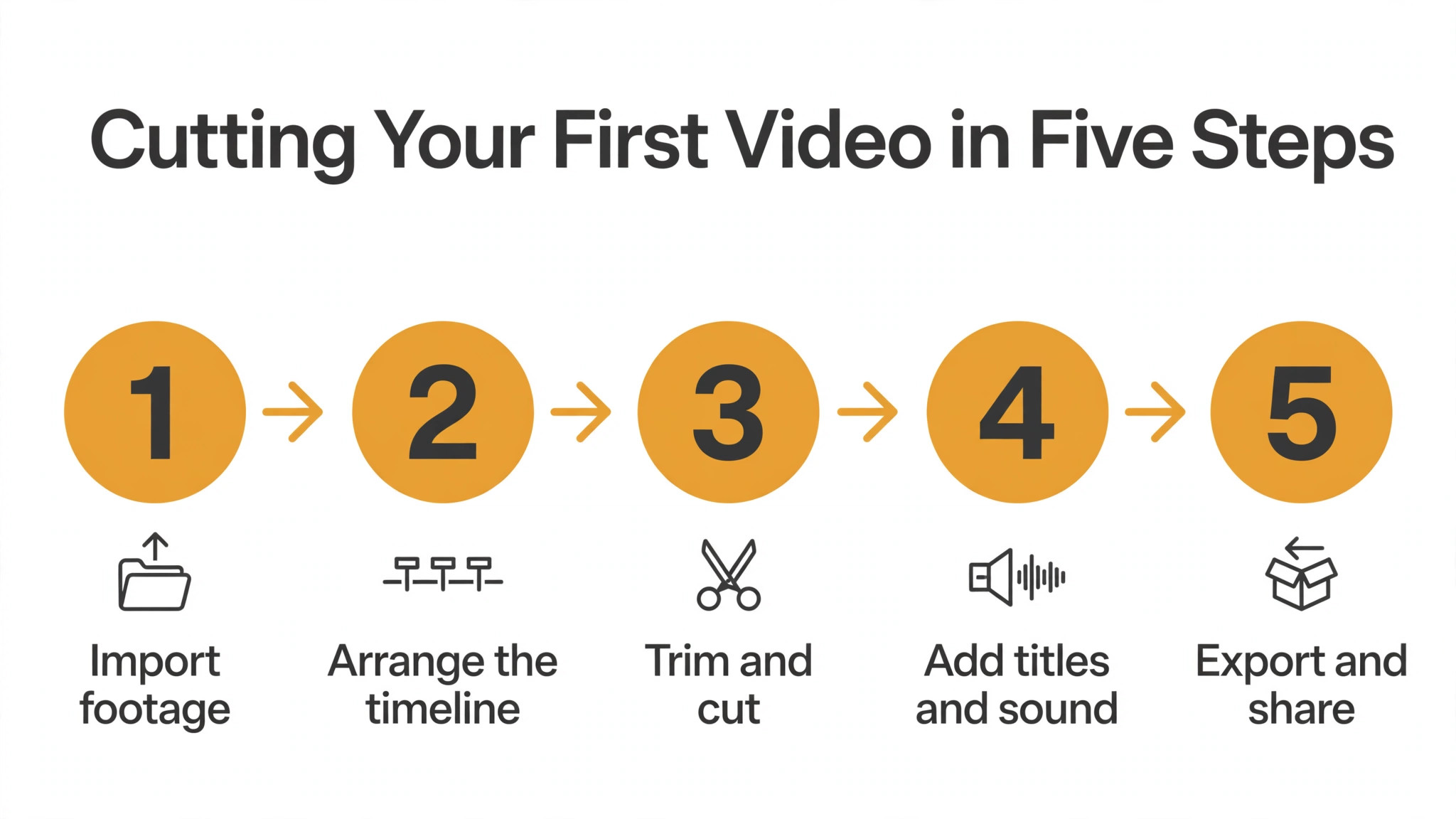
Cutting Your First Video in Five Steps
The top 10 video editing software in this guide was tested with this five-step sequence, and it is the fastest honest check a buyer can run.
- Import footage. Import all the footage into one project and let the proxies build before you start, since a half-built proxy slows every playback.
- Arrange the timeline. Arrange the clips in story order first, before you touch any effect, so the structure is right before the polish starts.
- Trim and cut. Trim in two passes, first removing the dead air, then tightening the pauses, and watch the whole cut before you move on.
- Add titles and sound. Add titles and music last, and check the audio levels on headphones before you export anything.
- Export and share. Export with the preset that matches the platform, watch the exported file once through, and then share it.
Five Checks Before You Pay for a Video Editor
Any video editor worth your money should pass these five checks. They take ten minutes and they catch the expensive mistakes a video editor buyer makes most.
- Read the pricing page twice. Check what the renewal costs, what the cloud storage covers, and what counts as an extra.
- Test support with a real video editor question. Send one about video editor setup before you pay and judge the answer by its speed and its honesty.
- Export your project on day one. If the export is painful now, it will be worse when you want to move to another video editor.
- Ask who else uses the video editor daily. An editor your team will open every morning beats a stronger one they avoid.
- Check format support. If your camera footage is not supported, know it before you pay, not after.
Frequently Asked Questions
The six questions below are the ones buyers ask most about the top 10 video editing software, answered without hedging.
What is the best video editing software for a professional?
Premiere Pro is the best overall for a professional, because it runs on any machine, opens any format and hands projects to collaborators without conversion. Final Cut Pro is the better pick for Mac editors who want the fastest renders.
Is Premiere Pro worth the subscription?
It depends on how much you edit. An editor who cuts weekly earns the fee back in saved time, because the format support and collaboration tools cut hours off every job. A hobbyist who edits monthly will not feel the difference, and a free tool covers the basics.
Do I need a powerful computer to edit video?
Not for the tools in this guide, if you use proxies. Proxy editing lets a two-year-old laptop cut 4K footage smoothly, and every editor in this guide supports it. The machine matters less than the workflow, and a good proxy habit beats a new computer.
What is the difference between Premiere Pro and Final Cut Pro?
Premiere Pro focuses on compatibility, with support for any machine and any format. Final Cut Pro focuses on Mac speed, with the fastest renders on Apple hardware. Premiere Pro suits teams, Final Cut Pro suits solo Mac editors, and both beat a free editor.
Can I edit video on my phone?
Yes, for short social clips. CapCut on a phone handles quick edits well, and the results look good on a small screen. For anything longer than a minute, or anything with multiple audio tracks, a desktop editor is still the faster tool.
Can I switch video editors without losing my projects?
Yes, if you export before you cancel. Most editors export the timeline as a standard file, and the new tool imports it in minutes. Always test the export on day one, before you have months of projects at stake.
The Bottom Line for Video Editors
When the top 10 video editing software is judged on daily use rather than feature lists, Premiere Pro is the default for most professional editors, and Final Cut Pro is the pick for Mac editors who want speed.
Take the trial, cut a real project through it, and trust what you see. The right video editor proves itself in a week of ordinary use. That first week with Premiere Pro tells you more than any review can.
If Premiere Pro costs too much, DaVinci Resolve covers colour and editing free, and CapCut handles social clips well. The mistake is to buy an editor and keep cutting in the phone app. Import the footage, arrange the timeline, and let the tool do the heavy lifting.