
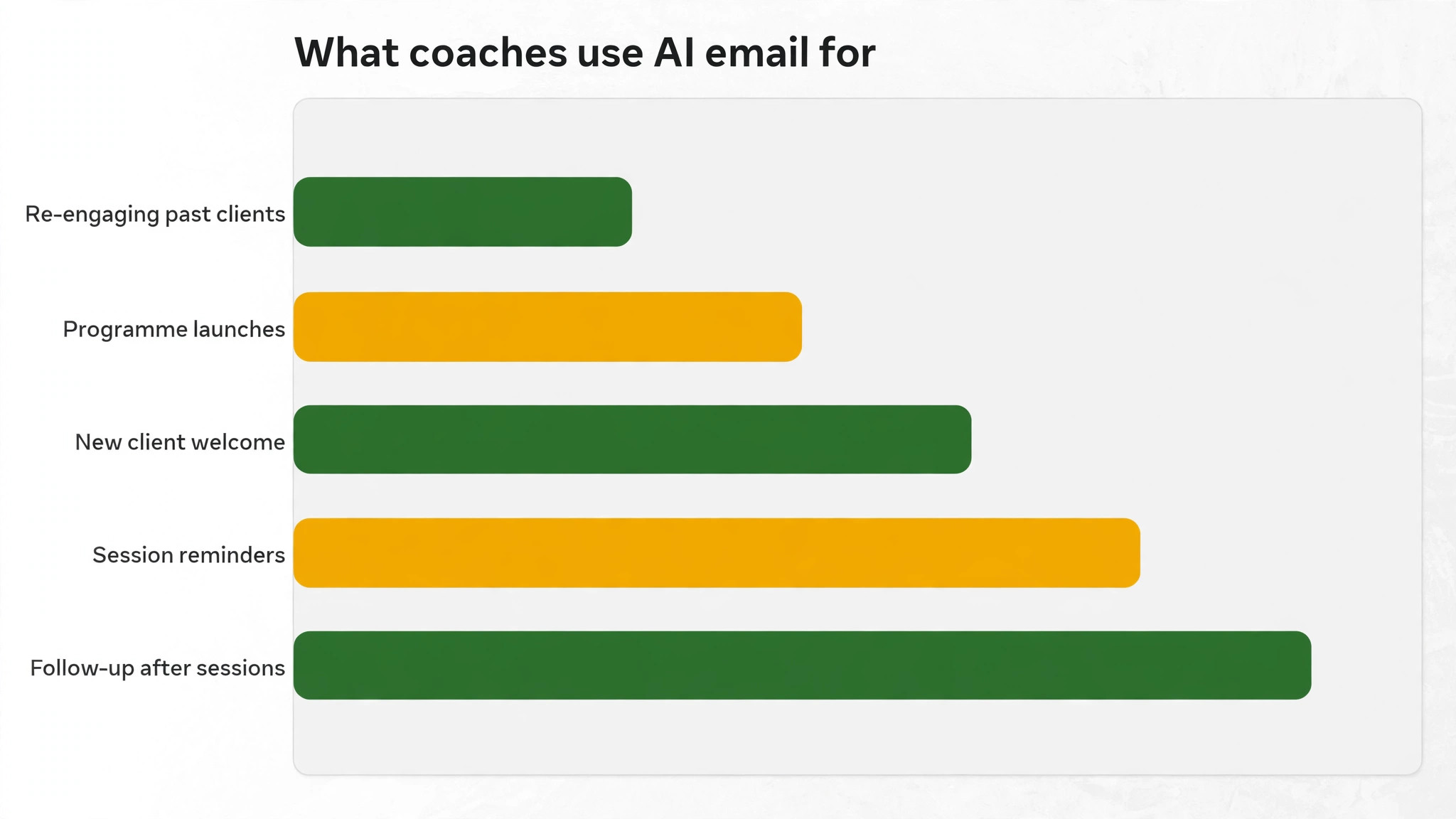
A coach opens the laptop to send three emails, and two hours later the coaching is still waiting. The follow-up after a session, the reminder before the next one, the welcome to a new client, and the outreach to a prospect who went quiet. Each email takes ten minutes, because the coach wants it to sound personal, and ten emails a day is nearly two hours. The best AI email tools for coaches exist for that exact loss, because a coach who spends the day writing email is not coaching, and the business grows only when the coach is coaching.
The problem is not that coaches cannot write. It is that the writing never ends, and the emails that matter most are the ones that get delayed. A follow-up sent the same day keeps a client, while one sent three days later feels like an afterthought, and a prospect who gets a thoughtful email within an hour is far more likely to book than one who waits a week. A tool that drafts the email in seconds, while the coach keeps the voice, turns a two-hour chore into twenty minutes.
This guide compares the best ai email tools for coaches on price, fit and day-to-day use, and it ends with a clear pick for each job.
Why a Coach Spends More Time Writing Email Than Coaching
Before comparing prices, run through this checklist for best ai email tools for coaches, which covers the six things that decide whether the tool earns its keep.
- Outreach that gets replies, because a coach who lives on new clients needs answers, not just sent emails.
- Follow-up automation, so no client waits three days for a reply that should have gone out the same day.
- A voice that stays the coach’s, because an email that sounds like a robot loses the client it was meant to keep.
- Works inside Gmail or Outlook, because a coach will not switch email clients for a tool.
- Tracking that shows opens and clicks, so the coach knows when to follow up and when to stop.
- A price the coaching income covers, because a tool that costs more than a session a month is hard to justify.
How We Judged the Best AI Email Tools for Coaches
We judged each tool on the coach’s day, which is a mix of follow-up, reminders and outreach. A tool scored well when it drafted emails the coach would actually send, when it kept the coach’s voice, and when it saved time on the repetitive emails without making the personal ones feel generic. A tool lost points when it wrote fast but sounded like a template, because a client who receives a generic email from a coach feels like a number, and a coach cannot afford that.
Judged as a shortlist led by Lavender, the scores below reflect the tools as they stand in 2026, with starting prices taken from the vendor sites and from roundups published this year.
- Reply rate on outreach, because a coach needs answers, not sent emails.
- Follow-up speed, so clients hear back the same day rather than next week.
- Voice preservation, because an email that sounds generic loses the client.
- Works inside the coach’s inbox, because switching email clients is a cost nobody wants.
- Price against coaching income, so the tool pays for itself in saved hours.
The 10 Tools at a Glance
Here is how the best ai email tools for coaches compare on price, fit and standout strength, so the shortlist is visible in one place.
| Tool | Starting price | Best for | Standout strength |
|---|---|---|---|
| Lavender | From $29 a month | coaches who write outreach and want replies | Lavender is an AI email assistant that scores each draft, suggests improvements and helps a coach write outreach that gets replies, from 29 dollars a month. It works inside Gmail and Outlook, and it analyses the recipient’s communication style before the coach writes. |
| Superhuman | From $30 a month | coaches drowning in inbox and wanting speed | Superhuman is an email client built for speed, with keyboard shortcuts, AI summaries, snippets and a fast inbox from 30 dollars a month. It suits a coach who processes dozens of client emails a day and needs the inbox to feel light. |
| Instantly | From $37 a month | coaches running outreach campaigns at volume | Instantly is an outreach platform with unlimited email accounts, warmup, campaign management and analytics from 37 dollars a month. It suits a coach who sends outreach at scale and needs the emails to land in the inbox. |
| Apollo | From $49 per user a month | coaches who need to find and contact new clients | Apollo combines a contact database with email outreach, from 49 dollars per user a month. A coach can find decision makers, verify their email, and send a sequence from the same tool, which suits a coach building a pipeline from scratch. |
| Mixmax | From $29 a month | coaches who live in Gmail and want sequences plus tracking | Mixmax adds email sequences, templates, tracking and scheduling to Gmail from 29 dollars a month, with a free plan for the basics. It suits a coach who wants outreach inside Gmail rather than in a separate tool. |
| Smartwriter | Pricing on the vendor site | coaches who want AI-written personalised outreach | Smartwriter is an AI tool that writes personalised cold emails using research about the recipient, and its pricing is shown on the vendor site. It suits a coach who sends outreach to people they have researched, because each email reads as if it was written for that person alone. |
| Lyne | Pricing on the vendor site | coaches who want AI to research each prospect before writing | Lyne is an AI outreach tool that researches each prospect and writes a personalised first line for the email, and its pricing is shown on the vendor site. It suits a coach who believes the first line decides whether the email is read. |
| Grammarly | From $12 a month | coaches who want every email clean and confident | Grammarly checks grammar, tone and clarity in real time, with a free plan and a Premium plan from 12 dollars a month. It suits a coach whose emails are the business, because a typo in a proposal email costs credibility. |
| Compose AI | Pricing on the vendor site | coaches who want AI to finish their sentences in Gmail | Compose AI is a browser extension that autocompletes sentences and generates full email replies inside Gmail, and its pricing is shown on the vendor site. It suits a coach who writes the same replies every day and wants them drafted instantly. |
| HyperWrite | Pricing on the vendor site | coaches who want an AI writing assistant for longer emails | HyperWrite is an AI writing assistant that drafts emails, proposals and longer documents, and its pricing is shown on the vendor site. It suits a coach who writes long proposals or programme descriptions and wants a first draft fast. |
Best Pick by Job
Our pick among the best ai email tools for coaches is Lavender, and the table below matches the right tool to the job at hand, because the best tool depends on what the reader is actually doing.
Use the table above as a shortlist for best ai email tools for coaches, not a final answer, and run the top two trials in the same week before paying for a year.
| Job | Best pick | Why |
|---|---|---|
| Coach who needs outreach replies | Lavender | Reply-focused scoring from $29 a month |
| Coach drowning in inbox | Superhuman | Fast inbox from $30 a month |
| Coach running outreach at volume | Instantly | Warmup and deliverability from $37 a month |
| Coach who needs to find new clients | Apollo | Contact database from $49 a user a month |
| Best overall for most coaches | Lavender | Outreach that gets replies |
The 10 Tools in Detail
The best ai email tools for coaches below are listed with the price, the fit and the reason to skip each one, so the decision is visible tool by tool.
1. Lavender
Lavender is built for coaches who write outreach and want replies. It starts from $29 a month.
Lavender is an AI email assistant that scores each draft, suggests improvements and helps a coach write outreach that gets replies, from 29 dollars a month. It works inside Gmail and Outlook, and it analyses the recipient’s communication style before the coach writes.
Its reply-rate focus suits a coach who lives on outreach, because the tool is judged on whether the email gets answered, not on how fast it is written.
Skip it when the coach mainly writes to existing clients, because Lavender is built for cold outreach rather than client care.
In the trial, check Lavender against the checklist above, and confirm the $29 a month plan covers the job before paying.
2. Superhuman
Superhuman is built for coaches drowning in inbox and wanting speed. It starts from $30 a month.
Superhuman is an email client built for speed, with keyboard shortcuts, AI summaries, snippets and a fast inbox from 30 dollars a month. It suits a coach who processes dozens of client emails a day and needs the inbox to feel light.
Its speed is the point, because a coach who answers fifty emails a day saves an hour when each one takes seconds less.
Skip it when the budget is tight, because 30 dollars a month is a lot for an email client when Gmail is free.
In the trial, check Superhuman against the checklist above, and confirm the $30 a month plan covers the job before paying.
3. Instantly
Instantly is built for coaches running outreach campaigns at volume. It starts from $37 a month.
Instantly is an outreach platform with unlimited email accounts, warmup, campaign management and analytics from 37 dollars a month. It suits a coach who sends outreach at scale and needs the emails to land in the inbox.
Its warmup and deliverability tools are the reason to pick it, because outreach that lands in spam earns nothing.
Skip it when the coach sends a handful of personal emails, because Instantly is built for campaigns, not one-to-one care.
In the trial, check Instantly against the checklist above, and confirm the $37 a month plan covers the job before paying.
4. Apollo
Apollo is built for coaches who need to find and contact new clients. It starts from $49 per user a month.
Apollo combines a contact database with email outreach, from 49 dollars per user a month. A coach can find decision makers, verify their email, and send a sequence from the same tool, which suits a coach building a pipeline from scratch.
Its database is the feature, because finding the right person to email is harder than writing the email.
Skip it when the coach already has a full client list, because the database adds cost without value.
In the trial, check Apollo against the checklist above, and confirm the $49 per user a month plan covers the job before paying.
5. Mixmax
Mixmax is built for coaches who live in Gmail and want sequences plus tracking. It starts from $29 a month.
Mixmax adds email sequences, templates, tracking and scheduling to Gmail from 29 dollars a month, with a free plan for the basics. It suits a coach who wants outreach inside Gmail rather than in a separate tool.
Its tracking shows when a client opens an email and clicks a link, which tells the coach when to follow up.
Skip it when the coach does not use Gmail, because Mixmax is built around it.
In the trial, check Mixmax against the checklist above, and confirm the $29 a month plan covers the job before paying.
6. Smartwriter
Smartwriter is built for coaches who want AI-written personalised outreach. Pricing is on the vendor site.
Smartwriter is an AI tool that writes personalised cold emails using research about the recipient, and its pricing is shown on the vendor site. It suits a coach who sends outreach to people they have researched, because each email reads as if it was written for that person alone.
Its personalisation is the point, because a generic cold email is ignored while a researched one is answered.
Skip it when a published price is needed before budgeting, because Smartwriter prices by quote.
In the trial, check Smartwriter against the checklist above, and confirm the quoted plan covers the job before paying.
7. Lyne
Lyne is built for coaches who want AI to research each prospect before writing. Pricing is on the vendor site.
Lyne is an AI outreach tool that researches each prospect and writes a personalised first line for the email, and its pricing is shown on the vendor site. It suits a coach who believes the first line decides whether the email is read.
Its research step is the feature, because a first line that mentions something real about the prospect earns the read.
Skip it when a published price is needed, because Lyne prices by quote.
In the trial, check Lyne against the checklist above, and confirm the quoted plan covers the job before paying.
8. Grammarly
Grammarly is built for coaches who want every email clean and confident. It starts from $12 a month.
Grammarly checks grammar, tone and clarity in real time, with a free plan and a Premium plan from 12 dollars a month. It suits a coach whose emails are the business, because a typo in a proposal email costs credibility.
Its tone check is the useful part, because a coach can sound warm and confident rather than rushed.
Skip it when the coach needs sequences or tracking, because Grammarly is a writing checker, not an outreach tool.
In the trial, check Grammarly against the checklist above, and confirm the $12 a month plan covers the job before paying.
9. Compose AI
Compose AI is built for coaches who want AI to finish their sentences in Gmail. Pricing is on the vendor site.
Compose AI is a browser extension that autocompletes sentences and generates full email replies inside Gmail, and its pricing is shown on the vendor site. It suits a coach who writes the same replies every day and wants them drafted instantly.
Its autocomplete saves the most time on repetitive replies, because the coach only edits rather than writes from scratch.
Skip it when a published price is needed, because Compose AI prices by plan on its site.
In the trial, check Compose AI against the checklist above, and confirm the quoted plan covers the job before paying.
10. HyperWrite
HyperWrite is built for coaches who want an AI writing assistant for longer emails. Pricing is on the vendor site.
HyperWrite is an AI writing assistant that drafts emails, proposals and longer documents, and its pricing is shown on the vendor site. It suits a coach who writes long proposals or programme descriptions and wants a first draft fast.
Its long-form drafting is the feature, because a coach who writes a ten-paragraph proposal saves an hour when the first draft arrives in seconds.
Skip it when a published price is needed, because HyperWrite prices by plan on its site.
In the trial, check HyperWrite against the checklist above, and confirm the quoted plan covers the job before paying.
Set Up the Coach Email System in Five Steps
The five steps below are the checklist we would follow for best ai email tools for coaches, in the order that wastes the least time.
Write the five emails you send every week. List the five emails the coach sends most often, such as the session follow-up, the reminder, the welcome, the proposal and the win-back. Those five are the ones the tool should draft, because automating the rare emails saves nothing.
Let the AI draft, then edit in your voice. Use the tool to draft each email, then rewrite the opening and closing in the coach’s own words. The AI saves the time, and the edit keeps the voice, which is the combination that works.
Set the follow-up to go out the same day. Make it a rule that the session follow-up goes out within two hours, because a client who hears back the same day feels looked after. The tool should make that easy, not something to remember.
Track opens and follow up on the quiet ones. Check which clients opened the email and which did not, and follow up personally with the ones who stayed silent. A tool that shows opens turns a guess into a list of people to call.
Review the reply rate every month. Spend twenty minutes each month looking at which emails got replies and which did not, and rewrite the ones that failed. A coach who measures replies improves them, while one who does not keeps sending the same ignored email.
What AI Email Tools Cost a Coach Each Month
The monthly bill for best ai email tools for coaches runs from the cheapest entry point to the top tier, and the right budget depends on volume rather than brand.
The monthly bill for AI email tools runs from free on Grammarly to 12 dollars a month for Grammarly Premium, 29 dollars for Lavender or Mixmax, 30 dollars for Superhuman, 37 dollars for Instantly, and 49 dollars per user for Apollo. Most coaches land on Lavender at 29 dollars or Grammarly Premium at 12 dollars, because those are the tools that fix the daily writing without changing how the coach works. A coach who runs outreach at volume will pay 37 dollars for Instantly, and one who needs a contact database will pay 49 dollars for Apollo.
The cost that coaches forget is the session the tool saves. A coach who charges 100 dollars a session and saves two hours a week with an AI draft has saved eight hours a month, which is worth far more than the 29 dollar bill. The tool pays for itself when it returns even one hour a week to coaching, and that is a low bar. The expensive choice is not the tool, it is the two hours a day spent writing email instead of coaching.
A coach should treat the follow-up email as part of the session, not as admin after it. The client who receives a thoughtful follow-up within two hours feels looked after, and the coach who sends it builds the relationship that keeps the client. The tool that drafts it in seconds makes the follow-up easy, and the easy follow-up is the one that actually happens. That is the whole value.
The first line of an outreach email decides whether it is read, and the AI tools that research the prospect earn that read. A first line that mentions something real about the prospect, such as a recent post or a shared connection, is worth more than a clever subject line, because the subject gets the open while the first line gets the reply. Write the first line for the person, not for the list.
A coach who measures reply rates learns fast. The email that got five replies out of ten is a template worth keeping, while the one that got none is a lesson worth learning. Spend twenty minutes a month on the numbers, rewrite the failures, and the outreach improves every month. A coach who does not measure keeps sending the same ignored email.
Five Mistakes That Waste a Coach’s Email Time
Sending the AI draft without editing. An unedited AI email sounds like every other AI email, and a client can tell. Edit the opening and the closing, because those two lines carry the voice.
Using outreach tools for client care. A cold outreach tool writes to strangers, and a client who receives a cold-sounding email feels like a lead rather than a person. Use the outreach tool for prospects and a personal draft for clients.
Never following up on opens. An email that was opened but not answered is a warm lead, and ignoring it wastes the open. Follow up with the people who read but did not reply.
Paying for a database the coach does not need. Apollo is worth 49 dollars a month when the coach needs to find new clients, and wasted money when the client list is already full. Buy the tool that fits the pipeline, not the one with the most features.
Letting the inbox decide the day. A coach who answers email all day coaches nobody, and the inbox will always refill. Set two email windows a day, and coach in between.
Frequently Asked Questions
These are the questions readers ask most about best ai email tools for coaches, answered with the prices and limits above.
How much do AI email tools cost a coach?
A coach can start free on Grammarly, pay 12 dollars a month for Grammarly Premium, 29 dollars for Lavender or Mixmax, 30 dollars for Superhuman, 37 dollars for Instantly, and 49 dollars per user for Apollo. Most coaches land on Lavender at 29 dollars or Grammarly Premium at 12 dollars, because those cover the daily writing. A coach who runs outreach at volume will pay 37 dollars for Instantly.
Which AI email tool is best for coaches?
Lavender is the best pick for most coaches, because it scores each draft, suggests improvements and helps the coach write outreach that gets replies, from 29 dollars a month. A coach who mainly wants a faster inbox should pick Superhuman at 30 dollars, while one who wants every email clean should start with Grammarly at 12 dollars a month.
Can AI write emails that still sound like me?
Yes, when the coach edits the draft. The AI writes the structure and the middle, and the coach rewrites the opening and closing in their own voice, which is where the personality lives. An unedited AI email sounds generic, but a draft that the coach has touched in two places reads as personal, because the two places the reader notices are the first and last lines.
Is Lavender or Superhuman better for a coach?
Lavender is better when the coach needs outreach that gets replies, because it scores each draft and analyses the recipient, from 29 dollars a month. Superhuman is better when the coach needs a faster inbox, because its shortcuts and AI summaries save time on every email, from 30 dollars a month. A coach who does both should pick Lavender first, because replies bring clients while speed only saves time.
Do coaches need an outreach tool like Instantly?
Only when the coach sends outreach at volume. Instantly at 37 dollars a month is built for campaigns with warmup and deliverability, which matters when the coach emails dozens of prospects a week. A coach who sends a handful of personal emails a week does not need it, and should spend the money on Lavender or Grammarly instead.
Will AI email tools replace the personal touch?
No, when they are used as a draft rather than a send. The tool writes the first version, the coach adds the personal detail that only they know, and the client receives an email that is both fast and personal. A coach who sends the AI draft untouched loses the personal touch, while one who edits it keeps it and gains the time.
Our Pick, Stated Plainly (Lavender)
Our pick for most coaches is Lavender, because it is the tool judged on replies, and replies are what fill a coaching practice. It costs 29 dollars a month, it works inside Gmail and Outlook, and it helps the coach write outreach that gets answered rather than ignored. The exception is a coach who mainly needs a faster inbox, where Superhuman at 30 dollars is the honest choice, and one who only needs clean writing, where Grammarly Premium at 12 dollars is enough.
Start with the trial, draft the five emails the coach sends every week, and edit each one in the coach’s voice before sending. If the replies come faster and the inbox feels lighter, the tool has earned its place. If the emails sound generic, edit harder, because the voice is the product, and no tool should be allowed to flatten it.