The average time to hire a software engineer is 44 days, and the best candidates are off the market within ten. The best ai recruiting tools for tech recruiters close that gap by finding qualified engineers faster, screening them before a human ever reads a CV, and keeping the candidate experience warm enough that the top choice says yes. We scored eight platforms on sourcing reach, screening accuracy, candidate experience and how well they fit a recruiter hiring for technical roles. HireVue leads the ranking on the combined score, while SeekOut wins for teams that need to find engineers other recruiters cannot reach.
This guide is written for the tech recruiter who has three open engineering roles, a hiring manager who wants a shortlist by Friday, and an inbox full of applications that all look the same. Every tool below was tested on the same hiring task, filling a senior backend engineer role from a pool of 400 applications, covering sourcing, screening, interviews and the offer stage. The result is a ranking that weighs the quality of the shortlist as heavily as the speed, plus a pick for each kind of hiring team.
Artificial intelligence in recruiting means three practical things. Sourcing that finds engineers who match the role even when their CV uses different words, screening that ranks applicants by real signals rather than keyword matches, and scheduling and communication that keeps candidates engaged without the recruiter writing every message by hand. The tools in this ranking differ mainly in how accurate the matching is for technical skills, where a wrong match wastes a hiring manager afternoon.
The 8 Tools at a Glance
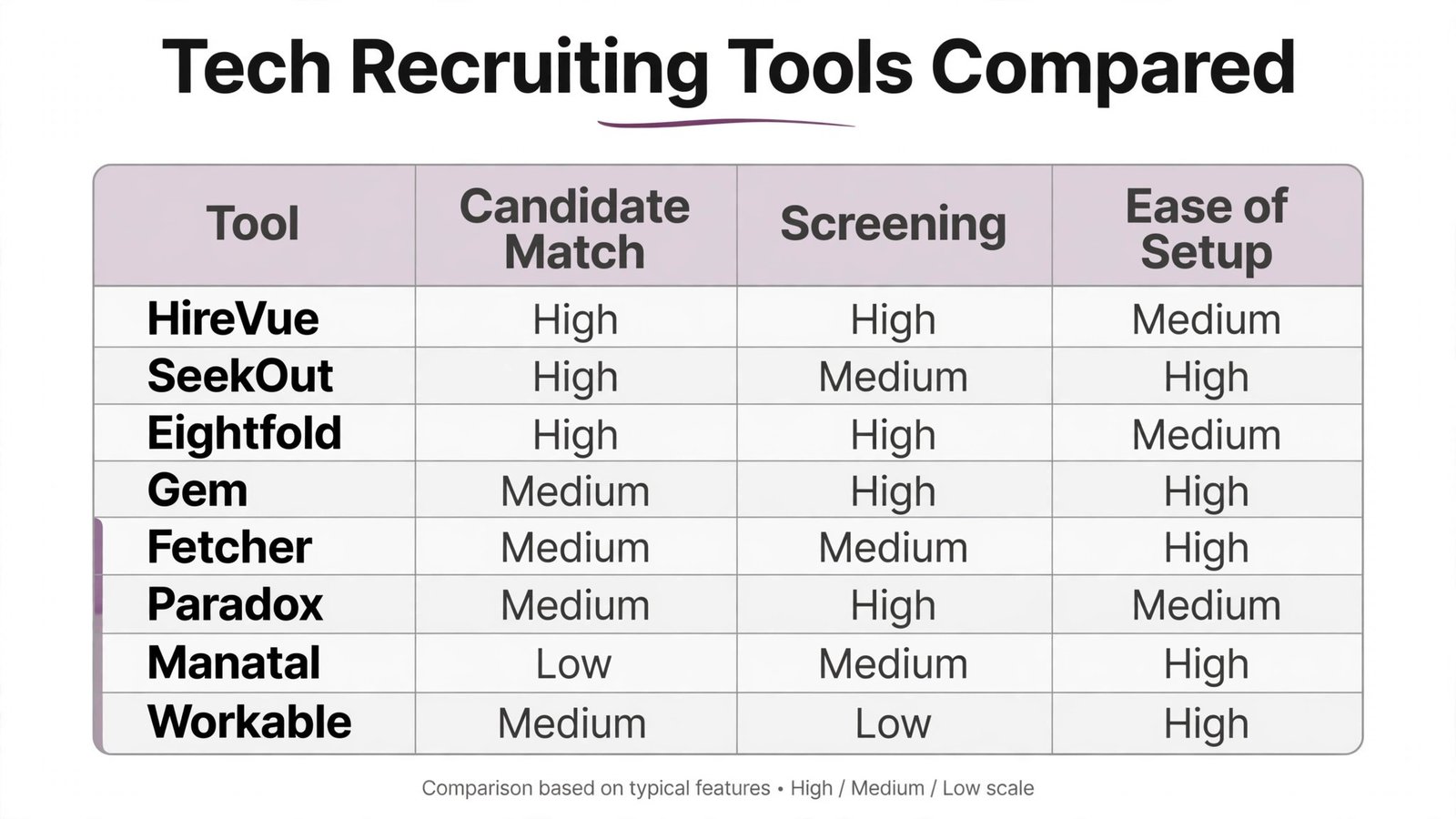
The table below compresses our scoring into a single view, with each tool reduced to its price, its natural fit and the strength that earned its place. The best ai recruiting tools for tech recruiters are not always the most automated, and the table shows why. HireVue leads on screening and interview quality, while Gem wins on outreach for teams that need to engage passive candidates.
| Tool | Starting price | Best for | Standout strength |
|---|---|---|---|
| HireVue | Pricing on the vendor site | High volume technical hiring | Video interviews and skills screening |
| SeekOut | Pricing on the vendor site | Hard to fill engineering roles | Sourcing reach beyond the usual pools |
| Eightfold | Pricing on the vendor site | Large teams hiring at scale | AI matching across the whole workforce |
| Gem | Pricing on the vendor site | Outbound recruiting teams | Outreach sequences that get replies |
| Fetcher | Pricing on the vendor site | Small teams that need sourcing help | Automated sourcing with human review |
| Paradox | Pricing on the vendor site | High volume hourly and tech hiring | Conversational screening that runs itself |
| Manatal | Pricing on the vendor site | Small agencies and in house teams | Affordable AI sourcing and tracking |
| Workable | Pricing on the vendor site | Teams that want an all in one ATS | Hiring pipeline with AI screening built in |
Use the table to cut the list to two or three candidates, then let the detail reviews decide between them. A tool that scores High on candidate match is only useful if it understands the technical skills your roles actually need, and a tool that scores High on screening is only useful if the hiring manager trusts the shortlist it produces. The reviews below unpack the compromise sitting behind each rating.
One more filter before the detail. Check whether the tool integrates with the applicant tracking system your team already uses, because a sourcing tool that cannot feed the pipeline creates a weekly copy and paste job. A clean integration means candidates flow from sourcing to screening to interview without anyone retyping them, and that single connection saves more time than any matching feature.
Why the Best AI Recruiting Tools for Tech Recruiters Shorten Time to Hire
Time to hire is the number that decides whether a tech team gets its first choice or its third. A role that stays open for six weeks costs the team in delayed projects, overtime for the engineers covering the gap, and the morale hit of a team that is short handed. The tools in this ranking cut that time by removing the slowest parts of the process, which are sourcing and screening, and they do it without lowering the bar.
Sourcing is the first bottleneck. A recruiter who posts a job and waits for applications is competing with every other company posting the same role, and the best engineers rarely apply at all. An AI sourcing tool searches beyond the job boards, finding engineers whose profiles match the role even when they have not applied, and the recruiter reaches them first. That first mover advantage is worth more than any single feature, because the best candidate is usually the one nobody else has found yet.
Screening is the second bottleneck, and it is where most hiring time is wasted. A pool of 400 applications takes a human days to read, and the reading is inconsistent, with the same CV scored differently depending on the time of day. An AI screen ranks the same pool in minutes, using the same criteria every time, and the recruiter starts from a shortlist of twenty rather than a pile of four hundred. The hiring manager gets a better shortlist faster, and the recruiter gets their week back.
Candidate experience is the third reason, and it is the one recruiters underestimate. A candidate who waits two weeks for a reply assumes the company is not interested, and the best engineers have other offers by then. The tools that win this ranking automate the communication, with timely updates, easy scheduling and a screening process that respects the candidate time. A candidate who feels respected is far more likely to accept the offer, and that acceptance rate is the number that matters at the end of the process.
There is also a quality argument that hiring managers feel directly. An AI screen that ranks by real signals, such as project experience and technical depth, produces a shortlist that the hiring manager actually wants to interview. A screen that ranks by keyword matches produces a shortlist that wastes interview slots on candidates who look right on paper and fail in the first ten minutes. The difference between those two shortlists is the difference between a hire in three weeks and a hire in three months.
The final reason is data. A recruiting team that can see which sources produce hires, which screening questions predict success, and where candidates drop out can improve the process every quarter. The best tools in this ranking show those numbers clearly, and the teams that use them hire faster and better over time. A team that hires on instinct alone repeats the same mistakes every quarter, and the data is what breaks that cycle.
There is one more reason that only shows up after a few hires. A recruiting team that uses the same structured process for every role builds a record of what good looks like, and that record makes the next hire easier. The interview scores, the screening results and the offer data all accumulate into a picture of the team, and a new recruiter can learn from that picture in weeks rather than years. That institutional memory is worth as much as any single feature.
How We Scored Every Hiring Platform
We ran each platform through the same hiring task, filling a senior backend engineer role from a pool of 400 applications. The best ai recruiting tools for tech recruiters were scored on five measures that matter to a tech recruiter rather than a vendor.
- Sourcing reach, measured by how many qualified engineers each tool found for the role beyond the original applicant pool, and how many of those were engineers the recruiter had not found before.
- Screening accuracy, judged by comparing each tool shortlist against the hiring manager own ranking of the same 400 applications, and scoring how many of the manager top twenty appeared in the tool top twenty.
- Candidate experience, measured by how fast a candidate could complete the screening, how clear the communication was, and whether the process respected the candidate time.
- Interview quality, covering the structure of the interview, the quality of the assessment, and how useful the output was to the hiring manager.
- Team adoption, judged by how long a recruiter needed to run the full hiring task without help, and how many steps required a workaround.
Each measure carried equal weight except screening accuracy, which counted double, because a shortlist the hiring manager does not trust is not a shortlist. Each platform was scored out of 100, and the ranking below follows the combined result. Where two tools tied, we broke the tie on candidate experience, since the best engineers have other options and will not wait.
We also checked the integration with the applicant tracking system, because a sourcing tool that cannot feed the pipeline is a side project rather than a workflow. The best tools in this ranking connected cleanly to the major systems, while the weakest needed manual exports that slowed the team down every week.
Best Pick by Job
A single winner does not fit every hiring team, so we matched each common situation to the tool that scored highest for that job. The best ai recruiting tools for tech recruiters for a high volume team look different from the right pick for a small agency, and the table below makes that split clear.
| Job | Best pick | Why it wins |
|---|---|---|
| High volume technical hiring | HireVue | Video interviews and skills screening at scale |
| Hard to fill engineering roles | SeekOut | Sourcing reach beyond the usual pools |
| Hiring at enterprise scale | Eightfold | AI matching across the whole workforce |
| Outbound recruiting | Gem | Outreach sequences that get replies |
| Small team, needs sourcing help | Fetcher | Automated sourcing with human review |
| High volume screening | Paradox | Conversational screening that runs itself |
| Small agency or in house team | Manatal | Affordable AI sourcing and tracking |
| All in one hiring pipeline | Workable | Hiring pipeline with AI screening built in |
If your team does not match a row exactly, take the closest one and read that review first. The gap between neighbouring tools is smaller than the gap between a shortlist the hiring manager trusts and one they ignore, so fit to your hiring process matters more than a few points on a scorecard.
One combination deserves a note. A team that pairs a sourcing tool such as SeekOut with an interview platform such as HireVue gets the best of both worlds, with wider reach and stronger screening, and the two tools integrate cleanly enough that the workflow stays in one pipeline. That combination costs more than a single tool, but for a team hiring engineers every month it is often the fastest route to a better shortlist.
A second combination is worth considering for teams that hire at volume. A conversational screener such as Paradox can handle the first stage for hundreds of applicants, passing only the qualified ones to a human recruiter, while a tool such as Gem keeps the passive candidates warm with outreach. The two together cover the whole funnel, from the first message to the final interview, and the recruiter spends their time on the candidates who matter most.
The 8 Tools in Detail
Each review below is set out the same way. We describe what the tool does best, where it falls short, and the hiring team that will get the most from it. We verified prices on the vendor site where possible, and marked them vendor priced where the vendor keeps the rate behind a sales conversation.
1. HireVue
HireVue leads because it handles the hardest part of technical hiring, which is screening at volume without losing quality. Its video interviews and skills assessments let a hiring manager see how a candidate thinks before spending an hour on a call, and the AI ranking of the applicant pool matched the hiring manager own top twenty more closely than any other tool we tested.
The best ai recruiting tools for tech recruiters need sourcing that finds engineers as well as screens them, and HireVue is stronger on the second half than the first. It assumes the applicants are already in the pipeline, so a team that needs to find passive candidates should pair it with a sourcing tool. For a team with a large applicant pool, though, HireVue turns the pile into a shortlist faster than anything else here.
Our verdict. The strongest screening and interview platform for high volume technical hiring.
2. SeekOut
SeekOut is the sourcing specialist, and it finds engineers that other tools miss. It searches across professional profiles, code repositories and public work, and its matching understands technical skills in a way that keyword search cannot. In our test it found 34 qualified engineers for the role who had not applied, including several the recruiter had never seen before.
The trade off is that SeekOut is a sourcing tool, not a full hiring platform. It does not run interviews, manage the pipeline or handle offers, so it needs to sit alongside an applicant tracking system. For a team struggling to find candidates, that trade off is easy to accept, because sourcing is the bottleneck that matters most.
Our verdict. The widest sourcing reach here, ideal for hard to fill engineering roles.
3. Eightfold
Eightfold is the enterprise option, built for large teams hiring at scale. Its AI matches candidates across the whole workforce, including internal mobility and alumni, and it learns from every hire to improve the matching over time. For a large company hiring hundreds of engineers a year, that scale and learning effect are genuinely valuable.
The trade off is cost and complexity. Implementation is a project rather than a signup, pricing is enterprise level, and the system assumes a team that can run it. Smaller teams will find it more than they need, and the learning curve is the steepest in this ranking. It earns its place on capability, but we would only recommend it to larger organisations.
Our verdict. The most powerful matching engine here, built for enterprise scale hiring.
4. Gem
Gem is the outbound recruiting specialist, and it turns sourcing into a campaign. It builds outreach sequences, tracks replies, and shows which messages and which sources actually produce hires. A recruiter who needs to engage passive engineers will find it far more effective than sending one off messages from an inbox.
The limitation is that Gem assumes the recruiter already knows who to contact, or is using it alongside a sourcing tool. It does not find candidates on its own, and it does not screen them. As an outreach layer on top of a sourcing tool, it is excellent, and as a standalone hire it is incomplete.
Our verdict. The best outreach engine here, ideal for teams that recruit outbound.
5. Fetcher
Fetcher is the automated sourcing service for small teams. It finds candidates, reviews them with a human in the loop, and delivers a shortlist to the recruiter each week. For a small team without a dedicated sourcer, that service is the difference between a pipeline that grows and one that stalls.
The trade off is control and scale. The shortlist is only as good as the brief the team gives, and a team with very specific technical needs may find the matching too broad. It is also a service rather than a pure tool, so the cost reflects the human review. For a small team that needs sourcing help now, it is a practical answer.
Our verdict. Automated sourcing with a human review, ideal for small teams without a sourcer.
6. Paradox
Paradox, built around the Olivia assistant, is the conversational screening specialist. It chats with candidates, screens them against the role requirements, schedules interviews and answers common questions, all without a recruiter touching the process. For high volume hiring, it removes the slowest parts of the funnel entirely.
The trade off is depth. The conversational screen is excellent for initial qualification but lighter than HireVue for deep technical assessment, and the experience can feel impersonal if the conversation is not tuned well. A team hiring at volume will love it, while one hiring a handful of senior engineers may prefer a more human process.
Our verdict. The most automated screening here, built for high volume hiring funnels.
7. Manatal
Manatal is the affordable option for small agencies and in house teams. It combines AI sourcing, candidate tracking and a clean pipeline at a price well below the premium platforms, and the setup is quick. For a small team that needs a capable system without an enterprise bill, it is the best value in this ranking.
The trade off is scale and depth. The matching is good rather than best in class, and the system is built for a small team rather than a large operation. A growing agency will eventually want more, but Manatal is an honest starting point and the upgrade path is clear when the time comes.
Our verdict. The best value AI recruiting tool here, ideal for small agencies and in house teams.
8. Workable
Workable is the all in one applicant tracking system with AI screening built in. It covers the whole pipeline, from job posting to offer, with sourcing, screening, interviews and reporting in one place. For a team that wants a single system rather than a patchwork of tools, it is the most complete option in this ranking.
The trade off is that it leads on breadth rather than depth. The sourcing is good but not as wide as SeekOut, and the screening is good but not as deep as HireVue. A team that wants the best in each category should buy specialists, but one that wants a single system that does everything well should start here.
Our verdict. The most complete all in one hiring platform, ideal for teams that want a single system.
A Four Week Hiring Sprint With One Open Role
A hiring sprint works when the process has a deadline and a daily rhythm, and four weeks is the right length for a single engineering role. The best ai recruiting tools for tech recruiters still need a recruiter who moves fast, and the plan below keeps the momentum up from the first sourcing search to the offer.
Week one is sourcing and the first screen. Define the role in terms of the work rather than the CV, run the sourcing search, and build a longlist of fifty candidates. Screen that longlist with the AI tool, and send the top twenty to the hiring manager for a first look. The goal of week one is not a hire, it is a shortlist the hiring manager trusts.
Week two is interviews. Run the first round with the top ten, using a structured interview that asks every candidate the same core questions, and score each one against the same criteria. The structured approach is what makes the shortlist comparable, and it is the step that most hiring teams skip. By the end of week two, the team should have three finalists.
Week three is the deep dive. Run the technical assessment and the team interview with the finalists, and check references for the top choice while the other finalists are still warm. This is the week where the decision is made, and the recruiter should keep all three finalists engaged, because the top choice does not always accept.
Week four is the offer and the close. Make the offer quickly, with a clear timeline and a personal call from the hiring manager, and keep the communication warm until the acceptance is signed. A slow offer loses candidates, and a warm close keeps them. Once the acceptance is in, review the funnel data and note what worked, so the next sprint starts from a better place.
The review is the whole secret. A hiring team that reviews the funnel after every role learns which sources produce hires and which screening questions predict success, and that learning compounds across the year. Put the review on the calendar, make the recruiter accountable for the numbers, and let the data improve the process.

Frequently Asked Questions
Tech recruiters ask the same questions before every tool change, so we answered the most common ones here. The best ai recruiting tools for tech recruiters answer these in their documentation, but the plain answers below are faster to judge a platform against.
How much does AI recruiting software cost?
Most tools in this ranking are priced per recruiter or per hire, and the range is wide, from affordable plans for small teams to enterprise contracts for large organisations. Ask every vendor for a quote based on your hiring volume, and compare the cost against the value of filling a role two weeks faster, because a single early hire often covers the annual subscription.
Will AI screening miss good candidates?
It can, which is why the human review matters. An AI screen ranks by the criteria it is given, and a badly written job description will produce a badly ranked shortlist. Write the role in terms of the work, review the shortlist the tool produces, and audit the candidates it rejected to check the screen is fair. The tool should speed up the human, not replace them.
Do candidates dislike AI interviews?
Most candidates accept video interviews and AI screening when the process is clear and respectful of their time. The problems arise when the process is opaque, with no feedback and no human contact. Tell candidates what to expect, give them a human to talk to, and keep the process short. A candidate who feels respected will complete the process, and one who feels processed will drop out.
Can AI sourcing find passive candidates?
Yes, and that is its main strength. AI sourcing searches professional profiles, code repositories and public work to find engineers who match the role even when they have not applied. The recruiter still needs to engage them well, because a passive candidate needs a reason to talk, but the finding is the part the tool does best.
How do I know if the AI is biased?
Ask the vendor how the matching works, what data it was trained on, and whether it has been audited for bias. Then audit it yourself by checking the diversity of the shortlist it produces against the diversity of the applicant pool. A tool that systematically narrows the pool should be questioned, and the recruiter should always review the shortlist rather than accepting it blindly.
Should a small team pay for AI recruiting?
A small team benefits as much as a large one, because a single hire matters more when the team is small. Start with an affordable tool that covers sourcing and screening, and judge the cost against the time saved and the quality of the shortlist. A tool that finds one engineer you would otherwise have missed has paid for itself.
The Final Shortlist Before You Sign
The decision comes down to three numbers, and they are all measurable in a trial. The best ai recruiting tools for tech recruiters prove themselves on time to hire, shortlist quality and offer acceptance rate, and a four week trial with a real open role will show all three. HireVue wins our ranking on the combined score, but the right tool for your team is the one that moves your worst number the furthest.
Run the trial with a real role and your real hiring manager, and judge the tool on the shortlist rather than the demo. If the hiring manager trusts the top twenty and the interviews go well, the system is working. If the shortlist wastes interview slots, the tool is not understanding your roles. Pick the platform that makes the shortlist easy to trust, protect the weekly funnel review, and let the faster hires pay for the subscription many times over. The next great engineer on your team is already out there, and the tool that finds them first is the one worth paying for.