
A freelancer earning 60,000 dollars a year typically sees monthly income swing by 40 percent between the best and worst months, and the tax bill arrives in the quarter when the work is thinnest. The best ai budgeting apps for freelancers solve that problem by forecasting the lean months, setting aside tax automatically and showing what is actually safe to spend. We scored ten apps on income forecasting, tax handling, expense capture and how well they fit irregular freelance income. YNAB leads the ranking on the combined score, while PocketSmith wins for freelancers who want to see the next six months clearly.
This guide is written for the freelancer who is good at the work and tired of the money stress that comes with it. Every app below was tested through the same six months of freelance income, with three clients, two dry months and a quarterly tax bill, covering the budget setup, the daily capture and the month end review. The result is a ranking that weighs the irregular income problem as heavily as the feature list, plus a pick for each kind of freelancer.
Artificial intelligence in a budgeting app means three practical things. Automatic categorisation that learns how you spend, forecasting that predicts the lean months before they arrive, and alerts that flag spending that does not match the pattern. The apps in this ranking differ mainly in how accurate the forecasting is for income that arrives in lumps, where a small error becomes a missed rent payment.
The 10 Tools at a Glance
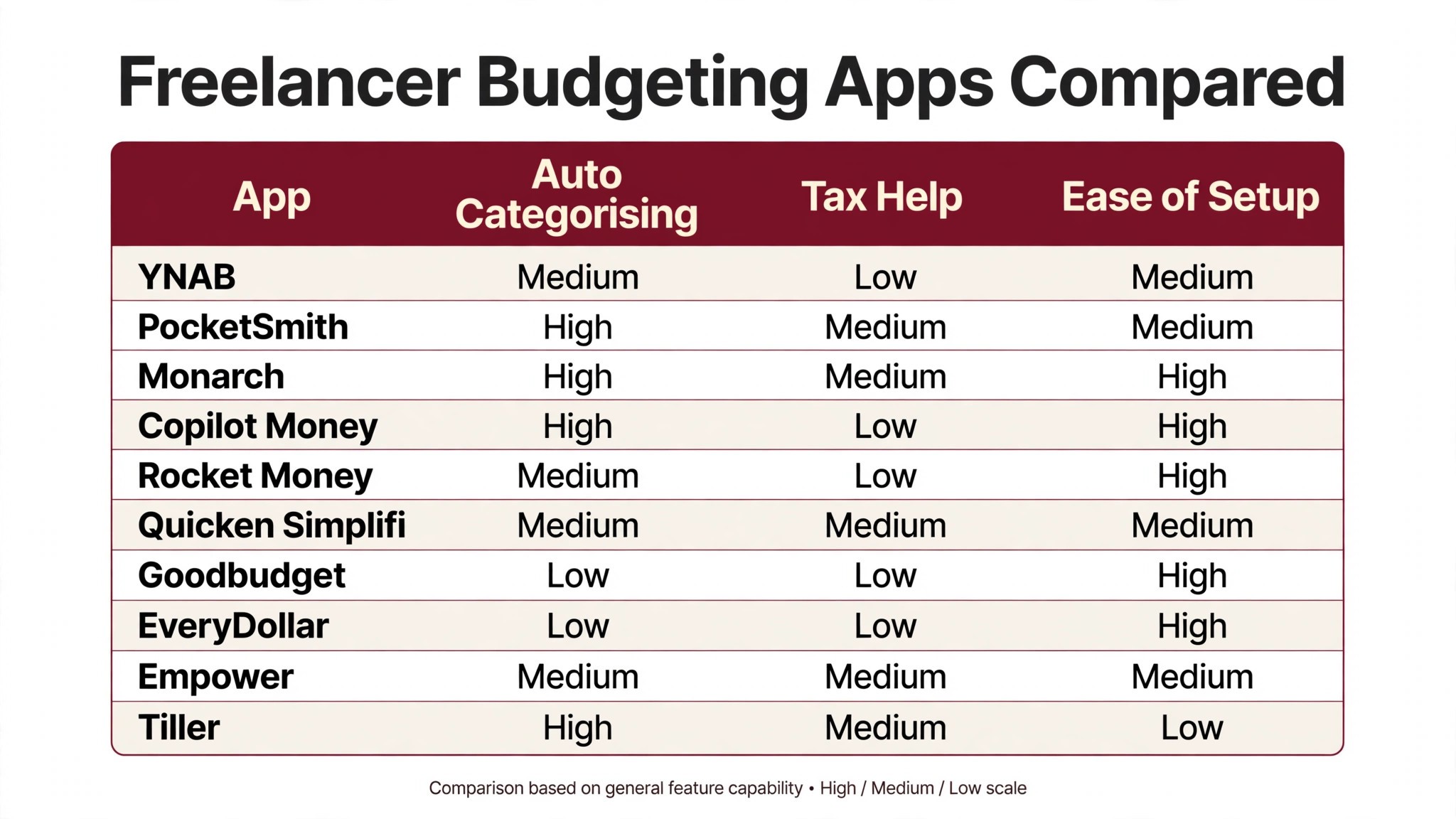
The table below compresses our scoring into a single view, with each app reduced to its price, its natural fit and the strength that earned its place. The best ai budgeting apps for freelancers are not always the most automated, and the table shows why. YNAB leads on discipline and forecasting, while Goodbudget wins on simplicity for freelancers who want a plain envelope system that just works.
| Tool | Starting price | Best for | Standout strength |
|---|---|---|---|
| YNAB | Pricing on the vendor site | Freelancers who want discipline | Give every dollar a job before you spend it |
| PocketSmith | Pricing on the vendor site | Freelancers who plan ahead | Six month cash flow forecasting |
| Monarch | Pricing on the vendor site | Freelancers who want the full picture | Net worth and budgeting in one view |
| Copilot Money | Pricing on the vendor site | Freelancers who want smart tracking | Clean design with strong auto categorisation |
| Rocket Money | Pricing on the vendor site | Freelancers who want to cut costs | Subscription tracking and bill negotiation |
| Quicken Simplifi | Pricing on the vendor site | Freelancers who want a simple plan | Spending plan that updates itself |
| Goodbudget | Free plan; paid plans on the vendor site | Envelope budgeters | Simple envelopes that work on any income |
| EveryDollar | Free plan; paid plans on the vendor site | Beginners who want a simple start | The easiest first budget here |
| Empower | Free plan; paid plans on the vendor site | Freelancers who invest too | Budgeting plus investment tracking |
| Tiller | Pricing on the vendor site | Spreadsheet lovers | Your budget in a live spreadsheet |
Use the table to cut the list to two or three candidates, then let the detail reviews decide between them. An app that scores High on auto categorising is only useful if it learns your spending correctly, and an app that scores High on tax help is only useful if it understands freelance tax in your country. The reviews below put a number on that balance wherever we could measure it.
One more filter before the detail. Check whether the app connects to your bank and your invoicing system, because a budgeting app that cannot see your real income and spending will always lag behind reality. A clean bank connection means transactions appear automatically and the budget stays current without manual entry, and that single connection is worth more than a dozen extra features.
Why the Best AI Budgeting Apps for Freelancers Beat a Spreadsheet
A spreadsheet works until the income stops being regular, and for a freelancer that moment arrives every year. A dry month, a late paying client, a tax bill that lands in the same week as the rent. The spreadsheet shows the numbers, but it does not warn you, and by the time the problem is visible it is usually too late to fix it cheaply.
A budgeting app replaces the spreadsheet with a system that looks forward rather than backward. It forecasts the next three months from your income pattern, shows which months will be tight, and tells you how much to set aside now so the lean month does not hurt. That forward view is the whole point, because a freelancer who can see the lean month coming can prepare for it, while one who cannot is surprised by it.
Tax is the second reason the app matters. A freelancer who does not set aside tax with every payment will face a bill they cannot pay, and the stress of that bill is the single biggest money worry in freelance life. The better apps in this ranking set aside a percentage automatically, show the tax pot growing with each payment, and make the quarterly bill a non event rather than a crisis. That automation is worth more than any forecasting chart.
The third reason is spending awareness. A freelancer who sees exactly where the money goes, with categories that update automatically, makes better decisions without trying. The daily coffee, the subscription that nobody uses, the software tool that seemed essential in January and is untouched by June. The app does not judge the spending, it simply shows it, and that visibility is usually enough to change it.
There is also a pricing argument that freelancers discover only after tracking for a few months. A freelancer who knows their true monthly costs, including tax, insurance and the quiet months, can set a day rate that actually covers them, rather than one that feels right. That rate is often higher than the freelancer expected, and the difference is the margin between a sustainable practice and one that slowly runs out of money.
The final reason is peace of mind. A freelancer who can open an app and see that the rent is covered, the tax is set aside and the next month is forecast is a freelancer who can focus on the work instead of the money. That calm is the real product, and the budget is just the mechanism that produces it.
One more benefit only appears after a few months of steady budgeting. The data shows which clients pay late, which months are always thin, and which kinds of work actually make money after costs. That pattern is worth more than any single forecast, because it lets the freelancer shape the practice around the work that pays, and that is a decision no spreadsheet alone can make.
How We Scored Every Budgeting App
We ran each app through the same six months of freelance income, with three clients, two dry months and a quarterly tax bill. The best ai budgeting apps for freelancers were scored on five measures that matter to a freelancer rather than a vendor.
- Income forecasting, measured by how accurately each app predicted the cash position three months ahead, and how clearly it showed the lean months before they arrived.
- Tax handling, judged by how easily the app set aside tax with each payment, showed the tax pot growing, and prepared the freelancer for the quarterly bill.
- Auto categorisation, measured by how accurately the app categorised a month of real freelance spending without manual correction, and how quickly it learned from corrections.
- Setup speed, timed from account creation to a working budget with the bank connected and the first month of spending categorised.
- Daily usability, judged by how long it took to check the budget each morning, record a cash expense, and see whether the month was on track.
Each measure carried equal weight except income forecasting, which counted double, because a budgeting app that cannot forecast irregular income is not a budgeting app for freelancers. Apps were scored out of 100, and the ranking below reflects the combined score. Where two apps tied, we broke the tie on tax handling, since the tax bill is the freelancer biggest financial risk.
We also checked the reporting, because a freelancer needs to see profit by client, spending by category and the trend over time, not just a balance. The best apps in this ranking show those numbers clearly, while the weakest need a spreadsheet to make sense of the data. That reporting gap matters more as the freelance practice grows.
Best Pick by Job
A single winner does not fit every freelancer, so we matched each common situation to the app that scored highest for that job. The best ai budgeting apps for freelancers for a designer look different from the right pick for a writer with a dozen small clients, and the table below makes that split clear.
| Job | Best pick | Why it wins |
|---|---|---|
| Wants discipline | YNAB | Give every dollar a job before you spend it |
| Plans six months ahead | PocketSmith | The clearest long range cash flow forecast |
| Wants the full picture | Monarch | Net worth and budgeting in one view |
| Wants smart tracking | Copilot Money | Clean design with strong auto categorisation |
| Wants to cut costs | Rocket Money | Finds subscriptions and negotiates bills |
| Wants a simple plan | Quicken Simplifi | Spending plan that updates itself |
| Envelope budgeter | Goodbudget | Simple envelopes that work on any income |
| Complete beginner | EveryDollar | The easiest first budget here |
| Invests as well | Empower | Budgeting plus investment tracking |
| Loves spreadsheets | Tiller | Your budget in a live spreadsheet |
If your situation does not match a row exactly, take the closest one and read that review first. The gap between neighbouring apps is smaller than the gap between a budget you check daily and one you avoid, so fit to your habits matters more than a few points on a scorecard.
One habit deserves a mention. The freelancers who get the most from any app in this ranking check their budget for two minutes every morning, moving money between categories before the day starts. That short routine is what turns the app into a habit, and no feature can replace it.
The 10 Tools in Detail
Each review below runs to the same template. We describe what the app does best, where it falls short, and the freelancer who will get the most from it. Where the vendor site published a price we could check, it is quoted; where pricing sits behind a sales conversation, it is marked as vendor priced.
1. YNAB
YNAB, short for You Need A Budget, leads because it changes behaviour rather than just recording it. Its rule is simple, give every dollar a job before you spend it, and that discipline is exactly what irregular freelance income needs. The forecasting shows the lean months clearly, and the age of money metric shows whether you are living on last month income or this week panic.
The best ai budgeting apps for freelancers need tax handling that matches their budgeting, and YNAB is good rather than best here. Tax set aside is manual, through categories rather than automation, and a freelancer who wants automatic tax pots should look at PocketSmith or a dedicated tax tool. For most freelancers, though, the discipline YNAB teaches is worth more than the automation it lacks.
Our verdict. The strongest budgeting discipline here, and the best all rounder for freelancers who want control.
2. PocketSmith
PocketSmith is the forecasting specialist, and it shows the next six months of cash flow with a clarity no other app in this ranking matches. It projects income and spending forward, shows the lean months in red before they arrive, and lets a freelancer test what happens if a client pays late. For a freelancer whose main worry is the dry month, that forward view is the whole product.
The trade off is complexity. The interface is denser than YNAB or Monarch, and the setup takes longer because the forecasting needs good data to work from. A freelancer who wants a simple daily budget may find it heavy, but one who plans ahead will find it indispensable.
Our verdict. The clearest long range forecast here, ideal for freelancers who plan ahead.
3. Monarch
Monarch is the full picture app, combining budgeting with net worth, investments and goals in one clean view. It replaced Mint for many users, and the design is the most polished in this ranking. A freelancer who wants to see the whole financial life, not just the monthly budget, will find it the most satisfying app to open each morning.
The trade off is that the freelance specific features are lighter than the leaders. Tax handling is basic, and the forecasting is good rather than best in class. It is a beautiful general budgeting app that works well for freelancers, rather than a freelancer specific tool, and a freelancer with complex tax needs should look elsewhere.
Our verdict. The most polished full picture app here, ideal for freelancers who want everything in one view.
4. Copilot Money
Copilot Money is the smart tracking app, with automatic categorisation that learns quickly and a design that makes the budget pleasant to check. It connects to the bank, categorises spending with impressive accuracy, and shows the month at a glance without clutter. For a freelancer who wants the app to do the work, it is the most effortless option here.
The limitation is availability and depth. Copilot is built for the United States market, and its forecasting is lighter than PocketSmith or YNAB. A freelancer outside the United States should check availability first, and one who needs deep forecasting should look at the leaders.
Our verdict. The most effortless tracking here, with categorisation that learns fast.
5. Rocket Money
Rocket Money, formerly Truebill, is the cost cutting app. It finds subscriptions, shows what they cost over a year, and can negotiate bills on your behalf. For a freelancer who suspects money is leaking through forgotten subscriptions, it is the fastest way to find the leaks and plug them.
The trade off is that Rocket Money is not a full budgeting app. Its budgeting features are lighter than YNAB or Monarch, and the forecasting is basic. It works best as a companion to a proper budget, finding the savings that the budget then protects. Used alone, it leaves the freelancer without the forward view that matters most.
Our verdict. The best subscription finder here, ideal as a companion to a full budget.
6. Quicken Simplifi
Quicken Simplifi is the simple plan app, with a spending plan that updates itself as income and spending change. It is the easiest of the full featured apps to live with, because the plan adjusts without the freelancer doing the maths. For a freelancer who wants a budget that maintains itself, it is the most hands off option here.
The limitation is depth. The forecasting is good but not as detailed as PocketSmith, and the customisation is lighter than YNAB. A freelancer who wants fine control will find it restrictive, but one who wants a reliable plan without effort will find it ideal.
Our verdict. The most hands off budget here, ideal for freelancers who want a plan that maintains itself.
7. Goodbudget
Goodbudget is the envelope system, and it is the simplest concept in this ranking. Money is divided into envelopes for rent, food, tax and fun, and spending comes out of the envelope until it is empty. The system works on any income, regular or irregular, because the envelope does not care when the money arrived, only how much is left.
The trade off is automation. Goodbudget is deliberately manual, with no bank connection on the free plan, and the envelope system requires the freelancer to move money by hand. That manual work is the point for some people, because it forces attention, but a freelancer who wants automation should look elsewhere.
Our verdict. The simplest envelope system here, ideal for freelancers who like manual control.
8. EveryDollar
EveryDollar is the easiest first budget in this ranking. It is built on the zero based method, where every dollar is assigned before the month starts, and the interface is the plainest here. A freelancer who has never budgeted before can be up and running in an afternoon, and the learning curve is the shortest of any app in this ranking.
The limitation is depth. The free plan is manual, the premium plan adds bank connection, and the forecasting is basic compared with the leaders. It is an excellent first budget that a growing freelancer will outgrow, but the habit it teaches is worth more than the features it lacks.
Our verdict. The easiest first budget here, ideal for freelancers who have never budgeted.
9. Empower
Empower, formerly Personal Capital, is the investment app that also budgets. It tracks net worth, investments and retirement alongside the monthly budget, and the dashboard shows the whole financial life in one view. A freelancer who invests as well as earns will find it the most complete picture in this ranking.
The budgeting itself is lighter than the leaders, with less focus on forecasting and tax. It is a wealth tracking tool with a budget attached, rather than a budgeting tool with wealth tracking, and a freelancer whose main problem is irregular income should start higher up this list.
Our verdict. The best budgeting plus investing combination, ideal for freelancers who invest.
10. Tiller
Tiller is the spreadsheet app, and it is the only one here that puts the budget in a live spreadsheet. It feeds bank transactions into Google Sheets or Excel automatically, and the freelancer builds the budget in the spreadsheet they already know. For a freelancer who loves spreadsheets and wants total control, it is the most flexible option here.
The trade off is that Tiller assumes the freelancer is comfortable building their own budget. There is no ready made app experience, and the setup takes longer than a standard app. It is a power user tool, and a freelancer who wants a finished app should look elsewhere.
Our verdict. The most flexible option here, ideal for freelancers who love spreadsheets.
A Four Week Budget Reset for Irregular Income
A budget reset works when it is done in stages, and four weeks is the right length for a freelancer with irregular income. The best ai budgeting apps for freelancers still need a human to make the decisions, and the plan below builds the habit alongside the numbers.
Week one is the truth. Connect the bank, categorise the last three months of spending, and look at the real numbers without flinching. Most freelancers find they spend more than they thought on food, subscriptions and the small daily costs that never feel like spending. That first look is uncomfortable, and it is the most valuable week of the reset.
Week two is the tax pot. Open a separate account for tax, set the percentage aside with every payment, and move the money the moment it arrives rather than at the end of the month. The tax pot should grow with each invoice, so the quarterly bill is a transfer rather than a crisis. This single habit removes the biggest source of freelance money stress.
Week three is the forecast. Turn on the forecasting, look at the next three months, and mark the lean ones. If a lean month is coming, decide now what to cut and what to chase, rather than waiting for the month to arrive. A freelancer who prepares for the lean month in advance rarely suffers from it, because the preparation is the whole difference.
Week four is the routine. Set a two minute morning check, a weekly review on Friday, and a monthly review on the first of the month. The morning check moves money between categories, the weekly review fixes the mistakes, and the monthly review sets the plan for the next month. That routine is what turns the app into a habit, and the habit is what keeps the budget alive.
The routine is the whole secret. A budget that is checked daily stays accurate, and an accurate budget is one the freelancer trusts. Put the morning check on the calendar, protect it like a client meeting, and let the habit compound across the year.
Frequently Asked Questions
Freelancers ask the same questions before every budgeting app change, so we answered the most common ones here. The best ai budgeting apps for freelancers answer these in their help centres, but the plain answers below are faster to judge an app against.
How much should a freelancer set aside for tax?
It depends on the country and the income, but 25 to 30 percent of each payment is a safe starting point for most freelancers in the United States. Set the money aside the moment the payment arrives, in a separate account, so it is never confused with spending money. Adjust the percentage after the first tax return, when the real rate is known.
Can a budgeting app handle irregular income?
Yes, and the better apps in this ranking are built for it. They forecast from your income pattern, show the lean months before they arrive, and let you budget from the money you actually have rather than the money you expect. The key is to budget from the lowest recent month rather than the average, so the plan survives the dry spells.
Do I need to connect my bank account?
A bank connection makes the app far more useful, because transactions appear automatically and the budget stays current without manual entry. If the connection worries you, start with manual entry for a month and connect later, once the habit is formed. The app is only as good as the data it sees, and manual entry is the reason most budgets die.
What is the difference between YNAB and a normal budget?
YNAB assigns every dollar a job before you spend it, and only lets you budget the money you actually have. A normal budget often plans from expected income, which breaks the moment a payment is late. That single difference, budgeting real money rather than expected money, is why YNAB works so well for irregular freelance income.
Should I use one app or several?
One app for the budget, and a second only if it does a specific job better. A freelancer who uses YNAB for the budget and Rocket Money for subscription hunting gets the best of both, but a freelancer who runs three budgeting apps will use none of them properly. Pick one, commit to it for three months, and judge it on the habit rather than the features.
How long does it take for budgeting to feel natural?
About four weeks, which is why the reset plan in this guide is four weeks long. The first week is uncomfortable, the second is mechanical, and by the fourth the morning check is a habit. A freelancer who survives the first month rarely goes back, because the calm that follows is worth more than the effort it took.
The Final Balance Before You Choose
The decision comes down to three numbers, and they are all measurable in a trial. The best ai budgeting apps for freelancers prove themselves on forecast accuracy, tax set aside and the time the budget takes each day, and a four week trial with your real income will show all three. YNAB wins our ranking on the combined score, but the right app for your practice is the one that moves your worst number the furthest.
Run the trial with your real bank account and your real income, and judge the app on the morning check rather than the demo. If the check takes two minutes and the forecast is honest, the system is working. If the check takes twenty minutes and the numbers feel wrong, the app is fighting you rather than helping you. Pick the app that makes the truth easy to see, protect the morning check, and let the calmer money pay for the subscription many times over.