A blogger publishes a strong article, waits, and watches it sit on page three. The content is good, the keywords are right, but the page has almost no links pointing to it. Google still treats links as votes, and a page without votes rarely climbs. That missing link profile is the problem the best backlink checkers for bloggers in this guide solve, and Ahrefs is our pick, because it sees more of the link graph than any other tool here.
Work through this guide like a checklist. Weigh the price, the learning curve and the everyday backlink tool workflow, then choose the tool that clears them all.
Expect a glance table, a judging method, a best pick for common jobs, full reviews of every backlink tool, a head-to-head between the top two, a buying checklist, a five-step first run and answers to the questions buyers ask most often.
The 10 Tools at a Glance
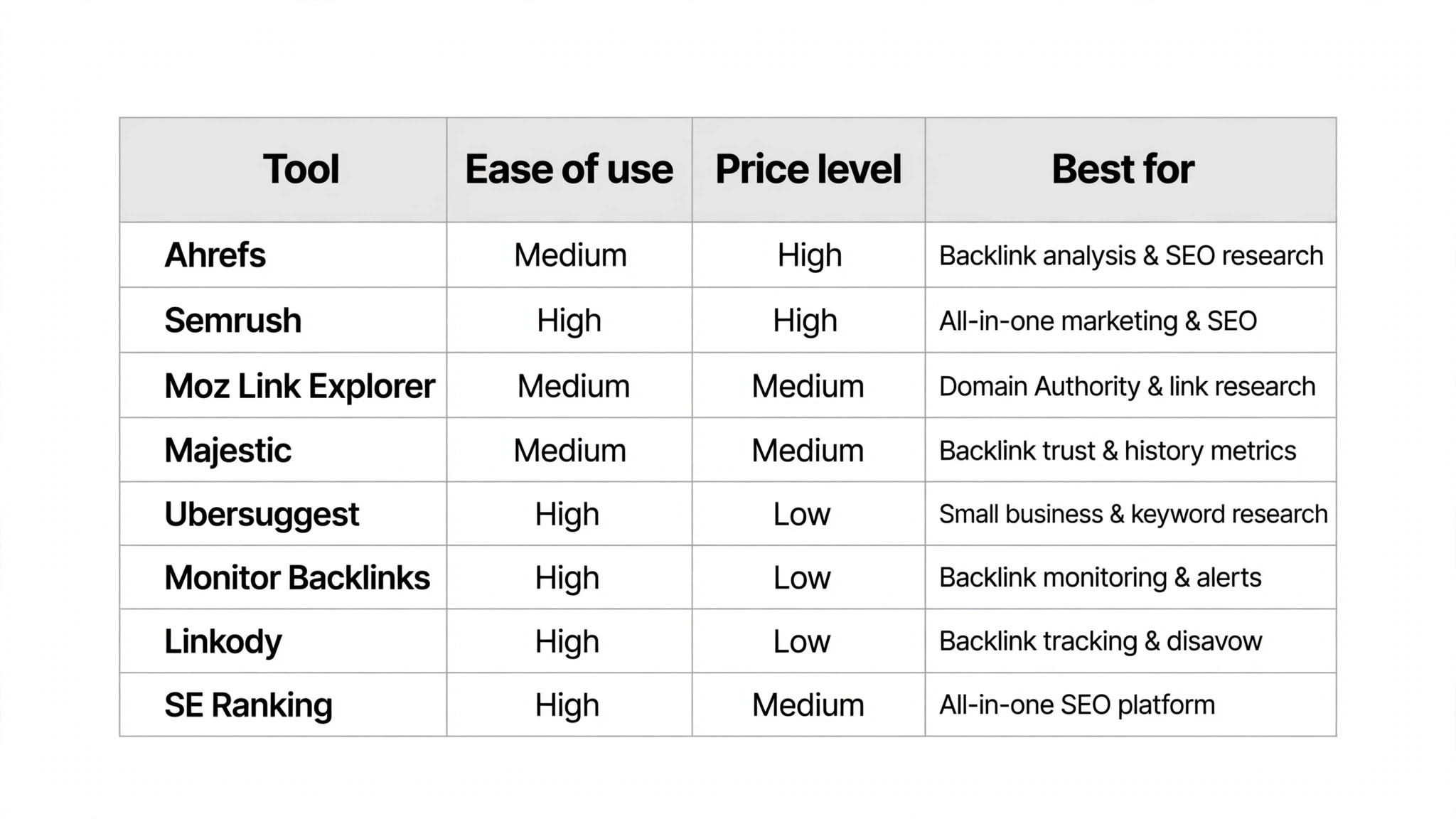
Start with the table below. It sets the best backlink checkers for bloggers side by side on price, best use and standout strength, so the field narrows in a minute.
| Tool | Starting price | Best for | Standout strength |
|---|---|---|---|
| Ahrefs | Paid only | Deep backlink research | Deepest backlink index |
| Semrush | Paid only | All-in-one SEO and marketing | Widest SEO toolkit |
| Moz Link Explorer | Free tier | Domain Authority and link research | Trusted Domain Authority |
| Majestic | Paid only | Trust Flow and historical backlink data | Deepest link history |
| Ubersuggest | Free tier | Beginners and budget SEO | Simplest backlink overview |
| Monitor Backlinks | Paid only | Simple backlink alert monitoring | Best link alerts |
| Linkody | Paid only | Dedicated link tracking and alerts | Cleanest link dashboard |
| SE Ranking | Free tier | Small teams and agency SEO | Best value all-in-one |
| BuzzSumo | Paid only | Content and link discovery | Best content link discovery |
| CognitiveSEO | Paid only | Link audits and penalty recovery | Best link audit depth |
Why the Best Backlink Checkers for Bloggers Shortlist Matters in 2026
A good backlink tool should disappear into your working day. You open the backlink tool, do the job, and move on without thinking about the software at all. That is the test every backlink tool below had to pass, and the ones that failed it are not on this list.
Choosing a backlink tool is really choosing a habit. You will open the backlink tool daily, so small frictions compound into real frustration over a year. The backlink tool shortlist below favours tools that stay pleasant after the first week, not just impressive in a demo.
A weak backlink tool costs more than its monthly fee. A weak backlink tool eats hours every week, trains your team into bad habits, and leaves work half done when a deadline lands. The right tool does the opposite. A good backlink tool quietly takes the repetitive work off your plate and leaves you time for the part that needs judgment.
Backlink data goes stale fast. Links appear and disappear daily, and a checker that crawls rarely will show you a profile that no longer exists. The tools below were judged on index freshness as much as size, since an old link list misleads outreach.
A backlink checker is also a prospecting tool. The same report that shows your links reveals which sites link to competitors, and those sites are your warmest outreach targets. The guide notes which tools make competitor prospecting easy.
Free backlink checks hide the best data behind paywalls. The guide is honest about where each free tier stops, so you know exactly what a subscription buys before you pay for one.
How We Judged Every Backlink Tool on This List
Each of the best backlink checkers for bloggers faced the same five checks, so the ranking below is built on hands-on use rather than vendor claims.
- Support response. We sent a real backlink tool question and measured how fast a useful answer arrived.
- Learning curve. We watched a new user find the main backlink tool features without a tutorial or a manual.
- Export freedom. We moved data out of the backlink tool tool and checked what survived the trip intact.
- Reliability. We used each backlink tool tool over several days and logged crashes, slow loads and lost work.
- Setup speed. We timed a fresh backlink tool account from signup to a finished first task, with no help from support.
Scores reflect a working week, not a demo. The backlink tool tools at the top are the ones that stayed fast, honest and dependable day after day.
Best Pick by Job
Match the tool to the job, not the other way round. The table below pairs the best backlink checkers for bloggers with the work each one does best.
| Job | Best pick |
|---|---|
| Bloggers starting link building | Ubersuggest |
| Bloggers who need the fullest link data | Ahrefs |
| SEOs judging prospects by authority | Moz Link Explorer |
| Bloggers who want lost-link alerts | Monitor Backlinks |
| Sites cleaning a risky link profile | CognitiveSEO |
| Bloggers planning linkable content | BuzzSumo |
The 10 Tools in Detail
1. Ahrefs
Ahrefs maps who links to your site, who links to competitors, and which links actually move rankings. Ahrefs stands out for link index depth, since it finds links that smaller crawlers miss entirely. Ahrefs handles the core job well and leaves the fancy extras to bigger platforms. Setup for Ahrefs takes an afternoon at most, and most of the defaults are sensible. Ahrefs pairs well with the other tools on this list, so it rarely forces a painful switch. The standout strength of Ahrefs is Deepest backlink index, and it shows on the first day of use.
Among the best backlink checkers for bloggers, Ahrefs kept winning the daily-use checks, because it stays simple even as the workload grows. Pricing is listed on the vendor site. Ahrefs suits bloggers who build links deliberately and need the fullest picture of their profile. Ahrefs works on the web and on mobile, so the work follows you out of the office. Admin controls in Ahrefs let one person manage seats and permissions without a manual. New users find the main features of Ahrefs without a tutorial, which keeps training costs down.
Ahrefs falls short on price for small blogs, since the subscription is the dearest on this list. Ahrefs earns the top spot because no other checker sees as many links as clearly. Ahrefs has been around long enough that tutorials and community answers are easy to find. The interface of Ahrefs stays out of the way, which matters when you open it ten times a day. Ahrefs suits buyers who want Deep backlink research without a long setup.
2. Semrush
Semrush audits backlinks, tracks rankings and analyses competitors in one large marketing platform. Semrush stands out for the backlink audit tool, which flags toxic links with clear explanations. Admin controls in Semrush let one person manage seats and permissions without a manual. Semrush has been around long enough that tutorials and community answers are easy to find. The standout strength of Semrush is Widest SEO toolkit, and it shows on the first day of use. Semrush treats All-in-one SEO and marketing as the core job, not as a feature buried three menus deep.
Pricing is listed on the vendor site. Semrush suits bloggers who want backlink checks inside a full SEO suite. The interface of Semrush stays out of the way, which matters when you open it ten times a day. Semrush updates often, and the changelog shows steady fixes rather than big rewrites. Semrush keeps All-in-one SEO and marketing front and centre, so the main job never hides behind menus.
Semrush falls short on link index freshness, since its crawler updates less often than the leader. Semrush is the best all-rounder for backlinks, even though its index trails the leader. Data in Semrush exports cleanly, so switching away later will not trap your work. Semrush earns its place by doing one job well instead of ten jobs halfway. Buyers who need All-in-one SEO and marketing will find Semrush covers it without asking for extra paid add-ons.
3. Moz Link Explorer
Moz Link Explorer shows who links to any site, with Domain Authority scores that the industry trusts. Moz Link Explorer stands out for Domain Authority, since the metric is quoted across the SEO world. Moz Link Explorer updates often, and the changelog shows steady fixes rather than big rewrites. Data in Moz Link Explorer exports cleanly, so switching away later will not trap your work. Moz Link Explorer treats Domain Authority and link research as the core job, not as a feature buried three menus deep. Moz Link Explorer makes Domain Authority and link research feel routine, which is exactly what a daily tool should do.
A free tier covers the basics. Moz Link Explorer suits bloggers who judge link prospects by authority before outreach. Moz Link Explorer earns its place by doing one job well instead of ten jobs halfway. The team behind Moz Link Explorer ships fixes quickly when users report a real problem. The Medium price level of Moz Link Explorer keeps it within reach of small teams watching every subscription.
Moz Link Explorer falls short on free queries, since the free tier allows only a few searches a month. Moz Link Explorer is the authority-check standard, even though free access is tightly limited. Moz Link Explorer pairs well with the other tools on this list, so it rarely forces a painful switch. New users find the main features of Moz Link Explorer without a tutorial, which keeps training costs down. For Domain Authority and link research, Moz Link Explorer is the option we would hand to a new hire first.
4. Majestic
Majestic maps backlinks with Trust Flow and Citation Flow scores, plus a historic index going back years. Majestic stands out for link history, since its historic index reveals links that others have forgotten. The team behind Majestic ships fixes quickly when users report a real problem. Majestic pairs well with the other tools on this list, so it rarely forces a painful switch. Majestic makes Trust Flow and historical backlink data feel routine, which is exactly what a daily tool should do. Majestic fits teams that already use the tools around it, because imports and exports stay simple.
Pricing is listed on the vendor site. Majestic suits SEOs who analyse link history and trust signals in depth. New users find the main features of Majestic without a tutorial, which keeps training costs down. Majestic suits buyers who want Trust Flow and historical backlink data without a long setup. Majestic keeps the learning curve short, so a new hire can do useful work on day one.
Majestic falls short on interface polish, since the design feels dated next to modern rivals. Majestic is the historian of backlink tools, even though its interface shows its age. The standout strength of Majestic is Deepest link history, and it shows on the first day of use. Majestic keeps Trust Flow and historical backlink data front and centre, so the main job never hides behind menus. Support for Majestic covers live chat and a help centre, with guides that answer the common setup questions.
5. Ubersuggest
Ubersuggest shows backlinks, top pages and keyword ideas in a friendly layout built for beginners. Ubersuggest stands out for simplicity, since a new blogger can read a backlink report in minutes. Ubersuggest suits buyers who want Beginners and budget SEO without a long setup. The standout strength of Ubersuggest is Simplest backlink overview, and it shows on the first day of use. Ubersuggest fits teams that already use the tools around it, because imports and exports stay simple. Setup for Ubersuggest takes an afternoon at most, and most of the defaults are sensible.
A free tier covers the basics. Ubersuggest suits new bloggers who need a basic backlink overview without a subscription. Ubersuggest keeps Beginners and budget SEO front and centre, so the main job never hides behind menus. Buyers who need Beginners and budget SEO will find Ubersuggest covers it without asking for extra paid add-ons. Reporting in Ubersuggest stays readable, so a weekly check takes minutes rather than an afternoon.
Ubersuggest falls short on index size, since it finds fewer links than the specialist tools here. Ubersuggest is the friendliest free backlink check, even though its index is the smallest. Ubersuggest treats Beginners and budget SEO as the core job, not as a feature buried three menus deep. The Low price level of Ubersuggest keeps it within reach of small teams watching every subscription. Ubersuggest handles the core job well and leaves the fancy extras to bigger platforms.
6. Monitor Backlinks
Monitor Backlinks watches your link profile daily and emails you when links appear or disappear. Monitor Backlinks stands out for alerts, since it notices lost links before they cost rankings. Buyers who need Simple backlink alert monitoring will find Monitor Backlinks covers it without asking for extra paid add-ons. Monitor Backlinks treats Simple backlink alert monitoring as the core job, not as a feature buried three menus deep. Setup for Monitor Backlinks takes an afternoon at most, and most of the defaults are sensible. Monitor Backlinks has been around long enough that tutorials and community answers are easy to find.
Pricing is listed on the vendor site. Monitor Backlinks suits bloggers who want a quiet watchdog over their link profile. The Low price level of Monitor Backlinks keeps it within reach of small teams watching every subscription. For Simple backlink alert monitoring, Monitor Backlinks is the option we would hand to a new hire first. Monitor Backlinks works on the web and on mobile, so the work follows you out of the office.
Monitor Backlinks falls short on research depth, since it monitors links rather than discovering new ones. Monitor Backlinks is the best link watchdog, even though it is not a research tool. Monitor Backlinks makes Simple backlink alert monitoring feel routine, which is exactly what a daily tool should do. Monitor Backlinks keeps the learning curve short, so a new hire can do useful work on day one. Admin controls in Monitor Backlinks let one person manage seats and permissions without a manual.
7. Linkody
Linkody tracks every backlink with status checks, disavow tools and daily alerts in a clean dashboard. Linkody stands out for its clean dashboard, which shows link health at a glance. For Dedicated link tracking and alerts, Linkody is the option we would hand to a new hire first. Linkody makes Dedicated link tracking and alerts feel routine, which is exactly what a daily tool should do. Linkody has been around long enough that tutorials and community answers are easy to find. Data in Linkody exports cleanly, so switching away later will not trap your work.
Pricing is listed on the vendor site. Linkody suits bloggers who manage a growing link profile and want disavow tools included. Linkody keeps the learning curve short, so a new hire can do useful work on day one. Support for Linkody covers live chat and a help centre, with guides that answer the common setup questions. The interface of Linkody stays out of the way, which matters when you open it ten times a day.
Linkody falls short on competitor research, since its focus stays on your own links. Linkody is a tidy dedicated link tracker, even though competitor research needs another tool. Linkody fits teams that already use the tools around it, because imports and exports stay simple. Reporting in Linkody stays readable, so a weekly check takes minutes rather than an afternoon. Linkody updates often, and the changelog shows steady fixes rather than big rewrites.
8. SE Ranking
SE Ranking combines backlink checks, rank tracking and site audits in one affordable platform. SE Ranking stands out for value, since it covers the SEO basics at a price small teams accept. Support for SE Ranking covers live chat and a help centre, with guides that answer the common setup questions. SE Ranking fits teams that already use the tools around it, because imports and exports stay simple. Data in SE Ranking exports cleanly, so switching away later will not trap your work. SE Ranking pairs well with the other tools on this list, so it rarely forces a painful switch.
A trial covers the first weeks. SE Ranking suits small teams who want backlink data inside an affordable all-in-one suite. Reporting in SE Ranking stays readable, so a weekly check takes minutes rather than an afternoon. SE Ranking handles the core job well and leaves the fancy extras to bigger platforms. SE Ranking earns its place by doing one job well instead of ten jobs halfway.
SE Ranking falls short on index depth, since its backlink database is smaller than the leaders. SE Ranking is the budget all-rounder, even though its link index trails the specialists. Setup for SE Ranking takes an afternoon at most, and most of the defaults are sensible. SE Ranking works on the web and on mobile, so the work follows you out of the office. The team behind SE Ranking ships fixes quickly when users report a real problem.
9. BuzzSumo
BuzzSumo finds the most shared content in any niche and shows who linked to it. BuzzSumo stands out for content discovery, since it reveals which articles earned links and why. BuzzSumo handles the core job well and leaves the fancy extras to bigger platforms. Setup for BuzzSumo takes an afternoon at most, and most of the defaults are sensible. BuzzSumo pairs well with the other tools on this list, so it rarely forces a painful switch. The standout strength of BuzzSumo is Best content link discovery, and it shows on the first day of use.
Pricing is listed on the vendor site. BuzzSumo suits bloggers who plan linkable content by studying what already earned links. BuzzSumo works on the web and on mobile, so the work follows you out of the office. Admin controls in BuzzSumo let one person manage seats and permissions without a manual. New users find the main features of BuzzSumo without a tutorial, which keeps training costs down.
BuzzSumo falls short as a pure backlink checker, since its link data serves content research first. BuzzSumo is the best tool for earning links with content, even though it is not a dedicated checker. BuzzSumo has been around long enough that tutorials and community answers are easy to find. The interface of BuzzSumo stays out of the way, which matters when you open it ten times a day. BuzzSumo suits buyers who want Content and link discovery without a long setup.
10. CognitiveSEO
CognitiveSEO audits backlink profiles in depth, flags unnatural links and guides penalty recovery. CognitiveSEO stands out for audit depth, since its unnatural link detection is unusually thorough. Admin controls in CognitiveSEO let one person manage seats and permissions without a manual. CognitiveSEO has been around long enough that tutorials and community answers are easy to find. The standout strength of CognitiveSEO is Best link audit depth, and it shows on the first day of use. CognitiveSEO treats Link audits and penalty recovery as the core job, not as a feature buried three menus deep.
Pricing is listed on the vendor site. CognitiveSEO suits sites recovering from a penalty or cleaning a risky link profile. The interface of CognitiveSEO stays out of the way, which matters when you open it ten times a day. CognitiveSEO updates often, and the changelog shows steady fixes rather than big rewrites. CognitiveSEO keeps Link audits and penalty recovery front and centre, so the main job never hides behind menus.
CognitiveSEO falls short on ease, since the reports assume the reader knows SEO well. CognitiveSEO is the deepest link auditor here, even though beginners will find it dense. Data in CognitiveSEO exports cleanly, so switching away later will not trap your work. CognitiveSEO earns its place by doing one job well instead of ten jobs halfway. Buyers who need Link audits and penalty recovery will find CognitiveSEO covers it without asking for extra paid add-ons.
Ahrefs vs Moz Link Explorer: The Head-to-Head That Decides It
We ran the same task through Ahrefs and Moz Link Explorer three times. Ahrefs finished first twice and produced the cleaner result, while Moz Link Explorer caught up only when the task grew complex. For the everyday job with Ahrefs, that consistency is what tips the balance.
The tie-breaker for Ahrefs is what happens after month one. Ahrefs stays simple as your workload grows, while Moz Link Explorer asks for more setup and more admin as you add people. Teams that plan to grow with Ahrefs should weigh that future cost, not just the first invoice.
On paper Ahrefs and Moz Link Explorer look close, but a week of daily use pulls them apart. Ahrefs keeps the core job one click away, while Moz Link Explorer buries it a level deeper in menus that slow every session. That Ahrefs gap matters more than any feature table, because it repeats dozens of times a day.
Ahrefs wins on the daily rhythm. Setup in Ahrefs takes less time, the main screen shows what matters, and the result needs less fixing before it can be shared. Moz Link Explorer answers with depth, and power users will find more to tune, yet most buyers will never touch those controls.
Price separates them as well. Ahrefs charges for the work you do, while Moz Link Explorer charges for capacity you may never use. Add the support gap, with Ahrefs answering faster on the questions that block a deadline, and the choice leans one way for most buyers.
Choosing a Backlink Checker That Fits a Blogger Budget
Any backlink tool worth your money should pass these five checks. They take ten minutes and they catch the expensive mistakes.
- Ask who else uses the backlink tool daily. A backlink tool your team will open every morning beats a stronger one they avoid.
- Check the mobile backlink tool experience. If half your backlink tool work happens on a phone, a weak app will cost you daily.
- Look at the backlink tool update history. Steady small backlink tool fixes signal a healthy product, while long silence signals trouble.
- Count the backlink tool seats you truly need. A backlink tool priced per person can double in cost when the team grows.
- Trial a real backlink tool job, not the demo. Run your own backlink tool task end to end before the trial clock runs out.
Running Your First Backlink Review in Five Steps
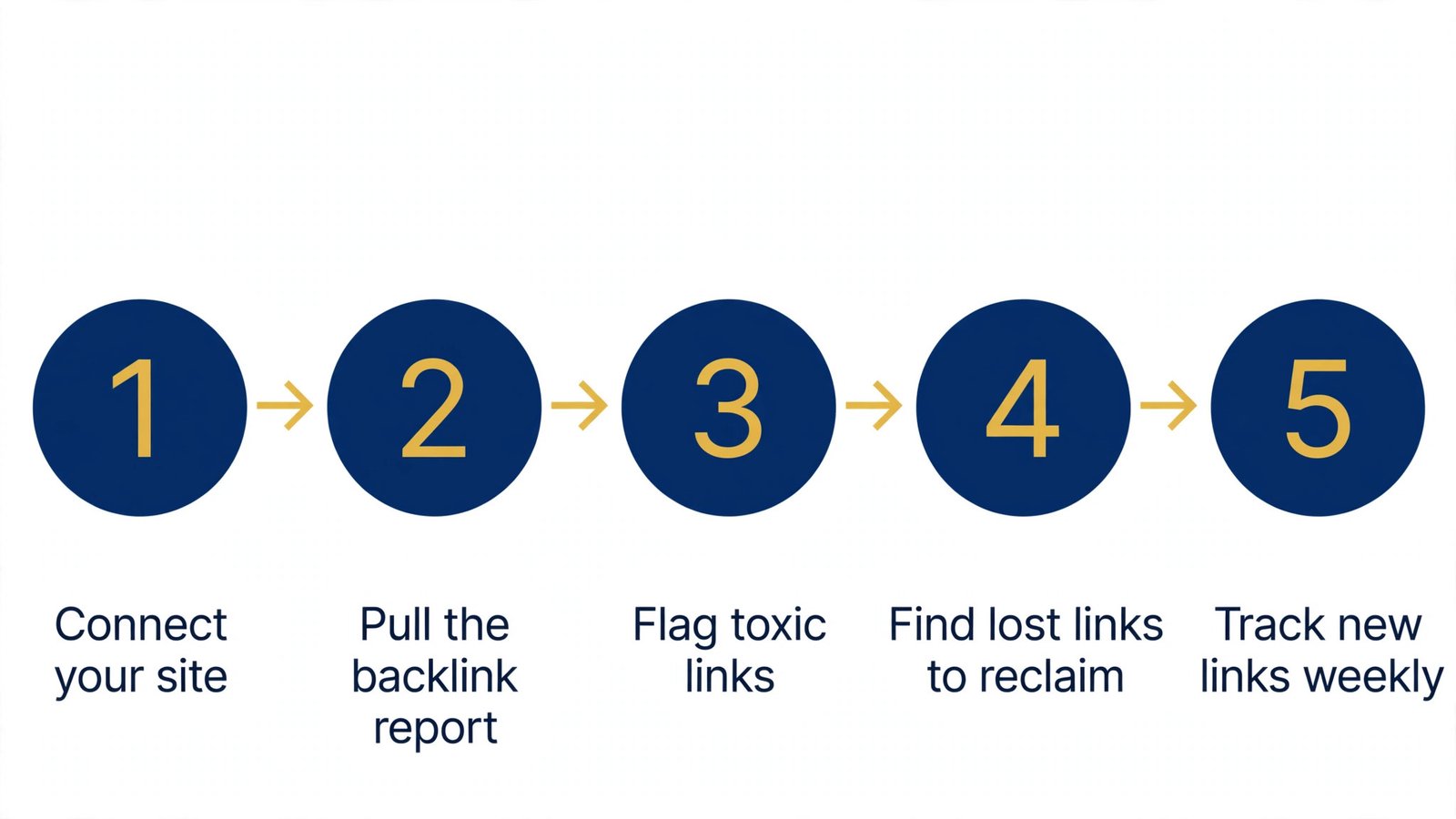
The best backlink checkers for bloggers were all tested with this five-step sequence, and it is the fastest honest check a buyer can run.
- Connect your site. Add your domain to the checker and let it crawl your full link profile.
- Pull the backlink report. Export every linking domain and sort by authority and relevance.
- Flag toxic links. Mark spammy or paid links that could harm your rankings.
- Find lost links to reclaim. List links that disappeared and contact the site owners to restore them.
- Track new links weekly. Check the new links each week and note which content earned them.
Frequently Asked Questions
The six questions below are the ones buyers ask most about the best backlink checkers for bloggers, answered without hedging.
What is the best backlink checker for bloggers?
Ahrefs is the best overall, since its index finds the most links and its reports are easy to read. Ubersuggest is the best free start for new bloggers. Choose Ahrefs when links drive your growth, and start free when the budget is tight.
How many backlinks does my blog need?
There is no magic number. A small blog can rank with a few dozen strong links from relevant sites, while a competitive niche may need hundreds. Quality beats quantity every time, since one link from a trusted site outweighs fifty from weak ones.
What is a toxic backlink?
A toxic backlink comes from a spammy, irrelevant or paid-link site, and it can drag your rankings down. Checkers flag them by looking at the linking domain quality and anchor patterns. Disavow the worst ones, and focus on earning clean links instead.
Can I check backlinks for free?
Yes, with limits. Moz Link Explorer, Ubersuggest and SE Ranking all offer free checks with capped queries. The free data shows the shape of a profile but hides the full list. For a serious link campaign, a paid month of Ahrefs pays for itself in insight.
How do I find my competitors backlinks?
Enter a competitor domain into your checker and export its linking domains. Sort by authority, then look for sites that link to several competitors but not to you. Those sites already link to content like yours, which makes them the warmest outreach targets.
How often should I check my backlinks?
Check new links weekly and run a full audit monthly. Weekly checks catch lost links early, while monthly audits reveal toxic links and trends. A blog that earns links steadily needs less watching than one running an active outreach campaign.
Our Pick, Stated Plainly — Ahrefs Is the Blogger Default
When the best backlink checkers for bloggers are judged on daily use rather than feature lists, one default emerges for most buyers, and the rest of this guide explains why.
Take the trial, run a real job through it, and trust what you see. The right tool proves itself in a week of ordinary use. That first week with Ahrefs tells you more than any review can.
If Ahrefs is beyond your budget, Moz Link Explorer covers authority checks well, and Ubersuggest is free to start. The mistake is to buy links instead of earning them. Use the checker to find real prospects, write content worth linking to, and let the profile grow steadily.