
A restaurant needs money at the worst possible moments. The walk-in fridge dies on a Friday, the landlord raises the rent, or a busy season arrives before the cash to staff it does. The best business loan tools for restaurants exist for those moments, and the difference between a good loan and a bad one is not the interest rate on the brochure, it is how the repayment behaves on a slow Tuesday in February.
Restaurants are a hard case for lenders. Revenue swings with seasons, weekends, and weather, and a fixed monthly payment that looks fine in December can choke the business in January. That is why the structure matters more than the headline rate. A line of credit, a revenue-based advance, and a term loan behave like three different products, even when the amounts look the same.
This guide compares eight financing options on restaurant criteria. How fast the money arrives, how repayment flexes with revenue, what credit score and revenue each lender requires, and what the real cost looks like over the life of the loan. Amounts and terms below come from current 2026 lender listings.
The 8 Tools at a Glance
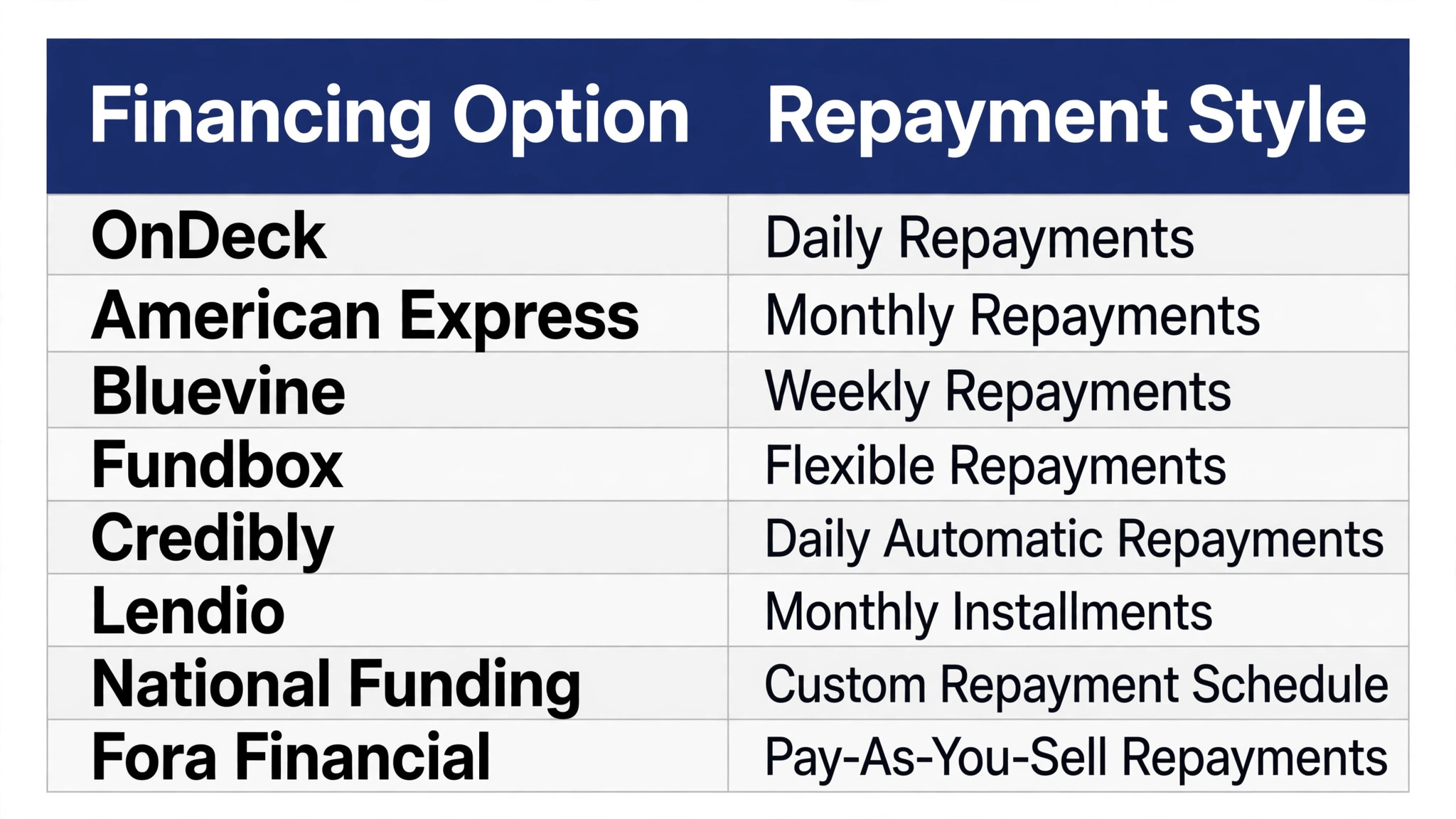
The table gives the fast comparison. Each row shows the amount available, the repayment structure that matters most to a restaurant, and the situation the option fits best.
| Tool | Best for | Starting price |
|---|---|---|
| OnDeck | Speed and reliability for larger needs | Term loans $5,000 to $400,000 |
| American Express Business Line of Credit | Flexible monthly repayment with no junk fees | $2,000 to $250,000 |
| Bluevine | Borrower-friendly terms and fast approval | Line of credit up to $250,000 |
| Fundbox | Small draws with no monthly fee | Line of credit up to $150,000 |
| Credibly | Revenue-based repayment for card-heavy restaurants | Up to $600,000 |
| Lendio | One application, many lenders including SBA | $500 to $5,000,000 via 75 plus lenders |
| National Funding | Fast funding with revenue-based approval | $5,000 to $500,000 |
| Fora Financial | Flexible terms for established restaurants | Amounts on the vendor site |
Best Pick by Job
No single lender fits every restaurant. A new food truck, a five-year-old bistro buying equipment, and a busy seasonal restaurant bridging a slow month each need a different kind of money.
| Job | Pick | Why it fits |
|---|---|---|
| The fastest first win | OnDeck | It installs in minutes and covers the most common apps, so the first result arrives on day one. |
| The best value at scale | American Express Business Line of Credit | Its pricing model stays cheap as volume grows, which matters more than the entry price. |
| The technical pick | Bluevine | It offers the deepest control for teams that can use it, with features the simpler tools lack. |
| The budget pick | Fora Financial | It covers the essentials at the lowest cost, which suits a small team or a solo buyer. |
| The pick for a specific workflow | Fundbox | It handles the specialised job better than the general tools, so it earns its place on that one task. |
How the Best Business Loan Tools for Restaurants Handle Slow Months
The best business loan tools for restaurants are judged by February, not December. A lender that lets repayment fall when card sales fall keeps a restaurant alive through the slow season, while a lender that demands the same fixed payment every week can turn a quiet month into a crisis. Revenue-based repayment is the feature that matters most, and it is worth paying more for.
Speed is the second test. A broken oven cannot wait for a six-week bank process, and a restaurant that needs money in three days cannot use a lender that takes three weeks. Online lenders fund in one to three days, which is why they dominate this list, even though their rates run higher than a bank or an SBA loan.
The third test is what the money can actually buy. Some lenders restrict funds to equipment, others allow any working capital use, and a few charge fees on every draw. A restaurant owner should know before applying whether the loan covers payroll, inventory, and repairs, or only the one thing the lender prefers to finance.
How We Tested These Tools for Restaurant Owners
Every tool on this list was judged against the same restaurant owners test, and the best business loan tools for restaurants were scored on what they do in real work rather than what their marketing pages promise. We checked the published pricing page for each tool, read the free tier limits, and compared the features that decide whether a restaurant owner keeps using it after the first month. Unpublished prices are flagged as such in the tables below, so the reader knows which tools need a quote before the cost is known.
Ranking rests on four measures. Core-job strength comes first, because a tool that cannot do the main task is useless at any price. Realistic cost comes second, measured at the volume a buyer actually reaches. Speed to first result comes third. Failure handling comes fourth, since the cheapest tool becomes expensive when it breaks without warning. For a restaurant owner, realistic cost matters most, because a loan that looks cheap on paper can still choke a slow month.
No ranking fits every reader, so use the order as a shortlist. The Best Pick by Job table narrows it by situation, and each detail section names the weakness that could matter, which is the information a buyer needs to choose against the ranking when their own job demands it. A restaurant owner who knows the slow month already knows which repayment style to check first.
The 8 Tools in Detail
Each option below was judged on restaurant reality. The questions were about the kitchen, not the spreadsheet. How fast does the money arrive, what happens on a slow week, and what does the loan cost when the year is counted in full.
1. OnDeck
OnDeck is a direct lender offering a term loan up to $400,000 with terms up to 24 months and daily or weekly payments, plus a line of credit up to $200,000. It funds term loans the same day when checkout finishes by mid-morning, which matters when equipment fails.
The cost is the catch. Average APRs near 58 percent make OnDeck one of the priciest options here, and it asks for 625 FICO and $100,000 in annual revenue. It suits a restaurant that needs a large sum fast and can repay quickly.
Our verdict on OnDeck: OnDeck earns its place here because it does the speed and reliability for larger needs job well, and OnDeck is fairly priced for what it delivers. The trial is the real test for OnDeck, so use the free plan or the free trial on a genuine task with OnDeck, check the result the next morning, and only then decide whether the OnDeck subscription stays.
2. American Express Business Line of Credit
The American Express Business Line of Credit, formerly Kabbage, revolves from $2,000 to $250,000 with no application, origination, annual, or maintenance fees. Each draw becomes a loan with 6, 12, 18, or 24-month terms and monthly payments.
It asks for a 660 FICO and $3,000 a month in revenue, and funding takes one to three business days. It suits a restaurant with a decent credit score that wants a flexible line without fees eating every draw.
Buy American Express Business Line of Credit when the flexible monthly repayment with no junk fees job is the one that matters most, and skip American Express Business Line of Credit when that job is rare in the reader’s week. Judge the cost of American Express Business Line of Credit against the hours American Express Business Line of Credit saves on that single job, not against the whole feature list, because a tool that saves five hours a week on one task pays for itself even if American Express Business Line of Credit does nothing else well.
3. Bluevine
Bluevine offers a line of credit up to $250,000 with transparent pricing and fast approval, and it charges no prepayment penalty. Its weekly or monthly repayment options suit restaurants that want flexibility without daily debits.
Bluevine asks for a 625 score and about $40,000 a month in revenue on some listings, which excludes smaller restaurants. It suits a growing restaurant with solid monthly revenue that wants a clean, honest line of credit.
Trial check for Bluevine: run one real job through Bluevine before paying, using the exact data the team handles every day. If Bluevine handles that job and Bluevine still looks fairly priced at twice the volume, Bluevine earns its place. If the trial exposes a missing integration in Bluevine or a surprise fee from Bluevine, that is the answer, and the next tool on the list deserves the same test.
4. Fundbox
Fundbox offers a line of credit up to $150,000 with 12 or 24-week terms per draw and no prepayment penalty. The standard plan charges no monthly fee, and draws are quick, which suits a restaurant covering a short gap.
The amounts are smaller than OnDeck or Credibly, and the short terms mean each draw must be repaid fast. Fundbox suits a restaurant that needs a few thousand dollars for inventory or a repair, not a six-figure renovation.
Our verdict on Fundbox: Fundbox earns its place here because it does the small draws with no monthly fee job well, and Fundbox is fairly priced for what it delivers. The trial is the real test for Fundbox, so use the free plan or the free trial on a genuine task with Fundbox, check the result the next morning, and only then decide whether the Fundbox subscription stays.
5. Credibly
Credibly offers a merchant cash advance up to $600,000 where remittances are a percentage of daily card sales, so payments fall on slow days. Its working capital loan runs 6 to 24 months with factor rates from 1.11, and it accepts lower credit profiles.
Factor rate pricing is expensive, and the total cost is easy to underestimate. Credibly suits a restaurant with consistent card volume and a short-term need, where the flexible repayment is worth the premium price.
Buy Credibly when the revenue-based repayment for card-heavy restaurants job is the one that matters most, and skip Credibly when that job is rare in the reader’s week. Judge the cost of Credibly against the hours Credibly saves on that single job, not against the whole feature list, because a tool that saves five hours a week on one task pays for itself even if Credibly does nothing else well.
6. Lendio
Lendio is a marketplace that connects a restaurant to more than 75 lenders with one application, including SBA 7(a) loans where rates are capped. It surfaces options a direct application would miss, and its range covers almost every restaurant need.
Terms, rates, and amounts are set by the matched lender, not Lendio, so the quality of the offer varies. Lendio suits a restaurant owner who wants to compare widely before committing, especially one that might qualify for an SBA loan.
Trial check for Lendio: run one real job through Lendio before paying, using the exact data the team handles every day. If Lendio handles that job and Lendio still looks fairly priced at twice the volume, Lendio earns its place. If the trial exposes a missing integration in Lendio or a surprise fee from Lendio, that is the answer, and the next tool on the list deserves the same test.
7. National Funding
National Funding funds in as little as 24 hours with no collateral, and it approves on revenue rather than perfect credit. It is a practical pick for a restaurant that needs money tomorrow and has the sales to support repayment.
Factor rates from 1.10 make it expensive, and the cost is the trade for speed. It suits an urgent need where a day of delay costs more than the premium, and it should not be the first choice for planned spending.
Our verdict on National Funding: National Funding earns its place here because it does the $5,000 to $500,000 job well, and National Funding is fairly priced for what it delivers. The trial is the real test for National Funding, so use the free plan or the free trial on a genuine task with National Funding, check the result the next morning, and only then decide whether the National Funding subscription stays.
8. Fora Financial
Fora Financial offers working capital and term loans with flexible terms for restaurants that have been trading for a year or more. Its application is straightforward, and it works with businesses that banks turn away for thin credit files.
Pricing is not published, so a restaurant must apply to learn the cost, which slows comparison. Fora suits an established restaurant that wants a human conversation about terms rather than a self-serve checkout.
Buy Fora Financial when the flexible terms for established restaurants job is the one that matters most, and skip Fora Financial when that job is rare in the reader’s week. Judge the cost of Fora Financial against the hours Fora Financial saves on that single job, not against the whole feature list, because a tool that saves five hours a week on one task pays for itself even if Fora Financial does nothing else well.
What the Money Actually Costs Over a Full Year
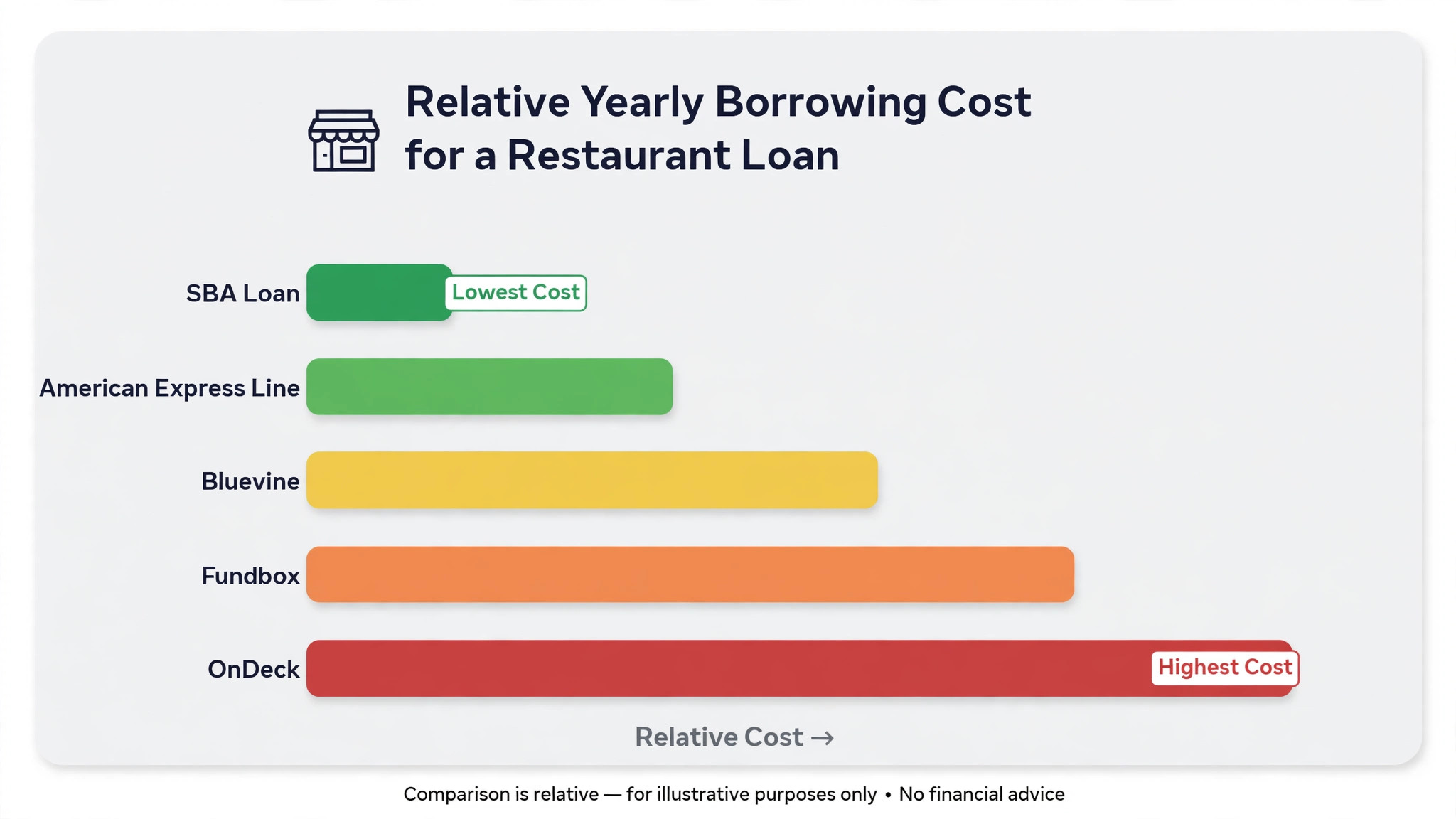
Headline rates hide the real cost of restaurant financing. The table below shows the realistic annual cost of borrowing $50,000 from each option, because the best business loan tools for restaurants are the ones whose total cost stays honest when the whole year is counted.
| Option | Amount available | Realistic cost on $50,000 over a year | Repayment style |
|---|---|---|---|
| OnDeck term loan | $5,000 to $400,000 | High, average APR near 58 percent | Daily or weekly fixed payments |
| American Express line of credit | $2,000 to $250,000 | Moderate, estimated APR 9 to 36 percent | Monthly payments, flexible draws |
| Bluevine line of credit | Up to $250,000 | Moderate, APR varies by profile | Weekly or monthly payments |
| Fundbox line of credit | Up to $150,000 | Moderate, no monthly fee on standard plan | Weekly payments over 12 or 24 weeks |
| Credibly working capital | Up to $600,000 | High, factor rates from 1.11 | Daily or weekly payments |
| Credibly merchant cash advance | Up to $600,000 | High, factor rate pricing | Percentage of daily card sales |
| Lendio marketplace | $500 to $5,000,000 | Varies, APR 4.63 to 60 percent | Set by the matched lender |
| National Funding | $5,000 to $500,000 | High, factor rates from 1.10 | Daily or weekly payments |
The gap between the cheapest and the most expensive option is enormous. An SBA loan matched through Lendio can cost under 10 percent a year, while a short-term online loan can cost more than 50 percent. The expensive money is not always wrong, because it arrives in a day and an SBA loan can take weeks, but the owner should know the price before signing.
Factor rates deserve a plain explanation. A factor rate of 1.11 on $50,000 means paying back $55,500 in total, which sounds small until the term is three months. Always convert a factor rate into a total dollar cost and an effective APR before comparing it with a loan that quotes an APR.
The honest way to compare the best business loan tools for restaurants is at ten times today’s volume. Per-run and per-account pricing stays forecastable, while per-step, per-resolution, and per-site pricing turns a busy month into a surprise invoice. Choose the pricing model that stays calm when the work grows, and let the entry price decide only between tools with the same model.
Five Costly Mistakes Restaurant Owners Make With Loans
Restaurant loans go wrong in predictable ways. The best business loan tools for restaurants cannot protect an owner from these five decisions, so they are worth reading before any application goes in.
Borrowing for a slow month instead of fixing the cause. A loan that covers a bad month without changing prices, staffing, or menu mix just delays the same problem. Fix the leak first, then borrow for growth.
Taking a daily-payment loan on thin margins. Daily debits hit the account before the day’s sales settle, and a restaurant with 10 percent margins feels every debit. Match the payment schedule to the cash cycle, not the lender’s preference.
Ignoring the total cost and comparing only the monthly payment. A low monthly payment over a long term can cost more in total than a higher payment over a short term. Compare total dollars repaid, always.
Applying to one lender only. Only about 41 percent of applicants get all the financing they seek from a single application, according to Federal Reserve survey data. Apply to two or three and compare the real offers.
Using a merchant cash advance for a long-term need. An advance that takes a percentage of daily sales is built for a short bridge, not for a renovation that pays back over two years. Match the loan term to the life of what it buys.
Applying for Restaurant Financing Without Wasting a Week
A prepared application moves faster and gets better terms. The best business loan tools for restaurants reward owners who arrive with clean numbers, because a lender that can verify revenue quickly can approve quickly too.
- Decide exactly what the money buys. Write the amount, the purpose, and the expected payback in one sentence before talking to any lender.
- Gather three months of bank statements and a profit and loss summary. Lenders ask for these first, and having them ready saves days.
- Check the business credit score and the owner’s FICO score. OnDeck asks for 625, American Express asks for 660, and knowing the number avoids a wasted application.
- Compare a line of credit against a term loan. A line suits uneven cash flow, while a term loan suits a single purchase like equipment.
- Ask for the total repayment amount in writing. Convert any factor rate into total dollars before comparing offers.
- Read the prepayment terms. Bluevine, Fundbox, and American Express charge no prepayment penalty on some products, which matters if revenue recovers early.
- Apply to two lenders on the same day. Comparing real offers beats comparing brochures, and the credit impact of two applications close together is small.
- Set a calendar reminder for the first payment date. Daily and weekly debits start fast, and a missed first payment creates fees and stress.
Frequently Asked Questions
Restaurant owners ask practical questions about loans, not theoretical ones. The answers below focus on speed, cost, and what happens when a slow month arrives.
How fast can a restaurant get a business loan funded?
Online lenders like OnDeck and National Funding can fund in as little as 24 hours, and most online options fund within one to three days. American Express takes one to three business days. An SBA loan matched through Lendio or Fundera takes weeks, so it suits planned spending like a renovation, not an emergency repair.
What credit score does a restaurant need for a business loan?
OnDeck asks for a minimum FICO of 625 and $100,000 in annual revenue, while American Express asks for 660 and $3,000 a month in revenue. Bluevine asks for 625. Lenders that accept lower scores charge higher rates, so a restaurant with a strong score should compare an SBA option before accepting an expensive online loan.
Is a merchant cash advance a good idea for a restaurant?
A merchant cash advance fits a short bridge, because repayment takes a percentage of daily card sales and falls on slow days. It is expensive, with factor rates that convert to high effective APRs, so it suits a restaurant with strong card volume and a short-term need. It is a poor choice for a long-term purchase like a renovation.
Can a restaurant get a loan with no collateral?
Yes. Most online lenders on this list are unsecured, including OnDeck, Fundbox, and National Funding. Equipment financing uses the equipment itself as collateral, which can lower the rate. A lender that asks for a personal guarantee is common, so read that clause before signing.
What is the difference between a business line of credit and a term loan for a restaurant?
A line of credit lets a restaurant draw only what it needs, pay interest only on what it draws, and reuse the line as it repays. A term loan gives one lump sum with fixed payments. Lines suit uneven cash flow and repeated small needs, while term loans suit a single large purchase.
Should a restaurant use Lendio or apply directly to a lender?
Lendio connects a restaurant to more than 75 lenders, including SBA options, with one application. That saves time and surfaces cheaper loans a direct application might miss. Applying directly can be faster when the owner already knows the lender fits, so use Lendio to compare and go direct when one lender clearly wins.
Borrowing for the Restaurant Without Regretting It
First, write down the amount, the purpose, and the payback in one sentence, and gather three months of bank statements. Second, apply to two lenders on the same day and compare the total dollars repaid, not the monthly payment. Third, set the first payment date on the calendar and check the account balance on the slowest day of the week before the debits start.
The best business loan tools for restaurants are the ones that keep a restaurant open through a slow month and leave enough margin to grow in a busy one. Choose the structure that matches the cash cycle, know the total cost before signing, and borrow for the thing that pays the loan back.
The SBA route deserves a closer look before a restaurant accepts an expensive online loan. SBA 7(a) loans cap rates between about 10 and 13.5 percent on larger loans, which is a fraction of the average online rate, and they suit planned spending like a renovation or a second location.
The trade is time, because an SBA application takes weeks and needs a business plan, tax returns, and patience. A restaurant with a planned project and a month to spare should apply through Lendio or Fundera first, and compare the SBA offer with the fastest online offer before deciding.
Equipment financing is the other option owners often overlook. When the money buys a specific piece of equipment, the equipment itself serves as collateral, which can lower the rate and the credit requirements. A new oven, a walk-in fridge, or a point-of-sale system all qualify, and the loan term can match the useful life of the equipment. A restaurant that needs one machine should price equipment financing beside a general term loan, because the dedicated option is usually cheaper.
State availability is one more detail worth checking before applying. Some lenders do not operate in every state, and OnDeck, for example, is not available in Nevada, North Dakota, or South Dakota. A restaurant that applies in an excluded state wastes days waiting for a rejection that a two-minute check would have prevented. Confirm the lender operates in the restaurant’s state, and confirm the fees, because origination fees of up to 4 percent and late fees of $100 or more can change the real cost of an otherwise attractive offer.
A final check before signing is the prepayment clause. Some online lenders charge a fee for paying early, while others, like Bluevine and Fundbox, charge no prepayment penalty on certain products. A restaurant whose revenue recovers faster than expected should be able to clear the loan early and stop paying interest, and a prepayment fee can wipe out that saving. Read the clause, ask the lender to confirm it in writing, and factor the fee into the total cost before the first draw.
One more habit helps after the loan is repaid. Keep the lender relationship warm with a short update on how the money was used, because a lender that knows the restaurant repaid on time is faster to approve the next loan.
A local bank relationship is worth building beside the online lenders on this list. A bank that knows the restaurant, its owner, and its seasonal pattern can approve a larger loan at a lower rate than any online lender, even if the process takes longer.
Open a business account with a local bank early, even before the restaurant needs a loan. Deposit the revenue there, keep the statements clean, and introduce the owner to the business banker in person, because that relationship is what turns a future application from a cold form into a conversation.